a column by Yong Suk Lee, Benjamin Cedric Larsen, Michael Webb and Mariano-Florentino Cuéllar for VOX: CEPR’s Policy Portal
As artificial intelligence becomes more widespread and its performance improves, it will likely have significant long-term consequences for jobs, inequality, organisations, and competition. Regulation may be used to address its risks and possibilities, but little is known about how AI-related regulation might affect firm behaviour.
This column examines the impact of actual and potential AI regulations on business managers through a randomised online survey experiment. It finds that exposure to information about regulation decreases managers’ reported intent to adopt AI technologies in their firm’s business processes.
Continue reading
There are four very useful figures which provide visual information (my favourite way of absorbing facts) but without the text they do not make a great deal of sense!
Showing posts with label USA. Show all posts
Showing posts with label USA. Show all posts
Friday, 20 December 2019


Thursday, 19 December 2019
Terrorism and lethal moralism in the United States and United Kingdom, 1970–2017
an article by Joseph H. Michalski (King’s University College at Western University, Canada) published in The British Journal of Sociology Volume 70 Issue 5 (December 2019)
Abstract
The current paper examines terrorism as a special form of moralistic violence, with several key features that distinguish such behaviour from other types of violence.
The theory of lethal moralism highlights the importance of social polarisation, characterised by vast differences in social space and inequality between adversaries as crucial to explaining deadly terrorist attacks.
Where the differences are more permanent or chronic – and the groups in question define and justify their existence specifically in contradistinction to ‘other’ groups – then the polarisation intensifies and attacks tend to be more lethal. In contrast, groups that appeal to broader audiences or the general public as potential allies more often use non‐lethal terrorism to their strategic advantage.
The study examines the United States and the United Kingdom to classify each of more than 8,000 attacks between 1970 and 2017 in terms of their ideological orientations. The evidence highlights the arc of terrorism in relation to different types of groups, as well as confirms the more lethal nature of terrorism linked especially to radical Islam, right‐wing religious extremists, hate groups, ethno‐nationalist sectarian violence, and anti‐government anarchists.
Yet apart from the extensive use of terrorism associated with ‘The Troubles’ in Northern Ireland, the majority of terrorist attacks in the US and the UK have not produced deaths.
Most terrorism instead has been perpetrated by groups aiming to rally support for a general cause and has been far less deadly on balance. The implications of these findings are discussed with a view toward developing more powerful explanatory models that focus on the socio‐cultural contexts and justification frameworks that inspire extremism and the use of lethal moralism to settle disputes.
Abstract
The current paper examines terrorism as a special form of moralistic violence, with several key features that distinguish such behaviour from other types of violence.
The theory of lethal moralism highlights the importance of social polarisation, characterised by vast differences in social space and inequality between adversaries as crucial to explaining deadly terrorist attacks.
Where the differences are more permanent or chronic – and the groups in question define and justify their existence specifically in contradistinction to ‘other’ groups – then the polarisation intensifies and attacks tend to be more lethal. In contrast, groups that appeal to broader audiences or the general public as potential allies more often use non‐lethal terrorism to their strategic advantage.
The study examines the United States and the United Kingdom to classify each of more than 8,000 attacks between 1970 and 2017 in terms of their ideological orientations. The evidence highlights the arc of terrorism in relation to different types of groups, as well as confirms the more lethal nature of terrorism linked especially to radical Islam, right‐wing religious extremists, hate groups, ethno‐nationalist sectarian violence, and anti‐government anarchists.
Yet apart from the extensive use of terrorism associated with ‘The Troubles’ in Northern Ireland, the majority of terrorist attacks in the US and the UK have not produced deaths.
Most terrorism instead has been perpetrated by groups aiming to rally support for a general cause and has been far less deadly on balance. The implications of these findings are discussed with a view toward developing more powerful explanatory models that focus on the socio‐cultural contexts and justification frameworks that inspire extremism and the use of lethal moralism to settle disputes.
Monday, 2 December 2019
The Long History Of Debt Cancellation
posted by S. Abbas Raza in 3 Quarks Daily: Olivia Schwob in the Boston Review:

unattributed
Today the phrase “debtors’ prison” is often invoked to describe this experience of punitive indebtedness. Sometimes it is meant literally.
Consider Melissa Welch-Latronica, a thirty-year-old single mother, who in February was wrenched from her minivan and thrown into a jail cell in Porter County, Illinois, over failure to pay an ambulance bill.
Her story is unusual but not unique.
A 2018 ACLU report documented a thousand cases of the “criminalization of private debt” and compiled a dozen of the most extreme stories. Most of the people featured ended up in jail because they failed to appear in court over unpaid debts, resulting in a warrant.
And then there is the abominable, systemic cycle of incarceration and reincarceration of poor people – and particularly poor people of color – unable to pay fines and court fees.
Continue reading
unattributed
Today the phrase “debtors’ prison” is often invoked to describe this experience of punitive indebtedness. Sometimes it is meant literally.
Consider Melissa Welch-Latronica, a thirty-year-old single mother, who in February was wrenched from her minivan and thrown into a jail cell in Porter County, Illinois, over failure to pay an ambulance bill.
Her story is unusual but not unique.
A 2018 ACLU report documented a thousand cases of the “criminalization of private debt” and compiled a dozen of the most extreme stories. Most of the people featured ended up in jail because they failed to appear in court over unpaid debts, resulting in a warrant.
And then there is the abominable, systemic cycle of incarceration and reincarceration of poor people – and particularly poor people of color – unable to pay fines and court fees.
Continue reading
Thursday, 21 November 2019
The politics of distraction: Evidence from presidential executive orders
a column by Milena Djourelova and Ruben Durante for VOX: CEPR’s Policy Portal
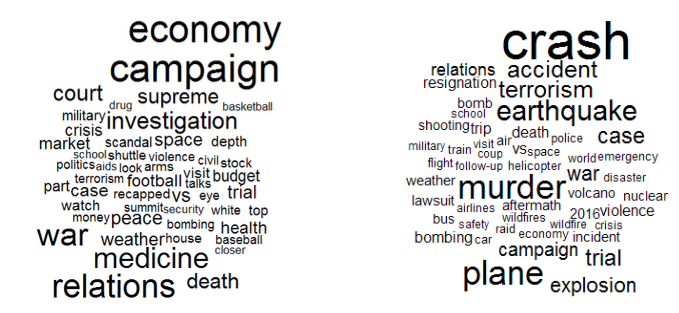
Source: Djourelova and Durante (2019).
It is often suspected that politicians time announcements of controversial policies strategically to avoid public scrutiny.
This column reports evidence from a systematic analysis of executive orders issued by US presidents, showing that their timing is consistent with strategic behaviour. Presidents tend to issue executive orders, and specifically ones that are likely to generate negative publicity, in coincidence with other important events that distract the media and the public.
Continue reading
I know that this piece is telling many people what they already know but it is good to see the evidence.
I would dearly love to see a similar analysis of political announcements made in the UK.
Source: Djourelova and Durante (2019).
It is often suspected that politicians time announcements of controversial policies strategically to avoid public scrutiny.
This column reports evidence from a systematic analysis of executive orders issued by US presidents, showing that their timing is consistent with strategic behaviour. Presidents tend to issue executive orders, and specifically ones that are likely to generate negative publicity, in coincidence with other important events that distract the media and the public.
Continue reading
I know that this piece is telling many people what they already know but it is good to see the evidence.
I would dearly love to see a similar analysis of political announcements made in the UK.
Friday, 8 November 2019
The Personal Diet Has Become Not Only A Cult, It Has Become A Political Statement
posted by S. Abbas Raza in 3 Quarks Daily: James McWilliams in The Hedgehog Review:

In the summer of 2016, James and Becca Reed, a lower-income couple living in Austin, Texas, decided it was time to save their lives. The Reeds, married more than twenty-five years, had become morbidly obese, diabetic, and depressed. They were taking a combined thirty-two medications. Only in their early fifties, they had arrived at this condition via a well-trod path: They ate their way into it. They did no more than consume what the American food industry not only offers in abundance—salt, starch, and sweetness—but also encourages us to eat.
As nearly 40 percent of the adult US population can attest, it doesn’t take a lot of time, effort, or expense for the consequences of the American way of eating to add up.1 A steady diet of processed and fast food, oversized restaurant meals, and “favorited” takeout options can quickly make the average American a victim of the growing obesity epidemic. Considering that the Reeds live paycheck to paycheck, and given what we know about the strong link between economic disadvantage and poor eating choices, I was especially intrigued when a friend, who knew James and Becca from church, told me about this really interesting couple getting ready to reclaim their health in a dramatic way.
With disarming generosity, the Reeds opened their lives to me as they undertook their mission.
More here.
In the summer of 2016, James and Becca Reed, a lower-income couple living in Austin, Texas, decided it was time to save their lives. The Reeds, married more than twenty-five years, had become morbidly obese, diabetic, and depressed. They were taking a combined thirty-two medications. Only in their early fifties, they had arrived at this condition via a well-trod path: They ate their way into it. They did no more than consume what the American food industry not only offers in abundance—salt, starch, and sweetness—but also encourages us to eat.
As nearly 40 percent of the adult US population can attest, it doesn’t take a lot of time, effort, or expense for the consequences of the American way of eating to add up.1 A steady diet of processed and fast food, oversized restaurant meals, and “favorited” takeout options can quickly make the average American a victim of the growing obesity epidemic. Considering that the Reeds live paycheck to paycheck, and given what we know about the strong link between economic disadvantage and poor eating choices, I was especially intrigued when a friend, who knew James and Becca from church, told me about this really interesting couple getting ready to reclaim their health in a dramatic way.
With disarming generosity, the Reeds opened their lives to me as they undertook their mission.
More here.
Saturday, 26 October 2019
The Humanitarian Crisis Of Deaths Of Despair
posted by S, Abbas Raza in 3 Quarks Daily: David V. Johnson in the APA Blog:

Image by cocoparisienne from Pixabay
Last April, Princeton University economists and married partners Anne Case and Sir Angus Deaton delivered the Tanner Lectures on Human Values at Stanford University. The title of their talks, “Deaths of Despair and the Future of Capitalism”, is also the provisional name of their forthcoming book, to be published in 2020.
The couple’s research has focused on disturbing mortality data for a specific demographic: white non-Hispanic Americans without college degrees. This century, they have been dying at alarming rates from what Case and Deaton call “deaths of despair”, which cover suicide, alcohol-related disease, and drug overdoses (primarily driven by opioids). These deaths have, along with US obesity, heart disease, and cancer rates, contributed to a shocking recent decline in US life expectancy for three straight years—something which hasn’t happened since World War I and the 1918 Spanish flu pandemic. The rates for “deaths of despair” are not as high for college-educated whites or for other racial minorities, and there are many potential economic and sociological reasons for this.
Case and Deaton’s research raises important questions for the US political economy and the legacy of neoliberalism. But I am more interested in the framing of the mortality statistics as “deaths of despair.”
More here.
Image by cocoparisienne from Pixabay
Last April, Princeton University economists and married partners Anne Case and Sir Angus Deaton delivered the Tanner Lectures on Human Values at Stanford University. The title of their talks, “Deaths of Despair and the Future of Capitalism”, is also the provisional name of their forthcoming book, to be published in 2020.
The couple’s research has focused on disturbing mortality data for a specific demographic: white non-Hispanic Americans without college degrees. This century, they have been dying at alarming rates from what Case and Deaton call “deaths of despair”, which cover suicide, alcohol-related disease, and drug overdoses (primarily driven by opioids). These deaths have, along with US obesity, heart disease, and cancer rates, contributed to a shocking recent decline in US life expectancy for three straight years—something which hasn’t happened since World War I and the 1918 Spanish flu pandemic. The rates for “deaths of despair” are not as high for college-educated whites or for other racial minorities, and there are many potential economic and sociological reasons for this.
Case and Deaton’s research raises important questions for the US political economy and the legacy of neoliberalism. But I am more interested in the framing of the mortality statistics as “deaths of despair.”
More here.
Thursday, 24 October 2019
The link between declining middle-wage jobs, rising wage inequality, and worker welfare
a column by Jennifer Hunt and Ryan Nunn for VOX: CEPR’s Policy Portal
Over the last five decades, middle-wage jobs diminished in the US as wage inequality increased.
This column investigates the relationship between these two phenomena, and finds no evidence that either computerisation or automation (often cited as a source of both trends) produced employment polarisation or increased wage inequality.
By examining wages at the individual level (rather than occupation-average wages), the column suggests that the evolution of wages can be better explained by distinct causes — ranging from changing labour market institutions to globalisation — than by observable demographic factors.
Continue reading
Over the last five decades, middle-wage jobs diminished in the US as wage inequality increased.
This column investigates the relationship between these two phenomena, and finds no evidence that either computerisation or automation (often cited as a source of both trends) produced employment polarisation or increased wage inequality.
By examining wages at the individual level (rather than occupation-average wages), the column suggests that the evolution of wages can be better explained by distinct causes — ranging from changing labour market institutions to globalisation — than by observable demographic factors.
Continue reading
Wednesday, 23 October 2019
Climate Change Could Erase Human History. These Archivists Are Trying to Save It
an article by Caroline Haskins for MOTHERBOARD: Tech by VICE [via Library Link of the Day]
Climate change making the word hotter, more humid, and more stormy—all conditions that put sensitive paper archives at risk. This problem is forcing us to ask, which histories will we choose to remember?
Brooklyn's Green-Wood Cemetery is a giant place of memory.
For one, there’s the gravestones, mausoleums, statues, and stone structures. It’s hard to describe the scale of it. They rise up, respectfully spaced out, on nearly every patch of ground for miles, up and down hills, under trees, unfurling everywhere for 478 acres.
Then there’s the archives. Not every grave at Green-Wood gets an intentional visitor, like a descendent, or a history-lover seeking out a specific name and story. But every grave, every lot, and every person is meticulously documented, and thereby remembered by dozens of paid archivists and volunteers. Everyone buried in Green-Wood has the privilege of being considered a part of capital-H History. If Green-Wood is a city, then the archives are a census for everyone lucky enough to be a resident.

IMAGE: GREEN-WOOD CEMETERY ARCHIVES. TAKEN BY CAROLINE HASKINS.
Continue reading This is not only about the records maintained for one cemetery but about climate change and the danger to people as well as paper records.
Climate change making the word hotter, more humid, and more stormy—all conditions that put sensitive paper archives at risk. This problem is forcing us to ask, which histories will we choose to remember?
Brooklyn's Green-Wood Cemetery is a giant place of memory.
For one, there’s the gravestones, mausoleums, statues, and stone structures. It’s hard to describe the scale of it. They rise up, respectfully spaced out, on nearly every patch of ground for miles, up and down hills, under trees, unfurling everywhere for 478 acres.
Then there’s the archives. Not every grave at Green-Wood gets an intentional visitor, like a descendent, or a history-lover seeking out a specific name and story. But every grave, every lot, and every person is meticulously documented, and thereby remembered by dozens of paid archivists and volunteers. Everyone buried in Green-Wood has the privilege of being considered a part of capital-H History. If Green-Wood is a city, then the archives are a census for everyone lucky enough to be a resident.
IMAGE: GREEN-WOOD CEMETERY ARCHIVES. TAKEN BY CAROLINE HASKINS.
Continue reading This is not only about the records maintained for one cemetery but about climate change and the danger to people as well as paper records.
Tuesday, 22 October 2019
What Is the Gig Economy, and Why Is It So Controversial?
a post by Andrew Heinzman for How-To Geek

Artur Szczbylo/Shutterstock
The “gig economy” is a buzzword on the news and in everyday conversation. It refers to the rise in contracted work—or “gigs”—that aren’t traditional jobs. Ridesharing, food delivery, dog walker, and writers are part of this economy.
An Economy of Contracted or Independent Work
The “gig economy” is a phenomenon defined by a rise in independent or contracted work. According to a Marist poll, one-fifth of American jobs are contracted right now, and half of the US workforce could find themselves doing contract or freelance work over the next decade.
But what is an independent contractor? Think of construction, web design, freelance writing, or Uber driving. Workers in these fields aren’t legally defined as “employees.” Instead, they work under contracts or operate their own business as an independent worker.
[Depending on where you live. This post specifically refers to the USA but some of the comments will apply equally in the UK.)
To some people, the rise in contracted work comes as no surprise. We’ve spent the last decade recovering from a recession, so our workforce is bigger than it was a decade ago. And of course, there’s the internet. The internet’s made it super easy to hunt down contracted work (especially short-term work), and the rise of internet content, like YouTube videos (or the article you’re reading right now), has created a demand for writers, creatives, web designers, and programmers.
Continue reading
Artur Szczbylo/Shutterstock
The “gig economy” is a buzzword on the news and in everyday conversation. It refers to the rise in contracted work—or “gigs”—that aren’t traditional jobs. Ridesharing, food delivery, dog walker, and writers are part of this economy.
An Economy of Contracted or Independent Work
The “gig economy” is a phenomenon defined by a rise in independent or contracted work. According to a Marist poll, one-fifth of American jobs are contracted right now, and half of the US workforce could find themselves doing contract or freelance work over the next decade.
But what is an independent contractor? Think of construction, web design, freelance writing, or Uber driving. Workers in these fields aren’t legally defined as “employees.” Instead, they work under contracts or operate their own business as an independent worker.
[Depending on where you live. This post specifically refers to the USA but some of the comments will apply equally in the UK.)
To some people, the rise in contracted work comes as no surprise. We’ve spent the last decade recovering from a recession, so our workforce is bigger than it was a decade ago. And of course, there’s the internet. The internet’s made it super easy to hunt down contracted work (especially short-term work), and the rise of internet content, like YouTube videos (or the article you’re reading right now), has created a demand for writers, creatives, web designers, and programmers.
Continue reading
Monday, 14 October 2019
Multinational enterprises in time and space: The effect of trade policy shocks
a column by Stefania Garetto, Lindsay Oldenski and Natalia Ramondo for VOX: CEPR’s Policy Portal
Multinational enterprises play an important role in coordinating production around the globe.
This column presents a dynamic quantitative model of multinational enterprise expansion that can be used to analyse the effects of policies that affect the cost of the operations of such firms. It uses this model to estaimte the impact of potential implementations of Brexit.
Continue reading
Multinational enterprises play an important role in coordinating production around the globe.
This column presents a dynamic quantitative model of multinational enterprise expansion that can be used to analyse the effects of policies that affect the cost of the operations of such firms. It uses this model to estaimte the impact of potential implementations of Brexit.
Continue reading
Friday, 11 October 2019
Does Philanthropy Subvert Democracy?
posted by Morgan Meis in 3 Quarks Daily
Nick Burns at The Hedgehog Review:
There is room for reform in American philanthropy, but circumspection is in order.
Is modern-day philanthropy a disease in the democratic body politic? Rob Reich, a professor of political science at Stanford University (not to be confused with former secretary of labor Robert Reich), believes that it is. And Reich is not alone. Near-universal outrage over the recent college admissions scandal has left two black eyes on American philanthropy: one for the role of Rick Singer’s fraudulent 501(c)(3) organization, Key Worldwide Foundation, in bribing several elite universities to accept children of privilege; the other for the universities’ susceptibility to such schemes. Reich’s book went to press well before the scandal broke, but it is hard to imagine a better indication of his central claim: that philanthropy amplifies the power of the few at the expense of the many.
Philanthropy, Reich reasons, is necessarily “a form or exercise of power”. Under the current regime, it is an undemocratic sort of power: Bill Gates’s donations to public schools, for example, give him a measure of curricular control that cannot be wrested away at the ballot box. Though Reich favors greater government oversight and a freer hand for representative bodies to regulate charities’ operations, he goes a step further by arguing for the abolition of American philanthropy’s legal mainstay: the tax deduction.
more here.
Nick Burns at The Hedgehog Review:
There is room for reform in American philanthropy, but circumspection is in order.
Is modern-day philanthropy a disease in the democratic body politic? Rob Reich, a professor of political science at Stanford University (not to be confused with former secretary of labor Robert Reich), believes that it is. And Reich is not alone. Near-universal outrage over the recent college admissions scandal has left two black eyes on American philanthropy: one for the role of Rick Singer’s fraudulent 501(c)(3) organization, Key Worldwide Foundation, in bribing several elite universities to accept children of privilege; the other for the universities’ susceptibility to such schemes. Reich’s book went to press well before the scandal broke, but it is hard to imagine a better indication of his central claim: that philanthropy amplifies the power of the few at the expense of the many.
Philanthropy, Reich reasons, is necessarily “a form or exercise of power”. Under the current regime, it is an undemocratic sort of power: Bill Gates’s donations to public schools, for example, give him a measure of curricular control that cannot be wrested away at the ballot box. Though Reich favors greater government oversight and a freer hand for representative bodies to regulate charities’ operations, he goes a step further by arguing for the abolition of American philanthropy’s legal mainstay: the tax deduction.
more here.
Wednesday, 9 October 2019
How Wiping Out $1.5 Trillion In Student Debt Would Boost The Economy
posted by S. Abbas Raza in 3 Quarks Daily
Jillian Berman in Market Watch:

Student-debt cancellation, once viewed as a niche political issue, has now, with loans topping a staggering $1.5 trillion, made it onto the platforms of major presidential candidates.
Since at least the Great Recession a decade ago, borrowers, activists and others have been building a case that erasing debt acquired during students college years is a matter of economic justice. More recently, researchers have found that canceling some or all of the nation’s outstanding student debt has the potential to boost gross domestic product, narrow the widening racial wealth gap and liberate millions of Americans from a financial albatross that previous generations never had to contend with.
Sens. Elizabeth Warren and Bernie Sanders, both vying for the Democratic nomination for president, are proposing to wipe away some or all of the country’s burdensome debt as a key part of their campaigns. They plan to pay for it — and accompanying proposals to make public college tuition-free — by raising taxes on the wealthy. Warren estimates her plan would cost $1.25 trillion over 10 years, and Sanders says his would cost $2.2 trillion.
Critics question whether those proposals would fix the underlying problems in the way Americans pay for college, and also whether student-debt cancellation would entail a giveaway to well-off families.
More here.
Hazel's comment:
Yes, this is about the USA but the debts of many UK students are astronomical (not, of course, in Scotland), My granddaughter graduated this year and walked into a job the following week, she was lucky in that regard but she has no hope of paying off her student loan and the interest mounts up when you don't/can't pay.
Jillian Berman in Market Watch:
Student-debt cancellation, once viewed as a niche political issue, has now, with loans topping a staggering $1.5 trillion, made it onto the platforms of major presidential candidates.
Since at least the Great Recession a decade ago, borrowers, activists and others have been building a case that erasing debt acquired during students college years is a matter of economic justice. More recently, researchers have found that canceling some or all of the nation’s outstanding student debt has the potential to boost gross domestic product, narrow the widening racial wealth gap and liberate millions of Americans from a financial albatross that previous generations never had to contend with.
Sens. Elizabeth Warren and Bernie Sanders, both vying for the Democratic nomination for president, are proposing to wipe away some or all of the country’s burdensome debt as a key part of their campaigns. They plan to pay for it — and accompanying proposals to make public college tuition-free — by raising taxes on the wealthy. Warren estimates her plan would cost $1.25 trillion over 10 years, and Sanders says his would cost $2.2 trillion.
Critics question whether those proposals would fix the underlying problems in the way Americans pay for college, and also whether student-debt cancellation would entail a giveaway to well-off families.
More here.
Hazel's comment:
Yes, this is about the USA but the debts of many UK students are astronomical (not, of course, in Scotland), My granddaughter graduated this year and walked into a job the following week, she was lucky in that regard but she has no hope of paying off her student loan and the interest mounts up when you don't/can't pay.
Tuesday, 1 October 2019
Driving the superstar economy: Skilled tradable services
a column by Fabian Eckert, Sharat Ganapati and Conor Walsh for VOX: CEPR’s Policy Portal
In recent years, wages for highly skilled workers have grown rapidly.
Using US data between 1980 and 2015, this column studies a group of service industries that are skill-intensive, widely traded, and have recently seen explosive wage growth. It shows that, unlike any other sector, the wage growth in these industries was strongly biased toward the densest local labour markets and the highest-paying firms.
These developments alone explain 30% of the increase in inequality between the 50th and 90th percentiles of the wage distribution.
Continue reading
In recent years, wages for highly skilled workers have grown rapidly.
Using US data between 1980 and 2015, this column studies a group of service industries that are skill-intensive, widely traded, and have recently seen explosive wage growth. It shows that, unlike any other sector, the wage growth in these industries was strongly biased toward the densest local labour markets and the highest-paying firms.
These developments alone explain 30% of the increase in inequality between the 50th and 90th percentiles of the wage distribution.
Continue reading
Thursday, 19 September 2019
Bilateral and aggregate trade balances: Finding the right focus
a column by Johannes Eugster, Florence Jaumotte, Margaux MacDonald and Roberto Piazza for VOX: CEPR’s Policy Portal
Bilateral trade balances have come under scrutiny recently, with some policymakers concerned that their large and rising size may reflect asymmetric obstacles to trade.
This column argues that macroeconomic factors – rather than bilateral tariffs – have been the key drivers of the evolution of bilateral trade balances. While tariffs have played a modest role in the evolution of bilateral balances, declines in tariffs have lifted productivity by allowing a greater international division of labour, including through participation in global value chains.
A sharp increase in tariffs would therefore create significant spillovers, leaving the global economy worse off.
Continue reading
Bilateral trade balances have come under scrutiny recently, with some policymakers concerned that their large and rising size may reflect asymmetric obstacles to trade.
This column argues that macroeconomic factors – rather than bilateral tariffs – have been the key drivers of the evolution of bilateral trade balances. While tariffs have played a modest role in the evolution of bilateral balances, declines in tariffs have lifted productivity by allowing a greater international division of labour, including through participation in global value chains.
A sharp increase in tariffs would therefore create significant spillovers, leaving the global economy worse off.
Continue reading
Tuesday, 10 September 2019
It Was Legal Teams—Not Politicians—That Ultimately Held The Tobacco Industry To Account. Their Next Target? Perpetrators Of Climate Change
an article by Mitch Anderson at Reasons to be Cheerful [via 3 Quarks Daily by S. Abbas Raza]

A poster depicting Rhea Suh, president of the National Resources Defense Council, which employs 600 scientists, lawyers, and policy advocates across the globe to fight for the environment. Poster part of Amplifier’s #MyClimateHero campaign
Lawyers are one of America’s most distrusted professions, bringing up the rear behind even bankers and local politicians. But what if lawyers end up saving the world?
Scientists have been warning for years that mounting carbon emissions are dangerously destabilizing our climate. Efforts to tackle this urgent challenge through the political process have so far come up far short of the action needed to avoid some very bad outcomes.
Can litigation succeed where politics has so far failed?
We’ve actually been here before. Several decades ago it also seemed the tobacco industry was an invincible foe to public health. Over the course of decades, however, a series of long-shot lawsuits finally enfeebled this previously unassailable political lobby. Civil litigation against cigarette manufacturers began in the 1950s, but did not bear fruit until 40 years later in a series of court victories that culminated in the $206 billion Master Settlement Agreement with 46 U.S. states.
Continue reading
A poster depicting Rhea Suh, president of the National Resources Defense Council, which employs 600 scientists, lawyers, and policy advocates across the globe to fight for the environment. Poster part of Amplifier’s #MyClimateHero campaign
Lawyers are one of America’s most distrusted professions, bringing up the rear behind even bankers and local politicians. But what if lawyers end up saving the world?
Scientists have been warning for years that mounting carbon emissions are dangerously destabilizing our climate. Efforts to tackle this urgent challenge through the political process have so far come up far short of the action needed to avoid some very bad outcomes.
Can litigation succeed where politics has so far failed?
We’ve actually been here before. Several decades ago it also seemed the tobacco industry was an invincible foe to public health. Over the course of decades, however, a series of long-shot lawsuits finally enfeebled this previously unassailable political lobby. Civil litigation against cigarette manufacturers began in the 1950s, but did not bear fruit until 40 years later in a series of court victories that culminated in the $206 billion Master Settlement Agreement with 46 U.S. states.
Continue reading
Thursday, 29 August 2019
Is Science Political?
an article by Michael D. Gordin in the Boston Review posted to 3 Quarks Daily by S. Abbas Raza

Sidney Hook speaking at the opening session of the Congress for Cultural Freedom in Berlin on June 26, 1950. The second day of the conference featured a panel on “Science and Totalitarianism.” Image: cia.gov
The word “science” typically evokes epistemic ambitions to explore the fundamental laws of the natural world. This is the stuff of philosophical reflection and documentary specials—and it is unquestionably important. This ethereal vision of science appears starkly divorced from the messy fray of “politics,” however you might want to understand the term.
Yet consider two other central features of today’s science: it is élite, and it is expensive. By élite, I do not mean that only certain sorts of people – the “right sorts” – have the capacity to do science. What I mean is that you cannot just pick up and decide today that you are going to be a scientist. It requires years, even decades, of training in the methods and practices of inquiry; consulting a scientist means that you are obligated to turn to someone who has already undergone that process. You do science with the scientists you have, regardless of whether they are socially or politically agreeable to you.
More here.
Freedom’s Laboratory: The Cold War Struggle for the Soul of Science
Audra J. Wolfe
Johns Hopkins University Press, $29.95 (cloth)
Sidney Hook speaking at the opening session of the Congress for Cultural Freedom in Berlin on June 26, 1950. The second day of the conference featured a panel on “Science and Totalitarianism.” Image: cia.gov
The word “science” typically evokes epistemic ambitions to explore the fundamental laws of the natural world. This is the stuff of philosophical reflection and documentary specials—and it is unquestionably important. This ethereal vision of science appears starkly divorced from the messy fray of “politics,” however you might want to understand the term.
Yet consider two other central features of today’s science: it is élite, and it is expensive. By élite, I do not mean that only certain sorts of people – the “right sorts” – have the capacity to do science. What I mean is that you cannot just pick up and decide today that you are going to be a scientist. It requires years, even decades, of training in the methods and practices of inquiry; consulting a scientist means that you are obligated to turn to someone who has already undergone that process. You do science with the scientists you have, regardless of whether they are socially or politically agreeable to you.
More here.
Freedom’s Laboratory: The Cold War Struggle for the Soul of Science
Audra J. Wolfe
Johns Hopkins University Press, $29.95 (cloth)
Friday, 16 August 2019
Why Secular Humanism can do what Atheism can't
a post by Scotty Hendricks for the Big Think blog
Atheism doesn't offer much beyond non-belief, can Secular Humanism fill the gaps?
The decline of these traditional belief systems is a tragedy for some and a cause for celebration for others. There is an element of it that causes a problem for everybody, though. As the old religious ties that bind decline, the communities associated with them start to go too. This isn't to say that a neighborhood without a church will immediately start to decay into poverty, violence, and misery but that the social element of these organizations was essential to people and without it, we've got problems.
Continue reading
Hazel’s comment
Are social conditions any different in the UK from those described by Scotty in this piece? Probably not but as a committed Christian I am maybe not as aware of the issues as I could/should be.
Atheism doesn't offer much beyond non-belief, can Secular Humanism fill the gaps?
- Atheism is increasingly popular, but the lack of an organized community around it can be problematic.
- The decline in social capital once offered by religion can cause severe problems.
- Secular Humanism can offer both community and meaning, but it has also attracted controversy.
The decline of these traditional belief systems is a tragedy for some and a cause for celebration for others. There is an element of it that causes a problem for everybody, though. As the old religious ties that bind decline, the communities associated with them start to go too. This isn't to say that a neighborhood without a church will immediately start to decay into poverty, violence, and misery but that the social element of these organizations was essential to people and without it, we've got problems.
Continue reading
Hazel’s comment
Are social conditions any different in the UK from those described by Scotty in this piece? Probably not but as a committed Christian I am maybe not as aware of the issues as I could/should be.
Public transit infrastructure and urban social connectedness
a column by Theresa Kuchler and Johannes Stroebel for VOX: CEPR’s Policy Portal
The mixing of people and ideas in cities is at the heart of the ‘agglomeration externalities’ that drive the high productivity of cities. While public transit infrastructure is thought to help different people living in different parts of the same city to interact with one another, the lack of large-scale data has made it difficult to study.
This column explores the link between public transit and social connectedness in New York City. It finds the first suggestive evidence that New York City’s public transit system plays an important role in enabling social ties to be formed and maintained across geographic distances.
Continue reading
The mixing of people and ideas in cities is at the heart of the ‘agglomeration externalities’ that drive the high productivity of cities. While public transit infrastructure is thought to help different people living in different parts of the same city to interact with one another, the lack of large-scale data has made it difficult to study.
This column explores the link between public transit and social connectedness in New York City. It finds the first suggestive evidence that New York City’s public transit system plays an important role in enabling social ties to be formed and maintained across geographic distances.
Continue reading
Monday, 1 July 2019
The Declining Labor Market Prospects of Less-educated Men
a paper (NBER Working Paper No. 25577) by Ariel J. Binder and John Bound (National Bureau of Economic Research, Cambridge, MA, USA) republished in Journal of Economic Prospects Volume 33 Number 2 (Spring 2019)
Abstract
Over the last half century, U.S. wage growth stagnated, wage inequality rose, and the labor force participation rate of prime-age men steadily declined.
In this article, we examine these labor market trends, focusing on outcomes for males without a college education.
Though wages and participation have fallen in tandem for this population, we argue that the canonical neo-classical framework, which postulates a labor demand curve shifting inward across a stable labor supply curve, does not reasonably explain the data. Alternatives we discuss include adjustment frictions associated with labor demand shocks and effects of the changing marriage market—that is, the fact that fewer less-educated men are forming their own stable families—on male labor supply incentives.
Our observations lead us to be skeptical of attempts to attribute the secular decline in male labor-force participation to a series of separately-acting causal factors.
We argue that the correct interpretation probably involves complicated feedback between falling labor demand and other factors which have disproportionately affected men without a college education.
JEL Classificagtion: E24, J12, J21, J22, J23, J31
Full text (PDF 48pp)
Abstract
Over the last half century, U.S. wage growth stagnated, wage inequality rose, and the labor force participation rate of prime-age men steadily declined.
In this article, we examine these labor market trends, focusing on outcomes for males without a college education.
Though wages and participation have fallen in tandem for this population, we argue that the canonical neo-classical framework, which postulates a labor demand curve shifting inward across a stable labor supply curve, does not reasonably explain the data. Alternatives we discuss include adjustment frictions associated with labor demand shocks and effects of the changing marriage market—that is, the fact that fewer less-educated men are forming their own stable families—on male labor supply incentives.
Our observations lead us to be skeptical of attempts to attribute the secular decline in male labor-force participation to a series of separately-acting causal factors.
We argue that the correct interpretation probably involves complicated feedback between falling labor demand and other factors which have disproportionately affected men without a college education.
JEL Classificagtion: E24, J12, J21, J22, J23, J31
Full text (PDF 48pp)
Monday, 17 June 2019
No, climate action can't be separated from social justice
an article by Julian Brave NoiseCat for the Guardian
Elites who divorce climate policy from social justice are almost as out of touch as those who deny climate science altogether
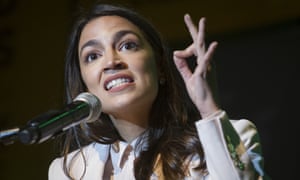
Alexandria Ocasio-Cortez speaks about the Green New Deal at Howard University. The Democratic congresswoman says adequately addressing climate change would cost at least $10tn. Photograph: Cliff Owen/AP
If you set aside Republicans’ obsession with cow farts, perhaps the most prevalent criticism of the Green New Deal is its emphasis on social justice. Critics contend that the far-reaching climate agenda is far too concerned with extraneous issues such as jobs, infrastructure, housing, healthcare and civil and indigenous rights. Stick to greenhouse gases, they say; reforming the energy system is utopian enough.
Continue reading
Elites who divorce climate policy from social justice are almost as out of touch as those who deny climate science altogether
Alexandria Ocasio-Cortez speaks about the Green New Deal at Howard University. The Democratic congresswoman says adequately addressing climate change would cost at least $10tn. Photograph: Cliff Owen/AP
If you set aside Republicans’ obsession with cow farts, perhaps the most prevalent criticism of the Green New Deal is its emphasis on social justice. Critics contend that the far-reaching climate agenda is far too concerned with extraneous issues such as jobs, infrastructure, housing, healthcare and civil and indigenous rights. Stick to greenhouse gases, they say; reforming the energy system is utopian enough.
Continue reading
Subscribe to:
Posts (Atom)

