Showing posts with label archives. Show all posts

Wednesday, 23 October 2019

Climate Change Could Erase Human History. These Archivists Are Trying to Save It

an article by Caroline Haskins for MOTHERBOARD: Tech by VICE [via Library Link of the Day]

Climate change making the word hotter, more humid, and more stormy—all conditions that put sensitive paper archives at risk. This problem is forcing us to ask, which histories will we choose to remember?

Brooklyn's Green-Wood Cemetery is a giant place of memory.

For one, there’s the gravestones, mausoleums, statues, and stone structures. It’s hard to describe the scale of it. They rise up, respectfully spaced out, on nearly every patch of ground for miles, up and down hills, under trees, unfurling everywhere for 478 acres.

Then there’s the archives. Not every grave at Green-Wood gets an intentional visitor, like a descendent, or a history-lover seeking out a specific name and story. But every grave, every lot, and every person is meticulously documented, and thereby remembered by dozens of paid archivists and volunteers. Everyone buried in Green-Wood has the privilege of being considered a part of capital-H History. If Green-Wood is a city, then the archives are a census for everyone lucky enough to be a resident.
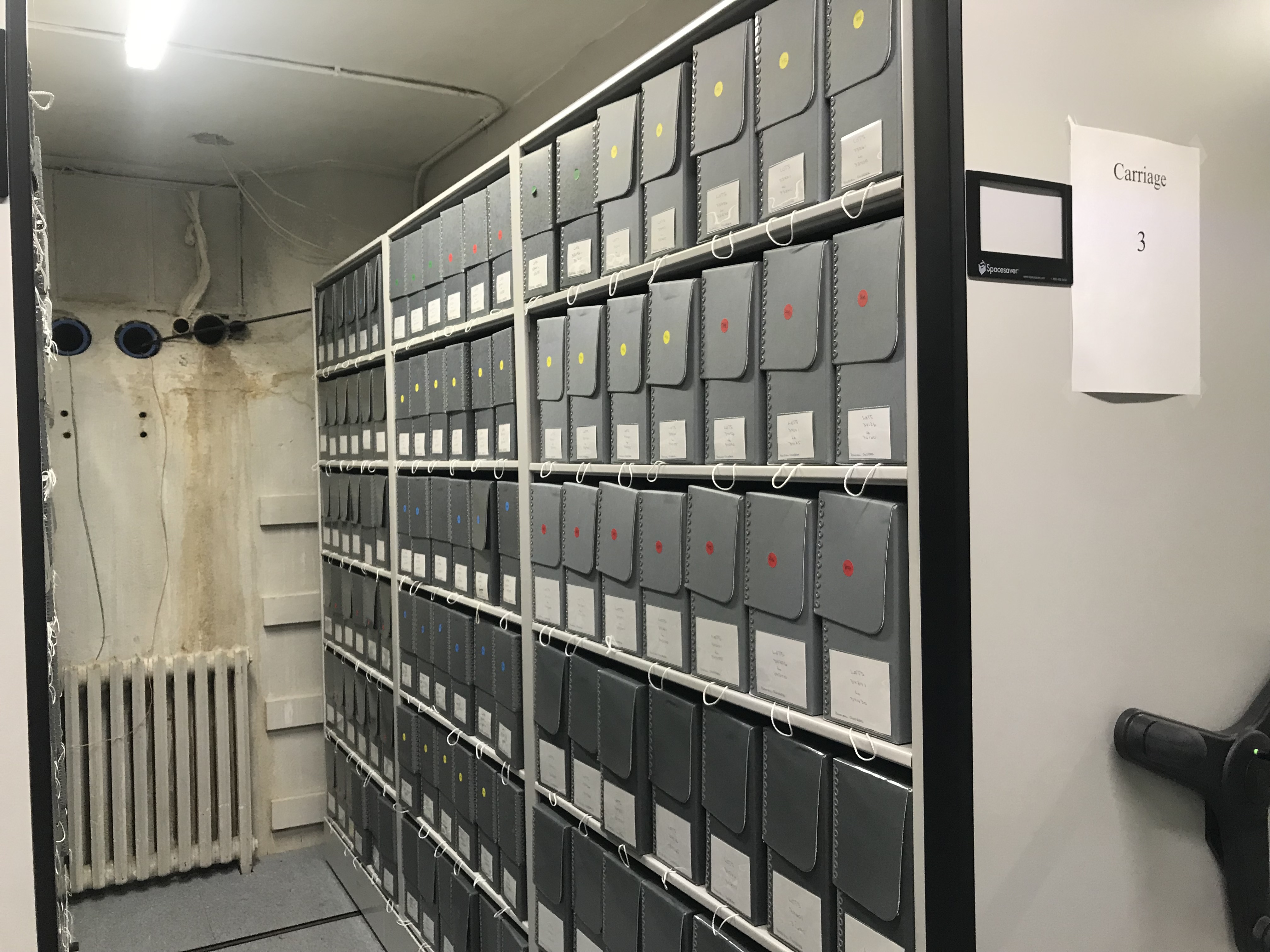
Green-Wood Cemetery archives. Taken by Caroline Haskins.
IMAGE: GREEN-WOOD CEMETERY ARCHIVES. TAKEN BY CAROLINE HASKINS.

Continue reading This is not only about the records maintained for one cemetery but about climate change and the danger to  people as well as paper records.


Friday, 24 May 2019

Your internet data is rotting

an article by Paul Royster for The Conversation [with grateful thanks to ResearchBuzz: Firehose for this item]

Many MySpace users were dismayed to discover earlier this year that the social media platform lost 50 million files uploaded between 2003 and 2015.

The failure of MySpace to care for and preserve its users’ content should serve as a reminder that relying on free third-party services can be risky.

MySpace has probably preserved the users’ data; it just lost their content. The data was valuable to MySpace; the users’ content less so.

What happened to MySpace
MySpace is a social networking media site where performers could upload music or other content for access and distribution to its user community. It has always been a free site, with revenues coming from ads and programming that targets users for specific products.

Formed in 2003 in imitation of the social gaming site Friendster, MySpace grew rapidly and was purchased by Rupert Murdoch’s News Corporation in 2005. By 2008, MySpace was the leading social networking site, valued at one time at US$12 billion But it declined in popularity – thanks to an overprevalence of ads, concerns about exposure of minors to sexual content and other issues. In 2011, News Corporation sold MySpace to Specific Media, who sold it again in 2016 to Time Inc., which was in turn bought by the Meredith Corporation in 2018.

So the company went through three changes in ownership over a 12-year period, and saw revenues and membership drop precipitously over that time. One sale might be fine, but three sales over short term suggests to me a troubled business that was not in a good position to watch over others’ intellectual property.

Continue reading


Wednesday, 21 February 2018

The tattoo as a document

an article by Kristina Sundberg and Ulrika Kjellman (ALM, Uppsala, Sweden) published in Journal of Documentation Volume 74 Issue 1 (2018)

Abstract

Purpose
The purpose of this paper is to investigate how tattoos can be considered documents of an individual’s identity, experiences, status and actions in a given context, relating to ideas stating that archival records/documents can be of many types and have different functions. The paper also wants to discuss how tattoos serve as a bank of memories and evidence on a living body; in this respect, the tattooed body can be viewed as an archive, which immortalises and symbolises the events and relationships an individual has experienced in his or her life, and this in relation to a specific social and cultural context.

Design/methodology/approach
To discuss these issues, the authors take the point of departure in the tattoo practice of Russian/Soviet prisoners. The tattoo material referred to is from the “Russian Criminal Tattoo Archive”. The archive is created by FUEL Design and Publishing that holds the meanings of the tattoos as explained in Russian Criminal Tattoo Encyclopaedia Volume I-III. The authors exemplify this practice with two photographs of Soviet/Russian prisoners and their tattoos. By using a semiotic analysis that contextualises these images primarily through literature studies, the authors try to say something about what meaning these tattoos might carry.

Findings
The paper argues that it is possible to view the tattoo as a document, bound to an individual, reflecting his/her life and a given social and cultural context. As documents, they provide the individual with the essential evidence of his or her endeavours in a criminal environment. They also function as an individual’s memory of events and relationships (hardships and comradeships). Subsequently, the tattoos help create and sustain an identity. Finally, the tattoo presents itself as a document that may represent a critique of a dominant society or simply the voice of the alienated.

Originality/value
By showing how tattoos can be seen as documents and memory records, this paper brings a new kind of item into information and archival studies. It also uses theories and concepts from information and archival studies to put new light on the functions of tattoos.


Thursday, 30 August 2012

Research on energy savings opportunities in university libraries

an article by Jeremy Linden and James Reilly (Rochester Institute of Technology, New York, USA) and Peter Herzog, (Herzog/Wheeler & Associates, LLP, St Paul, Minnesota, USA) published in Library Hi Tech Volume 30 Issue 3 (2012)

Abstract

Purpose
Mechanical systems in library environments are typically designed to run continuously in order to maintain the desired environmental conditions for preservation purposes, often resulting in a high cost in dollars and energy consumption. Altering these conditions through changed HVAC operating schedules is a risk many librarians and institutions are hesitant to take. This study aims to introduce the methodology and early findings of current research into the question of whether energy usage can be significantly reduced in libraries by carefully monitored and risk-managed shutdowns of air handling units (AHUs) during unoccupied hours in selected spaces without compromising the quality of the preservation environment.
Design/methodology approach
As part of the project, the authors are monitoring up to three air handling units (AHUs) at each of five partner institutions, three of which are university libraries or repositories, as well as the associated collections spaces served by the units.
Findings
Early findings show the potential value of systems shutdowns in various parts of the country, while also identifying regions that are less favourable.
Practical implications
In all cases, the experimentation with and successful implementation of a shutdown schedule, without adversely affecting preservation conditions, was preceded by careful documentation and risk management, as described.
Originality/value
Unlike unilateral HVAC equipment shutdowns and setbacks conducted solely for energy management, with little regard for collections, this risk-managed and documented approach potentially allows for the reduction of energy usage without placing collections’ health at risk.


Friday, 2 November 2007

Who do they think they are?

from IWR Blog by dgriffin
Today’s Guardian reports that family historians (both professional and amateur) have raised concerns over the lack access being given to paper-based archives. The report says, “There will never again be public access to the paper records”.

This report raises a problem for family historians but a lack of paper records is not only creating difficulties for this group of people. Have you ever tried to get hold of a government leaflet on ... [fill in your chosen subject here] only to discover that "it's online at ...". You want it to give to a client (customer, friend or whomever) and it would be good to be able to do this as part of a "pack" of information which the other person can take away and study at his/her leisure. Oops, printer gone down, PDF doesn't print, it's so colourful that I can't afford to do it etc etc. Ridiculous!

And if I want to look at how the same leaflet has changed over time and need to rely on someone printing out the new "online only" information and preserving it in the right sequence.