an article by David Bailey (University of Birmingham, UK), Dan Coffey (Leeds University Business School, UK), Maria Gavris (Warwick Business School, UK and Carole Thornley (Keele Business School, UK) published in Cambridge Journal of Regions, Economy and Society Volume 12 Issue 3 (November 2019)
Abstract
Industrial policy is a potential vehicle for more participative and democratic forms of policy formation. But in Britain an ademocratic policy culture is transforming into an undemocratic one.
This article explores the roots of this in major sea changes in the industrial policy climate of Western Europe, where non-discriminatory and aspatial policy stances are now giving way under pressure to openly discriminatory policies aimed at favoured industries or locations.
The British case is contrasted with France, Germany and Italy, and their variety of responses. It is proposed that an extended notion of ‘place’ offers a basis for social dialogue.
JEL Classification: L98, O52, R11
Showing posts with label democracy. Show all posts
Showing posts with label democracy. Show all posts
Tuesday, 26 November 2019


Tuesday, 19 November 2019
Investigating the online and offline contexts of day-to-day democracy as participation spaces
an article by Ella Taylor-Smith and Colin F. Smith (Edinburgh Napier University, UK) published in Information, Communication & Society Volume 22 Issue 13 (2019)
Abstract
Citizen-led participation in democracy is explored through studying the online and offline spaces where people work together to influence those in power and improve their communities.
The concept of a participation space is introduced to describe these contexts. The spatial theme guides the research, from literature, through methodology, to findings.
Case studies of three community/activist groups provide the data to identify participation spaces and model these as Socio-Technical Interaction Networks (STINs) (Kling, McKim, & King, 2003). These participation spaces include social media, email, and blogs, as well as paper media and offline spaces, such as rooms.
The STIN models of these participation spaces reveal that the characteristics which influence their use for participation are the same for online and offline spaces.
These can be understood in terms of spatial characteristics: the spaces’ perceived boundaries and inhabitants, combined with ownership and access, including costs. As well as recording the roles of these spatial characteristics, the participation space models map the day-to-day activities of participation.
Collating these activities reveals that participation primarily takes the form of communication: organising and increasing solidarity, sharing information, encouraging involvement, and trying to influence events. The models also reveal that most of these activities are non-public.
This sociotechnical study describes the relationship between the activities of local, grassroots democracy and the characteristics of the online and offline spaces where it takes place.
Abstract
Citizen-led participation in democracy is explored through studying the online and offline spaces where people work together to influence those in power and improve their communities.
The concept of a participation space is introduced to describe these contexts. The spatial theme guides the research, from literature, through methodology, to findings.
Case studies of three community/activist groups provide the data to identify participation spaces and model these as Socio-Technical Interaction Networks (STINs) (Kling, McKim, & King, 2003). These participation spaces include social media, email, and blogs, as well as paper media and offline spaces, such as rooms.
The STIN models of these participation spaces reveal that the characteristics which influence their use for participation are the same for online and offline spaces.
These can be understood in terms of spatial characteristics: the spaces’ perceived boundaries and inhabitants, combined with ownership and access, including costs. As well as recording the roles of these spatial characteristics, the participation space models map the day-to-day activities of participation.
Collating these activities reveals that participation primarily takes the form of communication: organising and increasing solidarity, sharing information, encouraging involvement, and trying to influence events. The models also reveal that most of these activities are non-public.
This sociotechnical study describes the relationship between the activities of local, grassroots democracy and the characteristics of the online and offline spaces where it takes place.
Thursday, 7 November 2019
Philosophers Debate Democracy
post by Morgan Meis in 3 Quarks Daily: John Tasioulas and Jonathan Wolf at the TLS:
Does the ferocity of the Brexit debate reveal different conceptions of the nature and value of democracy?
Brexiteers proudly talk as if the 2016 vote was a rare paradigm of real democracy – “the largest democratic exercise in our history” – while Remainers respond that majority voting by the electorate is only a small part of our democratic system.
In a representative democracy, our elected representatives can and should scrutinize the result of an “advisory” referendum as they scrutinize anything else.
So why should a referendum result be “respected” if the democratically elected politicians were to decide that, all things considered, it is not in the country’s best interests? On the other hand, Brexiteers will respond that if parliament can overturn the result, what was the point of the referendum in the first place?
It might seem, then, that the Brexit debate is a debate about democracy itself: what it is, why it is valuable, and how it should work.
Continue reading
Does the ferocity of the Brexit debate reveal different conceptions of the nature and value of democracy?
Brexiteers proudly talk as if the 2016 vote was a rare paradigm of real democracy – “the largest democratic exercise in our history” – while Remainers respond that majority voting by the electorate is only a small part of our democratic system.
In a representative democracy, our elected representatives can and should scrutinize the result of an “advisory” referendum as they scrutinize anything else.
So why should a referendum result be “respected” if the democratically elected politicians were to decide that, all things considered, it is not in the country’s best interests? On the other hand, Brexiteers will respond that if parliament can overturn the result, what was the point of the referendum in the first place?
It might seem, then, that the Brexit debate is a debate about democracy itself: what it is, why it is valuable, and how it should work.
Continue reading
Friday, 11 October 2019
Does Philanthropy Subvert Democracy?
posted by Morgan Meis in 3 Quarks Daily
Nick Burns at The Hedgehog Review:
There is room for reform in American philanthropy, but circumspection is in order.
Is modern-day philanthropy a disease in the democratic body politic? Rob Reich, a professor of political science at Stanford University (not to be confused with former secretary of labor Robert Reich), believes that it is. And Reich is not alone. Near-universal outrage over the recent college admissions scandal has left two black eyes on American philanthropy: one for the role of Rick Singer’s fraudulent 501(c)(3) organization, Key Worldwide Foundation, in bribing several elite universities to accept children of privilege; the other for the universities’ susceptibility to such schemes. Reich’s book went to press well before the scandal broke, but it is hard to imagine a better indication of his central claim: that philanthropy amplifies the power of the few at the expense of the many.
Philanthropy, Reich reasons, is necessarily “a form or exercise of power”. Under the current regime, it is an undemocratic sort of power: Bill Gates’s donations to public schools, for example, give him a measure of curricular control that cannot be wrested away at the ballot box. Though Reich favors greater government oversight and a freer hand for representative bodies to regulate charities’ operations, he goes a step further by arguing for the abolition of American philanthropy’s legal mainstay: the tax deduction.
more here.
Nick Burns at The Hedgehog Review:
There is room for reform in American philanthropy, but circumspection is in order.
Is modern-day philanthropy a disease in the democratic body politic? Rob Reich, a professor of political science at Stanford University (not to be confused with former secretary of labor Robert Reich), believes that it is. And Reich is not alone. Near-universal outrage over the recent college admissions scandal has left two black eyes on American philanthropy: one for the role of Rick Singer’s fraudulent 501(c)(3) organization, Key Worldwide Foundation, in bribing several elite universities to accept children of privilege; the other for the universities’ susceptibility to such schemes. Reich’s book went to press well before the scandal broke, but it is hard to imagine a better indication of his central claim: that philanthropy amplifies the power of the few at the expense of the many.
Philanthropy, Reich reasons, is necessarily “a form or exercise of power”. Under the current regime, it is an undemocratic sort of power: Bill Gates’s donations to public schools, for example, give him a measure of curricular control that cannot be wrested away at the ballot box. Though Reich favors greater government oversight and a freer hand for representative bodies to regulate charities’ operations, he goes a step further by arguing for the abolition of American philanthropy’s legal mainstay: the tax deduction.
more here.
Tuesday, 24 September 2019
Why more democracy isn’t better democracy
a post by Robert B. Talisse for the OUP blog

“Torn,” by Sergio Vassio Photography, CC 2.0, via Flickr
Democracy is necessary for a free and just society. It is tempting to conclude that democracy is such a crucial social good that there could never be too much of it. It seems that when it comes to democracy, the more the better.
Yet it is possible to have too much democracy. This is not an anti-democratic contention. Holding that democracy is a crucial good is consistent with denying that more is always better. Democracy’s flourishing requires that we avoid overdoing it. In other words, when democracy is overdone, democracy suffers and politics devolves. Let me explain.
Continue reading please. This man is making sense!
“Torn,” by Sergio Vassio Photography, CC 2.0, via Flickr
Democracy is necessary for a free and just society. It is tempting to conclude that democracy is such a crucial social good that there could never be too much of it. It seems that when it comes to democracy, the more the better.
Yet it is possible to have too much democracy. This is not an anti-democratic contention. Holding that democracy is a crucial good is consistent with denying that more is always better. Democracy’s flourishing requires that we avoid overdoing it. In other words, when democracy is overdone, democracy suffers and politics devolves. Let me explain.
Continue reading please. This man is making sense!
Thursday, 1 August 2019
The Debasement Puzzle
posted by S. Abbas Raza in 3 Quarks Daily
an article by Scott F. Aikin and Robert B. Talisse
Everybody knows what real-world political disagreement is like: shouting, name-calling, dissembling, browbeating, mobbing, and worse. As it is practiced, deliberation in actual democracy has little to do with collective reasoning about the common good; it’s instead a constrained, but nevertheless ruthless, struggle for power. Notice, however, that hardly anyone embraces this condition. When people describe democracy in such terms, they are most often complaining. But notice that lamentations over the cut-throat nature of politics make sense as criticisms only against the backdrop of an aspirational alternative. Our forthcoming book, Democracy in a Divided World, develops a democratic ideal worth aspiring to. According to that ideal, democracy is a system where political equals govern together by means of well-run political argument.
This ideal is admittedly distant, but it hasn’t been plucked from thin air. Despite the condition of our democracy, citizens and officials alike hold one another to high standards of civil conduct. When the President characterizes those he perceives to be his critics as “very dishonest people,” he appeals to the public virtue of honesty. Charges of bias uphold the related public virtue of evenhandedness. When one criticizes a news organization for being slanted, one is insisting upon a public virtue of fairness. Note, too, that it is common now for the word “partisanship” to be used as a criticism; when one official charges another with being “partisan,” she is claiming that the other is dogmatically committed to a party line. Such charges uphold the ideal of proper argumentation. The fact is that real world politics, warts and all, is still animated with the aspiration to democracy as a system of well-run argumentation.
Continue reading
an article by Scott F. Aikin and Robert B. Talisse
Everybody knows what real-world political disagreement is like: shouting, name-calling, dissembling, browbeating, mobbing, and worse. As it is practiced, deliberation in actual democracy has little to do with collective reasoning about the common good; it’s instead a constrained, but nevertheless ruthless, struggle for power. Notice, however, that hardly anyone embraces this condition. When people describe democracy in such terms, they are most often complaining. But notice that lamentations over the cut-throat nature of politics make sense as criticisms only against the backdrop of an aspirational alternative. Our forthcoming book, Democracy in a Divided World, develops a democratic ideal worth aspiring to. According to that ideal, democracy is a system where political equals govern together by means of well-run political argument.
This ideal is admittedly distant, but it hasn’t been plucked from thin air. Despite the condition of our democracy, citizens and officials alike hold one another to high standards of civil conduct. When the President characterizes those he perceives to be his critics as “very dishonest people,” he appeals to the public virtue of honesty. Charges of bias uphold the related public virtue of evenhandedness. When one criticizes a news organization for being slanted, one is insisting upon a public virtue of fairness. Note, too, that it is common now for the word “partisanship” to be used as a criticism; when one official charges another with being “partisan,” she is claiming that the other is dogmatically committed to a party line. Such charges uphold the ideal of proper argumentation. The fact is that real world politics, warts and all, is still animated with the aspiration to democracy as a system of well-run argumentation.
Continue reading
Monday, 15 July 2019
State of the world 2018: democracy facing global challenges
an article by Anna Lührmann, Sandra Grahn, Richard Morgan, Shreeya Pillai and Staffan I. Lindberg (University of Gothenburg, Sweden) published in Democratization Volume 26 Issue 6 (2019)
Abstract
This article analyses the state of democracy in the world in 2018, and recent developments building on the 2019 release of the V-Dem dataset.
First, the trend of autocratization continues and 24 countries are now affected by what is established as a “third wave of autocratization”.
Second, despite the global challenge of gradual autocratization, democratic regimes prevail in a majority of countries in the world (99 countries, 55%) in 2018. Thus, the state of the world is unmistakably more democratic compared to any point during the last century. At the same time, the number of electoral authoritarian regimes had increased to 55, or 31% of all countries.
Third, the autocratization wave is disproportionally affecting democratic countries in Europe and the Americas, but also India’s large population.
Fourth, freedom of expression and the media, and the rule of law are the areas under attack in most countries undergoing autocratization, but toxic polarization of the public sphere is a threat to democracy spreading across regimes.
Finally, we present the first model to predict autocratization (“adverse regime transitions”) pointing to the top-10 most at-risk countries in the world.
Full text (PDF 22pp)
Abstract
This article analyses the state of democracy in the world in 2018, and recent developments building on the 2019 release of the V-Dem dataset.
First, the trend of autocratization continues and 24 countries are now affected by what is established as a “third wave of autocratization”.
Second, despite the global challenge of gradual autocratization, democratic regimes prevail in a majority of countries in the world (99 countries, 55%) in 2018. Thus, the state of the world is unmistakably more democratic compared to any point during the last century. At the same time, the number of electoral authoritarian regimes had increased to 55, or 31% of all countries.
Third, the autocratization wave is disproportionally affecting democratic countries in Europe and the Americas, but also India’s large population.
Fourth, freedom of expression and the media, and the rule of law are the areas under attack in most countries undergoing autocratization, but toxic polarization of the public sphere is a threat to democracy spreading across regimes.
Finally, we present the first model to predict autocratization (“adverse regime transitions”) pointing to the top-10 most at-risk countries in the world.
Full text (PDF 22pp)
Thursday, 18 April 2019
Towards rising inequalities in newspaper and television news consumption? A longitudinal analysis, 2000–2016
an article by Annika Bergström, Jesper Strömbäck and Sofia Arkhede (University of Gothenburg, Sweden) published in European Journal of Communication Volume 34 Issue 2 (April 2019)
Abstract
The transformation from low- to high-choice media environments has triggered concerns of rising inequalities in news media use.
This concern has been buttressed by research showing that motivational factors have become more important predictors of news media use. Less attention has been paid to how changes in media environments have altered the impact of socioeconomic status on news media use.
Hence, the purpose of this study is to investigate the changing impact of socioeconomic status on newspaper and television news consumption, empirically focusing on Sweden between 2000 and 2016. Among other things, results suggest that the impact of socioeconomic status on news media use has increased with respect to reading morning newspapers but decreased for reading tabloids and watching television news.
Abstract
The transformation from low- to high-choice media environments has triggered concerns of rising inequalities in news media use.
This concern has been buttressed by research showing that motivational factors have become more important predictors of news media use. Less attention has been paid to how changes in media environments have altered the impact of socioeconomic status on news media use.
Hence, the purpose of this study is to investigate the changing impact of socioeconomic status on newspaper and television news consumption, empirically focusing on Sweden between 2000 and 2016. Among other things, results suggest that the impact of socioeconomic status on news media use has increased with respect to reading morning newspapers but decreased for reading tabloids and watching television news.
Monday, 25 March 2019
Whatever happened to digital democracy?
an article by Joe Mitchell (Democracy Club) published in IPPR Progressive Review Volume 25 Issue 4 (Spring 2019)
Introduction
In his 1932 novel, Brave New World, Aldous Huxley imagined a society utterly changed by technology: a utopia or dystopia, depending on your point of view. It is not uncommon to see commentators compare it with George Orwell's 1984 and suggest that Huxley more accurately ‘predicted’ today.
Has technology and modern consumer capitalism left us unthinking, uncritical beings blissfully and blindly stumbling through life? Are we living in a utopia or a dystopia as a result of terrific technological advance over the last decades? Or is this to overstate the case for the level of change so far wrought by technology?
“Over the last few years, the narrative of opportunity for a better democracy has faltered in the face of reality”
This debate has gone on in the domain of democracy for decades, where conflicting visions of ‘digital democracy’ abound. Over the last few years, the narrative of opportunity for a better democracy has faltered in the face of reality. Dystopian visions are in the ascendant. But if we can remain cognisant of, yet not bowed by, the risks presented by digital technology, there remains a case for cautious optimism.
Full text (PDF 8pp)
Introduction
In his 1932 novel, Brave New World, Aldous Huxley imagined a society utterly changed by technology: a utopia or dystopia, depending on your point of view. It is not uncommon to see commentators compare it with George Orwell's 1984 and suggest that Huxley more accurately ‘predicted’ today.
Has technology and modern consumer capitalism left us unthinking, uncritical beings blissfully and blindly stumbling through life? Are we living in a utopia or a dystopia as a result of terrific technological advance over the last decades? Or is this to overstate the case for the level of change so far wrought by technology?
“Over the last few years, the narrative of opportunity for a better democracy has faltered in the face of reality”
This debate has gone on in the domain of democracy for decades, where conflicting visions of ‘digital democracy’ abound. Over the last few years, the narrative of opportunity for a better democracy has faltered in the face of reality. Dystopian visions are in the ascendant. But if we can remain cognisant of, yet not bowed by, the risks presented by digital technology, there remains a case for cautious optimism.
Full text (PDF 8pp)
Wednesday, 13 February 2019
What the Paris Peace Conference can teach us about politics today
a post by Anand Menon, Margaret Macmillan and Patrick Quinton-Brown for the OUP blog

‘Hall of Mirrors’ by yuliu. CC0 Public Domain via Pixabay
One hundred years ago, the treaty of Versailles, the centerpiece of a set of treaties and agreements collectively known as the Paris Peace Settlements, was signed in the glittering hall of mirrors in the former home of France’s Sun King. For some, the war it brought to an end marked the final chapter of a distinct period in international relations, one dominated by a European states system that had endured since the Middle Ages and in which military conflict was relatively commonplace.
Anniversaries impose a misleading unity on a period of history. Nevertheless, it can still be useful to reflect on where we once were, what has changed, and what the prospects for the future might be. 2019 represents a moment of transition in both domestic and international politics. The backlash against globalization, the rise of intolerant and anti-democratic populisms, the tensions between rising and declining powers as well as the withdrawal of the United States from its hegemonic global role, are all calling into question norms and institutions underpinning a twentieth century world order many had taken for granted.
There are suggestive and sometimes troubling parallels between 2019 and 1919. At both moments, the world witnessed a retreat from globalism, the rise of nativist and populist political parties, demands from national movements for their own states, the spread of international revolutionary movements—Bolshevism then, radical Islamism today—and concerns about the absence of international order. One prominent observer speaks of a “concerted attack on the constitutional liberal order.”
Continue reading
‘Hall of Mirrors’ by yuliu. CC0 Public Domain via Pixabay
One hundred years ago, the treaty of Versailles, the centerpiece of a set of treaties and agreements collectively known as the Paris Peace Settlements, was signed in the glittering hall of mirrors in the former home of France’s Sun King. For some, the war it brought to an end marked the final chapter of a distinct period in international relations, one dominated by a European states system that had endured since the Middle Ages and in which military conflict was relatively commonplace.
Anniversaries impose a misleading unity on a period of history. Nevertheless, it can still be useful to reflect on where we once were, what has changed, and what the prospects for the future might be. 2019 represents a moment of transition in both domestic and international politics. The backlash against globalization, the rise of intolerant and anti-democratic populisms, the tensions between rising and declining powers as well as the withdrawal of the United States from its hegemonic global role, are all calling into question norms and institutions underpinning a twentieth century world order many had taken for granted.
There are suggestive and sometimes troubling parallels between 2019 and 1919. At both moments, the world witnessed a retreat from globalism, the rise of nativist and populist political parties, demands from national movements for their own states, the spread of international revolutionary movements—Bolshevism then, radical Islamism today—and concerns about the absence of international order. One prominent observer speaks of a “concerted attack on the constitutional liberal order.”
Continue reading
Monday, 17 December 2018
Does economic inequality breed political inequality?
an article by Christian Houle (Michigan State University, East Lansing, USA) published in Democratization Volume 25 Issue 8 (2018)
Abstract
Does economic inequality generate political inequality?
While there is a large literature on the effect of inequality on regime change and support for democracy, there is little research on its effect on political equality across socioeconomic positions. Yet democracy and political equality, although related, are distinct concepts.
While political power tends to be more evenly distributed in democracies than in autocracies, there is substantial variation in both regime types.
This study argues that economic inequality should decrease political equality through multiple mechanisms:
Using three measures of inequality and data on more than 140 countries between 1961 and 2008, it was found that economic inequality tends to increase political inequality, even when one controls for the level of democracy. Results hold when the sample is restricted by regime type.
Finally, evidence in favour of the mechanisms is provided.
Abstract
Does economic inequality generate political inequality?
While there is a large literature on the effect of inequality on regime change and support for democracy, there is little research on its effect on political equality across socioeconomic positions. Yet democracy and political equality, although related, are distinct concepts.
While political power tends to be more evenly distributed in democracies than in autocracies, there is substantial variation in both regime types.
This study argues that economic inequality should decrease political equality through multiple mechanisms:
- it increases the resources of the rich relative to the poor;
- it widens the gap in policy preferences across income groups;
- it reduces participation; and
- it depresses support for democracy.
Using three measures of inequality and data on more than 140 countries between 1961 and 2008, it was found that economic inequality tends to increase political inequality, even when one controls for the level of democracy. Results hold when the sample is restricted by regime type.
Finally, evidence in favour of the mechanisms is provided.
Monday, 3 December 2018
Using information security to explain why disinformation makes autocracies stronger and democracies weaker
a post by Cory Doctorow for the Boing Boing blog

The same disinformation campaigns that epitomize the divisions in US society – beliefs in voter fraud, vaccine conspiracies, and racist conspiracies about migrants, George Soros and Black Lives Matter, to name a few – are a source of strength for autocracies like Russia, where the lack of a consensus on which groups and views are real and which are manufactured by the state strengthens the hand of Putin and his clutch of oligarchs.
In a new Harvard Berkman Center paper, Common-Knowledge Attacks on Democracy, political scientist Henry Farrell (previously and security expert Bruce Schneier (previously) team up to explore this subject by using information security techniques, and come to a very plausible-seeming explanation and a set of policy recommendations to address the issue.
Continue reading
Please take your time over this. The author is someone I trust to say it as it is.
Trust can, of course, be misplaced but over time I have not found this to be true of Cory Doctorow.
The same disinformation campaigns that epitomize the divisions in US society – beliefs in voter fraud, vaccine conspiracies, and racist conspiracies about migrants, George Soros and Black Lives Matter, to name a few – are a source of strength for autocracies like Russia, where the lack of a consensus on which groups and views are real and which are manufactured by the state strengthens the hand of Putin and his clutch of oligarchs.
In a new Harvard Berkman Center paper, Common-Knowledge Attacks on Democracy, political scientist Henry Farrell (previously and security expert Bruce Schneier (previously) team up to explore this subject by using information security techniques, and come to a very plausible-seeming explanation and a set of policy recommendations to address the issue.
Continue reading
Please take your time over this. The author is someone I trust to say it as it is.
Trust can, of course, be misplaced but over time I have not found this to be true of Cory Doctorow.
Tuesday, 13 November 2018
Voice, silence and social class on television
an article by Peter Jakobsson and Fredrik Stiernstedt (Södertörn University, Sweden) published in European Journal of Communication Volume 33 Issue 5 (October 2018)
Abstract
The question of voice is a central and timeless political issue. Who gets to speak? Who is silenced? Who is listening? One of the main arenas for voice in modern, advanced democracies is the media.
Media infrastructures, technologies, institutions and organizations are a precondition for political voice in large-scale societies, but are also an important factor in distributing the possibilities for voice among different groups and sectors of the population.
In this article, we take on the question of voice in relation to social class and aim to analyse how the medium of television gives voice to people from different social classes.
This study operationalizes the theoretical notion of voice by asking the following questions:
Television thus constructs a social hierarchy of voice and authority that reproduces and legitimizes already existing social hierarchies.
Abstract
The question of voice is a central and timeless political issue. Who gets to speak? Who is silenced? Who is listening? One of the main arenas for voice in modern, advanced democracies is the media.
Media infrastructures, technologies, institutions and organizations are a precondition for political voice in large-scale societies, but are also an important factor in distributing the possibilities for voice among different groups and sectors of the population.
In this article, we take on the question of voice in relation to social class and aim to analyse how the medium of television gives voice to people from different social classes.
This study operationalizes the theoretical notion of voice by asking the following questions:
- who has the opportunity to appear and speak on television,
- to whom do they speak and
- under what circumstances does this communication occur?
Television thus constructs a social hierarchy of voice and authority that reproduces and legitimizes already existing social hierarchies.
Friday, 12 October 2018
A rational backlash against globalisation
a column by Lubos Pastor and Pietro Veronesi for VIX: CEPR’s Policy Portal
The vote for Brexit and the election of protectionist Donald Trump to the US presidency – two momentous markers of the ongoing pushback against globalisation – led some to question the rationality of voters.
This column presents a framework that demonstrates how the populist backlash against globalisation is actually a rational voter response when the economy is strong and inequality is high. It highlights the fragility of globalisation in a democratic society that values equality.
Continue reading
The vote for Brexit and the election of protectionist Donald Trump to the US presidency – two momentous markers of the ongoing pushback against globalisation – led some to question the rationality of voters.
This column presents a framework that demonstrates how the populist backlash against globalisation is actually a rational voter response when the economy is strong and inequality is high. It highlights the fragility of globalisation in a democratic society that values equality.
Continue reading
Sunday, 4 March 2018
Democratic legitimacy in regional economic organizations: the European Union in comparative perspective
an article by Francesca Duina (Bates College, Lewiston, ME, USA) and Tobias Lenz (University of Goettingen, Germany published in Economy and Society Volume 46 Issue 3-4 (2017)
Abstract
Regional organizations have been widely criticized for lacking democratic legitimacy, but these criticisms have been rather ad hoc, concerned with single case studies and reliant on unclear standards or metrics.
Are all organizations similarly deficient?
And how does the European Union (EU), the target par excellence of the criticisms, fare in comparative perspective?
In this paper, we take a first step towards answering these questions by leveraging the rich debate on the EU to identify several institutional dimensions of democratic legitimacy and operationalizing them for comparative analysis. We then investigate the most important regional economic organizations (REOs) in the world.
Our findings are three-fold:
Abstract
Regional organizations have been widely criticized for lacking democratic legitimacy, but these criticisms have been rather ad hoc, concerned with single case studies and reliant on unclear standards or metrics.
Are all organizations similarly deficient?
And how does the European Union (EU), the target par excellence of the criticisms, fare in comparative perspective?
In this paper, we take a first step towards answering these questions by leveraging the rich debate on the EU to identify several institutional dimensions of democratic legitimacy and operationalizing them for comparative analysis. We then investigate the most important regional economic organizations (REOs) in the world.
Our findings are three-fold:
- there is systematic variation across REOs, with a group doing rather well, one mixed, and one poorly;
- procedural dimensions fare better than those related to representation or local self-determination;
- no organization exhibits or lacks legitimacy in all dimensions.
Monday, 20 November 2017
The internet against democracy
Digitalization reveals the distance between the democratic ideal and its practical reality. Only a society that is open, sceptical and flexible can adapt successfully to this transformation, writes Manuel Arias Maldonado for Eurozine
First paragraph
We are becoming adults: It is already four years since the German language admitted into its rich vocabulary, by means of the twenty-sixth edition of the prestigious Duden dictionary, the English word shitstorm. And although the expression has not yet taken hold among Spanish-speakers, the practice of it is as popular here as in other liberal public spheres elsewhere.
Shitstorm: without any need for coordination, a group of people insult or otherwise dismiss another media user, public figure or company because of something they have done or said on social media or anywhere else. A textbook example is the reaction to the interview given by the Spanish actress Paula Echevarría to Zeleb, a digital platform devoted to celebrity culture: an avalanche of denigratory tweets fell upon her because of what was interpreted as an insufficient defence of the cause of feminism.
There are also less glamorous options: after inviting the public to send in ideas in a competition to design a limited edition of one of their products, the German detergent brand Pril unleashed the ire of those who took part by rejecting the one that got the most votes – ‘it tastes better if it tastes like chicken’ – due to its mocking tone. Dazzled by the public reaction, however, the company produced one hundred and eleven bottles with an image of an enraged monster on them, and distributed them in a lottery via Facebook. It’s better to laugh than cry.
Continue reading
First paragraph
We are becoming adults: It is already four years since the German language admitted into its rich vocabulary, by means of the twenty-sixth edition of the prestigious Duden dictionary, the English word shitstorm. And although the expression has not yet taken hold among Spanish-speakers, the practice of it is as popular here as in other liberal public spheres elsewhere.
Shitstorm: without any need for coordination, a group of people insult or otherwise dismiss another media user, public figure or company because of something they have done or said on social media or anywhere else. A textbook example is the reaction to the interview given by the Spanish actress Paula Echevarría to Zeleb, a digital platform devoted to celebrity culture: an avalanche of denigratory tweets fell upon her because of what was interpreted as an insufficient defence of the cause of feminism.
There are also less glamorous options: after inviting the public to send in ideas in a competition to design a limited edition of one of their products, the German detergent brand Pril unleashed the ire of those who took part by rejecting the one that got the most votes – ‘it tastes better if it tastes like chicken’ – due to its mocking tone. Dazzled by the public reaction, however, the company produced one hundred and eleven bottles with an image of an enraged monster on them, and distributed them in a lottery via Facebook. It’s better to laugh than cry.
Continue reading
Friday, 4 August 2017
'The higher the inequality, the more likely we are to move away from democracy'
an article by Branko Milanovic published in the Guardian on 2 May 2017
In every political system, the rich tend to hold more power – but the relationship between politics, economics and inequality is complex. To better understand these critical issues, we must look to Big Data
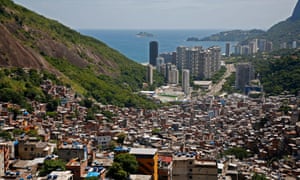
View down from the top of Rio de Janeiro Rocinha favela, Brazil. Inequality is high in Latin America and perpetuates across generations. Photograph: Alamy
I am asked this question very often: why should we care about inequality? There are three reasons.
First, every inequality in the treatment or position of individuals – including inequality in income and wealth – requires understanding and justification, because we are all fundamentally the same. That does not mean we should all have the same incomes because our effort and luck may vary, but we need to think about the reasons for any and every inequality.
…
Second, we want to study inequality and its effects on economic growth – not only on the growth of the mean, like GDP per capita, but along the entire income distribution: for the poor, the middle class and the rich.
…
Finally, we need to look at the relationship between inequality and politics.
Continue reading
Well explained with some data to illustrate the text and links to further information.
In every political system, the rich tend to hold more power – but the relationship between politics, economics and inequality is complex. To better understand these critical issues, we must look to Big Data
View down from the top of Rio de Janeiro Rocinha favela, Brazil. Inequality is high in Latin America and perpetuates across generations. Photograph: Alamy
I am asked this question very often: why should we care about inequality? There are three reasons.
First, every inequality in the treatment or position of individuals – including inequality in income and wealth – requires understanding and justification, because we are all fundamentally the same. That does not mean we should all have the same incomes because our effort and luck may vary, but we need to think about the reasons for any and every inequality.
…
Second, we want to study inequality and its effects on economic growth – not only on the growth of the mean, like GDP per capita, but along the entire income distribution: for the poor, the middle class and the rich.
…
Finally, we need to look at the relationship between inequality and politics.
Continue reading
Well explained with some data to illustrate the text and links to further information.
Friday, 3 February 2017
Democratic inclusiveness, climate policy outputs, and climate policy outcomes
an article by Tobias Böhmelt (University of Essex, Colchester, UK and ETH, Zurich, Switzerland), Marit Böker (ETH, Zurich, Switzerland) and Hugh Ward (University of Essex, Colchester, UK) published in Democratization Volume 12 Issue 7 (2016)
Abstract
In an ideal inclusive political system, all citizens are equally able to influence and challenge policies.
We focus on how inclusiveness affects climate policies and outcomes. We argue that more inclusive systems should produce more policies in response to environmental threats and should have better outcomes. We test these hypotheses using panel and cross-sectional data relating to climate policy outputs and outcomes.
The results suggest that inclusiveness is positively associated with policy outputs, but probably not with lower emissions of greenhouse gases. This pattern may relate to a lack of deliberation in systems, which are relatively inclusive in the narrower sense of pluralist democratic theory.
Abstract
In an ideal inclusive political system, all citizens are equally able to influence and challenge policies.
We focus on how inclusiveness affects climate policies and outcomes. We argue that more inclusive systems should produce more policies in response to environmental threats and should have better outcomes. We test these hypotheses using panel and cross-sectional data relating to climate policy outputs and outcomes.
The results suggest that inclusiveness is positively associated with policy outputs, but probably not with lower emissions of greenhouse gases. This pattern may relate to a lack of deliberation in systems, which are relatively inclusive in the narrower sense of pluralist democratic theory.
Thursday, 26 January 2017
The impact of the austerity measures to confront the economic crisis on the EU objectives and EU values
an article by Despina Anagnostopoulou (University of Macedonia, Thessaloniki, Greece) published in International Journal of Diplomacy and Economy Volume 3, Number 2 (2016)
Abstract
According to the EU Treaties, the EU economic policy coordination should serve the objectives of the EU, among which is the promotion of the EU values.
The paper demonstrates that:
Abstract
According to the EU Treaties, the EU economic policy coordination should serve the objectives of the EU, among which is the promotion of the EU values.
The paper demonstrates that:
- the EU values and objectives as well as the Charter of Fundamental Rights are binding on the EU institutions, even when they are acting outside the EU legal order (e.g., when drafting the MoUs);
- democratic principles are lacking in the EMU patchwork, especially in the case of member states under adjustment programmes;
- the national constitutional courts have recently ruled that equality and dignity were infringed by the laws implementing the MoUs, and so did the European Committee of Social Rights as far as social rights are concerned.
Tuesday, 1 November 2016
How to tell apart trade agreements that undermine democratic principles from those that don't
via Dani Rodrick’s weblog “Unconventional thoughts on economic development and globalization”
I discussed in an earlier post on Brexit how to think about international agreements and the constraints on state action they entail in terms of democratic legitimacy. Since that discussion has relevance beyond Brexit, I've pasted the relevant part here below. The basic point is this: the fact that an international rule is negotiated and accepted by a democratically elected government does not inherently make that rule democratically legitimate.
Continue reading
I discussed in an earlier post on Brexit how to think about international agreements and the constraints on state action they entail in terms of democratic legitimacy. Since that discussion has relevance beyond Brexit, I've pasted the relevant part here below. The basic point is this: the fact that an international rule is negotiated and accepted by a democratically elected government does not inherently make that rule democratically legitimate.
Continue reading
Subscribe to:
Posts (Atom)

