Showing posts with label debt. Show all posts

Monday, 2 December 2019

The Long History Of Debt Cancellation

posted by S. Abbas Raza in 3 Quarks Daily: Olivia Schwob in the Boston Review:

The Long History of Debt Cancellation
unattributed

Today the phrase “debtors’ prison” is often invoked to describe this experience of punitive indebtedness. Sometimes it is meant literally.

Consider Melissa Welch-Latronica, a thirty-year-old single mother, who in February was wrenched from her minivan and thrown into a jail cell in Porter County, Illinois, over failure to pay an ambulance bill.

Her story is unusual but not unique.

A 2018 ACLU report documented a thousand cases of the “criminalization of private debt” and compiled a dozen of the most extreme stories. Most of the people featured ended up in jail because they failed to appear in court over unpaid debts, resulting in a warrant.

And then there is the abominable, systemic cycle of incarceration and reincarceration of poor people – and particularly poor people of color – unable to pay fines and court fees.

Continue reading


Thursday, 6 June 2019

The wealth effect: The middle class and the changing politics of banking crises

a column by Jeffrey Chwieroth and Andrew Walter for VOX: CEPR’s Policy Portal

The accumulation of mass financialised wealth has transformed the politics of banking crises.

This column shows that the rising wealth of the middle classes has generated great expectations that their wealth will be protected by the government. As a result, democracies perform more financial sector bailouts and are also more financially fragile and politically unstable.

Continue reading


Thursday, 30 May 2019

Indebted life and money culture: payday lending in the United Kingdom

Paul Langley and Ben Anderson (Durham University, UK) and James Ash and Rachel Gordon (Newcastle University, UK) published in Economy and Society Volume 48 Issue 1 (2019)

Abstract

Critical social scientific research holds that credit–debt is a principal economic and governing relation in contemporary economy and society, but largely neglects money’s role in indebted life.

Drawing on qualitative research in the payday loan market in the United Kingdom, the paper shows that borrowers typically relate to loans in monetary rather than financial terms and incorporate them into practices of payment, spending and online banking.

To analyse how indebted life is variously experienced and enacted through money, the concept of money culture is developed to refer to money’s culture, money’s meanings and money’s affects. Borrowers enter into and negotiate payday loans through a digitally mediated money culture that both mobilizes and runs counter to money’s powerful fictions as circulating universal equivalent and calculative means of account.


Wednesday, 29 May 2019

Public debt and the risk premium: A dangerous doom loop

a column by Cinzia Alcidi and Daniel Gros for VOX: CEPR’s Policy Portal

The relationship between high public debt and low interest rates is once again at the forefront of debate.

This column shows that countries with high debt levels pay a risk premium. This creates the potential for self-reinforcing loops of high debt and high risk premia, which can become explosive.

Continue reading

Hazel’s comment:
I realise that this column is all about countries, large organisations, public debt etc but the underlying premise applies to individuals and households as well.
Too much debt is not a good thing.


Sunday, 21 April 2019

5 Steps to Lower Your Financial Stress When You're Drowning in Debt

a post by Sam Theron for the Tiny Buddha blog


“You can’t calm the storm, so stop trying. What you can do is calm yourself. The storm will pass.” ~Timber Hawkeye

I never anticipated the stress and pressure that come when you are no longer able to pay your bills on time.

Knowing that you owe money, and that your current income isn’t going to cover it, is a heavy reality to face.

I found myself starting to envy low-income, salaried employees. Even though they don’t earn a lot, which I’m sure brings its own challenges, they aren’t eligible to receive huge credit. This protects them from ever finding themselves owing millions.

My husband and I have recently gone through a time when we found ourselves way overextended. Due to a series of bad beats and various twists of fate, we found ourselves in over our heads. And this is not a good space to be in.

It’s a sickening feeling that has seemed to overshadow all the other areas of our lives. We’ve felt unable to breathe, knowing that debt is hanging over us. When the phone rings from an unknown number, we’re hesitant to answer it. It could be someone wanting to know when we will pay a bill.

Continue reading


Monday, 12 November 2018

Attitudes towards debt and debt behaviour

a column by Johan Almenberg, Annamaria Lusardi, Jenny Säve-Söderbergh and Roine Vestman for VOX: CEPR’s Policy Portal

Household indebtedness is high in many countries, and continues to rise.

This column uses data from Sweden to argue that evolving attitudes toward debt may help explain the observed increase. Individuals who report being comfortable with debt have considerably more of it, and they are more likely to have parents who were also comfortable with debt.

For others, discomfort with debt may act as a self-imposed borrowing constraint.

Continue reading


Monday, 17 September 2018

Tackling problem debt

a press release from the National Audit Office 6 September 2018

Full report: Tackling problem debt

Personal debt problems have a significant impact on individuals, but the government has a limited understanding of how this affects the public purse and there are weaknesses in its strategy for dealing with the issue, says today’s report by the National Audit Office (NAO).

Problem debt, which is defined as the inability to pay debts or household bills, affects around 8.3 million people in the UK. It can have significant damaging effects, such as causing anxiety and depression. It can also increase people’s likelihood of being in state-subsidised housing. Problem debt is caused by a large number of factors, including life events, access to affordable credit, debt collection practices and a person’s understanding of financial matters. An estimated 4 in 10 people in the UK cannot manage their money well day-to-day, and internationally the UK ranks below average in financial capability.

The NAO estimates that the increased use of public health and housing services by people with problem debt costs taxpayers an additional £248 million a year, and around £900 million a year to the economy as a whole. Due to gaps in the government’s data, it is not possible to model other impacts including on employment and benefits.

HM Treasury has overall policy responsibility for problem debt and works closely with many organisations across government and the private and third sectors in trying to address this issue. However, the NAO has found weaknesses in HM Treasury’s approach. It does not have any formal mechanism or forum to bring issues together in a coherent way, ensure a common understanding of priorities, or collectively hold delivery partners to account.

People increasingly report problems with debts to government or utility providers. The NAO estimates that the UK public owe at least £18 billion to utility providers, landlords, housing associations and government, such as through council tax arrears or benefit overpayments. HM Treasury has limited information on debt in these areas and, as such, does not fully understand the problem, which hinders its ability to respond effectively. The information available is much less clear and transparent than retail lending information.

Government also lags behind the retail lending sector in following good debt management practice. As an example, established best practice in how to assess affordability of repayments is used by only 19% of local authorities and is not used as standard by central government creditors. Debtors’ perceptions of whether they are treated fairly also lag behind retail lenders. A lack of data-sharing means government cannot identify individuals who owe money to more than one department, resulting in debt collection teams competing for repayments from the same person. Short-term incentives and funding pressures may also be leading to debts being pursued too quickly and aggressively, particularly in local government. NAO’s modelling estimates that intimidating actions and additional charges on over-indebted people are 15-29% more likely to make debts harder to manage or increase anxiety and depression. The Cabinet Office leads the government’s work to improve debt management practices across government, but departments, agencies and local councils are responsible for their own approaches.

To reduce the extent to which problem debt occurs in the first place, the Money Advice Service has improved coordination of efforts to improve the public’s understanding of financial matters, but its strategy does not involve all relevant parts of government. Meanwhile, the Financial Conduct Authority has taken action to improve responsible lending, for example by reducing fees and charges on a typical payday loan which it estimates saves borrowers £150 million per year. It recognises it has more to do though on high-cost credit to tackle persistent and unsustainable debt.

HM Treasury is developing proposals to strengthen statutory protections for people struggling with debt problems. The NAO recommends that HM Treasury should ensure its policies on personal debt are delivered effectively and are drawn on best practice. It must also improve the quality and availability of data from across government on the scale, nature and impact of problem debt on individuals and taxpayers.

"Problem debt has significant consequences both for individuals and the taxpayer. While government has made progress in seeking to address this issue, its attempts so far have been insufficient. The Treasury needs a better understanding of the scale of people’s debt problems and how it is impacting their lives and the taxpayer so it can effectively resolve the problem."

Amyas Morse, the head of the NAO


Monday, 2 April 2018

Payday loans are bad for your mental health

an article by Vicky Shaw published in the Guardian

Actor Michel Sheen, campaigning against high-interest credit providers.
Photograph: Ken McKay/ITV/REX/Shutterstock


Form of credit has been identified as the unhealthiest for mental well-being by a public health group

Payday loans have been identified in a new report as the “unhealthiest” form of credit, with unauthorised overdrafts coming second.

More than 500 borrowers were asked about the impact that different forms of credit had on them to compile the findings.

The report, from health education charity the Royal Society for Public Health (RSPH) ranked payday loans as having the most negative impact on mental well-being, followed by unauthorised overdrafts, doorstep loans and weekly payment stores.

The research was welcomed by Michael Sheen, who this week revealed he has decided to scale back his acting career to devote himself to campaigning against high-interest credit providers such as Wonga and BrightHouse, and working to find fairer alternative sources of credit.

Sheen, probably best known for playing Tony Blair in several films, has launched the End High Cost Credit Alliance, a campaign group of politicians, charities and tech firms that will work to promote more affordable ways of borrowing.

He says: “We share a moral responsibility to help protect vulnerable customers from the harm high-cost credit causes. The evidence on the impact on our health and well-being is now overwhelming. We have the evidence. Now we need action.”

Continue reading


Sunday, 1 April 2018

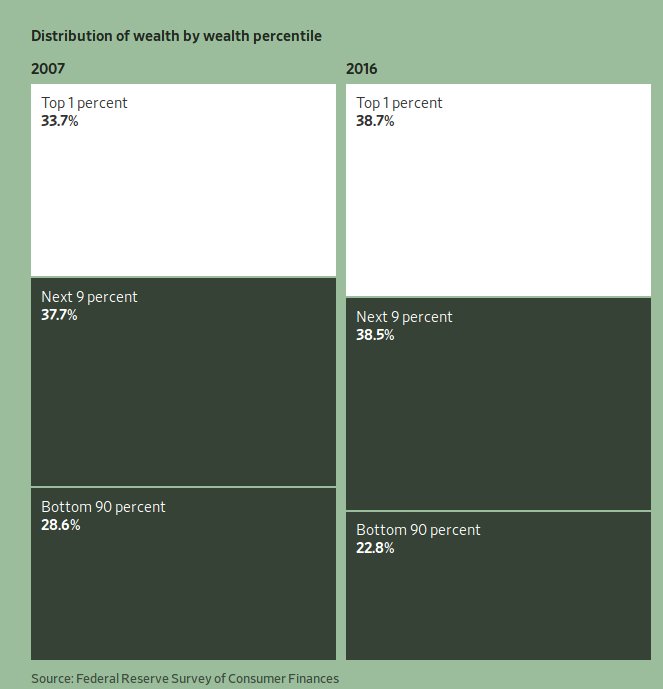
The Wall Street Journal on the decade since the crash: inequality, giant banks, regulatory failures, looming catastrophe

a post by Cory Doctorow for the Boing Boing blog


It’s been ten years since the financial crisis, when barely regulated banks destroyed the world’s economy, kicked off wars, and directly and indirectly killed millions.

The Wall Street Journal is a curious beast; its news stories tend to be firmly reality-grounded (because investors don’t get a return on ideology, and reality has a well-know left-wing bias), while its editorial page has grown steadily more troglodyte since Rupert Murdoch bought the paper.

The WSJ’s retrospective of the decade since the crash is much more in the reality-based news than the ideology-driven editorial section, despite a lot of editorializing.

Continue reading


Tuesday, 12 September 2017

Turning up to be sent home without pay: life in insecure work

by Alex Collinson in Working Life (Touchstone blog from the TUC)

Imagine turning up to work only to be sent home without pay. It would be frustrating, wouldn’t it?

It would be more frustrating still if you had already paid for childcare that day; or if you’d cancelled other plans so you could work; or if not receiving that day’s pay would make it difficult to make ends meet that week.

For millions of people working in insecure jobs, this is what they face every day.

In a recent survey, the TUC heard from hundreds of people about their experiences of insecure work. Over the next four days, we’ll look at four themes that emerged in the responses:
Terrifies me! I have been so lucky all my life. Unemployment benefit in the 60s when you could live on what you got, a civil service job for the next 22 years, then ran my own company and even when that went bottom up in the grand recession I had a pension to fall back on.


Wednesday, 30 November 2016

Payday lending in the UK: the regul(aris)ation of a necessary evil?

an article by Karen Rowlingson (University of Birmingham, UK), Lindsey Appleyard (Coventry University, UK) and Jodi Gardner (Corpus Christi College, Oxford, UK) published in Journal of Social Policy Volume 45, Issue 3 (July 2016)

Abstract

Concern about the increasing use of payday lending led the UK's Financial Conduct Authority to introduce landmark reforms in 2014/15. While these reforms have generally been welcomed as a way of curbing ‘extortionate’ and ‘predatory’ lending, this paper presents a more nuanced picture based on a theoretically-informed analysis of the growth and nature of payday lending combined with original and rigorous qualitative interviews with customers.

We argue that payday lending has grown as a result of three major and inter-related trends: growing income insecurity for people both in and out of work; cuts in state welfare provision; and increasing financialisation.

Recent reforms of payday lending do nothing to tackle these root causes.

Our research also makes a major contribution to debates about the ‘everyday life’ of financialisation by focusing on the ‘lived experience’ of borrowers. We show that, contrary to the rather simplistic picture presented by the media and many campaigners, various aspects of payday lending are actually welcomed by customers, given the situations they are in.

Tighter regulation may therefore have negative consequences for some. More generally, we argue that the regul(aris)ation of payday lending reinforces the shift in the role of the state from provider/redistributor to regulator/enabler.

Full text (HTML)


Tuesday, 13 August 2013

Six steps to tackle household debt: findings from The Netherlands

Schemes to address rising levels of household debt in the Netherlands are proving successful. What can the UK learn from their interventions, asks Clare Cummings in NewStart: the magazine for making better places

Just as in the UK and other European countries, household debt in the Netherlands has become a significant concern in recent years. It is estimated that 5% of households are in a situation of serious problematic debt and a further 10% are at risk of entering such a situation.

While the economic crisis is partly to blame, the financial behaviour of individuals is also at fault. In the Netherlands, the debt problem is increasingly being considered as a question of behaviour and a wide range of organisations are working to tackle individuals’ ‘unhealthy’ management of personal finances.

Continue reading

The original report from which this article is taken appears to have been only published in Dutch. I have however found some information about one of the authors, Nadja Jungmann, and the Centre for Social Innovation where she works.


Tuesday, 18 June 2013

Payday loan stories from our clients

an item from the Citizens Advice blog by Claire Bradnam, Case Study Officer

It would be impossible to miss the media coverage our report on payday lenders [I failed to find the report, sorry] generated in the last few weeks. High interest loans are hitting people hard.

There was a fantastic response to the survey which formed the backbone to our report, bringing together evidence from across the whole country.

Yet when facing headline figures individual stories can often be lost. The power of our clients’ stories is what make Citizens Advice stand out as a credible and powerful spokesperson.

Continue reading


Monday, 30 July 2012

Structure of government debt in Europe in 2011

Eurostat Statistics in Focus Issue number 34/2012

Upward trend in the EU government debt level continued in 2011

In order to analyse the debt structure in Europe, Eurostat conducts an annual survey to collect data from Member States information on debt by holder, instrument, maturity, currency of issuance, as well as guarantees granted by the government to non-government units. This publication examines the main results of the latest questionnaire, fully or partly completed by 25 countries.

Full text (PDF 8pp)


Wednesday, 27 June 2012

Poverty: the role of institutions, behaviours and culture

a report by Susan Harkness, Paul Gregg and Lindsey MacMillan published by JRF (Joseph Rowntree Foundation) June 2012

How much do individuals, institutional structures and culture influence poverty levels?

With unemployment rising, pressure on incomes, and cuts to public services, it is not unreasonable to believe poverty will become a pressing issue over coming years. What role will individuals, institutions and cultures play in any rise in poverty?

This programme paper assesses some of the causes of poverty and examines the role played by:
  • family structure;
  • employment and intergenerational worklessness;
  • geographical concentrations of poverty;
  • educational outcomes;
  • addiction to alcohol and drugs; and
  • debt.
Choosing themes which are prominent in current policy thinking, this study makes a useful contribution to an established social policy debate.

Full report (PDF 53pp)