Showing posts with label Brexit. Show all posts

Wednesday, 11 December 2019

The geography of EU discontent

a column by Lewis Dijkstra, Hugo Poelman and Andrés Rodríguez-Pose for VOX: CEPR’s Policy Portal


Support for Eurosceptic parties and the rise of populism threaten not only European integration, but peace and prosperity on the continent more broadly.

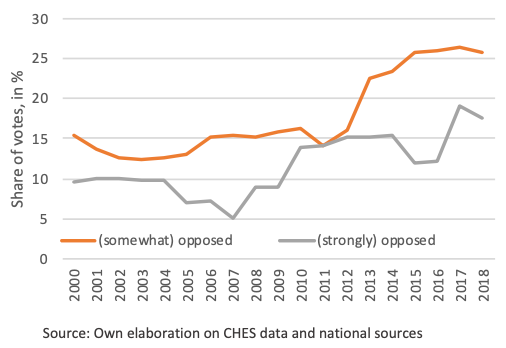
Rather than attributing their rise to the individual characteristics of voters – such as age or income – this column takes a different approach. Using results from recent legislative elections to map the geography of EU discontent, it finds that purely geographical factors – chiefly, long-term economic and industrial decline – are the fundamental drivers of anti-European voting.

Continue reading Please do, There are a couple of maps which will be of interest to most people whatever their personal view of the EU actually is.


Tuesday, 10 December 2019

It’s more complicated than that!: Unpacking ‘Left Behind Britain’ and some other spatial tropes following the UK’s 2016 EU referendum

an article by Alexander Nurse and Olivier Sykes (University of Liverpool, UK) published in Local Economy: The Journal of the Local Economy Policy Unit Volume 34 Issue 6 (September 2019)

Abstract

In the aftermath of the UK’s vote to leave the European Union, a number of dominant narratives and spatial imaginaries of ‘Brexit’ have come to the fore including the notion of a revolt of a ‘Left Behind Britain’, and of a generational splintering manifested in different political attitudes.

Informed by this context, this paper considers some of these issues at the micro-scale, using voting data from two contiguous local authority districts within the same city region. It presents data from wards that have similar socio-economic conditions and which are highly ranked in the Index of Multiple Deprivation but which voted differently in the referendum.

The data reinforce the arguments of those who have claimed that the phenomenon of Brexit is powerfully contextual and that general socio-economic analyses of its causes do not fully explain why some areas and populations voted to leave the EU and others with comparable profiles voted to remain.

With poorer regions predicted to be the biggest economic losers of ‘Brexit’, an understanding of such issues is of material consequence and might inform progressive responses to such populist phenomena.


Tuesday, 19 November 2019

Global Britain vs Little England

an article by Sacha Hilhorst for DEMOS

Since the EU Referendum, Boris Johnson has ramped up the rhetoric about ‘Global Britain’, a country that is “more open, more outward-looking, more engaged with the world than ever before.” In this view, the referendum result is a vote for free trade and international enterprise, free from the constraints of EU trade policy. There seems to be a tension here with the core of the Leave vote, which was widely seen to represent a vote against globalisation, against immigration and for protecting UK markets. A new project by academics at the University of York, in collaboration with Demos, will shine a light on public attitudes on trade after Brexit. The first tranche of findings (available here (PDF 35pp)) suggests that, somewhat paradoxically, Leave voters are in favour of Global Britain and opposed to globalisation.

Continue reading

There is a number of interesting charts.


Monday, 14 October 2019

Multinational enterprises in time and space: The effect of trade policy shocks

a column by Stefania Garetto, Lindsay Oldenski and Natalia Ramondo for VOX: CEPR’s Policy Portal

Multinational enterprises play an important role in coordinating production around the globe.

This column presents a dynamic quantitative model of multinational enterprise expansion that can be used to analyse the effects of policies that affect the cost of the operations of such firms. It uses this model to estaimte the impact of potential implementations of Brexit.

Continue reading


Wednesday, 2 October 2019

The Treasury and Bank of England should prepare for a three-pronged economic shock from ‘no deal’

a post by Jack Leslie for the Resolution Foundation blog

It’s a well-worn trope that no one knows what the economic impact of a no deal Brexit would be. And for good reason. The scale of disruption at the border, in supply chains and in the wider economy, is impossible to predict with any accuracy. Much would depend on the timing and the success of the government’s preparations.

This is why estimates of the hit to the economy have varied so widely. The OECD has forecast the UK’s economy could be 3 per cent smaller by 2022 after a no deal. The Bank of England thinks it could be as much as 6 per cent in a ‘disorderly’ Brexit. That would be catastrophic, though still far smaller than the 12 per cent hit to the economy in the two years following the financial crisis.

Given all this uncertainty, the natural reaction for economic policy makers might be to throw up their hands in defeat and decide to work out how best to support the economy if and when a no deal exit happens. But any delay risks making the impact of no deal worse.

So can the Treasury and the Bank of England prepare, even though no one knows how big the hit will be? Yes, is the unequivocal answer in new Resolution Foundation research.

You can continue reading the blog post or go straight to the PDF of the 35-page briefing

Dealing with no deal
Understanding the policy implications of leaving the EU without a formal agreement
Richard Hughes, Jack Leslie, Cara Pacitti & James Smith (September 2019)


New dawn fades: The post-referendum rise in import costs has hurt UK workers

a column by Rui Costa, Swati Dhingra and Stephen Machin for VOX: CEPR’s Policy Portal

Some commentators argue that globalisation is systematically connected to the real-wage and productivity stagnation seen across the developed world.

This column analyses the relationship between international trade and worker outcomes in the immediate aftermath of the Brexit referendum, when the value of the sterling fell massively against other nations’ currencies. It finds that the rise in import costs from the sterling depreciation hurt wages and training.

This relative decline in real earnings of workers has reinforced pre-existing real-wage stagnation; UK workers have not fared well since the referendum price rise.

Continue reading


Wednesday, 25 September 2019

Global lessons from Euroscepticism

a column by Stephanie Bergbauer, Jean-Francois Jamet, Hanni Schölermann, Livio Stracca and Carina Stubenrauch for VOX: CEPR’s Policy Portal

Recent successes of populist movements in Europe might seem to reflect eroded trust in the EU’s institutions.

This column asks what global lessons can be drawn from recent research on Euroscepticism at the ECB and elsewhere. It argues that taking citizens’ concerns seriously and addressing salient issues, building on a sense of togetherness, and caring about public trust should inspire a course of action at the global level. Insufficient progress along these dimensions has played a key role not only in Brexit, but also in the backlash against the multilateral world order underpinning globalisation.

Continue reading


Thursday, 12 September 2019

The labour market is delivering on jobs and pay – it is vital for living standards that we keep it that way

a post by Nye Cominetti for the Resolution Foundation blog

A tight labour market is finally delivering decent pay growth. In the three months to July 2019, average weekly regular pay (i.e. excluding bonuses) grew by 1.9 per cent on the previous year (slightly down on the previous month). Given that average real pay grew by 2.1 per cent in the eight years prior to the crisis, we can safely say now that we more or less back to ‘normal’ on pay growth. And with employment (and unemployment) little changed in recent months – at record highs and close to record lows respectively – it looks like the labour market has settled into a healthy holding pattern.

But we should not take this for granted – it has taken ten years to get the economy delivering on both jobs and pay. And there remains an underlying fragility. We only have to look back to 2015 to see that a recovery can turn sour quickly. Then it was the Brexit vote, with the ensuing fall in the value of the pound and the jump in inflation choking off real pay growth. Today, stronger real pay growth is underpinned by stable inflation at normal levels, so we can be more confident that recent growth rates will be sustained. But this assumes, of course, that we do not suffer an economic shock. Our newly healthy labour market would surely not survive the economic disruption that would accompany a no-deal Brexit.

Continue reading


Monday, 9 September 2019

Dollars and sense: The sterling depreciation and UK price competitiveness

an article by Giancarlo Corsetti, Meredith A. Crowley and Lu Han for VOX: CEPR’s Policy Portal

An immediate impact of the Brexit referendum in 2016 was the large, rapid depreciation of the sterling against all other currencies.The weak pound did not boost UK export volumes, but less clear is whether UK firms lowered their ex column by port prices in line with the weaker pound.

This column shows that the UK export price response to depreciation depends on the currency in which UK firms invoice their cross-border transactions. Firms invoicing in sterling gained competitiveness by passing the sterling’s weakness through to prices, unlike firms invoicing in vehicle or destination currencies,which adjusted their mark-ups.

Continue reading


Tuesday, 25 June 2019

It’s the EU immigrants stupid! UKIP’s core-issue and populist rhetoric on the road to Brexit

an article by Ceri Hughes (University of Wisconsin–Madison, USA) published in European Journal of Communication Volume 34 Issue 3 (June 2019)

Abstract

The 2016 vote to leave the European Union was one of the biggest developments in recent United Kingdom political history. Only one political party was wholly united for Brexit – the United Kingdom Independence Party.

This research finds that in the years leading up to Brexit, the United Kingdom Independence Party presented itself as a rigid core-issue complete-populist party. Content analysis shows how pervasive the European Union was in much of the party output and in the contemporaneous newspaper coverage of the party.

The party also utilizes complete-populist rhetoric, with ‘othering’ populism as the most prevalent form. The consistent concentration on the European Union collocated with populist messaging, in both news releases and select newspaper coverage, may have helped afford the United Kingdom Independence Party issue-eliteness in the referendum campaign.

But this same work may have also ultimately contributed to make them irrelevant by 2017, and possibly moribund by 2018.

Hazel’s comment:
So irrelevant that Farage set up yet another minot political party!


Friday, 21 June 2019

Between the crises: Migration politics and the three periods of neoliberalism

an article by Gareth Mulvey and Neil Davidson (University of Glasgow, UK) pubvlished in Capital & Class Volume 43 Issue 2 (June 2019)

Abstract

Between the two UK referendums on European Community/European Union membership, the issue of migration came to dominate the entire debate.

The period between 1975 and 2016 corresponds almost exactly to the neoliberal era in capitalism, in its British manifestation, and this is not coincidental.

This article traces the shifting periods of neoliberalism (‘vanguard’, ‘social’ and ‘crisis’) across these 40 years, focusing in each case on how the policies associated with them specifically impacted migration into the United Kingdom. In particular, it will argue that the current migration crisis is at least partly an aspect of the wider crisis of neoliberalism as a form of capitalist organisation.

It concludes that current levels of anti-migrant sentiment are a displaced expression of hostility to the social effects of neoliberalism, and which may nevertheless cause difficulties for British capital through the imposition of anti-free movement policies to which it is opposed.


Tuesday, 30 April 2019

Interregional inequalities and UK sub-national governance responses to Brexit

Chloe Billing City-REDI Institute, University of Birmingham, Birmingham, UK. C.A.Billing@bham.ac.uk
View further author information
, Philip McCann & Raquel Ortega-Argilés ORCID Icon

Philip McCann University of Sheffield Management School, Sheffield, UK. p.mccann@sheffield.ac.uk
View further author information
& Raquel Ortega-Argilés ORCID Icon

Raquel Ortega-Argilés City-REDI Institute, University of Birmingham, Birmingham, UK.
Correspondence
r.ortegaargiles@bham.ac.uk
ORCID Iconhttp://orcid.org/0000-0002-7783-2230
View further author information
ORCID Icon

a C.A.Billing@bham.ac.uk
City-REDI Institute, University of Birmingham, Birmingham, UK.
b p.mccann@sheffield.ac.uk
University of Sheffield Management School, Sheffield, UK. c
(Corresponding author) r.ortegaargiles@bham.ac.uk
City-REDI Institute, University of Birmingham, Birmingham, UK.


Regional Studies
Volume 53, 2019 - Issue 5: Regional aspects in small firm financing

This paper discusses the various potential impacts of Brexit on UK regions and outlines the sub-national governance challenges these potential impacts raise. In the light of these, the types of activities that UK sub-national governance bodies have initiated in preparation for Brexit are then reviewed. The conclusions suggest that the UK sub-national institutional system is largely unprepared for the post-Brexit realities.

JEL Classification: R12, R58, R59

Full text (PDF 21pp)

Thursday, 25 April 2019

Populism: Roots, consequences, and counter strategy

a column by Karl Aiginger for VOX: CEPR’s Policy Portal

Populism represents a challenge to liberal democracy, pluralism, human rights, and the exchange of ideas.

This column examines the features and drivers of populism, as well as the potential strategic response by the EU and its member states. This includes a vision for Europe to become the role model for high-income societies providing well-being, lower unemployment, and less inequality, and a leader in decarbonisation and public sector management.

Continue reading


Wednesday, 17 April 2019

What makes the EU, the UN, and their peers legitimate?

a post by Klaus Digerwerth and Antonia Witt for the OUP blog


United Nations Office at Geneva by Falcon® Photography. CC BY-SA 2.0 via Flickr

The first “Brexit” is almost a century old, and it did not even involve Britain. It occurred on 14 June 1926, when Brazil notified the League of Nations it would leave the world organization. Paraguay, Guatemala, Honduras, Nicaragua, El Salvador, Chile, Venezuela, and Peru, together with Germany, Italy, Spain, and Japan, followed in the 1930s. These mass withdrawals from the League were widely interpreted as a sign that the organization was in crisis.

Brexit is not a singular phenomenon. In legal terms, it constitutes a withdrawal of a member state from an intergovernmental organization, though with a profound effect on the organization being left. Since World War II, such withdrawals may have been less spectacular but they have occurred frequently. When the US left the International Labour Organization in 1977, for example, the consequences for the organization were severe. In 1984/85 when the US, the UK and Singapore withdrew from the United Nations Educational, Scientific and Cultural Organisation, the institution noted plainly that its “budget [dropped] considerably.” And when Morocco left the Organisation of African Unity in 1984, the pan-African organization no longer represented Africa as a whole.

Continue reading


Monday, 15 April 2019

Westminster versus Whitehall: Two Incompatible Views of the Constitution

a post by David Howarth for the UK Constitutional Law Association blog

Lawyers like to make as much sense as possible of the material in front of them, transforming it, if they can, from a jumble of decisions and remarks into a coherent whole. For constitutional lawyers that habit of mind is both a blessing and a curse. It is a blessing because it causes lawyers to look for subtleties others miss (albeit sometimes subtleties they themselves create). It is a curse because when the material is generated by underlying mechanisms and ideas that fundamentally conflict, it leaves lawyers at a loss, or, worse, going round in circles.

The recent controversy played out in this blog, in the pages of The Times, and elsewhere about whether a UK government could procure from the monarch a veto of any bill passed by both houses of parliament without government support is an example of the curse. As A.H. Birch pointed out more than 50 years ago (A. H. Birch, Representative and Responsible Government: an Essay on the British Constitution London: Allen and Unwin, 1964), the British system of government encompasses two very different, often conflicting views of how it works. One view, perhaps more familiar to lawyers, is the constitution as it looks from Westminster. According to this Westminster view, Parliament, and especially the House of Commons, sits at the centre of the system. The Commons is, with the aid of the Parliament Acts 1911-49, legislatively supreme, and it makes and breaks governments by granting or withholding its confidence. Ministers, though not technically its delegates, are at its beck and call. It is the ‘cockpit of the nation’, the centre of political attention. As a result, although the House of Commons should not seek to administer the country, it is the ultimate source of authority for those who do. The other view, the Whitehall view, posits that the Crown, now largely in the form of its ministers, is the centre of the system. Effective government requires ministers to be able to act quickly and authoritatively. On this view, parliament is peripheral. It can assist effective government by passing legislation when ministers ask, but otherwise it is a side-show.

Continue reading


Friday, 15 February 2019

Brexit and foreign investment in the UK

Nigel Driffield (Warwick University, Coventry, UK) and Michail Karoglou (Aston University, Birmingham, UK) published in Journal of the Royal Statistical Society Statistics in Society Series A Volume 182 Issue 2 (February 2019)

Abstract

We explore the likely effect of Brexit on inward foreign direct investment (FDI) through its possible effect on the benchmark variables that characterize the macroeconomy. For this we propose the use of a Markov regime switching structural vector auto‐regression to distinguish between the volatile and stable states of the economy and account, among other effects, for the contemporaneous effects that the frequency of FDI innately generates.

Our findings suggest that, if Brexit triggers a sterling depreciation in the current economic climate, this will fuel a prolonged negative effect on FDI. FDI flows may be positively affected (at most) by a sterling depreciation after Brexit only if this event drives the UK economy to a period of highly volatile growth, inflation, interest and exchange rates: a scenario that is rather unlikely.

And, even then, the sterling depreciation benefits would last for only a short period of time.

Full text (PDF 24pp)


Friday, 25 January 2019

The impact of Brexit uncertainty on UK exports

a column by Meredith Crowley, Oliver Exton and Lu Han for VOX: CEPR’s Policy Portal

Uncertainty over the future of the world trading system is at its highest since the introduction of GATT in 1947. The US-China trade war and suggestions that President Trump intends to withdraw the US from the WTO have significantly raised uncertainty in the global economy.

Meanwhile, uncertainty over the future of the UK-EU trading relationship spiked on 15 January when the UK parliament overwhelmingly rejected the negotiated terms of the UK’s withdrawal from the EU.

This column documents that an earlier period of heightened trade policy uncertainty for the UK – the period following the Brexit referendum in June 2016 – depressed the UK’s international trading activity, with some UK businesses choosing to not enter the EU market while others chose to exit.


Tuesday, 22 January 2019

Brexit: Blame it on the banking crisis

a column by Nicholas Crafts for VOX: CEPR’s Policy Portal

Brexit in 2019 and the banking crisis in 2007 to 2009 are usually seen as unrelated events.

This column argues that they are in fact closely connected.

The austerity policies embarked on in response to the fiscal damage resulting from the banking crisis triggered the protest votes of left-behind voters, which at the margin allowed Leave to win the referendum vote. The implication is that the economic costs of the banking crisis are much larger than is usually supposed.

Continue reading


Monday, 7 January 2019

The gains from economic integration: The EU has still a long way to go

a column by David Comerford and Sevi Rodriguez Mora for VOX: CEPR’s Policy Portal

Populists in Europe are contesting the perceived benefits of economic integration between countries.

This column uses data on trade frictions to estimate the long-run impact of trade frictions on GDP if countries in Europe were to be more or less integrated. Negative between-country impacts, such as from Brexit or an EU collapse, imply a GDP reduction of between 1-3%. The potential trade benefits of a 'United States of Europe', on the other hand, may be an order of magnitude greater for its members.

Continue reading


Monday, 26 November 2018

Uncertainty and legal institutions: The impact of the Brexit vote on EU law application in the UK

a column by Arthur Dyevre, Monika Glavina, Nicolas Lampach, Michal Ovádek and Wessel Wijtvliet for VOX: CEPR’s Policy Portal

Twenty-eight months after the Brexit referendum, EU laws, regulations, and doctrines continue to apply to UK residents and state officials.

This column shows that UK judges and litigants have already started to move away from EU law in anticipation of Brexit, with judges submitting 22–23% fewer questions to the European Court of Justice since the referendum. The broader lesson for the future of supranational legal systems is that effective disintegration may precede formal withdrawal, or may occur even if formal withdrawal is delayed or does not come about.

Continue reading