an article by Joseph H. Michalski (King’s University College at Western University, Canada) published in The British Journal of Sociology Volume 70 Issue 5 (December 2019)
Abstract
The current paper examines terrorism as a special form of moralistic violence, with several key features that distinguish such behaviour from other types of violence.
The theory of lethal moralism highlights the importance of social polarisation, characterised by vast differences in social space and inequality between adversaries as crucial to explaining deadly terrorist attacks.
Where the differences are more permanent or chronic – and the groups in question define and justify their existence specifically in contradistinction to ‘other’ groups – then the polarisation intensifies and attacks tend to be more lethal. In contrast, groups that appeal to broader audiences or the general public as potential allies more often use non‐lethal terrorism to their strategic advantage.
The study examines the United States and the United Kingdom to classify each of more than 8,000 attacks between 1970 and 2017 in terms of their ideological orientations. The evidence highlights the arc of terrorism in relation to different types of groups, as well as confirms the more lethal nature of terrorism linked especially to radical Islam, right‐wing religious extremists, hate groups, ethno‐nationalist sectarian violence, and anti‐government anarchists.
Yet apart from the extensive use of terrorism associated with ‘The Troubles’ in Northern Ireland, the majority of terrorist attacks in the US and the UK have not produced deaths.
Most terrorism instead has been perpetrated by groups aiming to rally support for a general cause and has been far less deadly on balance. The implications of these findings are discussed with a view toward developing more powerful explanatory models that focus on the socio‐cultural contexts and justification frameworks that inspire extremism and the use of lethal moralism to settle disputes.
Showing posts with label UK. Show all posts
Showing posts with label UK. Show all posts
Thursday, 19 December 2019


Friday, 13 December 2019
Using history to understand hidden wealth in the UK
a column by Neil Cummins for VOX: CEPR’s Policy Portal
Sharp declines in the concentration of declared wealth occurred across Europe and the US during the 20th century. But the rich may have been hiding much of their wealth.
This column introduces a new method to measure this hidden wealth, in any form. It finds that between 1920 and 1992, English elites concealed 20-32% of their wealth. Accounting for hidden wealth eliminates one-third of the observed decline of top 10% wealth share over the past century.
Continue reading
The column contains some really useful charts/graphs but I have not reproduced any of them in this very short introduction as I think you will need to read the surrounding text for them to make a lot of sense!
Hazel
Sharp declines in the concentration of declared wealth occurred across Europe and the US during the 20th century. But the rich may have been hiding much of their wealth.
This column introduces a new method to measure this hidden wealth, in any form. It finds that between 1920 and 1992, English elites concealed 20-32% of their wealth. Accounting for hidden wealth eliminates one-third of the observed decline of top 10% wealth share over the past century.
Continue reading
The column contains some really useful charts/graphs but I have not reproduced any of them in this very short introduction as I think you will need to read the surrounding text for them to make a lot of sense!
Hazel
Tuesday, 10 December 2019
Do the regulatory standards require religious literacy of U.K. health and social care professionals?
an article by Beth R. Crisp (Deakin University, Geelong, Victoria, Australia; Goldsmiths, University of London, UK) and Adam Dinham (Goldsmiths, University of London, UK) published in Social Policy and Administration Volume 53 Issue 7 (December 2019)
Abstract
Health and social care professionals need sufficient religious literacy in order to handle the complexities of religious beliefs and practices, including the growing numbers who identify with other belief systems and those who claim to identify with no religion.
The extent to which the need for religious literacy has been formalised was examined in an analysis of regulatory frameworks for health and social care professionals in the United Kingdom. Although all but one of the regulators make some reference to religion and beliefs, they are silent on the question as to what is meant by religion and beliefs.
Some standards include a requirement not to impose one's own beliefs on others, but there is very little requirement to develop a reflective and self‐critical awareness of one's own stance.
Likewise, some standards refer to knowledge and skills required, but greater specificity is required for these to be meaningful.
Abstract
Health and social care professionals need sufficient religious literacy in order to handle the complexities of religious beliefs and practices, including the growing numbers who identify with other belief systems and those who claim to identify with no religion.
The extent to which the need for religious literacy has been formalised was examined in an analysis of regulatory frameworks for health and social care professionals in the United Kingdom. Although all but one of the regulators make some reference to religion and beliefs, they are silent on the question as to what is meant by religion and beliefs.
Some standards include a requirement not to impose one's own beliefs on others, but there is very little requirement to develop a reflective and self‐critical awareness of one's own stance.
Likewise, some standards refer to knowledge and skills required, but greater specificity is required for these to be meaningful.
Wednesday, 4 December 2019
Industrial strategy and the UK regions: sectorally narrow and spatially blind
an article by Steve Fothergill, Tony Gore and Peter Wells (Sheffield Hallam University, UK) published in Cambridge Journal of Regions, Economy and Society Volume 12 Issue 3 (November 2019)
Abstract
The UK government’s new Industrial Strategy could have a significant impact on the country’s regions and localities.
However, this has received little attention to date.
The analysis presented here examines the existing location of the sectors targeted by the first phase of the Industrial Strategy Challenge Fund and the location of the RandD laboratories likely to be first in line for funding.
In focusing on an extremely narrow range of sectors, the Fund is likely to have limited impact on the UK’s persistent regional inequalities. The activities eligible for support account for relatively little of manufacturing or the rest of the economy and the basis of this targeting and its potential distributional consequences are spatially blind.
As such, it runs the risk of widening regional divides in prosperity.
JEL Classification: L52, O25, R11
Full text (PDF 22pp)
Abstract
The UK government’s new Industrial Strategy could have a significant impact on the country’s regions and localities.
However, this has received little attention to date.
The analysis presented here examines the existing location of the sectors targeted by the first phase of the Industrial Strategy Challenge Fund and the location of the RandD laboratories likely to be first in line for funding.
In focusing on an extremely narrow range of sectors, the Fund is likely to have limited impact on the UK’s persistent regional inequalities. The activities eligible for support account for relatively little of manufacturing or the rest of the economy and the basis of this targeting and its potential distributional consequences are spatially blind.
As such, it runs the risk of widening regional divides in prosperity.
JEL Classification: L52, O25, R11
Full text (PDF 22pp)
Friday, 15 November 2019
The economics of neutrality in World War II
a column by Eric Golson for VOX: CEPR’s Policy Portal
Neutrality has long been viewed as impartiality in war.
This column, part of the Vox debate on World War II, asserts that neutral states in the war were realist in approaching their defence to ensure their survival. Neutrals such as Portugal, Spain, Sweden, and Switzerland maintained independence by offering economic concessions to the belligerents to make up for their relative military weakness.
Economic concessions took the form of merchandise trade, services, labour, and capital flows. Depending on their position and the changing fortunes of war, neutral countries could also extract concessions from the belligerents, if their situation permitted.
Continue reading
Neutrality has long been viewed as impartiality in war.
This column, part of the Vox debate on World War II, asserts that neutral states in the war were realist in approaching their defence to ensure their survival. Neutrals such as Portugal, Spain, Sweden, and Switzerland maintained independence by offering economic concessions to the belligerents to make up for their relative military weakness.
Economic concessions took the form of merchandise trade, services, labour, and capital flows. Depending on their position and the changing fortunes of war, neutral countries could also extract concessions from the belligerents, if their situation permitted.
Continue reading
Friday, 8 November 2019
Risks of illegal migration and associated damage to transport companies. The case of the corridor France-UK
an article by Aidas Vasilis Vasiliauskas (General Jonas Žemaitis Military Academy of Lithuania, Vilnius, Lithuania), Virgilija Vasilienė-Vasiliauskienė and Margarita Marija Lietuvnikė (Vilnius Gediminas Technical University, Vilnius, Lithuania) and Ieva Meidutė-Kavaliauskienė (General Jonas Žemaitis Military Academy of Lithuania, Viln published iius, Lithuania and University Institute of Lisbon, Portugal) published in International Journal of Learning and Change Volume 11 Number 3 (2019)
Abstract
There were over one million unauthorised immigrants, refugees entering Europe in 2015.
A long-time frame for assessing asylum applications or frequent rejections, encourage refugees to migrate illegally by intruding land vehicles to cross the border of their chosen European country without being noticed.
The intrusion of illegal immigrants into road freight vehicles to cross borders without being noticed has caused a great deal of damage to the international freight transportation companies.
This article presents results of the study aimed at assessing problems caused by illegal immigrants to European road freight transport companies operating in the corridor France-UK.
I am not sure whether I will be able to find this article in the British Library but it is certainly one I would like to read in full.
Abstract
There were over one million unauthorised immigrants, refugees entering Europe in 2015.
A long-time frame for assessing asylum applications or frequent rejections, encourage refugees to migrate illegally by intruding land vehicles to cross the border of their chosen European country without being noticed.
The intrusion of illegal immigrants into road freight vehicles to cross borders without being noticed has caused a great deal of damage to the international freight transportation companies.
This article presents results of the study aimed at assessing problems caused by illegal immigrants to European road freight transport companies operating in the corridor France-UK.
I am not sure whether I will be able to find this article in the British Library but it is certainly one I would like to read in full.
Tuesday, 15 October 2019
Divorcing couples: beware the capital gains tax trap
an article by Kate Francis for the OUT-LAW blog from Pinsent Masons
A change to the capital gains tax (CGT) rules from April 2020 means divorcing or separating couples in the UK will have a shorter period of time in which to sell their interest in the family home without being hit by tax penalties.
From 6 April 2020, the spouse who moves out of the family home will only have a nine-month window in which to sell their interest before CGT applies to the proceeds of the sale, instead of the 18 months that currently applies. CGT will be charged at 28% on the departing party's share in the matrimonial home, assuming the departing party is a higher rate taxpayer.
CGT private residence relief means that anyone selling their main home does not need to pay CGT on the proceeds. The change, which was announced in the 2018 Budget, is to the final period exemption, which covers the final months of ownership of a residential property, regardless of whether the taxpayer is still living there. The final period exemption will be cut from 18 months to nine months in all circumstances, other than the extended 36 month final period exemption available to those with disabilities or those who have moved to a care home.
Continue reading
A change to the capital gains tax (CGT) rules from April 2020 means divorcing or separating couples in the UK will have a shorter period of time in which to sell their interest in the family home without being hit by tax penalties.
From 6 April 2020, the spouse who moves out of the family home will only have a nine-month window in which to sell their interest before CGT applies to the proceeds of the sale, instead of the 18 months that currently applies. CGT will be charged at 28% on the departing party's share in the matrimonial home, assuming the departing party is a higher rate taxpayer.
CGT private residence relief means that anyone selling their main home does not need to pay CGT on the proceeds. The change, which was announced in the 2018 Budget, is to the final period exemption, which covers the final months of ownership of a residential property, regardless of whether the taxpayer is still living there. The final period exemption will be cut from 18 months to nine months in all circumstances, other than the extended 36 month final period exemption available to those with disabilities or those who have moved to a care home.
Continue reading
Tuesday, 8 October 2019
Visualization of the United Kingdom's budget
a post by Rob Beschizza for the Boing Boing blog
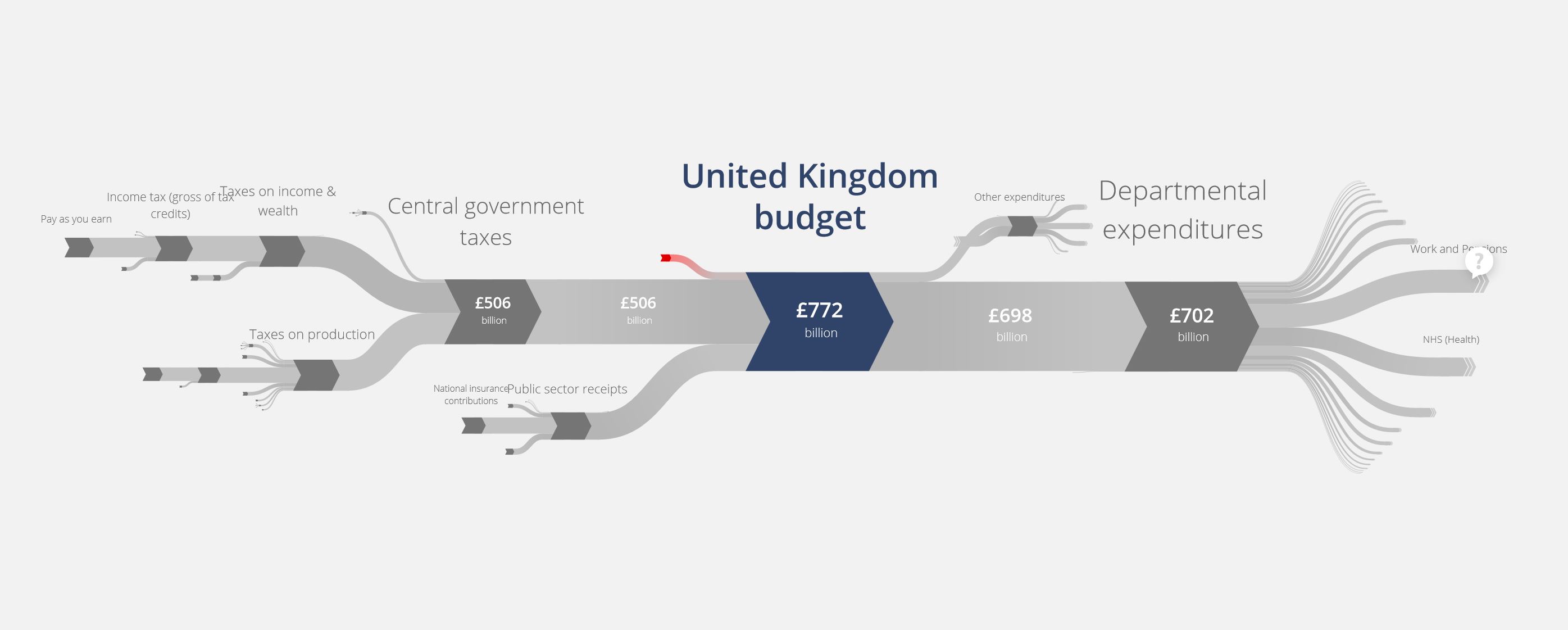
This one's good not only because it's simple yet interactive, but because it shows the receipts and the spending. There are various others on the site for different tendrils of the British state; hopefully the same visualization can be used to show other governments at work too. United Kingdom Budget 2016 [uk.wikibudgets]
This one's good not only because it's simple yet interactive, but because it shows the receipts and the spending. There are various others on the site for different tendrils of the British state; hopefully the same visualization can be used to show other governments at work too. United Kingdom Budget 2016 [uk.wikibudgets]
Wednesday, 2 October 2019
New dawn fades: The post-referendum rise in import costs has hurt UK workers
a column by Rui Costa, Swati Dhingra and Stephen Machin for VOX: CEPR’s Policy Portal
Some commentators argue that globalisation is systematically connected to the real-wage and productivity stagnation seen across the developed world.
This column analyses the relationship between international trade and worker outcomes in the immediate aftermath of the Brexit referendum, when the value of the sterling fell massively against other nations’ currencies. It finds that the rise in import costs from the sterling depreciation hurt wages and training.
This relative decline in real earnings of workers has reinforced pre-existing real-wage stagnation; UK workers have not fared well since the referendum price rise.
Continue reading
Some commentators argue that globalisation is systematically connected to the real-wage and productivity stagnation seen across the developed world.
This column analyses the relationship between international trade and worker outcomes in the immediate aftermath of the Brexit referendum, when the value of the sterling fell massively against other nations’ currencies. It finds that the rise in import costs from the sterling depreciation hurt wages and training.
This relative decline in real earnings of workers has reinforced pre-existing real-wage stagnation; UK workers have not fared well since the referendum price rise.
Continue reading
Tuesday, 17 September 2019
Why does the United Kingdom (UK) have inconsistent preferences on financial regulation? The case of banking and capital markets
an article by Scott James (King’s College London, UK) and Lucia Quaglia (University of Bologna, Italy) published in Journal of Public Policy Volume 39 Issue 1 (March 2019)
Abstract
What explains national preferences concerning international and regional financial regulation?
This article focuses on one of the main financial jurisdictions worldwide, the United Kingdom (UK).
It is puzzling that since the crisis this jurisdiction has pursued stringent harmonised regulation in certain areas (banking), but not others (capital markets). We explain this in terms of how the demands of powerful economic interests are mediated by the political process and regulatory institutions.
In banking, there was strong political pressure to restore financial stability, and regulatory institutions were significantly strengthened. This enabled UK regulators to resist industry lobbying and pursue more stringent harmonised rules at the international and European Union levels (“trading up”).
In the case of capital markets, by contrast, UK regulators lacked political support for tougher regulation and were institutionally much weaker. As a result, the industry was far more effective in shaping UK preferences aimed at protecting the sector’s competitiveness (“trading down”).
Abstract
What explains national preferences concerning international and regional financial regulation?
This article focuses on one of the main financial jurisdictions worldwide, the United Kingdom (UK).
It is puzzling that since the crisis this jurisdiction has pursued stringent harmonised regulation in certain areas (banking), but not others (capital markets). We explain this in terms of how the demands of powerful economic interests are mediated by the political process and regulatory institutions.
In banking, there was strong political pressure to restore financial stability, and regulatory institutions were significantly strengthened. This enabled UK regulators to resist industry lobbying and pursue more stringent harmonised rules at the international and European Union levels (“trading up”).
In the case of capital markets, by contrast, UK regulators lacked political support for tougher regulation and were institutionally much weaker. As a result, the industry was far more effective in shaping UK preferences aimed at protecting the sector’s competitiveness (“trading down”).
Monday, 12 August 2019
Internalised Ageism and Self-Exclusion: Does Feeling Old and Health Pessimism Make Individuals Want to Retire Early?
an article by Mariska van der Horst (Vrije Universiteit Amsterdam, The Netherlands) published in Social Inclusion Volume 7 Number 3 (2019)
Abstract
An important current policy goal in many Western countries is for individuals to extend their working lives. Ageism has been identified as a possible threat to achieving this; furthermore, the ways in which ageism may affect this policy goal may have been underestimated.
It has been claimed previously that ageism can be seen as discrimination against one’s future self and that a lifetime of internalising age stereotypes makes older people themselves believe the age stereotypes.
The current article uses the English Longitudinal Study of Ageing to assess the degree to which internalised ageism is related to one’s preferred retirement age.
For internalised ageism, assessments are made about the degree to which individuals consider themselves to be old; they agree that their age prevents them from undertaking activities; they are pessimistic about their own future health and that being old comes with deteriorating health more generally.
Results show that health pessimism especially affects one’s preferred retirement age negatively, even when controlling for current health and other factors, and mainly for middle-educated women. Implications are discussed.
Full text (PDF 17pp) download
Abstract
An important current policy goal in many Western countries is for individuals to extend their working lives. Ageism has been identified as a possible threat to achieving this; furthermore, the ways in which ageism may affect this policy goal may have been underestimated.
It has been claimed previously that ageism can be seen as discrimination against one’s future self and that a lifetime of internalising age stereotypes makes older people themselves believe the age stereotypes.
The current article uses the English Longitudinal Study of Ageing to assess the degree to which internalised ageism is related to one’s preferred retirement age.
For internalised ageism, assessments are made about the degree to which individuals consider themselves to be old; they agree that their age prevents them from undertaking activities; they are pessimistic about their own future health and that being old comes with deteriorating health more generally.
Results show that health pessimism especially affects one’s preferred retirement age negatively, even when controlling for current health and other factors, and mainly for middle-educated women. Implications are discussed.
Full text (PDF 17pp) download
Monday, 29 July 2019
Social protection for the self-employed in the UK: the disappearing contributions increase
an article by Fran Bennett (University of Oxford, UK) published in Journal of Poverty and Social Justice Volume 27 Number 2 (June 2019)
Abstract
A recent government proposal to increase national insurance contributions for the self-employed in the UK, in return for improved pensions and potentially also parental benefits, was immediately reversed.
This article analyses the reasons behind this about-turn, linking them to tensions between the goals of thwarting ‘bogus’ self-employment and increasing tax revenues versus commitment to a higher wage, lower tax, lower welfare economy.
The analysis is set in the context of the singularity of the UK system in relation to much social protection in continental Europe, and wider debates about the roles of individual, state and labour market in providing security.
Abstract
A recent government proposal to increase national insurance contributions for the self-employed in the UK, in return for improved pensions and potentially also parental benefits, was immediately reversed.
This article analyses the reasons behind this about-turn, linking them to tensions between the goals of thwarting ‘bogus’ self-employment and increasing tax revenues versus commitment to a higher wage, lower tax, lower welfare economy.
The analysis is set in the context of the singularity of the UK system in relation to much social protection in continental Europe, and wider debates about the roles of individual, state and labour market in providing security.
Thursday, 11 July 2019
Decent work in the UK: Context, conceptualization, and assessment
an article by Vanessa Dodd (Nottingham Trent University, UK) and Tristram Hooley and Ciaran Burke (University of Derby, UK) published in Journal of Vocational Behavior Volume 112 (June 2019)
Highlights
Access to decent work is an important goal for policymakers and for individuals navigating their working lives. Decent work is a career goal for individuals and a priority for many employers and policy makers seeking to promote social justice. Decent work forms part of the United Nations sustainable development goals and the International Labor Organisation's (ILO) Decent Work Agenda. The findings of the Taylor Review (2017) have helped to prioritize decent work as a policy aim for the current UK government.
Although macro-level indicators have been well developed to monitor access to decent work, there have been few studies which attempt to understand decent work at the individual level. As a result, our studies explore the measurement and definition of decent work in the UK. Study 1 investigates whether the Decent Work Scale (DWS) is a valid measure for use in the UK and Study 2 uses a qualitative approach to further understand what decent work means to working people in the UK. Study results may have implications for the assessment and conceptualization of decent work among this specific population.
Highlights
- The following studies sought to further understand decent work in the UK context.
- Study 1 was a validation of The Decent Work Scale (DWS) within the UK context.
- We found evidence that The DWS is a valid measure for use in the UK.
- In study 2 we found all decent work subscales to be relevant to decent work in the UK except for access to healthcare.
- Additional constructs may be important to understanding decent work in the UK context.
Access to decent work is an important goal for policymakers and for individuals navigating their working lives. Decent work is a career goal for individuals and a priority for many employers and policy makers seeking to promote social justice. Decent work forms part of the United Nations sustainable development goals and the International Labor Organisation's (ILO) Decent Work Agenda. The findings of the Taylor Review (2017) have helped to prioritize decent work as a policy aim for the current UK government.
Although macro-level indicators have been well developed to monitor access to decent work, there have been few studies which attempt to understand decent work at the individual level. As a result, our studies explore the measurement and definition of decent work in the UK. Study 1 investigates whether the Decent Work Scale (DWS) is a valid measure for use in the UK and Study 2 uses a qualitative approach to further understand what decent work means to working people in the UK. Study results may have implications for the assessment and conceptualization of decent work among this specific population.
Monday, 24 June 2019
Positive local externalities of immigration on entrepreneurship: Evidence from the UK East Midlands region
an article by Frederick Wedzerai Nyakudya (Coventry University, UK) published in Local Economy: The Journal of the Local Economy Policy Unit Volume 34 Issue 3 (May 2019)
Abstract
This article examines the effects of immigration on entrepreneurship, making a distinction between the individual level and the neighbourhood characteristics.
The study combined individual level drawn from the Global Entrepreneurship Monitor data with neighbourhood level data for the English Index of Multiple Deprivation East Midlands region in the UK and applied a maximum likelihood logit model to test the hypotheses. The empirical evidence suggests that there is no direct link between the internal immigrants and start-ups on the one side; yet, there is direct link between the external immigrants and start-ups on the other side.
However, the findings point to the importance of indirect effect of neighbourhood characteristics, as external immigrants have a significant effect on an individual’s perception of new entrepreneurial opportunities which predicts start-up activity. Their presence in the neighbourhood has a positive monotonic effect on individual entrepreneurship.
Therefore, the critical factor is not that external immigrants come with unique knowledge and skills they utilise in the creation of their own businesses, instead they produce positive local externalities enabling others to start-up businesses.
Abstract
This article examines the effects of immigration on entrepreneurship, making a distinction between the individual level and the neighbourhood characteristics.
The study combined individual level drawn from the Global Entrepreneurship Monitor data with neighbourhood level data for the English Index of Multiple Deprivation East Midlands region in the UK and applied a maximum likelihood logit model to test the hypotheses. The empirical evidence suggests that there is no direct link between the internal immigrants and start-ups on the one side; yet, there is direct link between the external immigrants and start-ups on the other side.
However, the findings point to the importance of indirect effect of neighbourhood characteristics, as external immigrants have a significant effect on an individual’s perception of new entrepreneurial opportunities which predicts start-up activity. Their presence in the neighbourhood has a positive monotonic effect on individual entrepreneurship.
Therefore, the critical factor is not that external immigrants come with unique knowledge and skills they utilise in the creation of their own businesses, instead they produce positive local externalities enabling others to start-up businesses.
Monday, 17 June 2019
Simply a matter of compliance with the rules? The moralising and responsibilising function of fraud-based citizenship deprivation in France and the UK
an article by Émilien Fargues (Centre de recherches politiques, Sciences Po Paris, France) published in Citizenship Studies Volume 23 Issue 4 (June 2019)
Abstract
Scholarship largely sees fraud-based citizenship stripping as a tool for guaranteeing the consistency of the naturalisation process against applicants who do not respect the rules. This implies that the line between ‘desirable’ and ‘undesirable’ citizens is drawn in accordance with procedural norms.
In contrast, this article argues that deprivation on grounds of fraud aims to create a virtuous and responsible political subject.
Drawing on the cases of France and the UK, the paper shows how government officials and judges understand citizenship deprivation not simply as a means to safeguard the procedural integrity of naturalisation, but as a mechanism for the moralisation and responsibilisation of applicants.
The article further contends that not everyone is made the subject of ‘renationalisation’. British and French deprivation policies reproduce suspicions and stereotypes against specific categories of migrants, constructing them as second-class citizens.
Abstract
Scholarship largely sees fraud-based citizenship stripping as a tool for guaranteeing the consistency of the naturalisation process against applicants who do not respect the rules. This implies that the line between ‘desirable’ and ‘undesirable’ citizens is drawn in accordance with procedural norms.
In contrast, this article argues that deprivation on grounds of fraud aims to create a virtuous and responsible political subject.
Drawing on the cases of France and the UK, the paper shows how government officials and judges understand citizenship deprivation not simply as a means to safeguard the procedural integrity of naturalisation, but as a mechanism for the moralisation and responsibilisation of applicants.
The article further contends that not everyone is made the subject of ‘renationalisation’. British and French deprivation policies reproduce suspicions and stereotypes against specific categories of migrants, constructing them as second-class citizens.
Thursday, 13 June 2019
Why deservingness theory needs qualitative research: Comparing focus group discussions on social welfare in three welfare regimes
an article by Tijs Laenen, Federica Rossetti and Wim van Oorschot (KU Leuven, Belgium) published in International Journal of Comparative Sociology Volume 60 Issue 3 (June 2019)
Abstract
This article argues that the ever-growing research field of welfare deservingness is in need of qualitative research. Using focus group data collected in Denmark, Germany, and the United Kingdom, we show that citizens discussing matters of social welfare make explicit reference not only to the deservingness criteria of control, reciprocity, and need but also to a number of context-related criteria extending beyond the deservingness framework (e.g. equality/universalism).
Furthermore, our findings suggest the existence of an institutional logic to welfare preferences, as the focus group participants to a large extent echoed the normative criteria that are most strongly embedded in the institutional structure of their country’s welfare regime.
Whereas financial need is the guiding criterion in the “liberal” United Kingdom, reciprocity is dominant in “corporatist-conservative” Germany. In “social-democratic” Denmark, it appears impossible to single out one dominant normative criterion. Instead, the Danish participants seem torn between the criteria of need, reciprocity, and equality/universalism.
Abstract
This article argues that the ever-growing research field of welfare deservingness is in need of qualitative research. Using focus group data collected in Denmark, Germany, and the United Kingdom, we show that citizens discussing matters of social welfare make explicit reference not only to the deservingness criteria of control, reciprocity, and need but also to a number of context-related criteria extending beyond the deservingness framework (e.g. equality/universalism).
Furthermore, our findings suggest the existence of an institutional logic to welfare preferences, as the focus group participants to a large extent echoed the normative criteria that are most strongly embedded in the institutional structure of their country’s welfare regime.
Whereas financial need is the guiding criterion in the “liberal” United Kingdom, reciprocity is dominant in “corporatist-conservative” Germany. In “social-democratic” Denmark, it appears impossible to single out one dominant normative criterion. Instead, the Danish participants seem torn between the criteria of need, reciprocity, and equality/universalism.
The benefits of starting school early
a column by Thomas Cornelissen and Christian Dustmann for VOX: CEPR’s Policy Portal
Primary education starts at age 6 or 7 in most OECD countries, but in the UK children start primary school at the age of 4 or 5.
This column exploits local variation in school entry rules in the UK to investigate the effects of schooling at an early age on cognitive and non-cognitive development. It finds that early schooling boosts both cognitive and non-cognitive skills up until the age of 11. These effects tend to be strongest for boys from disadvantaged family backgrounds.
Continue reading
Primary education starts at age 6 or 7 in most OECD countries, but in the UK children start primary school at the age of 4 or 5.
This column exploits local variation in school entry rules in the UK to investigate the effects of schooling at an early age on cognitive and non-cognitive development. It finds that early schooling boosts both cognitive and non-cognitive skills up until the age of 11. These effects tend to be strongest for boys from disadvantaged family backgrounds.
Continue reading
Wednesday, 17 April 2019
A tale of two nationalisations: experiences of post 1945 public ownership in the UK and France compared
an article by Andrew Cumbers (University of Glasgow, Scotland) published in International Journal of Public Policy Volume 15 Number 1/2 (2019)
Abstract
As public ownership comes back into fashion following the failings and growing contradictions of neoliberal processes of marketisation and privatisation, it is important to learn the lessons for public policy from earlier processes of nationalisation.
In this article, I compare the post 1945 experiences of nationalisation in the UK and France.
Both countries underwent sweeping processes of nationalisation in the aftermath of the Second World War amidst a broader international shift towards a more state driven model of economic development under capitalism. However, the two experiences of nationalisation diverged considerably, reflecting underlying differences in past forms of economic development, the different balance of class forces and the integration of each country into the broader global economy.
The article suggests that these experiences remind us of the importance of a variegated perspective on the evolution of capitalism, distinctive political-economic trajectories and situating major policy shifts in time and space.
Abstract
As public ownership comes back into fashion following the failings and growing contradictions of neoliberal processes of marketisation and privatisation, it is important to learn the lessons for public policy from earlier processes of nationalisation.
In this article, I compare the post 1945 experiences of nationalisation in the UK and France.
Both countries underwent sweeping processes of nationalisation in the aftermath of the Second World War amidst a broader international shift towards a more state driven model of economic development under capitalism. However, the two experiences of nationalisation diverged considerably, reflecting underlying differences in past forms of economic development, the different balance of class forces and the integration of each country into the broader global economy.
The article suggests that these experiences remind us of the importance of a variegated perspective on the evolution of capitalism, distinctive political-economic trajectories and situating major policy shifts in time and space.
Friday, 29 March 2019
Just because the map says so, doesn't mean it's true
Thirty years after 1989, from an island perspective
an article by Owen Hatherley published in Eurozine (March 2019)
The workings of western capitalism were almost as unknown in the Eastern Bloc as the everyday realities of ‘real socialism’ were among western Trotskyists. Then, after ’89, eastern Europe disappeared off the political map of the left. Nowhere was this more so than in Britain, writes Owen Hatherley.
I can remember three particular moments of realising there was a distinct thing called ‘Eastern Europe’ which was different from ‘Western Europe’, and both of them date me as being just about old enough to remember the Soviet Union. One is at Christmas 1989, in my grandmother’s flat on the Isle of Wight, an appropriately plush location to watch, on BBC News, the uprising in Romania and the subsequent televised execution of Nicolae and Elena Ceauşescu, and learn several new words, like ‘dictator’ and ‘firing squad’. Also often said was the word ‘Communism’, but my Trotskyist parents referred to themselves as ‘socialists’ rather than communists, so that wasn’t concerning. What was, was looking in the Children’s Atlas that my mother bought for me in the late 1980s and finding the existence of a very, very large country called the ‘Union of Soviet Socialist Republics’. Being that sort of obnoxiously inquisitive child, I asked her ‘but we’re socialists, aren’t we? Isn’t this our country?’ ‘They’re not socialists. It’s very complicated’, she replied and refused to explain further. The next memory comes a few years later and concerns a Lufthansa map that my dad had brought back from work, where that space had suddenly been filled with over a dozen new countries, all with incredibly evocative names. Belarus! Azerbaijan! Kyrgyzstan!
Full text (PDF 6pp)
an article by Owen Hatherley published in Eurozine (March 2019)
The workings of western capitalism were almost as unknown in the Eastern Bloc as the everyday realities of ‘real socialism’ were among western Trotskyists. Then, after ’89, eastern Europe disappeared off the political map of the left. Nowhere was this more so than in Britain, writes Owen Hatherley.
I can remember three particular moments of realising there was a distinct thing called ‘Eastern Europe’ which was different from ‘Western Europe’, and both of them date me as being just about old enough to remember the Soviet Union. One is at Christmas 1989, in my grandmother’s flat on the Isle of Wight, an appropriately plush location to watch, on BBC News, the uprising in Romania and the subsequent televised execution of Nicolae and Elena Ceauşescu, and learn several new words, like ‘dictator’ and ‘firing squad’. Also often said was the word ‘Communism’, but my Trotskyist parents referred to themselves as ‘socialists’ rather than communists, so that wasn’t concerning. What was, was looking in the Children’s Atlas that my mother bought for me in the late 1980s and finding the existence of a very, very large country called the ‘Union of Soviet Socialist Republics’. Being that sort of obnoxiously inquisitive child, I asked her ‘but we’re socialists, aren’t we? Isn’t this our country?’ ‘They’re not socialists. It’s very complicated’, she replied and refused to explain further. The next memory comes a few years later and concerns a Lufthansa map that my dad had brought back from work, where that space had suddenly been filled with over a dozen new countries, all with incredibly evocative names. Belarus! Azerbaijan! Kyrgyzstan!
Full text (PDF 6pp)
Friday, 15 March 2019
Work conditions and financial difficulties in post-crisis Europe: Utility versus quality of working life
an article by Helena Lopes and Sérgio Lagoa (University Institute of Lisbon, Portugal) and Ana C Santos (University of Coimbra, Portugal) published in The Economic and Labour Relations Review Volume 30 Issue 1 (March 2019)
Abstract
This article critically examines the relation between work and utility and challenges the mainstream economic view of well-being as a hedonic state for which work is a less pleasurable trade-off.
It proposes a conception of work as a potential source of eudaimonic well-being, providing meaning and contributing to human flourishing and self-realisation.
Based on micro-level data, the article shows the relevance of distinguishing between hedonic and eudaimonic well-being by way of comparing the effects of increased financial difficulties and deteriorated work conditions on these two types of well-being in five European Union countries – Germany, Poland, Portugal, Sweden and the UK – in the post global financial crisis years between 2009 and 2014.
The article concludes by underlining the political importance of addressing aspects pertaining to the quality of working life and of creating jobs that serve to improve the eudaimonic well-being of citizens.
JEL Classification: I31, J28, J81
Abstract
This article critically examines the relation between work and utility and challenges the mainstream economic view of well-being as a hedonic state for which work is a less pleasurable trade-off.
It proposes a conception of work as a potential source of eudaimonic well-being, providing meaning and contributing to human flourishing and self-realisation.
Based on micro-level data, the article shows the relevance of distinguishing between hedonic and eudaimonic well-being by way of comparing the effects of increased financial difficulties and deteriorated work conditions on these two types of well-being in five European Union countries – Germany, Poland, Portugal, Sweden and the UK – in the post global financial crisis years between 2009 and 2014.
The article concludes by underlining the political importance of addressing aspects pertaining to the quality of working life and of creating jobs that serve to improve the eudaimonic well-being of citizens.
JEL Classification: I31, J28, J81
Subscribe to:
Posts (Atom)

