a column by Yong Suk Lee, Benjamin Cedric Larsen, Michael Webb and Mariano-Florentino Cuéllar for VOX: CEPR’s Policy Portal
As artificial intelligence becomes more widespread and its performance improves, it will likely have significant long-term consequences for jobs, inequality, organisations, and competition. Regulation may be used to address its risks and possibilities, but little is known about how AI-related regulation might affect firm behaviour.
This column examines the impact of actual and potential AI regulations on business managers through a randomised online survey experiment. It finds that exposure to information about regulation decreases managers’ reported intent to adopt AI technologies in their firm’s business processes.
Continue reading
There are four very useful figures which provide visual information (my favourite way of absorbing facts) but without the text they do not make a great deal of sense!
Showing posts with label firms. Show all posts
Showing posts with label firms. Show all posts
Friday, 20 December 2019


Monday, 28 October 2019
Middle management, geographic frictions, and firm establishments
a column by Anna Gumpert, Henrike Steimer and Manfred Antoni for VOX: CEPR’s Policy Portal
Distance and other geographic frictions between firms’ headquarters and their establishments have a negative effect on performance.
Figure 2 Intuition of the model mechanism
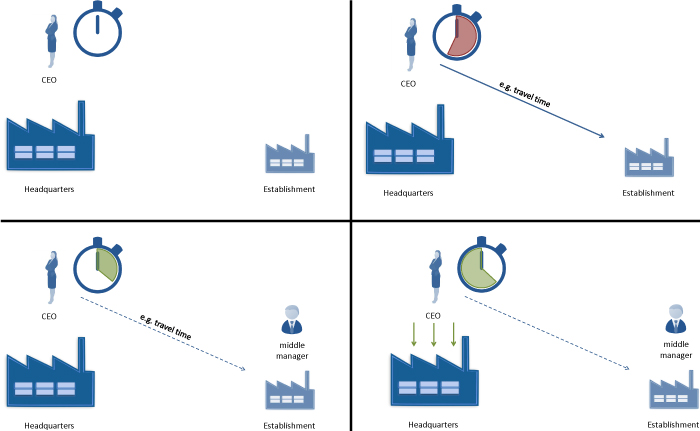
Source: self-created based on publicly available elements
This column shows that hiring middle managers helps firms mitigate the impact of geographic frictions, by improving the efficiency of management resources. Factors affecting the efficiency of a local establishment have knock-on effects for the whole firm, regardless of distance.
Continue reading
Distance and other geographic frictions between firms’ headquarters and their establishments have a negative effect on performance.
Figure 2 Intuition of the model mechanism
Source: self-created based on publicly available elements
This column shows that hiring middle managers helps firms mitigate the impact of geographic frictions, by improving the efficiency of management resources. Factors affecting the efficiency of a local establishment have knock-on effects for the whole firm, regardless of distance.
Continue reading
Tuesday, 24 September 2019
Automation and jobs: When technology boosts employment
an article by James Bessen for VOX: CEPR’s Policy Portal
Do industries shed or create jobs when they adopt new labour-saving technologies?
This column shows that manufacturing employment grew along with productivity for a century or more, and only later decreased. It argues that the changing nature of demand was behind this pattern, which led to market saturation.
This implies that the main impact of automation in the near future may be a major reallocation of jobs, not necessarily massive job losses.
Continue reading
Do industries shed or create jobs when they adopt new labour-saving technologies?
This column shows that manufacturing employment grew along with productivity for a century or more, and only later decreased. It argues that the changing nature of demand was behind this pattern, which led to market saturation.
This implies that the main impact of automation in the near future may be a major reallocation of jobs, not necessarily massive job losses.
Continue reading
Wednesday, 11 September 2019
Costs of employment and flexible labour demand
a column by Yukiko Asai for VOX: CEPR’s Policy Portal
One factor exacerbating gender gaps in employment is the cost of affording maternity and parental leave to women as primary caregivers.
This column analyses the relationship between the costs of providing parental leave and labour demand for childbearing-age women. As evidenced by a series of reforms in Japan in the last two decades, reducing the burden of parental leave costs from firms to social insurance systems increases both labour demand and starting wages for such workers.
Continue reading
One factor exacerbating gender gaps in employment is the cost of affording maternity and parental leave to women as primary caregivers.
This column analyses the relationship between the costs of providing parental leave and labour demand for childbearing-age women. As evidenced by a series of reforms in Japan in the last two decades, reducing the burden of parental leave costs from firms to social insurance systems increases both labour demand and starting wages for such workers.
Continue reading
Tuesday, 2 April 2019
Short-time work in the Great Recession: firm-level evidence from 20 EU countries
an article by Reamonn Lydon (Central Bank of Ireland, Dublin),Thomas Y. Mathä (Banque centrale du Luxembourg) and Stephen Millard (Bank of England, Durham University Business School and Centre for Macroeconomics,
Durham, UK) published in IZA Journal of Labor Policy Volume 8 Article 2 (2019)
Abstract
Using firm-level data from a large-scale European survey among 20 countries, we analyse the determinants of firms using short-time work (STW). We show that firms are more likely to use STW in case of negative demand shocks. We show that STW schemes are more likely to be used by firms with high degrees of firm-specific human capital, high firing costs, and operating in countries with stringent employment protection legislation and a high degree of downward nominal wage rigidity.
STW use is higher in countries with formalised schemes and in countries where these schemes were extended in response to the recent crisis. On the wider economic impact of STW, we show that firms using the schemes are significantly less likely to lay off permanent workers in response to a negative shock, with no impact for temporary workers.
Relating our STW take-up measure in the micro data to aggregate data on employment and output trends, we show that sectors with a high STW take-up exhibit significantly less cyclical variation in employment.
JEL classification: C25, E24, J63, J68
Full text (PDF 29pp)
Durham, UK) published in IZA Journal of Labor Policy Volume 8 Article 2 (2019)
Abstract
Using firm-level data from a large-scale European survey among 20 countries, we analyse the determinants of firms using short-time work (STW). We show that firms are more likely to use STW in case of negative demand shocks. We show that STW schemes are more likely to be used by firms with high degrees of firm-specific human capital, high firing costs, and operating in countries with stringent employment protection legislation and a high degree of downward nominal wage rigidity.
STW use is higher in countries with formalised schemes and in countries where these schemes were extended in response to the recent crisis. On the wider economic impact of STW, we show that firms using the schemes are significantly less likely to lay off permanent workers in response to a negative shock, with no impact for temporary workers.
Relating our STW take-up measure in the micro data to aggregate data on employment and output trends, we show that sectors with a high STW take-up exhibit significantly less cyclical variation in employment.
JEL classification: C25, E24, J63, J68
Full text (PDF 29pp)
Saturday, 3 March 2018
The dynamics of inter-firm networks and firm growth
a column by Daisuke Fujii, Yukiko Saito and Tatsuro Senga for VOX: CEPR’s Policy Portal
Firms develop inter-firm networks throughout their lifecycles, continually adding and dropping trading partners. This column examines the role that the dynamics of these networks play in firm growth. The findings point to the importance of searching for potential trading partners and learning match-specific productivity for younger firms. Surviving older firms, in contrast, tend to enjoy a stable set of customers and suppliers to keep their operations.
Continue reading
Firms develop inter-firm networks throughout their lifecycles, continually adding and dropping trading partners. This column examines the role that the dynamics of these networks play in firm growth. The findings point to the importance of searching for potential trading partners and learning match-specific productivity for younger firms. Surviving older firms, in contrast, tend to enjoy a stable set of customers and suppliers to keep their operations.
Continue reading
Subscribe to:
Posts (Atom)

