Showing posts with label childhood_emotional_neglect. Show all posts

Tuesday, 10 September 2019

Use This 4 Step Technique to Decide if You Can Trust Your Feelings or Not

a post by Jonice Webb for the Childhood Emotional Neglect blog [via World of Psychology]


Whether you realize it or not, every minute of every day, you are experiencing feelings.

Whether it’s a burst of frustration when you realize you forgot your keys, a second of peaceful calm as you recall your day at the beach last month, or a pang of painful helplessness when you think of a family member who is struggling with addiction, emotions come and go, one after another, constantly.

Just as your physical feelings reside in your body, so do your emotions. Many people describe feeling sadness in their belly, anxiety in their throat, anger in their chest or arms, for example. Where you feel your feelings is unique to you, but rest assured that you have feelings, and if you focus in on a feeling, you can locate it in your body.

Continue reading


Thursday, 11 July 2019

20 Brilliant Ways People Avoid Their Feelings (and the Havoc it Wreaks)

a post by Jonice Webb for the Childhood Emotional Neglect blog [via World of Psychology]


We humans are connected by a river that runs through us all. It’s a powerful river, deep and still in some places, frothy and rapid in others, yet sometimes dry and arid, and other times flooded.

We are all stimulated, challenged, warmed, cooled, driven, and connected by the emotions that are biologically wired into us at birth.

An important fact that most people never consider: We cannot choose what we feel.

The feelings we naturally feel are biological and automatic. Emotions arise automatically from our deepest self, a deeply personal expression of who we are, what we want, what we need, what we enjoy and who we like.

Our emotions tell us when we need to protect ourselves (fear), when to prepare (anxiety), when to reach out (lonely), when to let go (grief), and what we need (longing). They also tell us much more about ourselves, if we would only listen.

It is also true that, however useful our feelings are, they can hurt us. Feeling sadness, rage, grief or pain can be deeply unpleasant. Especially when we do not know what to do with those feelings.

In truth, it is our responsibility to listen to our feelings, use them to guide and connect us, and also manage them.

But if you grew up in a family that did not know how emotions work and did not teach you how to listen to your feelings, use them, and manage them (the definition of an emotionally neglectful family or Childhood Emotional Neglect or CEN), you may find yourself with only one trick up your sleeve when you come upon rapids in the river.

Unfortunately, it’s the lowest common denominator of tricks and the trickiest of tricks. Because it seems to work but it only makes things worse.

Avoidance.

Continue reading

Hazel’s comment:
You will get a word picture of my husband of 38 years! Not been an easy ride particularly as he self-medicates with alcohol.


Monday, 24 June 2019

How Unhealed Childhood Wounds Wreak Havoc in Our Adult Lives

a post by Marlena Tillhon-Haslam for the Tiny Buddha blog


“The emotional wounds and negative patterns of childhood often manifest as mental conflicts, emotional drama, and unexplained pains in adulthood.” ~Unknown

I am a firm believer in making the unconscious conscious. We cannot influence what we don’t know about. We cannot fix when we don’t know what’s wrong.

I made many choices in my life that I wouldn’t have made had I recognized the unconscious motivation behind them, based on my childhood conditioning.

In the past, I beat myself up over my decisions countless times. Now I feel that I needed to make these choices and have these experiences so that the consequences would help me become aware of what I wasn’t aware of. Maybe, after all, that was the exact way it had to be.

In any case, I am now hugely aware of how we, unbeknownst to us, negatively impact our own lives.

Continue reading


Wednesday, 29 May 2019

The Difference Between Self-Esteem, Self-Worth, Self-Confidence and Self-Knowledge

a post by Jonice Webb for the Childhood Emotional Neglect blog [via World of Psychology]


I have noticed that there is a great deal of confusion between the four common struggles listed in the title. Sometimes folks ask me if they are all the same.

The differences can be subtle and there can be overlap, yes. But they are all indeed different in some very specific ways. Ways that are important to understand as you think about your own view of, and feelings about, yourself.

So let’s start with a little “quiz.” As you read the descriptions below, see if you can identify which person has low self-esteem, which has low self-worth, who has low self-confidence, and who has low self-awareness.

Then read on to see if you identified them correctly, and also to learn much more about each of these common struggles.

Continue reading


Tuesday, 23 April 2019

15 Benefits of Healing Your Childhood Emotional Neglect

a post by Jonice Webb for the Childhood Emotional Neglect blog [World of Psychology]


Becoming aware of the silent role of Childhood Emotional Neglect (CEN) in your adult life is no small thing. It’s true.

Once you know it, you cannot go back. You now know what you know, and like the cake that cannot be unbaked, you are changed forever.

Childhood Emotional Neglect: When your parents fail to respond enough to your emotional needs as they raise you.

But just as you cannot go back, it’s also hard to go forward. Even though you realize why you struggle with emptiness or numbness, disconnection and/or lack of fulfillment, it’s natural to assume that since it’s rooted in your childhood, you must be stuck with it forever.

But it is my goal to make sure that every man, woman, and child who is living with CEN learns that this assumption could not be more wrong.

As a psychologist who has treated almost every diagnosis in the book, I have never seen a mental health struggle that is more fixable and has its roots in more areas of one’s life, than CEN. Nor have I seen one that has such a clear and defined path to healing.

Continue reading


Friday, 15 March 2019

When Expectations Hurt: How I've Forgiven My Absentee Father and Healed

a post by Bridget Garcia for the Tiny Buddha blog


“What will mess you up most in life is the picture in your head of how it’s supposed to be.” ~Unknown

I may have said a few words that hurt my father’s feelings, but…

See, here’s the backstory.

I’m thirty-four years old, and I started having a relationship with my biological father at age twenty-one. During my childhood years I would see him every now and then even though he lived less than three miles away from my home. I don’t have any memories of being with my dad for birthdays, holidays, family vacations, or even just hanging out watching TV at home.

When I was twenty-one my father called and said, “Hey, I’m outside your house.”

I went outside and he said, “Your mom told me you just had another baby.”

I said, “Yes, I did.”

By this time I rarely had any dealings with my father, and I had some negative feelings about him because he was not in my life in the way I felt he should have been.

A part of me was upset and confused as to why he wasn’t around during my childhood when I needed him. I wanted his guidance and protection, and I felt that he hadn’t given that to me.

We had a conversation, and he told me that I was welcome at his home anytime and that I should come around more often. Despite how I was feeling, I decided I would give it a try because a part of me wanted to be daddy’s girl.

So, I did just that. I called him as often as I could and would go by his house for visits. I finally got comfortable enough that felt like I was in a good place with my dad. He has a wealth of knowledge, so we began having deep conversations about different things in life, and he would give me advice on things I was going through.

Continue reading


Monday, 11 March 2019

6 Things Adults With Childhood Emotional Neglect Need to be Happy

a post by Jonice Webb for the World of Psychology


Funny thing about people who grow up with Childhood Emotional Neglect (CEN): they go through their entire adult lives with a set of requirements for happiness in their minds. But sadly, those requirements end up keeping them from being happy.

CEN folks don’t know it, but the things they think will make them happy have little to do with their actual happiness. In fact, their notion of happiness is mostly about protecting themselves.

Growing up with your feelings unvalidated (Childhood Emotional Neglect) sets you up to feel that there is something wrong with you for simply having normal human feelings. Then, moving through your adulthood, you then feel you must not only protect yourself from your own feelings and needs but also hide them from others.

Continue reading


Wednesday, 13 February 2019

Do These 5 Things to Increase Your Emotional Intelligence

a post by Jonice Webb (Childhood Emotional Neglect) for World of Psychology


What’s been shown by research to be more important for job success than IQ?

What’s a major factor in life satisfaction?

What contributes to lasting marriages and happy children?

What can leap tall buildings in a single bound? (Well, maybe not that.)

It’s Emotional Intelligence! Also known as EQ.

Emotional Intelligence has been defined as the capacity to be aware of, control, and express one’s emotions, and to handle interpersonal relationships and conflicts with empathy and skill.

Research tells us that people with high EQ enjoy many advantages and benefits in life. But some people have a lot more of it than others.

Many people feel rather mystified by the concept of EQ. It’s natural to wonder how people get EQ. Are we born with our EQ already set? And why do some people have high EQ and some people don’t? And, probably the most important question of all: Can we increase our EQ?

Are We Born With EQ?

The answer is, “Maybe somewhat.” Few things are purely genetic, and EQ is no exception. Sure, some babies are undoubtedly born with a more natural tendency toward emotional awareness and capability for abstract thought, both of which would make it easier to learn about and understand emotions.

But in the nature/nurture question, I have clearly seen that nurture is enormously important.

The Role of Parenting in EQ

Childhood is a training ground for emotional intelligence. When your parents see what you feel and respond to your feelings by helping you name and manage them, you learn what different emotions feel like, and how to put them into words. You learn how to identify what you’re feeling, and why you may be feeling it. You learn how to understand why you do what you do and deduce the reasons for others’ actions as well.

Emotionally aware and skilled parents do all of the above, naturally. So they tend to raise high EQ kids. But, unfortunately, the opposite is also true. When your parents are not emotionally aware or skilled, you do not get what you need to learn the EQ skills.

When your emotions are not noticed, validated or addressed enough in childhood (I call this Childhood Emotional Neglect or CEN), your emotions automatically become blocked off in adulthood. So throughout the most formative decades of your life, you are missing the opportunity to learn how emotions work.

You are left with a lack of crucial knowledge. Which emotion is which? What do you do with your feelings when you have them? How are your emotions affecting your decisions? How do other people’s emotions affect their behavior?

The effects of this lack of knowledge on every single area of the emotionally neglected person’s adult life are far more severe than most people realize.

Lacking a solid EQ makes it hard to handle situations when you are having feelings or when the other person is. So you are more likely to ignore issues, sweep problems under the rug, hurt other people’s feelings, or make decisions that you will later regret.

So, although less clearly visible, the effects of low EQ are so significant that I have often compared them to those of having a physical disability, such as a missing limb.

The Bright Side

Fortunately, for all of us, that is not the end of the story. There is some very good news here. EQ is nothing other than a set of skills. And you, no matter how much Emotional Neglect you were raised with, no matter what genes you were born with, can learn them.

Continue reading


Monday, 28 January 2019

How I Overcame Childhood Emotional Neglect and Learned to Meet My Needs

a post by Sherise Tan for the Tiny Buddha blog


“In order to move on, you must understand why you felt what you did and why you no longer need to feel it.” ~Mitch Albom

“Your feelings are valid,” said my life coach during one of our sessions, as we were working on an issue I had with my parents.
I had to do a double take. My feelings are valid? She actually accepts them as they are?

Eventually it started to dawn on me: My parents never validated my feelings. This sudden revelation earlier this year threw me into a dark period of my life.

When I was growing up, my parents criticized me for being “overly emotional” and “too sensitive,” and I never felt they truly accepted me.

My whole family shied away from expressing emotions, so I learned not to express or talk about my emotions either. I felt deeply disconnected in romantic relationships and often didn’t want to depend on others for help. Something felt completely off in my life, but I just couldn’t put my finger on what.

Continue reading


Thursday, 16 August 2018

5 Ways Childhood Neglect and Trauma Skews Our Self-Esteem

a post by Darius Cikanavicius (Psychology of Self) for the World of Psychology blog


Self-esteem is one of the core concepts in regard to our self-perception, self-worth, and self-understanding. Self-esteem is something that people refer to all the time, be it a mental health professional, a regular person, and everyone in between.

What Is Self-Esteem?

The word esteem comes from a Latin word aestimare, which means to estimate, to value, to evaluate, to judge. Self means that it’s about me, and I’m the one who’s estimating myself.

We estimate ourselves in terms of our worth, actions, skills, abilities, emotions, motives, and various other things. We do it consciously or unconsciously. Our estimation of ourselves can be correct, incorrect, or partially correct.

How Self-Esteem Develops

We are not born already being able to accurately assess the world and ourselves. Self-reflection is something a child starts developing as they become self-aware and develop a stronger sense of self.

In order for a child to develop a healthy and accurate self-esteem, they need mirroring, attunement, and validation from the caregiver. If the child doesn‘t get enough of it, their ability to self-assess is stunted or even damaged.

A big factor in the development of our self-esteem is the fact that as children we are dependent on our caregivers. By the nature of it, our early self-perception is mostly shaped by how we are seen by our primary caregivers and other authority figures. We internalize other people‘s perception of us and eventually it becomes our self-image.

All of this means that if our early environment provides a skewed perception of us, we develop a skewed self-esteem. This impacts our lives as the issues that stem from it follow us into our adulthoods and sometimes last a lifetime.

These issues manifest themselves on many levels: intellectual (false beliefs, magical thinking, unrealistic standards), emotional (depression, chronic shame and guilt), or behavioral (addiction, self-loathing or destructive behavior).

Continue reading


Friday, 3 August 2018

The 10 Rules Emotions Follow That Everyone Should Know

a post by Jonice Webb for the World of Psychology "best of" blog


Do you sometimes feel mystified by your own feelings? Of course, you do!

Believe me when I say that everybody does.

It’s not always obvious why you’ve felt sad all day, for example. In fact, you may go through an entire day feeling sad without even realizing it until the evening. Then once you recognize how you’ve been feeling, you may still be confused about the reasons.

An experience like this is not at all unusual. You would be hard-pressed to find a single human being who hasn’t been there. And if you find someone who says he has never had that experience, it’s probably because he is not sufficiently aware of his feelings to realize that he is having them.

It is true that feelings are unbelievably complicated. Yet they are an integral part of our everyday lives. In fact, it’s truly incredible how much we are actually influenced by what we feel, whether we realize it or not. Our feelings drive our decisions and our actions. They cause us to get into conflicts and to work out problems. They help us choose our mates, our careers, and everything else in our lives.

So think of your emotions as a strong current that carries you through your life. The better you understand that current and work with it, the better you can harness its energy and use it, and the easier your life will be.

Although emotions are complex, they do follow certain rules. Once you know the rules you have a huge leg up on managing and using your feelings in a healthy way.

The 10 Rules Your Emotions Follow
  1. Your feelings do not originate from the part of your brain that is under your control. You cannot choose your feelings.
  2. Feelings are not subject to any moral code. They’re neither good nor bad, right or wrong. They just are what they are.
  3. Even though you can’t choose your feelings, you are responsible for them.
  4. Emotions can be “walled off” but they cannot be extinguished. If you wall off an emotion, it does not disappear. It just goes and lives on the other side of the wall.
  5. Feelings can lead you down the right path or they can lead you astray. It all depends on what you do with them.
  6. When you disregard an emotion, you are actually empowering it. Ignoring, pushing away, or walling off a feeling may seem to make it go away but it’s the feelings you’re the least aware of that can affect you without your knowledge.
  7. There is only one way to make an uncomfortable feeling go away, and that is to let yourself feel it.
  8. Your feelings drive your thoughts, but you can also use your thoughts to manage your feelings.
  9. Sitting with a powerful emotion and letting yourself feel it while thinking about it to understand why you’re having it, what it means, and what it’s telling you, is called “processing it.”
  10. Your feelings are valuable messages from your deepest self. When you follow Rule 9, you are listening to the messages, honoring yourself, and making use of this valuable resource from within.
Continue reading

I am learning, a bit late in life but I am learning. For a long time I have worked with “feelings just are” but now I have the other nine rules to go with it. Not that I understand it all but …


Saturday, 19 May 2018

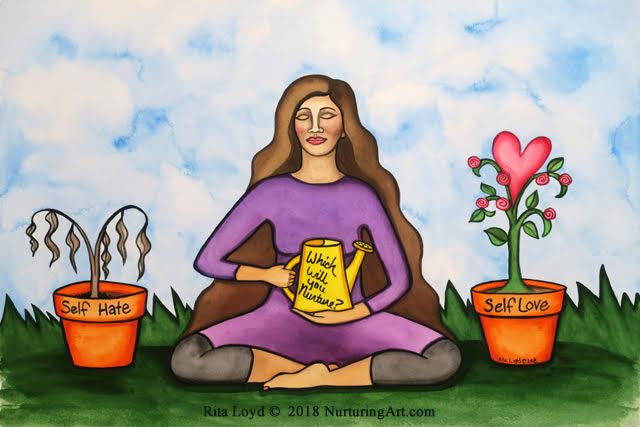
The Art of Nurturing Self-Talk: How to Tell Yourself What You Need to Hear

a post by Rita Loyd for the Tiny Buddha blog


“You will never speak to anyone more than you speak to yourself in your head. Be kind to yourself.” ~Unknown

Talking to ourselves in a nurturing way can be a challenge if we rarely heard nurturing words in the early formative years of our lives. In fact, if we were often criticized or neglected, we probably learned to criticize and neglect ourselves instead.

When I was growing up, my mom was a dedicated wife and mother, but she suffered from deep depression, anxiety, and low self-esteem. She didn’t know how to be encouraging or nurturing because she was never nurtured or encouraged by her parents while she was growing up. So her words to me reflected the negativity that she felt about life and herself.

I have forgiven my mother for all the mistakes she made in my childhood, and, in fact, we ended up extremely close during her last years of life. But that doesn’t mean that there wasn’t work for me to do on myself in order to heal the self-hatred that had been unconsciously passed down.

Growing up as I did, I struggled with low self-esteem, I was deeply depressed, I found myself in an abusive marriage with my first husband, I depended on other people for approval, and I neglected my dreams, since I didn’t believe in myself.

Continue reading


Sunday, 18 March 2018

Toxic Childhood? 4 Exercises to Promote Healing

a post by Peg Streep for Knotted: The Mother-Daughter Relationship blog [via World of Psychology]

I always thought that how I acted was just a function of my personality—that I was born defensive, quick to anger, prickly. I didn’t occur to me until recently that it had to do with my mother’s treatment. Imagine that? A revelation at 39.
I always knew my mother didn’t love me; I was really little when I understood that what she said and did wasn’t loving and that the way she treated my younger brother was really different. She lit up when she saw him, you know? But I also thought that the problem was me. That the ways in which I was different from my brother were bad and that she was probably right not to love me. I mean, why would she? I was 38 when I heard myself actually say that to my husband and the look on his face was like a bright light going off in the darkness. And then he said,’ Wait. You believed she was right not to love you?’ Bells went off in my head.
All children normalize their experiences in their families of origin, believing that what goes on at their house goes on everywhere until they grow up and perhaps begin to see that there are, in truth, meaningful differences. Note the word perhaps in that sentence because, as the opening quotations make clear, this isn’t precisely a foregone conclusion. Even when a daughter recognizes that she’s been wounded by her mother’s treatment, she’s unlikely to see how she’s affected without therapy or a great deal of guided self-reflection.

Continue reading


Monday, 12 March 2018

3 Guilt And Shame Messages Of Childhood Emotional Neglect And How To Defeat Them

a post by Jonice Webb for Childhood Emotional Neglect blog [via World of Psychology]


Adults who were emotionally neglected in childhood can be quite perfectionistic and hard on themselves. But for many, it does not stop there.

Why? Because the messages of Childhood Emotional Neglect run deep. They go to the heart of the child, and stay with him for a lifetime. They not only damage his ability to understand and trust his own feelings, they damage his ability to understand and trust himself.

The messages of CEN are like invisible infusions of guilt and shame that happen every day in the life of the child.

Continue reading


Monday, 5 March 2018

The Difference Between Honoring an Emotion and Indulging It

a post by Jonice Webb for the Childhood Emotional Neglect blog [via World of Psychology]

One of the most important challenges of growing up with your emotions under-responded to by your parents (Childhood Emotional Neglect, or CEN) is that you then enter adulthood without the essential knowledge of what to do with your emotions.

If your parents had noticed and named what you were feeling; if they had talked with you about your intense child emotions they would have automatically been teaching you that your feelings are real, are important, and can be managed. And just as importantly, their “emotion coaching” would have taught you some vital emotion skills for your life.

Everyone has intense emotions from time to time. I have discovered that even the people who experience themselves as emotionally empty or numb due to Childhood Emotional Neglect (CEN) actually do have moments of strong feelings at various times.

Continue reading


Wednesday, 3 January 2018

It took decades after leaving care to get the mental health help I needed

an article by Jolene Campbell published in the Guardian

It took a crisis for me to get the specialist support that children in care should receive from the start

‘Adverse childhood experiences can have long-term effects on psychological health and wellbeing.’
‘Adverse childhood experiences can have long-term effects on psychological health and wellbeing.’ Photograph: Alamy Stock Photo

Almost 30 years later, my heart still pounds when I think about the night before I was taken into care at the age of 10. Left alone in the house and sleeping with a knife under my pillow. To this day I have nightmares about it.

Trauma in childhood creates physical changes in the body; it makes us more likely to develop serious illnesses and increases the odds of depression and post-traumatic stress disorder later in life.

Looked-after children and young people have much poorer mental health than others; at least half have a mental health condition. About a quarter have had a mental health crisis since leaving care. According to charities such as Barnardo’s, most do not get specialist support.

Such systemic failure is brought into sharp focus when we consider that, in Scotland, the vast majority are referred to the children’s reporter for care and protection reasons. Neglect and lack of parental care is the most common reason for a child in Scotland to be on the child protection register.

Adverse childhood experiences like neglect can have complex, long-term effects on psychological health and wellbeing. My own experience bears out the growing evidence.

Continue reading


Wednesday, 29 November 2017

5 Steps to Tackling Avoidant Personality Disorder

a post by Jonice Webb for YourTango.com via World of Psychology blog

Avoidant personality disorder stems from emotional neglect as a child.
  • Do you secretly feel inferior to others and struggle with shame?
  • Are you reluctant to pursue goals, take risks, or meet new people?
  • Are you highly sensitive to criticism, and fear rejection?
  • Do you assume that others see you in a negative light?
  • Do you try not to get too close to people?
  • Do you suspect that you enjoy things less than other people do?
  • Do you often have anxiety in social situations?
Continue reading