an article by George J. Borjas (Harvard Kennedy School, USA) and Richard B. Freeman (Harvard University, USA) published in RSF: The Russell Sage Foundation Journal of the Social Sciences Volume 5 Issue 5 (December 2019)
Abstract
Using numbers of industrial robots shipped to primarily manufacturing industries as a supply shock to an industry labor market, we estimate that an additional robot reduces employment by roughly two to three workers overall and by three to four workers when robots are likely to be good substitutes for humans.
The supply shock also reduces wages. The estimates far exceed those of an additional immigrant on employment and wages.
While growth of robots in the 2000s was too modest to be a major determinant of wages and employment, the estimated effects suggest that continued exponential growth of industrial robots could disrupt job markets in the foreseeable future and thus merit attention from analysts and policymakers concerned about the economic well-being of workers.
Full text (PDF 23pp)
Showing posts with label labour_market. Show all posts
Showing posts with label labour_market. Show all posts
Thursday, 5 December 2019


Wednesday, 27 November 2019
Migration and post-conflict reconstruction: The effect of returning refugees on export performance in the former Yugoslavia
a column by Dany Bahar, Andreas Hauptmann, Cem Özgüzel and Hillel Rapoport for VOX: CEPR’s Policy Portal
The economic debate on immigration has focused on migration’s short-term labour market and fiscal effects. Less attention has been given to the long-run economic opportunities linked to migration.
This column uses the case of refugees returning to the former Yugoslavia from Germany after the end of the Yugoslav wars to explore the role that returning migrants play in shaping the industrial development of their home country. The findings support the idea that migrants are drivers of knowhow and technology transfers between countries.
Continue reading
The economic debate on immigration has focused on migration’s short-term labour market and fiscal effects. Less attention has been given to the long-run economic opportunities linked to migration.
This column uses the case of refugees returning to the former Yugoslavia from Germany after the end of the Yugoslav wars to explore the role that returning migrants play in shaping the industrial development of their home country. The findings support the idea that migrants are drivers of knowhow and technology transfers between countries.
Continue reading
Tuesday, 22 October 2019
Has the labour market reached a turning point?
a post by Nye Cominetti for the Resolution Foundation blog
On headline measures the labour market remains healthy. Conditions are tight and this continues to feed into decent real pay growth – 2.0 per cent in the three months to August 2019, not far off the levels we came to expect before the recession.
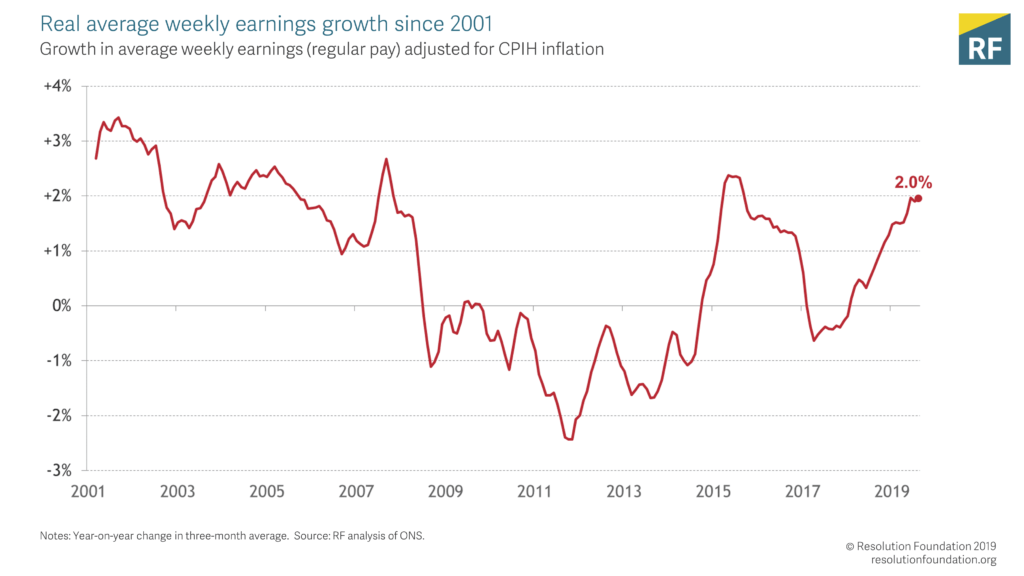
But alongside positive headlines are signs that the labour market is cooling. Certainly, things are no longer improving, either in terms of pay growth or employment – both nominal pay growth and the employment rate ticked downwards in the latest data. And so the question is – is the labour market at a turning point? How long will pay continue to grow at this rate?
The clearest signs of cooling are seen in measures of labour demand, and in the employment data. The number of unfilled vacancies has been falling for eight months in a row. There are 50,000 fewer vacancies now than at the beginning of the year, and the unemployment-to-vacancies ratio (a measure of labour market slack) has bottomed out. On employment – the employment rate ticked down by 0.2 percentage points over the latest quarter to 75.9 per cent, and the unemployment rate ticked upwards slightly.
Continue reading
On headline measures the labour market remains healthy. Conditions are tight and this continues to feed into decent real pay growth – 2.0 per cent in the three months to August 2019, not far off the levels we came to expect before the recession.
But alongside positive headlines are signs that the labour market is cooling. Certainly, things are no longer improving, either in terms of pay growth or employment – both nominal pay growth and the employment rate ticked downwards in the latest data. And so the question is – is the labour market at a turning point? How long will pay continue to grow at this rate?
The clearest signs of cooling are seen in measures of labour demand, and in the employment data. The number of unfilled vacancies has been falling for eight months in a row. There are 50,000 fewer vacancies now than at the beginning of the year, and the unemployment-to-vacancies ratio (a measure of labour market slack) has bottomed out. On employment – the employment rate ticked down by 0.2 percentage points over the latest quarter to 75.9 per cent, and the unemployment rate ticked upwards slightly.
Continue reading
Wednesday, 2 October 2019
New dawn fades: The post-referendum rise in import costs has hurt UK workers
a column by Rui Costa, Swati Dhingra and Stephen Machin for VOX: CEPR’s Policy Portal
Some commentators argue that globalisation is systematically connected to the real-wage and productivity stagnation seen across the developed world.
This column analyses the relationship between international trade and worker outcomes in the immediate aftermath of the Brexit referendum, when the value of the sterling fell massively against other nations’ currencies. It finds that the rise in import costs from the sterling depreciation hurt wages and training.
This relative decline in real earnings of workers has reinforced pre-existing real-wage stagnation; UK workers have not fared well since the referendum price rise.
Continue reading
Some commentators argue that globalisation is systematically connected to the real-wage and productivity stagnation seen across the developed world.
This column analyses the relationship between international trade and worker outcomes in the immediate aftermath of the Brexit referendum, when the value of the sterling fell massively against other nations’ currencies. It finds that the rise in import costs from the sterling depreciation hurt wages and training.
This relative decline in real earnings of workers has reinforced pre-existing real-wage stagnation; UK workers have not fared well since the referendum price rise.
Continue reading
Wednesday, 31 July 2019
Population with Criminal Records and Racial Disparity in Labor Markets
Jasmine Boatner (no affiliation provided) published in IZA Journal of Labor Policy Volume 9 Issue 1 (2019)
Abstract
Background
Although unemployment rates are at historical lows, there is still a persistent gap between unemployment rates in black and white population. Some have proposed that part of the gap for men can be explained by the higher rate of criminal records in the black population.
Methods
This analysis aims to use negative binomial regressions and the detailed crime data available from the National Longitudinal Survey of Youth 1997 survey to determine if black men with criminal records appear to be the driving force behind the gap.
Results
The author finds that there are significant deviations in labor market outcomes depending on race and ethnicity, even when controlling for a criminal record and premarket skills.
Conclusions
Lowering the disproportionate rate at which black men are incarcerated will not in itself eliminate the unemployment gap between white and black men.
JEL Classification: J01, J64, J71
Full text (PDF 13pp; HTML)
Abstract
Background
Although unemployment rates are at historical lows, there is still a persistent gap between unemployment rates in black and white population. Some have proposed that part of the gap for men can be explained by the higher rate of criminal records in the black population.
Methods
This analysis aims to use negative binomial regressions and the detailed crime data available from the National Longitudinal Survey of Youth 1997 survey to determine if black men with criminal records appear to be the driving force behind the gap.
Results
The author finds that there are significant deviations in labor market outcomes depending on race and ethnicity, even when controlling for a criminal record and premarket skills.
Conclusions
Lowering the disproportionate rate at which black men are incarcerated will not in itself eliminate the unemployment gap between white and black men.
JEL Classification: J01, J64, J71
Full text (PDF 13pp; HTML)
Tuesday, 16 July 2019
Do Men Favor Men in Recruitment? A Field Experiment in the Swedish Labor Market
an artticle by Anni Erlandsson (Swedish Institute for Social Research, Stockholm University, Sweden) puvblished in Work and Occupations Volume 46 Issue 3 (August 2019)
Abstract
Utilizing a field experiment design, this article examines whether discrimination based on any combination of job applicant gender and recruiter gender occurs in the first stage of the recruitment process, that is, selecting applicants to be contacted. This study includes 1,643 job applications in the Swedish labor market.
Overall, based on the callbacks received, male recruiters, unlike female recruiters, are found to contact male applicants more often than female applicants.
The results show a pro-male bias by male recruiters in gender-mixed occupations, whereas no significant gender differences in callbacks by recruiter gender are found in male- and female-dominated occupations.
Abstract
Utilizing a field experiment design, this article examines whether discrimination based on any combination of job applicant gender and recruiter gender occurs in the first stage of the recruitment process, that is, selecting applicants to be contacted. This study includes 1,643 job applications in the Swedish labor market.
Overall, based on the callbacks received, male recruiters, unlike female recruiters, are found to contact male applicants more often than female applicants.
The results show a pro-male bias by male recruiters in gender-mixed occupations, whereas no significant gender differences in callbacks by recruiter gender are found in male- and female-dominated occupations.
Friday, 5 July 2019
Work must pay: Does it? Precarious employment and employment motivation for low-income households
asn article by Lucie Trlifajová and Jakob Hurrle (Charles University, Czech Republic) published in Journal of European Social Policy Volume 29 Issue 3 (July 2019)
Abstract
One of the core dilemmas of current welfare politics is the question of how to ensure social protection while providing incentives to seek employment at the same time. A way to address this dilemma is to base policies and policy models on the principle notion that ‘work must pay’; in other words, income from employment should be higher than the social support of the unemployed.
However, how accurately do these approaches and models represent the reality of benefit recipients, particularly in the context of increased employment precariousness?
In this article, we use the cases of two disadvantaged regions in Czech Republic in order to contrast the presumptions of ‘making work pay’ policies with the everyday experience of welfare recipients. As we show, their situations are strongly shaped by current changes in the labour market, particularly the precarious character of accessible employment and high levels of indebtedness.
The modelling of financial employment incentives and the public policies based on these calculations often do not correspond with the reality of welfare recipients that are often cycling in and out of precarious forms of employment.
However, the authors’ main claim is that the very idea of the ‘work must pay’ approach focuses on the wrong question. A truly functioning financial incentive would need to focus not solely on the difference in income between those who work and those who do not work, but rather should analyse what type of arrangements allow working households to rise permanently above the poverty line.
Abstract
One of the core dilemmas of current welfare politics is the question of how to ensure social protection while providing incentives to seek employment at the same time. A way to address this dilemma is to base policies and policy models on the principle notion that ‘work must pay’; in other words, income from employment should be higher than the social support of the unemployed.
However, how accurately do these approaches and models represent the reality of benefit recipients, particularly in the context of increased employment precariousness?
In this article, we use the cases of two disadvantaged regions in Czech Republic in order to contrast the presumptions of ‘making work pay’ policies with the everyday experience of welfare recipients. As we show, their situations are strongly shaped by current changes in the labour market, particularly the precarious character of accessible employment and high levels of indebtedness.
The modelling of financial employment incentives and the public policies based on these calculations often do not correspond with the reality of welfare recipients that are often cycling in and out of precarious forms of employment.
However, the authors’ main claim is that the very idea of the ‘work must pay’ approach focuses on the wrong question. A truly functioning financial incentive would need to focus not solely on the difference in income between those who work and those who do not work, but rather should analyse what type of arrangements allow working households to rise permanently above the poverty line.
Monday, 10 June 2019
Discrimination in hiring based on potential and realised fertility: A field experiment
a column by Sascha O. Becker, Ana Fernandes and Doris Weichselbaumer for VOX: CEPR’s Policy Portal
The arrival of a child affects women and men differently in terms of labour market outcomes, but it is difficult to separate out the causal impact of discrimination from other factors.
This column uses empirical evidence from Germany, Switzerland, and Austria to show that women are most affected in part-time job applications if they signal a ‘risk’ of having young children soon.
Continue reading
Hazel’s comment
I would normally leave it to you to decide if you want to read the whole article but I do arge anyone with an interest in gendered employment issues to do so.
Yes, it does state the obvious (to me) but it also provides a wealth of statistical evidence.
The arrival of a child affects women and men differently in terms of labour market outcomes, but it is difficult to separate out the causal impact of discrimination from other factors.
This column uses empirical evidence from Germany, Switzerland, and Austria to show that women are most affected in part-time job applications if they signal a ‘risk’ of having young children soon.
Continue reading
Hazel’s comment
I would normally leave it to you to decide if you want to read the whole article but I do arge anyone with an interest in gendered employment issues to do so.
Yes, it does state the obvious (to me) but it also provides a wealth of statistical evidence.
Thursday, 9 May 2019
Promoting temporary work as an active labour market programme
a column by Bas van der Klaauw and Lennart Ziegler for VOX: CEPR’s Policy Portal
Although temporary jobs are often characterised by lower pay, advocates of temporary work argue that taking up such jobs can increase the chances to find regular work in the long run.
This column reviews evidence on the effectiveness of a labour market ‘speed date’ programme in the Netherlands, where unemployed job seekers are matched with temporary work agencies. The speed dates are effective in reducing the costs of unemployment insurance but, in the long run, temporary work does not serve as a stepping stone towards regular employment.
Continue reading
Although temporary jobs are often characterised by lower pay, advocates of temporary work argue that taking up such jobs can increase the chances to find regular work in the long run.
This column reviews evidence on the effectiveness of a labour market ‘speed date’ programme in the Netherlands, where unemployed job seekers are matched with temporary work agencies. The speed dates are effective in reducing the costs of unemployment insurance but, in the long run, temporary work does not serve as a stepping stone towards regular employment.
Continue reading
Wednesday, 27 March 2019
Gender disparities in European labour markets: A comparison of conditions for men and women in paid employment
an article by Rosalia Castellano and Antonella Rocca (Parthenope University of Naples, Italy) published in International Labour Review Volume 157 Number 4 (December 2018)
Abstract
Although the dramatic increase in female labour force participation in recent decades has been connected to significant changes in economic opportunities for women, gender disparities in the labour market persist in many forms.
This article seeks to assess whether higher gender differentials in European labour markets are directly related to poor economic conditions.
To this end, the results of a composite indicator designed and developed by the authors in a previous study are updated and three new composite indicators are constructed for a separate analysis of female and male labour market conditions and gender gap for paid employment.
Full text (PDF 20pp)
Abstract
Although the dramatic increase in female labour force participation in recent decades has been connected to significant changes in economic opportunities for women, gender disparities in the labour market persist in many forms.
This article seeks to assess whether higher gender differentials in European labour markets are directly related to poor economic conditions.
To this end, the results of a composite indicator designed and developed by the authors in a previous study are updated and three new composite indicators are constructed for a separate analysis of female and male labour market conditions and gender gap for paid employment.
Full text (PDF 20pp)
Tuesday, 9 October 2018
From childhood to young adulthood: the importance of self-esteem during childhood for occupational achievements among young men and women
Charlotta Magnusson & Magnus Nermo (Stockholm University, Sweden) published in Journal of Youth Studies Volume 21 Issue 10 (2018)
Abstract
This study investigates the impact of self-esteem during childhood on men’s and women’s occupational prestige in young adulthood. By combining first-hand information from parents in the Swedish Level-of-Living surveys (LNU) 2000 and their children in the Child-LNU in 2000 and the follow-up study in LNU-2010, we are able to assess how self-esteem during adolescence is related to occupational prestige in adulthood. Multivariate analyses were used to determine whether associations between self-esteem (global and domain-specific) in childhood (aged 10–18 years) and occupational prestige in young adulthood (aged 20–28) exist and, if so, what the magnitudes of these associations are for each respective gender.
For women, there is a positive association between confidence in mathematics and prestige, even when accounting for actual math grades. Global self-esteem is positively related to later occupational prestige as well. For men, self-esteem is unrelated to occupational prestige. Only actual performance in mathematics is important for men’s occupational achievements.
These results indicate the importance of taking gender differences into account when investigating how self-esteem is related to outcomes in young adulthood. A possible implication is the importance of focusing on the development of self-esteem among children, particularly girls, in school.
Full text (PDF 20pp)
Abstract
This study investigates the impact of self-esteem during childhood on men’s and women’s occupational prestige in young adulthood. By combining first-hand information from parents in the Swedish Level-of-Living surveys (LNU) 2000 and their children in the Child-LNU in 2000 and the follow-up study in LNU-2010, we are able to assess how self-esteem during adolescence is related to occupational prestige in adulthood. Multivariate analyses were used to determine whether associations between self-esteem (global and domain-specific) in childhood (aged 10–18 years) and occupational prestige in young adulthood (aged 20–28) exist and, if so, what the magnitudes of these associations are for each respective gender.
For women, there is a positive association between confidence in mathematics and prestige, even when accounting for actual math grades. Global self-esteem is positively related to later occupational prestige as well. For men, self-esteem is unrelated to occupational prestige. Only actual performance in mathematics is important for men’s occupational achievements.
These results indicate the importance of taking gender differences into account when investigating how self-esteem is related to outcomes in young adulthood. A possible implication is the importance of focusing on the development of self-esteem among children, particularly girls, in school.
Full text (PDF 20pp)
Monday, 10 September 2018
An Examination of Ethnic Hierarchies and Returns to Human Capital in the UK
an article by Wouter Zwysen and Neli Demireva (University of Essex, UK) published in Social Inclusion Volume 6 Number 3 (2018)
Abstract
This article focuses on the returns to human capital of migrants and minorities in the UK.
The question of whether skills and qualifications are properly utilized is very pertinent given the global competition for skilled migrants and the aim of European and British markets to attract such workers. Using data from Understanding Society (2009 to 2017) we find that there is a clear evidence of ethnic hierarchies with black Caribbean and black African minorities generally most disadvantaged, while other white UK-born have the best outcomes compared to the white British. Western migrants generally do very well, but new EU migrants have high levels of employment, and low returns to their qualifications and relatively high levels of over-qualification.
Foreign qualifications are generally discounted, and more so for migrants with less certain legal status or low language skills. Public sector employment plays an important role and is associated with the higher economic placement of migrants and minorities in the UK.
There are some worrying trends however. Highly skilled migrants, particularly black migrants as well as those from Eastern Europe, come in with high qualifications, but their jobs do not match their skill levels.
Full text (PDF 28pp)
Abstract
This article focuses on the returns to human capital of migrants and minorities in the UK.
The question of whether skills and qualifications are properly utilized is very pertinent given the global competition for skilled migrants and the aim of European and British markets to attract such workers. Using data from Understanding Society (2009 to 2017) we find that there is a clear evidence of ethnic hierarchies with black Caribbean and black African minorities generally most disadvantaged, while other white UK-born have the best outcomes compared to the white British. Western migrants generally do very well, but new EU migrants have high levels of employment, and low returns to their qualifications and relatively high levels of over-qualification.
Foreign qualifications are generally discounted, and more so for migrants with less certain legal status or low language skills. Public sector employment plays an important role and is associated with the higher economic placement of migrants and minorities in the UK.
There are some worrying trends however. Highly skilled migrants, particularly black migrants as well as those from Eastern Europe, come in with high qualifications, but their jobs do not match their skill levels.
Full text (PDF 28pp)
Sunday, 31 December 2017
Early exit or longer stay? The effect of precarious employment on planned age of retirement
an article by Ilias Livanos (European Centre for the Development of Vocational Training, Thessaloniki, Greece) and Imanol Nuñez (Universidad Publica de Navarra, Pamplona, Spain) published in Personnel Review Volume 46 Issue 8
Abstract
Purpose
The purpose of this paper is to investigate how precarious conditions at work affect older workers’ decision about their planned age of retirement.
Design/methodology/approach
Different theoretical approaches on the decision to retire are investigated in order to ascertain whether precarious employment extends, or not, one’s working life. A rich data set including over 250,000 old workers across EU-15 is built for the empirical investigation.
Findings
The results suggest that old workers involved in precarious employment are planning to retire later than those who are engaged with more stable and regular jobs. However, lack of training as well as poor health conditions at work are found to be associated with early retirement.
Originality/value
The analysis conceptually associates two key features of modern labour markets (precariousness and retirement) and empirically provides some evidence of the effect of poor employment conditions on the decision to retire.
Abstract
Purpose
The purpose of this paper is to investigate how precarious conditions at work affect older workers’ decision about their planned age of retirement.
Design/methodology/approach
Different theoretical approaches on the decision to retire are investigated in order to ascertain whether precarious employment extends, or not, one’s working life. A rich data set including over 250,000 old workers across EU-15 is built for the empirical investigation.
Findings
The results suggest that old workers involved in precarious employment are planning to retire later than those who are engaged with more stable and regular jobs. However, lack of training as well as poor health conditions at work are found to be associated with early retirement.
Originality/value
The analysis conceptually associates two key features of modern labour markets (precariousness and retirement) and empirically provides some evidence of the effect of poor employment conditions on the decision to retire.
Friday, 1 December 2017
Are Refugees' Labour Market Outcomes Different from Those of Other Migrants? Evidence from the United Kingdom in the 2005–2007 Period
an article by Isabel Ruiz and Carlos Vargas-Silva (University of Oxford, UK) published in Population, Space and Place Volume 23 Issue 6 (August 2017)
Abstract
We compare the labour market outcomes of recent refugees in the 2005–2007 period with those of other migrants in the UK. We compare refugees with a full sample of migrants and with a sample of recent migrants.
Controlling for relevant characteristics, we find that 8 and 15 months after the grant of protection, refugees have significantly worse outcomes than other migrants, including a lower likelihood of being in employment and higher likelihood of unemployment (i.e. not currently employed, but looking for work).
However, 21 months after the grant of protection, the labour market outcomes of recent refugees are not statistically different from those of recent migrants, and the difference with those in the full sample of migrants becomes smaller.
Results also show that female refugees are at a substantial economic disadvantage compared with male refugees and other female migrants.
Abstract
We compare the labour market outcomes of recent refugees in the 2005–2007 period with those of other migrants in the UK. We compare refugees with a full sample of migrants and with a sample of recent migrants.
Controlling for relevant characteristics, we find that 8 and 15 months after the grant of protection, refugees have significantly worse outcomes than other migrants, including a lower likelihood of being in employment and higher likelihood of unemployment (i.e. not currently employed, but looking for work).
However, 21 months after the grant of protection, the labour market outcomes of recent refugees are not statistically different from those of recent migrants, and the difference with those in the full sample of migrants becomes smaller.
Results also show that female refugees are at a substantial economic disadvantage compared with male refugees and other female migrants.
Tuesday, 21 November 2017
Evaluating the Labour Market Integration of New Immigrants in the UK
an article by Tommaso Frattini (University of Milan) published in Social Policy and Society Volume 16 Issue 4 (October 2016)
Abstract
This article analyses the labour market integration of newly arrived immigrants in the UK labour market, based on data from the UK Labour Force Survey. We focus on immigrants who arrived in the United Kingdom since 2000 and distinguish different cohorts based on the year of their arrival in the country.
We examine the extent to which these new arrivals were able to enter work and move up into skilled jobs, and analyse the sectors of the economy that have proved most amenable to this progression.
The analysis indicates that these new arrivals fared relatively well in the workforce. In part as a result of their relative youth and high education levels, many new arrivals (especially those from the European Union and in particular the EU10 countries) moved straight into work.
Full text (PDF 14pp)
Abstract
This article analyses the labour market integration of newly arrived immigrants in the UK labour market, based on data from the UK Labour Force Survey. We focus on immigrants who arrived in the United Kingdom since 2000 and distinguish different cohorts based on the year of their arrival in the country.
We examine the extent to which these new arrivals were able to enter work and move up into skilled jobs, and analyse the sectors of the economy that have proved most amenable to this progression.
The analysis indicates that these new arrivals fared relatively well in the workforce. In part as a result of their relative youth and high education levels, many new arrivals (especially those from the European Union and in particular the EU10 countries) moved straight into work.
Full text (PDF 14pp)
Tuesday, 16 August 2016
Inequality – ‘wicked problems’, labour market outcomes and the search for silver bullets
an article by Ewart Keep and Ken Mayhew (University of Oxford, UK) published in Oxford Review of Education Volume 40 Number 6 (November 2014)
Abstract
In recent years concerns about inequality have been growing in prominence within UK policy debates. The many causes of inequality of earnings and income are complex in their interactions and their tendency to reinforce one another. This makes inequality an intractable or ‘wicked’ policy problem, particularly within a contemporary context in which many of the established policy responses from previous eras are at best discussed in muted terms and more normally deemed to be unavailable.
This reflects the eclipse of ‘equality of outcome’ models and the concomitant rise of ‘equality of opportunity’ as the new policy mantra from Thatcher onwards. As traditional policy responses have withered, the role of education and training as a ‘silver bullet’ that can address a host of economic and social challenges has come to the fore. This article outlines policy makers’ beliefs that improving the educational attainment of students from lower socio-economic backgrounds can enable them to compete more effectively for elite jobs, and also that increasing the supply of educated employees can transform the level of demand for skills from employers.
These beliefs are then critiqued, with reference to occupational congestion, over-qualification and the evidence that skills supply does not always create its own demand.
Yes, I know that this is old but still worth reading. Hazel
Abstract
In recent years concerns about inequality have been growing in prominence within UK policy debates. The many causes of inequality of earnings and income are complex in their interactions and their tendency to reinforce one another. This makes inequality an intractable or ‘wicked’ policy problem, particularly within a contemporary context in which many of the established policy responses from previous eras are at best discussed in muted terms and more normally deemed to be unavailable.
This reflects the eclipse of ‘equality of outcome’ models and the concomitant rise of ‘equality of opportunity’ as the new policy mantra from Thatcher onwards. As traditional policy responses have withered, the role of education and training as a ‘silver bullet’ that can address a host of economic and social challenges has come to the fore. This article outlines policy makers’ beliefs that improving the educational attainment of students from lower socio-economic backgrounds can enable them to compete more effectively for elite jobs, and also that increasing the supply of educated employees can transform the level of demand for skills from employers.
These beliefs are then critiqued, with reference to occupational congestion, over-qualification and the evidence that skills supply does not always create its own demand.
Yes, I know that this is old but still worth reading. Hazel
Thursday, 9 July 2015
The capacity of social policies to combat poverty among new social risk groups
an article by Allison E Rovny (University of Gothenburg, Sweden) published in Journal of European Social Policy Volume 24 Number 5 (December 2014)
Abstract
This article considers groups who are most likely to be vulnerable to new social risks and tests the effects of social policies on their poverty levels. Specifically, the article conducts multi-level regression analyses across 18 OECD countries around the year 2004, analysing the effects of social policies on the likelihood of being poor for low-skilled young women and men, and for those at risk of possessing obsolete skills, namely low-educated men aged 55–64 years.
The central question asks which policies – active labour market policies (ALMP), passive labour market policies (PLMP), employment protection legislation (EPL), family policies, and government daycare spending – are effective at combating new social risks. In addition to analysing social policies, the article also considers union density and representation of women in national parliaments as two measures that depict agents who are most intent on combating old and new social risks, respectively.
The findings show that ALMP are the most important predictor of a decrease in poverty levels among the low skilled. The negative effect of PLMP on poverty is only significant for the older male group. Family policies are related to a reduction in poverty for both low-skilled young women and men.
Gross public social spending as a measure of overall welfare generosity is found to be associated with a reduction in poverty only of the older male group, but not that of the younger groups. The article’s analyses suggest that some social policies remain geared towards older segments of society, leaving the younger population at greater financial and therefore social risk.
Abstract
This article considers groups who are most likely to be vulnerable to new social risks and tests the effects of social policies on their poverty levels. Specifically, the article conducts multi-level regression analyses across 18 OECD countries around the year 2004, analysing the effects of social policies on the likelihood of being poor for low-skilled young women and men, and for those at risk of possessing obsolete skills, namely low-educated men aged 55–64 years.
The central question asks which policies – active labour market policies (ALMP), passive labour market policies (PLMP), employment protection legislation (EPL), family policies, and government daycare spending – are effective at combating new social risks. In addition to analysing social policies, the article also considers union density and representation of women in national parliaments as two measures that depict agents who are most intent on combating old and new social risks, respectively.
The findings show that ALMP are the most important predictor of a decrease in poverty levels among the low skilled. The negative effect of PLMP on poverty is only significant for the older male group. Family policies are related to a reduction in poverty for both low-skilled young women and men.
Gross public social spending as a measure of overall welfare generosity is found to be associated with a reduction in poverty only of the older male group, but not that of the younger groups. The article’s analyses suggest that some social policies remain geared towards older segments of society, leaving the younger population at greater financial and therefore social risk.
Friday, 13 June 2014
Using skills development strategies to tackle poverty and inequality
an article by Chris Goulden (Manager, Poverty Team at Joseph Rowntree Foundation) published in Journal of Urban Regeneration & Renewal Volume 7 Issue 3 (Spring 2014)
Abstract
On the face of it, it seems obvious that enabling people to develop their skills and improve their education would be an important way of decreasing their chances of experiencing poverty. For individuals, this can often be true, but when one looks at the full distribution of families and households in the context of wider changes in both the labour market and tax and benefit systems, the picture becomes much less straightforward.
This paper outlines research to test strategies for developing skills that might be used, and argues that these could worsen levels of poverty and income inequality if some of the interactions and underlying relationships are not better understood.
Abstract
On the face of it, it seems obvious that enabling people to develop their skills and improve their education would be an important way of decreasing their chances of experiencing poverty. For individuals, this can often be true, but when one looks at the full distribution of families and households in the context of wider changes in both the labour market and tax and benefit systems, the picture becomes much less straightforward.
This paper outlines research to test strategies for developing skills that might be used, and argues that these could worsen levels of poverty and income inequality if some of the interactions and underlying relationships are not better understood.
Wednesday, 28 August 2013
Examining the labor market presence of US WISEs
an article by Kate Cooney (Yale University School of Management, Connecticut, USA) published in Social Enterprise Journal Volume 9 Issue 2 (2013)
Abstract
Purpose
Work integration social enterprises (WISEs) create jobs through business ventures that function as locations for training and employment of disadvantaged workers. A key challenge for US WISEs is that the businesses that are easiest to launch and best suited to absorb large numbers of unskilled workers may be located in the same low wage labour market sectors out of which these interventions are designed to catapult workers. This paper aims to present data on an understudied aspect of WISEs: the labour market niches where they are active, the occupations associated with these labour market positions, and the work conditions offered through their WISE businesses.
Design/methodology/approach
Data presented in this paper are from a national WISE database developed by the author that includes 254 businesses associated with 123 WISEs, and a pilot study of 15 WISEs testing an instrument for use in a national survey of US WISEs. Each business associated with the WISEs in the national database was coded for industry, occupation and wage data using categories developed by the US Bureau of Labor Statistics. Each WISE business was further coded as preparing its workers for either low or middle skill jobs. These data were analysed using frequency counts, chi square tests of association and a two-step cluster analysis. To explore employment conditions inside WISE businesses, the pilot study data were analysed using a multiple case study analysis approach. Through focused coding techniques, descriptions of the employment conditions associated with the WISE jobs are reviewed.
Findings
Analysis at the level of occupation category reveals that about 72 percent of the jobs that WISEs train clients to perform exist in low skill occupations. Chi-square tests of association between NTEE code (a proxy for target population) and job skill level are not significant suggesting that low skill training is utilised by organisations serving clients facing a range of disadvantage. Cluster analyses indicate that for WISEs targeting disabled populations and for newer organisations targeting the general unemployed populations, low skill job training pervades but for education organisation and for older employment organisations, middle skill job training is more prevalent. The pilot data analyses show that the WISEs offer minimum wage or higher wage positions but many without guaranteed hours or a clear pathway out of WISE employment.
Practical implications
These data suggest WISEs in the USA have grown well beyond their earlier, narrower niche working with the disabled to employ a much broader portfolio of client populations, many higher functioning. However, the findings that many WISEs are positioned in the low skill labour market and on some dimensions can mirror the low skill labour market employment conditions suggest that additional aspects of WISE workforce development strategy should be taken into account.
Originality/value
The paper focuses on the labour market niches where WISEs are active, the occupations associated with these labour market positions, and the work conditions offered.
Hazel’s comment:
I could not find a similar study on social enterprises in the UK. If there is one then please let us know in the comments.
Abstract
Purpose
Work integration social enterprises (WISEs) create jobs through business ventures that function as locations for training and employment of disadvantaged workers. A key challenge for US WISEs is that the businesses that are easiest to launch and best suited to absorb large numbers of unskilled workers may be located in the same low wage labour market sectors out of which these interventions are designed to catapult workers. This paper aims to present data on an understudied aspect of WISEs: the labour market niches where they are active, the occupations associated with these labour market positions, and the work conditions offered through their WISE businesses.
Design/methodology/approach
Data presented in this paper are from a national WISE database developed by the author that includes 254 businesses associated with 123 WISEs, and a pilot study of 15 WISEs testing an instrument for use in a national survey of US WISEs. Each business associated with the WISEs in the national database was coded for industry, occupation and wage data using categories developed by the US Bureau of Labor Statistics. Each WISE business was further coded as preparing its workers for either low or middle skill jobs. These data were analysed using frequency counts, chi square tests of association and a two-step cluster analysis. To explore employment conditions inside WISE businesses, the pilot study data were analysed using a multiple case study analysis approach. Through focused coding techniques, descriptions of the employment conditions associated with the WISE jobs are reviewed.
Findings
Analysis at the level of occupation category reveals that about 72 percent of the jobs that WISEs train clients to perform exist in low skill occupations. Chi-square tests of association between NTEE code (a proxy for target population) and job skill level are not significant suggesting that low skill training is utilised by organisations serving clients facing a range of disadvantage. Cluster analyses indicate that for WISEs targeting disabled populations and for newer organisations targeting the general unemployed populations, low skill job training pervades but for education organisation and for older employment organisations, middle skill job training is more prevalent. The pilot data analyses show that the WISEs offer minimum wage or higher wage positions but many without guaranteed hours or a clear pathway out of WISE employment.
Practical implications
These data suggest WISEs in the USA have grown well beyond their earlier, narrower niche working with the disabled to employ a much broader portfolio of client populations, many higher functioning. However, the findings that many WISEs are positioned in the low skill labour market and on some dimensions can mirror the low skill labour market employment conditions suggest that additional aspects of WISE workforce development strategy should be taken into account.
Originality/value
The paper focuses on the labour market niches where WISEs are active, the occupations associated with these labour market positions, and the work conditions offered.
Hazel’s comment:
I could not find a similar study on social enterprises in the UK. If there is one then please let us know in the comments.
Monday, 8 July 2013
Are corporatist labour markets different? Labour market regimes and unemployment in OECD countries
an article by Simon Sturn (University of Massachusetts, Amherst, USA) published in International Labour Review Volume 152 Issue 2 (June 2013)
Abstract
Empirical studies on the unemployment effects of labour market institutions show contradictory results.
One explanation is that these institutions affect unemployment differently depending on the regime in which they operate. Because of good labour relations, institutional complementarities and a trade-off between external and internal flexibility, they produce distinctive effects in corporatist regimes.
Based on empirical evidence from 20 OECD countries over the period 1985–2008, the author finds that, in corporatist labour markets, strict employment protection legislation reduces unemployment, and unemployment benefits have no negative effect.
He also shows that high real interest rates, low capital accumulation and restrictive fiscal policy during recessions increase unemployment.
Abstract
Empirical studies on the unemployment effects of labour market institutions show contradictory results.
One explanation is that these institutions affect unemployment differently depending on the regime in which they operate. Because of good labour relations, institutional complementarities and a trade-off between external and internal flexibility, they produce distinctive effects in corporatist regimes.
Based on empirical evidence from 20 OECD countries over the period 1985–2008, the author finds that, in corporatist labour markets, strict employment protection legislation reduces unemployment, and unemployment benefits have no negative effect.
He also shows that high real interest rates, low capital accumulation and restrictive fiscal policy during recessions increase unemployment.
Subscribe to:
Posts (Atom)

