a post by Hannah Slaughter for the Resolution Foundation blog
We’re starting to see signs that the slowing economy may now be feeding through to the labour market. Even as GDP growth has faltered in recent months, and with Brexit uncertainty ramped up and productivity stagnant, the labour market had remained strong. The employment rate had reached a record high, with pay growth improving.
And at first glance, the headline statistics out today [12 November 2019] show a strong labour market continuing to defy economic uncertainty, with employment remaining high and unemployment and inactivity rates stable. But there are signs that the jobs market is catching up with the wider economic trends. Today’s data shows the highest quarterly fall in employment since May 2015. Jobs growth is tailing off, and pay growth is weakening.
Continue reading
Showing posts with label Resolution_Foundation. Show all posts
Showing posts with label Resolution_Foundation. Show all posts
Friday, 15 November 2019


Thursday, 7 November 2019
Sinner or saint?
The flaws of the UK labour market won’t solve themselves
a post by Gavin Kelly for the Resolution Foundation blog
The UK labour market is lauded for reaching record levels of employment at the same time as it is lacerated for the insecurities that are said to be its central feature.
Two things can, however, be true at once: an economy can be job-rich at the same time as too many of its workers are wage-poor and insecure. The fact that these problems persist in a tight labour market at the mature phase of the economic cycle suggests the shortcomings of the UK model won’t solve themselves.
When minds turn to improving aspects of Britain’s labour market, the temptation is always to cherry-pick desirable features from other systems — Danish “flexicurity” [link to the Financial Times behind a firewall], German training or Japanese management. Seasoned observers, however, express scepticism. Anglo-Saxon capitalism [another one form the Financial Times], it’s argued, is just different. The virtues of other models can’t just be bolted on.
Continue reading
a post by Gavin Kelly for the Resolution Foundation blog
The UK labour market is lauded for reaching record levels of employment at the same time as it is lacerated for the insecurities that are said to be its central feature.
Two things can, however, be true at once: an economy can be job-rich at the same time as too many of its workers are wage-poor and insecure. The fact that these problems persist in a tight labour market at the mature phase of the economic cycle suggests the shortcomings of the UK model won’t solve themselves.
When minds turn to improving aspects of Britain’s labour market, the temptation is always to cherry-pick desirable features from other systems — Danish “flexicurity” [link to the Financial Times behind a firewall], German training or Japanese management. Seasoned observers, however, express scepticism. Anglo-Saxon capitalism [another one form the Financial Times], it’s argued, is just different. The virtues of other models can’t just be bolted on.
Continue reading
Tuesday, 22 October 2019
Has the labour market reached a turning point?
a post by Nye Cominetti for the Resolution Foundation blog
On headline measures the labour market remains healthy. Conditions are tight and this continues to feed into decent real pay growth – 2.0 per cent in the three months to August 2019, not far off the levels we came to expect before the recession.
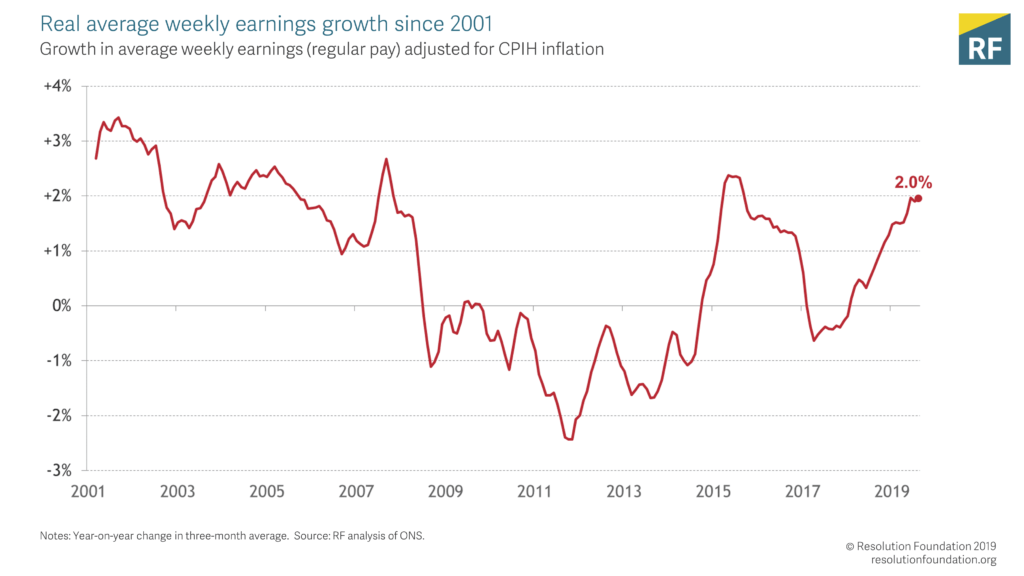
But alongside positive headlines are signs that the labour market is cooling. Certainly, things are no longer improving, either in terms of pay growth or employment – both nominal pay growth and the employment rate ticked downwards in the latest data. And so the question is – is the labour market at a turning point? How long will pay continue to grow at this rate?
The clearest signs of cooling are seen in measures of labour demand, and in the employment data. The number of unfilled vacancies has been falling for eight months in a row. There are 50,000 fewer vacancies now than at the beginning of the year, and the unemployment-to-vacancies ratio (a measure of labour market slack) has bottomed out. On employment – the employment rate ticked down by 0.2 percentage points over the latest quarter to 75.9 per cent, and the unemployment rate ticked upwards slightly.
Continue reading
On headline measures the labour market remains healthy. Conditions are tight and this continues to feed into decent real pay growth – 2.0 per cent in the three months to August 2019, not far off the levels we came to expect before the recession.
But alongside positive headlines are signs that the labour market is cooling. Certainly, things are no longer improving, either in terms of pay growth or employment – both nominal pay growth and the employment rate ticked downwards in the latest data. And so the question is – is the labour market at a turning point? How long will pay continue to grow at this rate?
The clearest signs of cooling are seen in measures of labour demand, and in the employment data. The number of unfilled vacancies has been falling for eight months in a row. There are 50,000 fewer vacancies now than at the beginning of the year, and the unemployment-to-vacancies ratio (a measure of labour market slack) has bottomed out. On employment – the employment rate ticked down by 0.2 percentage points over the latest quarter to 75.9 per cent, and the unemployment rate ticked upwards slightly.
Continue reading
Wednesday, 2 October 2019
The Treasury and Bank of England should prepare for a three-pronged economic shock from ‘no deal’
a post by Jack Leslie for the Resolution Foundation blog
It’s a well-worn trope that no one knows what the economic impact of a no deal Brexit would be. And for good reason. The scale of disruption at the border, in supply chains and in the wider economy, is impossible to predict with any accuracy. Much would depend on the timing and the success of the government’s preparations.
This is why estimates of the hit to the economy have varied so widely. The OECD has forecast the UK’s economy could be 3 per cent smaller by 2022 after a no deal. The Bank of England thinks it could be as much as 6 per cent in a ‘disorderly’ Brexit. That would be catastrophic, though still far smaller than the 12 per cent hit to the economy in the two years following the financial crisis.
Given all this uncertainty, the natural reaction for economic policy makers might be to throw up their hands in defeat and decide to work out how best to support the economy if and when a no deal exit happens. But any delay risks making the impact of no deal worse.
So can the Treasury and the Bank of England prepare, even though no one knows how big the hit will be? Yes, is the unequivocal answer in new Resolution Foundation research.
You can continue reading the blog post or go straight to the PDF of the 35-page briefing
Dealing with no deal
Understanding the policy implications of leaving the EU without a formal agreement Richard Hughes, Jack Leslie, Cara Pacitti & James Smith (September 2019)
It’s a well-worn trope that no one knows what the economic impact of a no deal Brexit would be. And for good reason. The scale of disruption at the border, in supply chains and in the wider economy, is impossible to predict with any accuracy. Much would depend on the timing and the success of the government’s preparations.
This is why estimates of the hit to the economy have varied so widely. The OECD has forecast the UK’s economy could be 3 per cent smaller by 2022 after a no deal. The Bank of England thinks it could be as much as 6 per cent in a ‘disorderly’ Brexit. That would be catastrophic, though still far smaller than the 12 per cent hit to the economy in the two years following the financial crisis.
Given all this uncertainty, the natural reaction for economic policy makers might be to throw up their hands in defeat and decide to work out how best to support the economy if and when a no deal exit happens. But any delay risks making the impact of no deal worse.
So can the Treasury and the Bank of England prepare, even though no one knows how big the hit will be? Yes, is the unequivocal answer in new Resolution Foundation research.
You can continue reading the blog post or go straight to the PDF of the 35-page briefing
Dealing with no deal
Understanding the policy implications of leaving the EU without a formal agreement Richard Hughes, Jack Leslie, Cara Pacitti & James Smith (September 2019)
Thursday, 12 September 2019
The labour market is delivering on jobs and pay – it is vital for living standards that we keep it that way
a post by Nye Cominetti for the Resolution Foundation blog
A tight labour market is finally delivering decent pay growth. In the three months to July 2019, average weekly regular pay (i.e. excluding bonuses) grew by 1.9 per cent on the previous year (slightly down on the previous month). Given that average real pay grew by 2.1 per cent in the eight years prior to the crisis, we can safely say now that we more or less back to ‘normal’ on pay growth. And with employment (and unemployment) little changed in recent months – at record highs and close to record lows respectively – it looks like the labour market has settled into a healthy holding pattern.
But we should not take this for granted – it has taken ten years to get the economy delivering on both jobs and pay. And there remains an underlying fragility. We only have to look back to 2015 to see that a recovery can turn sour quickly. Then it was the Brexit vote, with the ensuing fall in the value of the pound and the jump in inflation choking off real pay growth. Today, stronger real pay growth is underpinned by stable inflation at normal levels, so we can be more confident that recent growth rates will be sustained. But this assumes, of course, that we do not suffer an economic shock. Our newly healthy labour market would surely not survive the economic disruption that would accompany a no-deal Brexit.
Continue reading
A tight labour market is finally delivering decent pay growth. In the three months to July 2019, average weekly regular pay (i.e. excluding bonuses) grew by 1.9 per cent on the previous year (slightly down on the previous month). Given that average real pay grew by 2.1 per cent in the eight years prior to the crisis, we can safely say now that we more or less back to ‘normal’ on pay growth. And with employment (and unemployment) little changed in recent months – at record highs and close to record lows respectively – it looks like the labour market has settled into a healthy holding pattern.
But we should not take this for granted – it has taken ten years to get the economy delivering on both jobs and pay. And there remains an underlying fragility. We only have to look back to 2015 to see that a recovery can turn sour quickly. Then it was the Brexit vote, with the ensuing fall in the value of the pound and the jump in inflation choking off real pay growth. Today, stronger real pay growth is underpinned by stable inflation at normal levels, so we can be more confident that recent growth rates will be sustained. But this assumes, of course, that we do not suffer an economic shock. Our newly healthy labour market would surely not survive the economic disruption that would accompany a no-deal Brexit.
Continue reading
Friday, 5 July 2019
Who owns Britain’s £13tn wealth?
a post by George Bangham for the Resolution Foundation blog
Britain is in the middle of a decades-long wealth boom. Total wealth now stands at a record £12.8tn, or almost 13 million millions. But where you live, and when you were born plays a big part in how much of that wealth you are likely to own.
In the 1960s and 1970s, Britain’s collective wealth – the value of our property, pensions and savings – was about three times as big as the UK economy’s national output, or GDP. But since the 1980s, as wealth has boomed, it has surged to close to seven times the size of annual GDP. This growth continued even through the 2007-8 financial crises.
Continue reading – there are several very useful charts which show much more clearly than words (at least for me they do) what this is all about.
Britain is in the middle of a decades-long wealth boom. Total wealth now stands at a record £12.8tn, or almost 13 million millions. But where you live, and when you were born plays a big part in how much of that wealth you are likely to own.
In the 1960s and 1970s, Britain’s collective wealth – the value of our property, pensions and savings – was about three times as big as the UK economy’s national output, or GDP. But since the 1980s, as wealth has boomed, it has surged to close to seven times the size of annual GDP. This growth continued even through the 2007-8 financial crises.
Continue reading – there are several very useful charts which show much more clearly than words (at least for me they do) what this is all about.
Thursday, 13 June 2019
Young people are no longer footloose and fancy free – and rent rises are to blame
an article by Lindsay Judge for i news [via the Resolution Foundation blog]
In 1997, moving from Telford to Birmingham would mean a 14 per cent financial gain. Today, it would leave someone worse off

Millennials, eh? They never stand still. Always on the move, with their ‘portfolio careers’, side hustles in the gig economy, and no loyalty to the companies they work for. With an attitude like that, it’s no wonder they struggle to find decent work and pay.
There’s only one problem with this common trope though. It’s not true. Well apart from the struggle for decent pay – millennials who left education during the crisis are still feeling the effects in their pay packets and career prospects today.
In fact, young people today are moving jobs less than they were 20 years ago, and they’re even less likely to move areas to take up a new role. Resolution Foundation analysis of official labour market statistics finds that just 18,000 young people started a new job and moved home last year, compared to 30,000 in 1997.
Continue reading
In 1997, moving from Telford to Birmingham would mean a 14 per cent financial gain. Today, it would leave someone worse off
Millennials, eh? They never stand still. Always on the move, with their ‘portfolio careers’, side hustles in the gig economy, and no loyalty to the companies they work for. With an attitude like that, it’s no wonder they struggle to find decent work and pay.
There’s only one problem with this common trope though. It’s not true. Well apart from the struggle for decent pay – millennials who left education during the crisis are still feeling the effects in their pay packets and career prospects today.
In fact, young people today are moving jobs less than they were 20 years ago, and they’re even less likely to move areas to take up a new role. Resolution Foundation analysis of official labour market statistics finds that just 18,000 young people started a new job and moved home last year, compared to 30,000 in 1997.
Continue reading
Monday, 20 May 2019
Coming of age during a downturn can cause scarring – and it takes up to a decade to heal
a post by Stephen Clarke for the Resolution Foundation blog
Recessions are bad for people’s standard of living. And they’re particularly bad for young people. That’s the painful lesson we learnt after the 1980s recession where, for most of that decade, at least one in seven people under 30 were unemployed.
We know a lot about the unemployment scarring of the 1980s – from the rich academic literature, to UB40 or Shane Meadows’ This is England. But we’re only now beginning to learn what kind of long-term impacts the last big recession has had on young people.
While there’s never a good time to experience a recession, it’s particularly unlucky to come of age during one. What that bad luck means in terms of how much you earn, or what job you do, is something the Resolution Foundation has explored by looking at the ‘crisis cohort’ who left school, college or university between 2008 and 2011.
First, the good news. Although the recent downturn was far bigger than the 80s and early 90s recessions, it didn’t spur the big spike in youth unemployment that many feared. The recovery was quick, and Britain returned to record employment by early 2015. Instead, the pain of the recession was shared across more young people, through a deep pay squeeze. Now the biggest pay squeeze since the Napoleonic Wars isn’t pretty. But spreading the pain of a recession through everyone’s pay packets is certainly much fairer than concentrating the pain on those joining the dole queues, as occurred in the 1980s.
Continue reading
Recessions are bad for people’s standard of living. And they’re particularly bad for young people. That’s the painful lesson we learnt after the 1980s recession where, for most of that decade, at least one in seven people under 30 were unemployed.
We know a lot about the unemployment scarring of the 1980s – from the rich academic literature, to UB40 or Shane Meadows’ This is England. But we’re only now beginning to learn what kind of long-term impacts the last big recession has had on young people.
While there’s never a good time to experience a recession, it’s particularly unlucky to come of age during one. What that bad luck means in terms of how much you earn, or what job you do, is something the Resolution Foundation has explored by looking at the ‘crisis cohort’ who left school, college or university between 2008 and 2011.
First, the good news. Although the recent downturn was far bigger than the 80s and early 90s recessions, it didn’t spur the big spike in youth unemployment that many feared. The recovery was quick, and Britain returned to record employment by early 2015. Instead, the pain of the recession was shared across more young people, through a deep pay squeeze. Now the biggest pay squeeze since the Napoleonic Wars isn’t pretty. But spreading the pain of a recession through everyone’s pay packets is certainly much fairer than concentrating the pain on those joining the dole queues, as occurred in the 1980s.
Continue reading
Wednesday, 10 April 2019
New year, new era: tax and spend in 21st Century Britain
a post by Torsten Bell for the Resolution Foundation blog
Eras of Britain’s political economy come and go. They ebb and flow, driven by political and economic cycles. Sometimes shifts are hard to see at the time, particularly when they are obscured by the political fog of war. Or Brexit, as it’s currently known. But noticed or not, the financial year starting this Saturday will mark the end of an era – bringing the curtain down on the post-financial crisis austerity of David Cameron and George Osborne.
It will mark the end of an era because it will be the last year we see the three components of the post-crisis economic policy framework in action – cuts to many public services, a retrenchment of social security, and significant income tax cuts that increase the heavy lifting required of the first two.
On public services the year to come is the final one of George Osborne’s Autumn 2015 spending review. This means unprotected departments, not prioritised like the NHS, continuing to see major cuts. The Ministry of Justice and HMRC both face cuts in spending per capita of just over 8 per cent, on top of reductions of 48 and 37 per cent respectively since 2009-10.
On Saturday the Income Tax Personal Allowance (PTA) and Higher Rate Threshold (HRT) will increase to £12,500 and £50,000 respectively, at a cost of £2.8 billion. These build on a series of such tax cuts since 2011. This year’s will, however, be particularly heavily skewed towards higher earners – with the large HRT rise taking up almost half the long-run cost.
Continue reading
Eras of Britain’s political economy come and go. They ebb and flow, driven by political and economic cycles. Sometimes shifts are hard to see at the time, particularly when they are obscured by the political fog of war. Or Brexit, as it’s currently known. But noticed or not, the financial year starting this Saturday will mark the end of an era – bringing the curtain down on the post-financial crisis austerity of David Cameron and George Osborne.
It will mark the end of an era because it will be the last year we see the three components of the post-crisis economic policy framework in action – cuts to many public services, a retrenchment of social security, and significant income tax cuts that increase the heavy lifting required of the first two.
On public services the year to come is the final one of George Osborne’s Autumn 2015 spending review. This means unprotected departments, not prioritised like the NHS, continuing to see major cuts. The Ministry of Justice and HMRC both face cuts in spending per capita of just over 8 per cent, on top of reductions of 48 and 37 per cent respectively since 2009-10.
On Saturday the Income Tax Personal Allowance (PTA) and Higher Rate Threshold (HRT) will increase to £12,500 and £50,000 respectively, at a cost of £2.8 billion. These build on a series of such tax cuts since 2011. This year’s will, however, be particularly heavily skewed towards higher earners – with the large HRT rise taking up almost half the long-run cost.
Continue reading
Monday, 1 April 2019
My Generation, Baby: The Politics of Age in Brexit Britain
a post by Laura Gardiner and Torsten Bell for the Resolution Foundation blog
Generational politics is nothing new, but the extent of the profound generational cleavage that has emerged in British electoral politics is novel. The Brexit vote and the 2017 general election put generational politics centre‐stage, eclipsing in some ways the traditionally dominant role of class. Our two main parties now rely on age‐based coalitions of support—on the votes of the young in the case of Labour and the old in the case of the Conservatives. Both are severely constrained in their ability to spread their support to other age groups and, partly as a result, to form a government with a significant majority. This matters for understanding the cut and thrust of British politics today, but its importance only grows when we look ahead.
Both sides may be tempted to view this as an equilibrium they can live with, as Labour believes it has the voters of the future and the Conservatives rely on the age groups most likely to actually vote. But the risk is that this ‘generational lock’ on our politics blocks a much‐needed progressive governing shift for post‐Brexit Britain—a shift to address two crucial, but generationally charged, economic challenges.
First, the need to support young people’s living standards, because the expectation of each generation doing significantly better than their predecessors is not being met for younger cohorts today.
And second, delivering and, crucially, paying for the health and care that a growing older population will need as the large baby boomer generation retires. Such a governing agenda will involve trade‐offs that a generationally polarised politics hinders at best, and blocks at worst.
Continue reading
Generational politics is nothing new, but the extent of the profound generational cleavage that has emerged in British electoral politics is novel. The Brexit vote and the 2017 general election put generational politics centre‐stage, eclipsing in some ways the traditionally dominant role of class. Our two main parties now rely on age‐based coalitions of support—on the votes of the young in the case of Labour and the old in the case of the Conservatives. Both are severely constrained in their ability to spread their support to other age groups and, partly as a result, to form a government with a significant majority. This matters for understanding the cut and thrust of British politics today, but its importance only grows when we look ahead.
Both sides may be tempted to view this as an equilibrium they can live with, as Labour believes it has the voters of the future and the Conservatives rely on the age groups most likely to actually vote. But the risk is that this ‘generational lock’ on our politics blocks a much‐needed progressive governing shift for post‐Brexit Britain—a shift to address two crucial, but generationally charged, economic challenges.
First, the need to support young people’s living standards, because the expectation of each generation doing significantly better than their predecessors is not being met for younger cohorts today.
And second, delivering and, crucially, paying for the health and care that a growing older population will need as the large baby boomer generation retires. Such a governing agenda will involve trade‐offs that a generationally polarised politics hinders at best, and blocks at worst.
Continue reading
Friday, 22 March 2019
Taking stock of skills and education in Brexit Britain
a post by Kathleen Henehan for the Resolution Foundation blog
The skills and qualifications held by the British workforce have come under increased scrutiny lately, tied as they are to the Brexit-related migration debate. Some have argued that ‘turning off the tap’ of migrant labour will cause immediate, and substantial, recruitment difficulties for firms. Others maintain that reduced levels of migration could compel educators and employers to put renewed focus on upskilling UK-based workers.
Regardless of whether you view Brexit as a skills-related challenge, or an opportunity, now seems a good time to stock of where Britain is on educational attainment, and where we might be heading.
Continue reading
The skills and qualifications held by the British workforce have come under increased scrutiny lately, tied as they are to the Brexit-related migration debate. Some have argued that ‘turning off the tap’ of migrant labour will cause immediate, and substantial, recruitment difficulties for firms. Others maintain that reduced levels of migration could compel educators and employers to put renewed focus on upskilling UK-based workers.
Regardless of whether you view Brexit as a skills-related challenge, or an opportunity, now seems a good time to stock of where Britain is on educational attainment, and where we might be heading.
Continue reading
Tuesday, 29 January 2019
Five key takeaways on UK household spending
a post by L:aura Gardiner for the Resolution Foundation blog
Yesterday [24 January] the Office for National Statistics (ONS) published its annual rundown of what UK households spend their money on. Quite a bit of the ONS’s analysis focused on who spends most on takeaways. But given household consumption is perhaps the most detailed and direct window on current living standards, there’s plenty more of interest in this treasure trove of information. Here are our five key takeaways (of the non-edible kind).
Household spending appeared to rise gently in the year to 2017-18
Average weekly household spending was £573 during 2017-18, a gentle 0.7 per cent increase on the previous year (after adjusting for inflation). As the blue line in the chart below shows, this means we’ve had five years of almost-continuous growth in real spending – a trend mirrored in household income data, and consumption aggregates from the National Accounts.
Growth in spending was skewed towards higher-income households last year
It will come as no surprise that richer households spend more than poorer ones. The chart below shows that in 2017-18 those in the top 10 per cent of incomes spent over four times more than the bottom 10 per cent. Although large, this gap is smaller than the income differences between the top and bottom – further proof that the rich save more of the money they have coming in.
Essentials comprise nearly half of spending for the lowest-income households, compared to less than a third for those on the highest incomes
Beyond the overall value of spending, what are households spending money on? The chart below splits average spending in each income decile into different categories, with darker bars showing those categories commonly classed as ‘essentials’ (housing, fuel, food and clothing). 49 per cent of spending in the bottom income decile was devoted to essentials in 2017-18, compared to 29 per cent in the top decile.
Households headed by younger retirees spend most per-person overall, but those in their 20s spend most on essentials
Household spending varies across the life cycle and peaks when adults are in their 30s and 40s, in a large part because these households tend to be larger due to bringing up children. To correct for this, the chart below presents spending on a per-person basis, showing that on this measure it is households headed by those aged 50-75 that spend most overall.
Household spending patterns provide a window on wider social, cultural and economic shifts
The rich detail provided by spending data means it can be illuminating to wider debates about how life and work in Britain are changing. Perhaps wishing to keep up with the current focus on Deliveroo-type jobs, the ONS’s publication shines a light on the £5.10 per week UK households spend on takeaways, which make up a greater share of ‘catering services’ spending for the young and those on lower incomes. It also shows that we spend less on alcohol than we did a decade ago and do more of our drinking at home. This chimes with the ONS’s earlier work on the decline of small pubs, as consumers increasingly favour larger ones that focus on gastro menus rather than actual booze.
Details under each of these headings can be found here together with graphs and charts
Yesterday [24 January] the Office for National Statistics (ONS) published its annual rundown of what UK households spend their money on. Quite a bit of the ONS’s analysis focused on who spends most on takeaways. But given household consumption is perhaps the most detailed and direct window on current living standards, there’s plenty more of interest in this treasure trove of information. Here are our five key takeaways (of the non-edible kind).
Household spending appeared to rise gently in the year to 2017-18
Average weekly household spending was £573 during 2017-18, a gentle 0.7 per cent increase on the previous year (after adjusting for inflation). As the blue line in the chart below shows, this means we’ve had five years of almost-continuous growth in real spending – a trend mirrored in household income data, and consumption aggregates from the National Accounts.
Growth in spending was skewed towards higher-income households last year
It will come as no surprise that richer households spend more than poorer ones. The chart below shows that in 2017-18 those in the top 10 per cent of incomes spent over four times more than the bottom 10 per cent. Although large, this gap is smaller than the income differences between the top and bottom – further proof that the rich save more of the money they have coming in.
Essentials comprise nearly half of spending for the lowest-income households, compared to less than a third for those on the highest incomes
Beyond the overall value of spending, what are households spending money on? The chart below splits average spending in each income decile into different categories, with darker bars showing those categories commonly classed as ‘essentials’ (housing, fuel, food and clothing). 49 per cent of spending in the bottom income decile was devoted to essentials in 2017-18, compared to 29 per cent in the top decile.
Households headed by younger retirees spend most per-person overall, but those in their 20s spend most on essentials
Household spending varies across the life cycle and peaks when adults are in their 30s and 40s, in a large part because these households tend to be larger due to bringing up children. To correct for this, the chart below presents spending on a per-person basis, showing that on this measure it is households headed by those aged 50-75 that spend most overall.
Household spending patterns provide a window on wider social, cultural and economic shifts
The rich detail provided by spending data means it can be illuminating to wider debates about how life and work in Britain are changing. Perhaps wishing to keep up with the current focus on Deliveroo-type jobs, the ONS’s publication shines a light on the £5.10 per week UK households spend on takeaways, which make up a greater share of ‘catering services’ spending for the young and those on lower incomes. It also shows that we spend less on alcohol than we did a decade ago and do more of our drinking at home. This chimes with the ONS’s earlier work on the decline of small pubs, as consumers increasingly favour larger ones that focus on gastro menus rather than actual booze.
Details under each of these headings can be found here together with graphs and charts
Friday, 4 January 2019
How wealth taxes can raise billions more without scaring any horses
a post by Torsten Bell and Adam Corlett for the Resolution Foundation blog
Raising taxes is never easy. Raising taxes with the government’s slim parliamentary majority is harder still. Raising taxes on wealth in those circumstances, given our diverging senses of fairness is… not a walk in the park. But that doesn’t mean it doesn’t need doing, and the good news is that significant progress can be made despite these constraints.
There are three reasons it is needed. First, one of the biggest challenges facing our country is how to fund the rising cost of public service provision as the population ages. This demographic headwind and wider health cost pressures are set to increase the price tag of the current welfare state by £36 billion a year by 2030, and £84 billion by 2040. Crucially this is the cost of paying for what we’ve already got – not all the extensions to our welfare state, from extra childcare to badly needed social care provision, that are often called for. This isn’t just an issue for the future – managing these cost pressures and demand for new services, against the backdrop of a decade of austerity, will be exactly the challenge the late 2019 Spending Review will have to wrestle with (and changes to the accounting of student loans certainly won’t help the Chancellor).
Continue reading
Raising taxes is never easy. Raising taxes with the government’s slim parliamentary majority is harder still. Raising taxes on wealth in those circumstances, given our diverging senses of fairness is… not a walk in the park. But that doesn’t mean it doesn’t need doing, and the good news is that significant progress can be made despite these constraints.
There are three reasons it is needed. First, one of the biggest challenges facing our country is how to fund the rising cost of public service provision as the population ages. This demographic headwind and wider health cost pressures are set to increase the price tag of the current welfare state by £36 billion a year by 2030, and £84 billion by 2040. Crucially this is the cost of paying for what we’ve already got – not all the extensions to our welfare state, from extra childcare to badly needed social care provision, that are often called for. This isn’t just an issue for the future – managing these cost pressures and demand for new services, against the backdrop of a decade of austerity, will be exactly the challenge the late 2019 Spending Review will have to wrestle with (and changes to the accounting of student loans certainly won’t help the Chancellor).
Continue reading
Enforce the rules to help workers in Britain’s changing workforce
a post by Lindsay Judge for the Resolution Foundation blog
It’s here at last. Almost a year and a half after the Taylor Review was published and four consultations on, the government has finally released its plan of action to improve the quality of jobs in the UK. So is this an early Christmas present for the millions of people who work through an agency, are on a zero hour contract or find their jobs via a platform? Or simply a turkey for all of those in atypical work?
For agency workers there’s a certainly a big win: the commitment from government to repeal the ‘Swedish Derogation’, a piece of legislation that allows firms to pay agency workers who have been in post for three months-plus less than directly employed staff in the same job. From a living standards perspective that’s definitely good news, going some way to reducing the £400 a year pay penalty that agency workers experience simply because of the way they work. Moreover, the government has said it will take steps to provide agency workers with a clear statement of rights. Given we have flagged before that knowledge of holiday pay entitlements and auto-enrolment is particularly parlous, action on these fronts would be especially welcome.
Continue reading
It’s here at last. Almost a year and a half after the Taylor Review was published and four consultations on, the government has finally released its plan of action to improve the quality of jobs in the UK. So is this an early Christmas present for the millions of people who work through an agency, are on a zero hour contract or find their jobs via a platform? Or simply a turkey for all of those in atypical work?
For agency workers there’s a certainly a big win: the commitment from government to repeal the ‘Swedish Derogation’, a piece of legislation that allows firms to pay agency workers who have been in post for three months-plus less than directly employed staff in the same job. From a living standards perspective that’s definitely good news, going some way to reducing the £400 a year pay penalty that agency workers experience simply because of the way they work. Moreover, the government has said it will take steps to provide agency workers with a clear statement of rights. Given we have flagged before that knowledge of holiday pay entitlements and auto-enrolment is particularly parlous, action on these fronts would be especially welcome.
Continue reading
Thursday, 4 October 2018
Alternative paths to success? The jobs landscape facing young non-graduates today
a post by Conor D'Archy and Kathleen Henehan for the Resolution Foundation blog
From photos of jumping A level students to guides to freshers’ week, at this time of year it can feel like university is the only route taken by teenagers. But in fact, fewer than half of young people follow this seemingly well-trodden path at 18. And, as this morning’s ONS publication about non-graduates’ employment patterns reminds us, non-graduates are a diverse group with diverse outcomes in the world of work.
During 2017, the employment rate for non-graduates aged 22-29 was 78 per cent, compared to 90 per cent for their similarly-aged graduate counterparts. The proportion of young non-graduates classed as ‘economically inactive’ (meaning those not available nor looking for work) was 17 per cent, compared to just 6 percent for young graduates.
It would be wrong to think of non-graduates as a homogeneous block. As the chart below illustrates, roughly 60 per cent of today’s 22-29 year-olds are without a bachelor’s degree. But educational attainment varies widely within this group: 7 per cent of 22-29 year-olds have a Level 4 or 5 qualification (higher education below degree-level), nearly a quarter (24 per cent) have a Level 3 (A level or equivalent) qualification and just below a quarter (23 per cent) have a Level 2 (GCSE or equivalent) qualification. Another 8 per cent either have no formal qualifications or qualifications classed as ‘other.’
Continue reading
From photos of jumping A level students to guides to freshers’ week, at this time of year it can feel like university is the only route taken by teenagers. But in fact, fewer than half of young people follow this seemingly well-trodden path at 18. And, as this morning’s ONS publication about non-graduates’ employment patterns reminds us, non-graduates are a diverse group with diverse outcomes in the world of work.
During 2017, the employment rate for non-graduates aged 22-29 was 78 per cent, compared to 90 per cent for their similarly-aged graduate counterparts. The proportion of young non-graduates classed as ‘economically inactive’ (meaning those not available nor looking for work) was 17 per cent, compared to just 6 percent for young graduates.
It would be wrong to think of non-graduates as a homogeneous block. As the chart below illustrates, roughly 60 per cent of today’s 22-29 year-olds are without a bachelor’s degree. But educational attainment varies widely within this group: 7 per cent of 22-29 year-olds have a Level 4 or 5 qualification (higher education below degree-level), nearly a quarter (24 per cent) have a Level 3 (A level or equivalent) qualification and just below a quarter (23 per cent) have a Level 2 (GCSE or equivalent) qualification. Another 8 per cent either have no formal qualifications or qualifications classed as ‘other.’
Continue reading
Tuesday, 26 June 2018
No, the poorest don’t pay higher taxes than the richest
a post by Adam Corlett for the Resolution Foundation blog
We all know that parts of the tax system are very progressive – and this should be very apparent in the Autumn Statement when the Chancellor unveils perhaps £10 billion of tax rises that will target the wealthy. But wait, some say, when you factor in taxes such as VAT it’s actually poorer households that pay more tax.
That claim is usually based on the annual “Effects of taxes and benefits on UK household income” release, which was updated today with results for 2016-17. This looks at different sources of household incomes, including employment income and benefits, as well as the amounts paid in direct taxes like income tax and indirect taxes like VAT or tobacco duty. The data also allocates the benefits associated with the consumption of some public services, such as subsidised rail travel or the NHS, across different households. As such, it’s a fairly unique and invaluable resource.
Taken at face value, today’s 2016-17 data seems to confirm that the poorest tenth of households do pay more of their income (49 per cent) in tax than the richest tenth do (34 per cent). But the bottom line is that this data for the poorest is incorrect.
Continue reading
We all know that parts of the tax system are very progressive – and this should be very apparent in the Autumn Statement when the Chancellor unveils perhaps £10 billion of tax rises that will target the wealthy. But wait, some say, when you factor in taxes such as VAT it’s actually poorer households that pay more tax.
That claim is usually based on the annual “Effects of taxes and benefits on UK household income” release, which was updated today with results for 2016-17. This looks at different sources of household incomes, including employment income and benefits, as well as the amounts paid in direct taxes like income tax and indirect taxes like VAT or tobacco duty. The data also allocates the benefits associated with the consumption of some public services, such as subsidised rail travel or the NHS, across different households. As such, it’s a fairly unique and invaluable resource.
Taken at face value, today’s 2016-17 data seems to confirm that the poorest tenth of households do pay more of their income (49 per cent) in tax than the richest tenth do (34 per cent). But the bottom line is that this data for the poorest is incorrect.
Continue reading
Sunday, 20 May 2018
There’s something off-key about our approach to inheritance tax
a post by Mattew Whittaker for the Resolution Foundation
It takes something to be crowned Britain’s most hated tax – a bit like being the UK’s worst ever Eurovision entry – but that is the unwanted title held by inheritance tax. It doesn’t help that it’s a tax that’s unavoidably associated with the death of loved ones. And complexity is undoubtedly a problem too. But by far the biggest issue is the sense of inherent unfairness – there’s something fundamentally off-key about inheritance tax.
Just one-in-five of us think the current approach is “fair” – somewhat lower than for any other tax. It’s viewed as a double taxation of those who have earned the wealth and who have now had the temerity to die and pass their assets onto grieving families. With a flat rate of 40 per cent (above the nil-rate band), it’s also considered high – much higher than the 20 per cent income tax rate most people are familiar with. But it’s also regarded as a tax that is ‘voluntary’ for the super-rich and well-advised, with a range of reliefs and gifting rules that make it too easy – for some – to avoid.
That’s why any proposals for reform are treated with suspicion. It’s also why the review launched this week by the Office of Tax Simplification is important but tough. It will undoubtedly uncover useful insights and offer sensible options for improvement, but our view is that we need to move beyond tinkering. As our new report for the Intergenerational Commission argues, a much better approach would be to overhaul inheritance tax entirely. Done right, there’s the potential to raise significantly more money while simultaneously making it more popular.
Continue reading
It takes something to be crowned Britain’s most hated tax – a bit like being the UK’s worst ever Eurovision entry – but that is the unwanted title held by inheritance tax. It doesn’t help that it’s a tax that’s unavoidably associated with the death of loved ones. And complexity is undoubtedly a problem too. But by far the biggest issue is the sense of inherent unfairness – there’s something fundamentally off-key about inheritance tax.
Just one-in-five of us think the current approach is “fair” – somewhat lower than for any other tax. It’s viewed as a double taxation of those who have earned the wealth and who have now had the temerity to die and pass their assets onto grieving families. With a flat rate of 40 per cent (above the nil-rate band), it’s also considered high – much higher than the 20 per cent income tax rate most people are familiar with. But it’s also regarded as a tax that is ‘voluntary’ for the super-rich and well-advised, with a range of reliefs and gifting rules that make it too easy – for some – to avoid.
That’s why any proposals for reform are treated with suspicion. It’s also why the review launched this week by the Office of Tax Simplification is important but tough. It will undoubtedly uncover useful insights and offer sensible options for improvement, but our view is that we need to move beyond tinkering. As our new report for the Intergenerational Commission argues, a much better approach would be to overhaul inheritance tax entirely. Done right, there’s the potential to raise significantly more money while simultaneously making it more popular.
Continue reading
Monday, 14 May 2018
10 policies if you think you might want a Universal Basic Income but aren’t sure
a post by Adam Corlett for the Resolution Foundation blog
Universal Basic Income (UBI) is the policy idea du jour, especially among Labour, Lib Dem, SNP and Green members. But those three words by themselves are not a policy.
The concept draws support for a range of different – and sometimes contradictory – reasons, and a UBI could be designed in countless ways with vastly different results. In addition, the debate often fails to engage with the real-life benefits system we already have.
To help clarify which aspects of a UBI really matter to you, and which aspects may not be so appealing, here’s a set of thought experiments: what a UBI manifesto for incrementalists might look like (not all of them necessarily welcome). It shows that there are good ideas to be taken from the concept and the motivations behind it, but that UBI may not be the only or best way to achieve particular goals.
Continue reading
Universal Basic Income (UBI) is the policy idea du jour, especially among Labour, Lib Dem, SNP and Green members. But those three words by themselves are not a policy.
The concept draws support for a range of different – and sometimes contradictory – reasons, and a UBI could be designed in countless ways with vastly different results. In addition, the debate often fails to engage with the real-life benefits system we already have.
To help clarify which aspects of a UBI really matter to you, and which aspects may not be so appealing, here’s a set of thought experiments: what a UBI manifesto for incrementalists might look like (not all of them necessarily welcome). It shows that there are good ideas to be taken from the concept and the motivations behind it, but that UBI may not be the only or best way to achieve particular goals.
Continue reading
Saturday, 31 March 2018
Council tax is a farce – it’s time for a real property tax
a post by Laura Gardiner for the Resolution Foundation blog
It’s an open secret that council tax is a dog’s dinner. It was conjured up in the early 1990s as a half-way house between the hated ‘poll tax’ and the old domestic rates system, meaning those in top-band properties have much lower tax rates than those in cheaper homes. In England and Scotland, it is based on valuations that are 27 years out of date. And it allows local authorities with the highest property wealth to charge the lowest rates of all.
The result is that council tax only weakly relates to property values, and is therefore highly regressive. On average those living in £100,000 homes pay around five times the tax rate of those living in £1 million mansions. And a fifteen-minute walk in South London can take you from a £2.1 million flat with a £700 council tax bill to a £400,000 flat with a council tax bill 66 per cent higher. The ‘property tax’ label council tax gets given is a farce – it looks far more like the poll tax it replaced.
So why isn’t council tax a major political battleground? Politicians may be wary of touching it given it is used to finance local government. Or they may be scarred by botched revaluation attempts. Or maybe it reflects the national mood where wealth – of which property is a major part – is much less often discussed than incomes despite being huge and much more unequal.
Continue reading
It’s an open secret that council tax is a dog’s dinner. It was conjured up in the early 1990s as a half-way house between the hated ‘poll tax’ and the old domestic rates system, meaning those in top-band properties have much lower tax rates than those in cheaper homes. In England and Scotland, it is based on valuations that are 27 years out of date. And it allows local authorities with the highest property wealth to charge the lowest rates of all.
The result is that council tax only weakly relates to property values, and is therefore highly regressive. On average those living in £100,000 homes pay around five times the tax rate of those living in £1 million mansions. And a fifteen-minute walk in South London can take you from a £2.1 million flat with a £700 council tax bill to a £400,000 flat with a council tax bill 66 per cent higher. The ‘property tax’ label council tax gets given is a farce – it looks far more like the poll tax it replaced.
So why isn’t council tax a major political battleground? Politicians may be wary of touching it given it is used to finance local government. Or they may be scarred by botched revaluation attempts. Or maybe it reflects the national mood where wealth – of which property is a major part – is much less often discussed than incomes despite being huge and much more unequal.
Continue reading
Wednesday, 28 March 2018
Not quite pay growth party-time yet
a post by Stephen Clarke for the Resolution Foundation blog

Today [21 March 2018] the ONS published the latest pay growth figures covering the year to January. These, along with yesterday’s inflation data, suggest that the squeeze which has dragged down real pay for twelve months is finally over.
However, at the risk of sounding Eeyore-ish, pay growth is likely to remain subdued for the rest of the year, if not longer. Nominal pay growth is currently running at 2.6 per cent and, although inflation is falling, if it settles at 2 per cent then the best we can look forward to is pay growth of around 0.6 per cent this year.
Continue reading
Today [21 March 2018] the ONS published the latest pay growth figures covering the year to January. These, along with yesterday’s inflation data, suggest that the squeeze which has dragged down real pay for twelve months is finally over.
However, at the risk of sounding Eeyore-ish, pay growth is likely to remain subdued for the rest of the year, if not longer. Nominal pay growth is currently running at 2.6 per cent and, although inflation is falling, if it settles at 2 per cent then the best we can look forward to is pay growth of around 0.6 per cent this year.
Continue reading
Subscribe to:
Posts (Atom)

