Showing posts with label women_workers. Show all posts

Monday, 18 November 2019

Feel poor, work more – the real reason behind Britain’s record employment

an article by Torsten Bell for the Resolution Foundation

Why are three million more of us working today than were back in 2008? How has our employment rate reached 76 per cent, when full employment before the crisis meant 73 per cent of us working?

These are employment levels no-one thought possible a decade ago. There is almost no bigger change to our economy over the past decade than its jobs boom. And yet it is poorly understood.
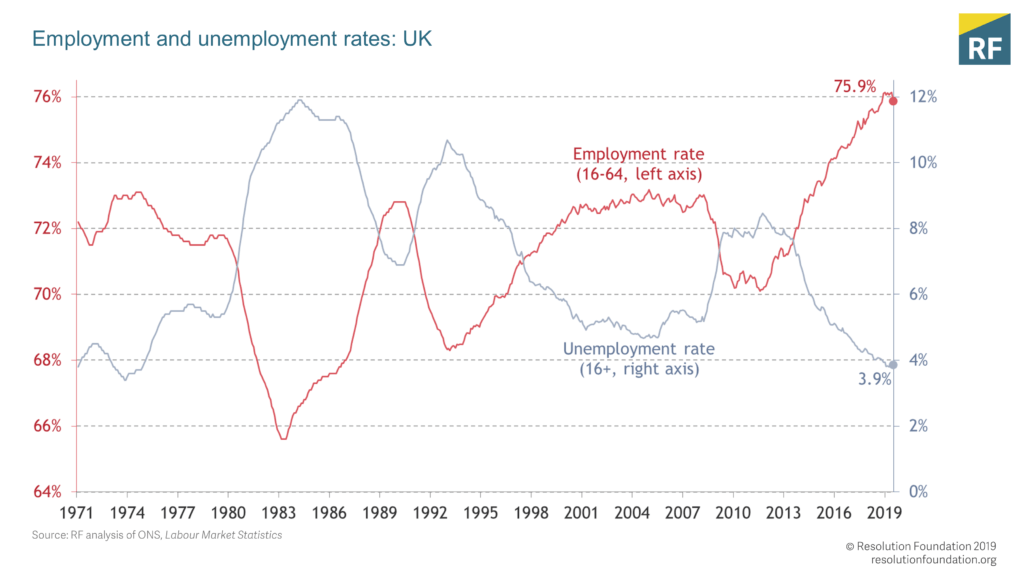


So why are so many of us working? Because we’re a lot poorer than we expected to be. That’s the fundamental cause of record employment.

Some have argued that actually policy changes are key. Conservative and Labour politicians, for very different reasons, like to say it’s because of the UK’s flexible labour market. It’s true that flexibility has enabled swift employment growth, and the less welcome rise in insecure work within it. But it cannot explain why more people are working today than before the crisis for the simple reason that the labour market is not significantly more flexible than it was in 2008.

Conservative ministers often say the jobs boom is because of Universal Credit and the better incentives to work it provides. But this rather misses the fact that the new benefit’s roll-out has been so slow that it only accounted for two per cent of the working-age population as late as 2018 – five years into the employment boom.

Continue reading


Wednesday, 27 March 2019

Gender disparities in European labour markets: A comparison of conditions for men and women in paid employment

an article by Rosalia Castellano and Antonella Rocca (Parthenope University of Naples, Italy) published in International Labour Review Volume 157 Number 4 (December 2018)

Abstract

Although the dramatic increase in female labour force participation in recent decades has been connected to significant changes in economic opportunities for women, gender disparities in the labour market persist in many forms.

This article seeks to assess whether higher gender differentials in European labour markets are directly related to poor economic conditions.

To this end, the results of a composite indicator designed and developed by the authors in a previous study are updated and three new composite indicators are constructed for a separate analysis of female and male labour market conditions and gender gap for paid employment.

Full text (PDF 20pp)


Monday, 18 March 2019

‘We Were the Ones Really Doing Something About It’: Gender and Mobilisation against Factory Closure

an article by Margaret Robertson (Retired, Scotland) and Andy Clark (Newcastle University, UK) published in Work, Employment and Society Volume 33 Issue 2 (April 2019)

Abstract

Current understandings of worker mobilisation against factory closure and capital migration in Britain are dominated by the perspectives of male industrial workers. The narratives of displaced miners, shipbuilders and steel workers are prominent in the historiography and collective memories of deindustrialisation.

There is considerably less understanding of the response of female manufacturing workers to these processes and the ways in which women mobilised in opposition to the free movement of capital.

This article presents the testimony of Margaret Robertson, shop steward at the Lee Jeans factory in Greenock, Scotland, where the predominantly female workforce conducted a successful seven-month occupation in opposition to proposed closure beginning in February 1981.

The contribution highlights the specific gendered challenges encountered by women workers. The occupation occurred in a period of accelerated factory closure in Britain, yet supporting female unionists resisting job loss was not a priority for the male-dominated union executive.

Full text (PDF 9pp)


Friday, 12 June 2015

Women at Work! Evaluating Equal Employment Policies and Outcomes in Construction

an article by Erica French (Queensland University of Technology, Brisbane) and Glenda Strachan (Griffith University, Brisbane) published in Equality, Diversity and Inclusion: An International Journal Volume 34 Issue 3 (March 2015)

Abstract

Purpose
The purpose of this paper is to examine equal employment policies in Australia’s male-dominated construction industry and categorise the types of activities undertaken against an equal employment typology to identify links to outcomes for women in the form of increased participation and management.

Design/methodology/approach
To explore the issue of low representation of women in construction through the content analysis of 83 construction organisations’ equal employment opportunity (EEO) reports.

Findings
This industry is not engaging with equal employment issues and the numbers of women working in the industry and/or management are based on individual decision rather than an institutional commitment to equality in diversity.

Research limitations/implications
Australian legislation mandates organisational reporting of relevant data and offers public access to this information offering a unique data set.

Practical implications
An ageing population means that the predominately older male workforce is leaving construction in greater numbers with fewer potential replacements making new labour markets a vital consideration.

Social implications
Legislation and organisational policies designed to promote EEO for women have existed in numerous countries for decades. One objective of this legislation was to reduce male domination in senior positions and industries/occupations where women were under-represented. Despite this, few women are employed in construction in operational or management roles worldwide.

Originality/value
This study offers a comprehensive analysis of a male-dominated industry in one jurisdiction rather than a few selected cases and uses a broader rigorous typology for analysis that acknowledges both equal and different treatment options.


Thursday, 22 August 2013

Working hard with gender: Gendered labour for women in male dominated occupations of manual trades and information technology (IT)

an article by Louisa Smith (University of Sydney, Australia) Equality, Diversity and Inclusion: An International Journal Volume 32 Issue 6 (2013)

Abstract

Purpose
Manual trades and information technology (IT) are male-dominated occupations and as such cultivate unique forms of hegemonic masculinity. Women entering these occupations represent a kind of crisis to this gender order in the workplace, making the experiences of these women a useful way of studying how gender regimes are maintained and may be challenged at work. The aim of this paper is to examine how women found doing gender in the male dominated workplaces became a kind of work in itself.

Design/methodology/approach
A life history framework was used for this research, in which 15 women from manual trades and 15 women from IT occupations were interviewed. The in-depth qualitative method allowed the participants the time and space to communicate the contradictions they experienced doing their gender and doing their gender at work.

Findings
The effort expended because the participants were women and because they were a minority was experienced both as an intense pressure and as significant to their success in their occupations. This indicates that gendered work outside of the formal duties of a job makes the work of those in a gender minority particularly strenuous. This understanding of gender at work as work is important to understanding how efforts to address gender equity in workplaces must work beyond quotas and policy and also address embodied gendered cultures.

Originality/value
While women working in male dominated cultures are often studied in terms of the challenges they face, from this research these challenges are framed as a kind of gendered work in itself. This work is often invisible, usually emotion work and mostly unrecognised. Highlighting the nature of this gendered labour and the pressures it places on women in male dominated work reframes what it means to work and the importance of these invisible forms of labour to maintaining successful production relations.


Wednesday, 26 June 2013

Performance, gender and sexualised work: Beyond management control, beyond legislation? A case study of work in a recruitment company

an article by Valerie Caven, Scott Lawley and Jocelyn Baker (Nottingham Trent University, UK) published in Equality, Diversity and Inclusion: An International Journal Volume 32 Issue 5 (2013)

Abstract

Purpose
Organisations seek to manage and control the dress, appearance and behaviour of their employees for strategic corporate advantage but what are the far-reaching implications of this for employers and employees? This paper aims to identify the explicit and implicit codes for appearance and behaviour imposed by management and co-workers.

Design/methodology/approach
Adopting a case study approach using ethnographic methods, this research, conducted in a recruitment agency specialising in placing construction industry personnel, draws on data obtained from four in-depth, semi-structured interviews with senior managers, a focus group with female employees and participant observation methods, and provides an intriguing insight into the grooming and packaging of female employees.

Findings
Findings show this aesthetic and behavioural “packaging” of the female employees comes with consequences for client, employer and employee. The females cannot escape the aesthetic and sexualised image imposed upon them as management strategy and often have no choice but to “perform” for clients to manipulate situations for their own advantage.

Research limitations/implications
Because of the research approach adopted and the relatively small sample size, generalisability is limited. It would be helpful to replicate the study in other settings.

Originality/value
The paper highlights the existence of official and unofficial controls over dress, appearance and behaviour and the pressure exerted on women in the workplace.