Showing posts with label Twitter. Show all posts

Friday, 4 October 2019

Feeling anxious? Perceiving anxiety in tweets using machine learning

an article by Dritjon Gruda and  Souleiman Hasan (National University of Ireland Maynooth) published in Computers in Human Behavior Volume 98 (September 2019)

Highlights

  • Predictive measurement tool to examine anxiety in tweets using a machine learning approach.
  • Machine learning approach depicts perceived user state-anxiety fluctuations and trait anxiety.
  • Perceived anxiety relates negatively to social engagement and popularity.
  • Implications include automatically assessing workers' wellbeing to reduce anxiety.


Abstract

This study provides a predictive measurement tool to examine perceived anxiety from a longitudinal perspective, using a non-intrusive machine learning approach to scale human rating of anxiety in microblogs.

Results suggest that our chosen machine learning approach depicts perceived user state-anxiety fluctuations over time, as well as mean trait anxiety.

We further find a reverse relationship between perceived anxiety and outcomes such as social engagement and popularity.

Implications on the individual, organizational, and societal levels are discussed.


Friday, 13 September 2019

Feeling alone among 317 million others: Disclosures of loneliness on Twitter

an article by Jamie Mahoney, Effie Le Moignan, John Vines and Shaun Lawson (Northumbria University, Newcastle-upon-Tyne, UK) Kiel Long (Lancaster University, Bailrigg, UK), Mike Wilson (Loughborough University, UK) and Julie Barnett (University of Bath, Claverton Down, UK) published in Computers in Human Behavior Volume 98 (September 2019)

Highlights
  • Twitter is used to both seek and provide support regarding loneliness.
  • Language in these disclosures differ when related to the day and time of disclosure.
  • Weekend and night-time disclosures are associated with the angriest language.
  • A range of disclosures suggest that user behaviour may develop over time.
Abstract

Increasing numbers of individuals describe themselves as feeling lonely, regardless of age, gender or geographic location. This article investigates how social media users self-disclose feelings of loneliness, and how they seek and provide support to each other.

Motivated by related studies in this area, a dataset of 22,477 Twitter posts sent over a one-week period was analyzed using both qualitative and quantitative methods.

Through a thematic analysis, we demonstrate that self-disclosure of perceived loneliness takes a variety of forms, from simple statements of “I'm lonely”, through to detailed self-reflections of the underlying causes of loneliness. The analysis also reveals forms of online support provided to those who are feeling lonely.

Further, we conducted a quantitative linguistic content analysis of the dataset which revealed patterns in the data, including that ‘lonely’ tweets were significantly more negative than those in a control sample, with levels of negativity fluctuating throughout the week and posts sent at night being more negative than those sent in the daytime.


Thursday, 15 August 2019

Social media use by government: adoption and efficiency

an article by Sultan Al-masaeed (Al-Ahliyya Amman University (AAU), Jordan) published in International Journal of Electronic Governance Volume 11 Number 2 (2019)

Abstract

This paper examines the presence, engagement and government-user-interactivity of all Jordanian governmental social media accounts (n = 110). The survey explored both the extent and nature of social media usage.

The study found that roughly a third of Jordanian government entities do not utilise social media in any identifiable manner. Dialogue via social media platforms in Jordan is a one-way dialogue with very low level of government-to-user interactivity, which indicates a low level of efficiency of Jordan governmental social media accounts in utilising social media tools.

Furthermore, the survey also discovered instances of a lack of technical efficiency in government agencies' linkages to their social media.

Hazel’s comment
I have no reason to think that the UK government is any different. Technical efficiency may be better but there never seems to be testing of how users interact with the push of social media.


Thursday, 27 June 2019

Analyzing change in network polarization

an article by Michael Wayne Kearney (University of Missouri, USA) published in New Media & Society Volume 21 Issue 6 (June 2019)

Abstract

The growing influence of social media in an era of media fragmentation has amplified concerns of political polarization. Yet relatively few studies have analyzed polarization in user networks over time.

This study therefore examines change in network polarization on Twitter during a highly contested general election.

Using Twitter’s REST API, user networks of 3000 randomly selected followers of well-known partisan and entertainment-oriented accounts were recorded 17 times in the 7 months leading up to the 2016 general election.

Results suggest that partisan users form highly partisan networks on Twitter, while moderate, or less engaged, users continue to mostly avoid politics.


Saturday, 20 April 2019

‘Vox Twitterati’: Investigating the effects of social media exemplars in online news articles

an article by Andrew R N Ross and Delia Dumitrescu (University of East Anglia, UK) published in New Media & Society Volume 21 Issue 4 (April 2019)

Abstract

There is a growing trend among online news outlets to include Twitter posts as an equivalent to the traditional “vox pop” or “man-on-the-street” interview.

Media effects research has documented the ability of vox pops to influence consumer perceptions of news issues within the traditional media environment, but there is limited research on the possible effects that including social media exemplars as vox pops within editorially curated articles might have on issue perceptions.

Drawing on the exemplification effects literature to inform the experimental design, we conduct two studies on two topics of either low or high national salience and find strong evidence that vox pop tweets can influence perceptions of public opinion and, indirectly, readers’ own opinions on an issue.

Results are discussed in light of implications for journalistic practice, media effects research and the wider democratic process.


Monday, 21 January 2019

Social media in emergency management: exploring Twitter use by emergency responders in the UK

an article by Sophie Parsons and Mark Weal (University of Southampton, UK), Nathaniel O'Grady (University of Manchester, UK) and Peter M. Atkinson (University of Lancaster, UK) published in International Journal of Emergency Management Volume 14 Number 4 (2018)

Abstract

Emergency management practices are being reshaped by social media.

Emergency responders are embracing social media to enhance communications during an emergency.

The integration of social media into UK emergency management is ambiguous, and it is uncertain as to whether it is an effective tool. Using a mixed methods approach, this research investigates the UK emergency responders' use of social media for emergency management, focusing in particular on the UK Winter Floods of 2013/14.

Furthermore, the effectiveness of the UK emergency responders' social media activity is examined. This research shows that the responders perceive social media as a useful tool to effectively deliver information to the public, although they do not appear to fully exploit it in an emergency.

While the responders appear to predominantly post caution and advice, the results suggest that information about structures and utilities affected by an incident is most likely to engage an audience.


Tuesday, 2 October 2018

Why Social Media and My Addictive Personality Don't Mesh

a post by Anonymous for the Tiny Buddha blog


Twitter didn’t give me the flu or bronchitis, but it made me sick. Unhealthy. Ill-feeling. And it could have been any social media platform that did it, I just happened to have chosen Twitter.

For years I avoided creating any sort of social media account. I complained to companies the old-fashioned way: calling or emailing customer service. I didn’t need to know what people I wasn’t in touch with in real life were doing.

As someone who was married and not dating, there simply wasn’t the requirement to be on any kind of social media. With two kids, I spent my (little) free time watching TV or texting with a few friends. I would proudly state, “I don’t even have Facebook” when people discussed it.

Then in January 2018, I decided to open a Twitter account, mostly to rant about things, as I had done a few years prior on a blog. Not big-issue political rants or anything, more “Why isn’t the first car on an advanced green turning?? YOU HAVE A RESPONSIBILITY, MAN” type stuff.

I had conveniently blocked from memory the reason I had stopped blogging about all my anger-inducing experiences: I had felt like it was poisoning me. To always be posting something negative, it builds over time. As much as I liked expressing my anger, I didn’t like the feeling it created.

Continue reading


Friday, 31 August 2018

Retweet or like? That is the question

an article by Eva Lahuerta-Otero, Rebeca Cordero-GutiĆ©rrez and Fernando De la Prieta-Pintado (University of Salamanca, Spain) published in Online Information Review Volume 42 Issue 5 (2018)

Abstract

Purpose
Due to the size and importance of social media, user-generated content analysis is becoming a key factor for companies and brands across the world. By using Twitter messages’ content, the purpose of this paper is to identify which elements of the messages enable tweet diffusion and facilitate eWOM.

Design/methodology/approach
In total, 30,082 tweets collected from 10,120 Twitter users were classified based on four assorted brands. By comparing with multiple regression techniques high vs low purchase involvement and hedonic vs utilitarian products and using the theory of heuristic-systematic processing of information, the authors examine the causes of tweet diffusion.

Findings
The authors illustrate how the elements of a tweet (hashtags, mentions, links, sentiment or tweet length) influence its diffusion and popularity.

Research limitations/implications
This study validated the use of information processing theories in the social media field. The study showed a picture on how different Twitter elements influence eWOM and message diffusion under several purchase involvement situations.

Practical implications
The results of this study can help social media brand community managers of all types of companies on how to write their Twitter messages to obtain greater dissemination and popularity.

Originality/value
The study offers a unique deep brand analysis which helps brands and companies to understand their social media popularity in detail. Depending on product category, companies can achieve maximum social impact on Twitter by focusing on the interactivity items that will work best for their products or brands.


Monday, 30 July 2018

Twitter's vast metadata haul is a privacy nightmare for users

via ResearchBuzz Firehose

Metadata is everywhere.

Everything you tweet, every picture you take, and every status update you post on Facebook. It’s used by police and security forces to identify people who try to hide their identities and locations, while associated metadata in selfies can inadvertently ensnare criminals unaware that the data can destroy their alibi.

And metadata on Twitter can also be used in extremely precise identification each and every one of us – according to a new paper by researchers at University College London and the Alan Turing Institute.

Original article by Chris Stokel-Walker published in WIRED

Working with publicly available metadata from Twitter, a machine learning algorithm was able to identify users with 96.7 per cent accuracy

Conference paper (PDF 10pp)

Abstract

Metadata are associated to most of the information we produce in our daily interactions and communication in the digital world. Yet, surprisingly, metadata are often still categorized as non-sensitive. Indeed, in the past, researchers and practitioners have mainly focused on the problem of the identification of a user from the content of a message.

In this paper, we use Twitter as a case study to quantify the uniqueness of the association between metadata and user identity and to understand the effectiveness of potential obfuscation strategies. More specifically, we analyze atomic fields in the metadata and systematically combine them in an effort to classify new tweets as belonging to an account using different machine learning algorithms of increasing complexity.

We demonstrate that through the application of a supervised learning algorithm, we are able to identify any user in a group of 10,000 with approximately 96.7% accuracy. Moreover, if we broaden the scope of our search and consider the 10 most likely candidates we increase the accuracy of the model to 99.22%.

We also found that data obfuscation is hard and ineffective for this type of data: even after perturbing 60% of the training data, it is still possible to classify users with an accuracy higher than 95%.

These results have strong implications in terms of the design of metadata obfuscation strategies, for example for data set release, not only for Twitter, but, more generally, for most social media platforms.



Tuesday, 24 July 2018

Parametrizing Brexit: mapping Twitter political space to parliamentary constituencies

an article by Marco Bastos and Dan Mercea (City, University of London, UK) published in Information, Communication & Society Volume 21 Issue 7 (2018)

Abstract

In this paper, a proof of concept study is performed to validate the use of social media signal to model the ideological coordinates underpinning the Brexit debate. We rely on geographically enriched Twitter data and a purpose-built, deep learning algorithm to map the political value space of users tweeting the referendum onto Parliamentary Constituencies.

We find a significant incidence of nationalist sentiments and economic views expressed on Twitter, which persist throughout the campaign and are only offset in the last days when a globalist upsurge brings the British Twittersphere closer to a divide between nationalist and globalist standpoints.

Upon combining demographic variables with the classifier scores, we find that the model explains 41% of the variance in the referendum vote, an indication that not only material inequality, but also ideological readjustments have contributed to the outcome of the referendum.

We conclude with a discussion of conceptual and methodological challenges in signal-processing social media data as a source for the measurement of public opinion.


Thursday, 5 July 2018

Social media, sentiment and public opinions: Evidence from #Brexit and the #USElection

a column by Yuriy Gorodnichenko, Tho Pham and Oleksandr Talavera for VOX: CEPR’s Policy Portal

The rise of social media has profoundly affected how people acquire and process information.

Using Twitter data on the Brexit referendum and the 2016 US presidential election, this column studies how social media bots shape public opinion and voting outcomes. Bots have a tangible effect on the tweeting activity of humans, but the degree of their influence depends on whether they provide information consistent with humans’ priors.

The findings suggest that effect of bots was likely marginal, but possibly large enough to affect voting outcomes in the two elections.

Continue reading


Tuesday, 24 April 2018

Quantifying the power and consequences of social media protest

an article by Deen Freelon (American University, USA), Charlton McIlwain (New York University, USA) and Meredith Clark (University of North Texas, USA) published in New Media & Society Volume 20 Issue 3 (March 2018)

Abstract

The exercise of power has been an implicit theme in research on the use of social media for political protest, but few studies have attempted to measure social media power and its consequences directly.

This study develops and measures three theoretically grounded metrics of social media power – unity, numbers, and commitment – as wielded on Twitter by a social movement (Black Lives Matter [BLM]), a counter-movement (political conservatives), and an unaligned party (mainstream news outlets) over nearly 10 months.

We find evidence of a model of social media efficacy in which BLM predicts mainstream news coverage of police brutality, which in turn is the strongest driver of attention to the issue from political elites.

Critically, the metric that best predicts elite response across all parties is commitment.


Friday, 6 April 2018

Twitter for Scientists: an Idea Whose Time Has Finally Come?

an article by Paul Basken published in The Chronicle of Higher Education with grateful thanks to ResearchBuzz Firehose

Tweeting has long posed a dilemma for scientists.

There’s abundant evidence that widely sharing a research finding in just one or two simple sentences greatly increases its use and effectiveness.

But, ugh, that usually means Twitter – in the eyes of many, a low-attention-span cesspool of trolls, political partisans, and amateur comedians known more for braggadocio and snark than reason and facts.

Now, with federal backing, there’s another option.

Known as Polyplexus, meaning “a network of many”, it’s a compilation of 300-character summaries of research findings, created with the idea of driving crossfield discoveries and spawning public and private funding for follow-up studies.

Unlike Twitter, it’s meant to be “a professional environment for research-and-development professionals”, said a Polyplexus developer, John A. Main, a program manager at the Pentagon’s Defense Advanced Research Projects Agency, or Darpa.

Continue reading


Saturday, 17 March 2018

The Grim Conclusions of the Largest-Ever Study of Fake News

an article by Robinson Meyer for The Atlantic [via 3 Quarks Daily with thanks]

Falsehoods almost always beat out the truth on Twitter, penetrating further, faster, and deeper into the social network than accurate information

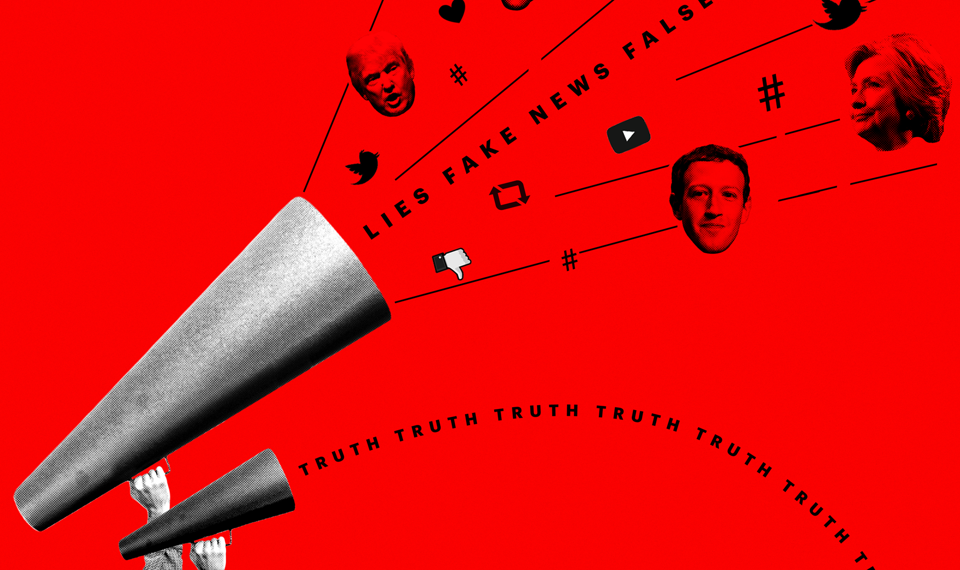
A large megaphone projects lies, fake news, falsehoods, and images of Donald Trump, Mark Zuckerberg, and Hillary Clinton. A smaller megaphone projects truth.

“Falsehood flies, and the Truth comes limping after it,” Jonathan Swift once wrote.

It was hyperbole three centuries ago. But it is a factual description of social media, according to an ambitious and first-of-its-kind study published Thursday [9 March] in Science.

The massive new study analyzes every major contested news story in English across the span of Twitter’s existence – some 126,000 stories, tweeted by 3 million users, over more than 10 years – and finds that the truth simply cannot compete with hoax and rumor. By every common metric, falsehood consistently dominates the truth on Twitter, the study finds: Fake news and false rumors reach more people, penetrate deeper into the social network, and spread much faster than accurate stories.

“It seems to be pretty clear [from our study] that false information outperforms true information,” said Soroush Vosoughi, a data scientist at MIT who has studied fake news since 2013 and who led this study. “And that is not just because of bots. It might have something to do with human nature.”

Continue reading

Hazel’s comment
I think one aspect of fake news stories, whether intended to be serious reports or inconsequential items, is that they have a longer shelf-life than the truth.


Sunday, 4 February 2018

Twitter to tell 677,000 users they were had by the Russians. Some signs show the problem continues.

an article by Eli Rosenberg for The Washington Post [grateful thanks to ResearchBuzz]

Twitter says it will notify nearly 700,000 users who interacted with accounts the company has identified as potential pieces of a propaganda effort by the Russian government during the 2016 presidential election.

The company on Friday also disclosed thousands of accounts that it said were associated with the Kremlin-linked troll farm, the Internet Research Agency (IRA) and the Russian government, adding to numbers that it released to Congress in October.

Twitter said that it had identified 3,814 IRA-linked accounts, which posted some 176,000 tweets in the 10 weeks preceding the election, and another 50,258 automated accounts connected to the Russian government, which tweeted more than a million times, while acknowledging that “such activity represents a challenge to democratic societies everywhere”, in a news release Friday afternoon.

Continue reading


Wednesday, 3 January 2018

An emotional step toward automated trust detection in crisis social media

an article by Shane E. Halse, Andria Tapia and Anna Squicciarini (Pennsylvania State University, State College, USA) and Cornelia Caragea (University of North Texas, Denton, USA) published in Information, Communication & Society Volume 21 Issue 2

Abstract

To this date, research on crisis informatics has focused on the detection of trust in Twitter data through the use of message structure, sentiment, propagation and author. Little research has examined the usefulness of these messages in the crisis response domain.

In this paper, we characterize tweets, which are perceived useful or trustworthy, and determine their main features as one possible dimension to identify useful messages in case of crisis.

In addition, we examine perceived emotions of these messages and how the different emotions affect the perceived usefulness and trustworthiness.

Our analysis is carried out on two datasets gathered from Twitter concerning Hurricane Sandy in 2012 and the Boston Bombings in 2013. The results indicate that there is a high correlation between trustworthiness and usefulness, and, interestingly, that there is a significant difference in the perceived emotions that contribute to each of these.

Our findings are poised to impact how messages from social media data are analyzed for use in crisis response.

Reading the title of this piece I was prepared for personal crisis such as severe distress but it is interesting to note the impact of Tweets on environmental and terrorist crises. H.


Saturday, 30 December 2017

Sarcastic Sentiment Detection Based on Types of Sarcasm Occurring in Twitter Data

an article by Santosh Kumar Bharti, Ramkrushna Pradhan, Korra Sathya Babu and Sanjay Kumar Jena (National Institute of Technology Rourkela, India) published in International Journal on Semantic Web and Information Systems Volume 13 Issue 4 (2017)

Abstract

In Natural Language Processing (NLP), sarcasm analysis in the text is considered as the most challenging task. It has been broadly researched in recent years.

The property of sarcasm that makes it harder to detect is the gap between the literal and its intended meaning. It is a particular kind of sentiment which is capable of flipping the entire sense of a text. Sarcasm is often expressed verbally through the use of high pitch with heavy tonal stress.

The other clues of sarcasm are the usage of various gestures such as gently sloping of eyes, hands movements, shaking heads, etc.

However, the appearances of these clues for sarcasm are absent in textual data which makes the detection of sarcasm dependent upon several other factors.

In this article, six algorithms were proposed to analyze the sarcasm in tweets of Twitter. These algorithms are based on the possible occurrences of sarcasm in tweets.

Finally, the experimental results of the proposed algorithms were compared with some of the existing state-of-the-art.


Wednesday, 15 March 2017

Identifying and predicting the desire to help in social question and answering

an article by Zhe Liu (IBM Almaden Research Center, San Jose, CA, USA) and Bernard J. Jansen (Qatar Computing Research Institute, Doha, Qatar) published in Information Processing & Management Volume 53 Issue 2 (March 2017)

Highlights
  • Evaluate the effectiveness of question routing systems in the social Q&A process.
  • Find that individuals are more willing to share their knowledge under question routing context whereas less connected.
  • Build an effective model to automatically identify active knowledge sharers from non-shares using non-Q&A features from four dimensions: profile, posting behavior, language style, and social activities.
Abstract

The increasing volume of questions posted on social question and answering sites has triggered the development of question routing services. Most of these routing algorithms are able to recognize effectively individuals with the required knowledge to answer a specific question.

However, just because people have the capability to answer a question, does not mean that they have the desire to help.

In this research, we evaluate the practical performance of the question routing services in social context by analyzing the knowledge sharing behavior of users in social Q&A process in terms of their participation, interests, and connectedness. We collect questions and answers over a ten-month period from Wenwo, a major Chinese question routing service.

Using 340,658 questions and 1,754,280 replies, findings reveal separate roles for knowledge sharers and consumers. Based on this finding, we identify knowledge sharers from non-sharers a priori in order to increase the response probabilities.

We evaluate our model based on an analysis of 3006 Wenwo knowledge sharers and non-sharers.

Our experimental results demonstrate knowledge sharer prediction based solely on non-Q&A features achieves a 70% success rate in accurately identifying willing respondents.


Monday, 21 November 2016

Do women only talk about “female issues”? Gender and issue discussion on Twitter

an article by Heather Evans (Sam Houston State University, Huntsville, Texas, USA) (MacEwan University, Edmonton, Canada) published in Online Information Review Volume 40 Issue 5 (2016)

Abstract

Purpose
Recent research has shown that female US House candidates were more likely to talk about so-called “female issues” on Twitter during the 2012 election (Evans and Clark, 2015). In this paper, the author extends this former work by investigating the Twitter activity of all US House representatives during their 2012 election and seven months later (June and July of 2013). The purpose of this paper is to show that women do talk more about “female issues” than men, but do not only focus on these issues.

Design/methodology/approach
This paper content analyzes the tweets sent by female and male representatives in the 113th Congress during their 2012 elections, and seven months later.

Findings
Female representatives spend significantly more time devoted to “female issues” on Twitter than male representatives, but their time is not dominated entirely by “female issues.” Even though the difference is not statistically significant, women sent more tweets about “male issues” than men both during and after the 2012 election. Women tweet more than men about “women,” but they also care about business issues, as is evidenced by that issue being one of the most discussed on Twitter by female representatives during both the election and seven months later.

Originality/value
Unlike other studies on gender and issue discussion, this paper examines a new type of communication: Twitter. Tweets are split by issue type (female/male) and the author sees that while women do discuss “female issues” more than men, they do not exclude “male issues.” This paper also shows that women focus on “female issues” both during elections and after.


Tuesday, 25 October 2016

‘To tweet or not to tweet?’ A comparison of academics’ and students’ usage of Twitter in academic contexts

an article by Charles G. Knight and Linda K. Kaye (Edge Hill University, Ormskirk, UK) published in Innovations in Education and Teaching International Volume 53 Issue 2 (2016)

Abstract

The emergence of social media as a new channel for communication and collaboration has led educators to hope that they may enhance the student experience and provide a pedagogical tool within Higher Education (HE). This paper explores academics’ and undergraduates’ usage of Twitter within a post-92 university. It argues that the observed disparity of usage between academics and undergraduates can be attributed to a number of factors.

Namely, academics’ perceived use of the platform for enhancing reputation is an implied acknowledgement of the importance of research within HE and the increasingly public engagement agenda. Additionally, academics’ limited usage of Twitter to support practical-based issues may be explained by issues relating to accountability of information through non-official channels. Moreover, students made greater use of Twitter for the passive reception of information rather than participation in learning activities. The implications of these issues will be discussed in reference to the study findings.

Full text (HTML)