Showing posts with label universal_credit. Show all posts

Monday, 18 November 2019

Feel poor, work more – the real reason behind Britain’s record employment

an article by Torsten Bell for the Resolution Foundation

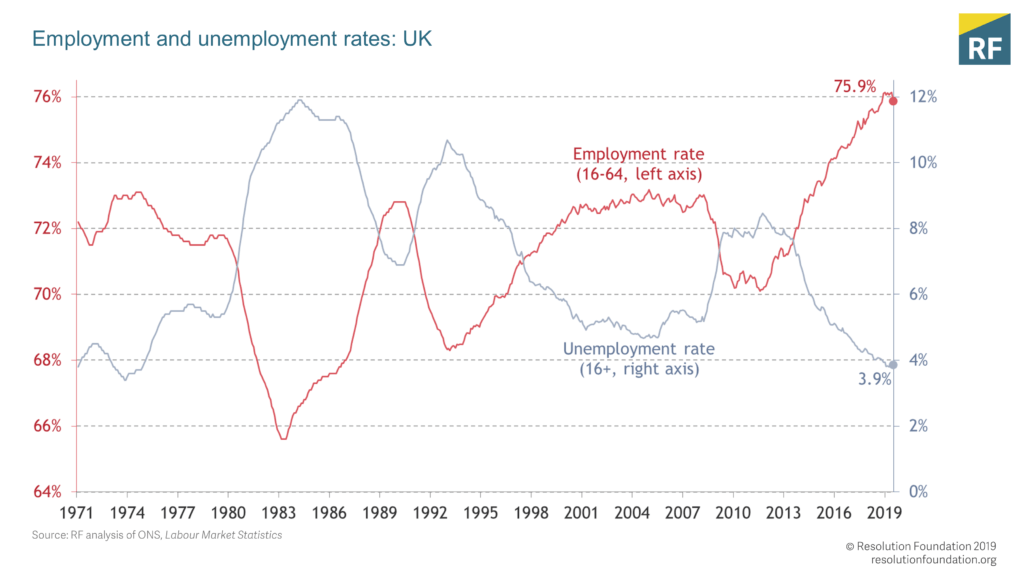
Why are three million more of us working today than were back in 2008? How has our employment rate reached 76 per cent, when full employment before the crisis meant 73 per cent of us working?

These are employment levels no-one thought possible a decade ago. There is almost no bigger change to our economy over the past decade than its jobs boom. And yet it is poorly understood.


So why are so many of us working? Because we’re a lot poorer than we expected to be. That’s the fundamental cause of record employment.

Some have argued that actually policy changes are key. Conservative and Labour politicians, for very different reasons, like to say it’s because of the UK’s flexible labour market. It’s true that flexibility has enabled swift employment growth, and the less welcome rise in insecure work within it. But it cannot explain why more people are working today than before the crisis for the simple reason that the labour market is not significantly more flexible than it was in 2008.

Conservative ministers often say the jobs boom is because of Universal Credit and the better incentives to work it provides. But this rather misses the fact that the new benefit’s roll-out has been so slow that it only accounted for two per cent of the working-age population as late as 2018 – five years into the employment boom.

Continue reading


Friday, 11 October 2019

How academic research can impact government policy

a post on the Transforming Society blog

Research having an impact on policy, and the wider world, can be extremely hard to quantify, but on occasion we find an example that illustrates the great potential we have to make a difference.

One such example came when Philip Alston, UN Special Rapporteur on extreme poverty and human rights, and his senior advisers, Bassam Khawaja and Rebecca Riddell, made an official visit to the UK in November 2018 [BBC News item]. They were tasked with conducting an investigation in the UK and subsequently presented their findings to the UK government in the form of a 21 page report [24-page PDF in clear English makes horrifying reading].

In order to maximise the efficacy of what are generally less than two-week visits, the time spent in the country must be carefully planned and structured extensively ahead of time. This involves “extensive advance work, including broad consultations and in-depth research”. It is during this planning that Alston used the Journal of Poverty and Social Justice [a plug for Policy Press's publication], later stating: “the Journal of Poverty and Social Justice is clearly one of the best in the field, as I learned in preparing for my visit to the UK”.

Continue reading


Thursday, 25 July 2019

Mind the gaps: Universal Credit and self-employment in the United Kingdom

an article by Kevin Caraher and Enrico Reuter (University of York, UK) published in Journal of Poverty and Social Justice Volume 27 Number 2 (June 2019)

Abstract

Self-employment in the United Kingdom rose steadily until 2017, as part of wider changes in labour markets towards more flexible and potentially more vulnerable forms of employment. At the same time, welfare reform has continued under the current and previous governments, with a further expansion of conditionality with respect to benefit recipients.

The incremental introduction of Universal Credit is likely to intensify the subjection of vulnerable categories of the self-employed to welfare conditionalities and to thus accentuate the ambivalent nature of self-employment.

This article analyses the impact of Universal Credit on the self-employed by first discussing elements of precarity faced by the self-employed, and, second, by exploring the consequences of the roll-out of Universal Credit for those self-employed people who are reliant on the social protection system.


The ‘Other Britain’

a post by Heidi Allen MP (Member of the Work and Pensions Select Committee) for the CPAG (Child Poverty ACtion Group[ blog

A little over a century ago, the cry among social reformers concerned about the plight of the poor was for a safety net to be stitched together by the state, to catch any of our fellow citizens who were falling into the clutches of destitution.

Had those same reformers witnessed what we have picked up during the past six months – from visits to food banks in Poplar, Waterloo, Leicester, Morecambe, Chester, and Glasgow – they would be appalled by the extent of hunger, homelessness, and insecurity afflicting so many families and vulnerable individuals in our country.

Here we are introduced to an ‘Other Britain’ where entire communities are not only bypassed by economic growth but are also being pushed through gaping holes in the safety net. One support worker in Chester, for example, told us that, “I don’t meet a single person now who isn’t cold and hungry.”

Continue reading

Read the whole report: The ‘Other  Britain’ and the failure of the welfare state


Tuesday, 7 May 2019

Computer says 'no!' - how good is information provision in universal credit?

a post by Lizzie Flew, Senior Communications and Campaigns Officer, for the CPAG blog

“It’s a fundamental principle in a democracy that governmental bodies must have reasons for their decisions… that they should be able to explain what those reasons are… [and any] decision should be open to review or appeal.” So begins our latest report, Computer says ‘No!’ These words are from former Court of Appeal Judge Sir Stephen Sedley, who offers the benefit of his many years of legal experience to something that often gets overlooked as too technical, but which can affect the day-to-day lives of many people: what information claimants are given about decisions relating to their universal credit support, and what information they have about challenging any of those decisions.

Our new report exposes how people claiming universal credit are kept in the dark about what they are getting – the online statements do not explain in full how universal credit amounts are calculated. This means that people cannot easily check if they are getting what they should be getting, and find it harder to predict how their payment will change if their circumstances do. This matters not just because we know the government does get things wrong when calculating benefits, but also because there is a vital principle at stake. In our social security system, decisions are made all the time about what support people are entitled to (for example when they are awarded help with rent, deemed fit for work, or given a sanction). If people cannot clearly see what those decisions are, they cannot challenge them when errors are made.

Continue reading

A difference of £400 a month between what has been allocated and what should have been is extreme but I read other sources where the amounts are of the order of £30-40 a week. That is the difference between eating and not having enough money for basic foodstuffs.


Wednesday, 1 May 2019

Is universal credit working for working people? – Usdaw members’ experiences

a post by Kelly-Marie Jones (Welfare Rights Adviser | Early Warning System) for the CPAG blog

Since 2010, the government has ignored rising child poverty while repeating the mantra that work is the best route out of poverty. Work is indeed a factor in escaping poverty, but it needs to be secure work, with a decent wage, decent hours and prospects. In-work poverty is on the rise with 70 per cent of children growing up in poverty having a parent who works. Together with colleagues at the Union of Shop, Distributive and Allied Workers (Usdaw), we set out to discover how the introduction of universal credit has affected Usdaw members.

Usdaw recently surveyed members receiving universal credit (UC). The results show that UC is not always supporting people out of poverty through work, or even upholding the early promise that “no-one will experience a reduction in the benefit they receive as a result of the introduction of Universal Credit”. Only one out of 25 respondents said they were better off on UC and nearly half reported being worse off. The biggest losses were borne by families with children, with one couple reporting a loss of £250 a month and a single parent losing as much as £320.

Getting hold of their entitlement, such as it was, wasn’t an easy process. Nearly half of survey respondents reported finding the claim process difficult, very difficult or even impossible – and only two of those received help with their claim. Difficulties included having to attend Jobcentre appointments around work hours and having their claim closed so having to start the claim process again.

Continue reading


Wednesday, 27 March 2019

Policy Practitioners’ Accounts of Evidence-Based Policy Making: The Case of Universal Credit

an article by Mark Monaghan (Loughborough University, UK) and Jo Ingold (University of Leeds, UK) published in Journal of Social Policy Volume 48 Issue 2 (April 2019)

Abstract

This paper draws on insider accounts from UK Department for Work and Pensions (DWP) officials to analyse the relationship between evidence and policy making at a time of rapid policy development relating to Universal Credit (UC).

The paper argues, firstly, that evidence selection within the DWP was constrained by the overarching austerity paradigm, which constituted a Zeitgeist and had a significant bearing on the evidence selection and translation process, sharpening the focus of policy officials and analysts on the primacy of quantitative evidence when advising Ministers.

Secondly, while methodological preferences (or an ‘evidence hierarchy’) impacted on evidence selection, this was not as significant as practitioners’ perceived capabilities to handle and develop evidence for policy. These capabilities were linked to departmental structures and constrained by political feasibility.

Together, these dimensions constituted a significant filtration mechanism determining the kinds of evidence that were selected for policy development and those omitted, particularly in relation to UC. The paper contributes to debates about the contemporary role of evidence in policy-making and the potential of the relationship between future evidence production and use.


Monday, 21 January 2019

Recent ruling on Universal Credit – UK Human Rights Blog

a post by by Sapan Maini-Thompson for the UK Human Rights blog

R (Johnson, Woods, Barrett and Stewart) v SSWP CO/1552/2018 (11 January 2019) – read judgment

This case was brought by four social security claimants contesting the proper method of calculating the amount of universal credit payable to each claimant under the Universal Credit Regulations 2013. Singh LJ and Lewis J concluded that treating claimants as having “earned” twice as much as they do if they happen to be paid twice within one monthly assessment period is “odd in the extreme” [para 54] and “…. could be said to lead to nonsensical situations” [para 55].

The Legal Proceedings

The four claimants are employees who are paid monthly. As they receive their salaries on or around either the last working day or last banking day of the month, there are times when salaries payable in respect of two months are paid during one assessment period. This means that there were occasions on which the claimants were only allowed to retain a single amount of £192 by way of the work allowance from the combined two months’ salary. The work allowance is the amount of earnings claimants with children or with limited capability for work can keep in full before universal credit is reduced by a proportion (63%) of their earned income under Regulation 22 of the 2013 Regulations. This way of calculating the allowance resulted in fluctuating universal credit awards and “severe cash flow problems” [para 4] for the claimants.

Continue reading


Tuesday, 27 February 2018

OBR sceptical about DWP's claims about Universal Credit

a post by Johnathan Bradshaw (Emeritus Professor of Social Policy | University of York) for the CPAG blog

The roll-out of Universal Credit may be running five years later than planned, having wasted £40 million in botched IT, and been emasculated by austerity cuts since 2015, but its advocates in the DWP still argue that it is all going to be worthwhile in the end because its labour supply effects will get people into work and onto higher earnings. Sir Robert Devereux, the DWP Permanent Secretary, claimed this in a retirement interview: “the roll-out will see unemployment rates fall as disincentives are taken out of the system”. Esther McVey, the new Secretary of State for Work and Pensions, even seemed to claim that 3.1 million extra people were in work as a result of UC when at the time only 700,000 were on it.

The impact assessment for UC in 2012 estimated that between 100,000 and 300,000 people would enter work and between 1 million and 2.5 million more hours would be worked as a result of UC. A parliamentary question in 2017 reduced the entering work number to 150,000 and made no claim on extra hours. The DWP presented estimates of the impact of UC in reports published in 2015 (the initial report and an update) and a further update in 2017. The latter found that that UC claimants were 3 percentage points more likely to be in work after six months than matched jobseeker’s allowance claimants (56 per cent versus 53 per cent).

Continue reading

There’s links to different reports and primary sources. The general feeling of the post is that Universal Credit is a mess (as if most of us did not know that already).


Wednesday, 22 November 2017

Six key points from 'The Austerity Generation: the impact of a decade of cuts on families with children'

a post by Alison Garnham, Chief Executive in the Child Poverty Action Group blog

Today [6 November 2017], CPAG publishes a major new study on the impact of austerity on families with children: ‘The Austerity Generation: the impact of a decade of cuts on family incomes and child poverty‘.

Here are the key points:

1. The promise of greater rewards from work under universal credit - its organising idea - has been broken.

Universal credit (like tax credits) has been mercilessly cut by the Treasury. The universal credit system we have today isn’t the same as the one that was sold to us.

Working families in the UK stand to lose £930 a year on average from cuts in the tax credit system and £420 a year from cuts to universal credit – these are losses across the population, so the losses for tax credit and universal credit recipients would be much higher.

2. David Cameron’s single mother is a good example of how badly universal credit is failing

In 2009, in his last party conference speech before being elected as Prime Minister, David Cameron had an angry riff on tax credits leaving a single mother with two children, earning £150 a week, facing an effective tax rate of 96p (factoring in the withdrawal of benefit and additional taxes) if she worked another hour. You can watch the short clip here: https://twitter.com/imran_1/status/926381637511843840

Our new report includes a lone parent with children as a model family. Earning £150 a week means working about 18.5 hours. Although universal credit reduces the effective tax rate to 74 per cent, this lone parent and her children would be £2,336 a year worse off (see box 4.2 and figure 4.10 of the report). In other words, like many others on universal credit, this family’s finances have been thrown down a deep hole with only a very short ladder thrown in to get them out of it.

3. It is almost impossible for many to make up these losses by working more hours

Freezes and cuts to universal credit work allowances will leave lone parents worse off by, on average, £710 a year, couples £250 a year (again, losses here are across the whole population – they’ll be much higher for those affected).

In order to make up the losses caused by the cut in work allowances in universal credit, for example, a full-time working couple on the so-called ‘national living wage’ would have to work 17 extra days a year.

A lone parent already working full time for the ‘national living wage’ would have to work 41 extra days a year to recoup their loss – equivalent to a fourteen month year. In any case, working extra days will depend on family responsibilities and whether it’s actually possible to increase your hours at work.

4. Families already at greater risk of poverty will lose most

The poorest 10 per cent will lose 10 per cent of their income (£450 a year) on average compared with what was promised by universal credit.

For larger families, cuts to universal credit mean the average family with three children will be 10 per cent (£2,540 a year) worse off, and the average family with four or more children 19 per cent (£5,000 a year) worse off due to universal credit cuts.

Cuts to universal credit mean families containing someone with a disability will be £300 a year worse off; families containing someone with a severe disability will be £530 a year worse off.

5. We’re creating an austerity generation

Since 2010, rather than investing in our children, government policy has been creating an Austerity Generation whose childhoods and life chances will be scarred by a decade of political decisions to stop protecting their living standards.

A major study by the LSE found poorer children have worse cognitive, social-behavioural and health outcomes because they are poor, and not just because poverty is correlated with other household and parental characteristics.

Our study today estimates that the cuts to universal credit would put 1,000,000 children in poverty and 900,000 in severe poverty by the end of the decade (assuming it was fully rolled-out by then).

6. Universal credit needs a full-scale rescue mission

This month’s Budget is an opportunity for the Chancellor to mount a full-scale rescue mission for universal credit. CPAG was the first to sound the alarm about the 6 week wait for universal credit, so progress on that would be very welcome, but this report makes it clear that the problems are more fundamental – the whole point of universal credit is being undermined.

The Chancellor should use this month’s Budget to:

Restore work allowances – the income level at which universal credit starts to be withdrawn. This would benefit all working families by an average of £150 a year – so those on universal credit would benefit by much more than this figure.
Triple-lock child benefit and the child element of universal credit: this would be the single most effective intervention to reduce child poverty (it would reduce numbers by 600,000).

Full report (PDF 98pp)


Saturday, 18 November 2017

Time to make Universal Credit fit for purpose in 21st century Britain

a post by David Finch for The Resolution Foundation blog

The pace of the roll-out of Universal Credit (UC) has quickened in recent months – and so too have the complaints and reputational hit that the reform is taking.

Much of the focus has been on the six week wait before new claimants moving out of work receive their first payment, which is the result of requiring people to wait seven days before earning any benefit entitlement and the view that all families should be got used to monthly payments in arrears. This is a classic case of the design of UC running up against the reality of people’s lives. After all, while it’s likely that 100 per cent of those designing UC are paid monthly, just 28 per cent of new claimants moving out of work and onto UC were paid this way, with the majority (58 per cent) paid either weekly or fortnightly.


The seven day wait should be scrapped and the option of more regular payments introduced. But while bringing more flexibility into the UC payment system can and should be solved they are really just the tip of the iceberg when it comes to the design challenges that need addressing.

Far bigger issues will emerge as more ‘complicated’ cases – for example working families with children – move onto the system. The government needs to get onto the front foot in dealing with the frictions that will arise between UC and the self-employed, along with childcare costs and free school meals. Otherwise, the slow drip of bad news risks draining support for UC – and with it a missed opportunity for UC to make a big positive change to our welfare system.

Continue reading

I could, of course, go on and on and on about UC, I could share posts from a large number of organisations but, and this is a big BUT … I have found very few praising the system even when going to look for them specifically in the right-wing press.


Thursday, 12 October 2017

Down the Universal Credit rabbit hole - what happened when East Lothian changed benefits systems

an article in New Statesman by Martin Whitfield, the Labour MP for East Lothian

Please just go and read it for yourself as I can't decide where to start or stop in bringing it to you.

My reaction is that this system is:
  • hateful
  • hurtful
  • harmful
  • hazardous, and many other such words but they are not alliterative.
I am so ashamed to admit that I used to work “on the other side of the counter” because people equate me with the minions in the Jobcentres who now do little to help and a great deal to hinder. Do I blame them? No, they are doing as they are told but it's a sad day when helping people is wrong.


Wednesday, 22 February 2017

Responsibilising recovery: Lone and low-paid parents, Universal Credit and the gendered contradictions of UK welfare reform

an article by Ruth Cain (University of Kent, Canterbury, UK) published in British Politics Volume 11 Issue 4 (December 2016)

Abstract

Universal Credit is a new benefits delivery system designed to streamline UK benefits and tax credits and encourage work.

This paper examines Universal Credit’s effect on lone parent and low-paid households. Lone mothers, identified as a moral and financial risk, face conditionality which ignores barriers to employment. Universal Credit also extends conditionality to lower-paid workers and their families. It encodes contradictory gendered messages.

While individual parental responsibility is increasingly socially and legally emphasised, unemployed or low-paid parents may be forced to spend minimal time with children under threat of sanctions or workfare.

Universal Credit demonstrates a clash between market-liberal economic ideals of labour flexibility, and conservative valorisations of the good mother and (married/heteronormative) family, enhanced by ‘recovery’ discourses of thrift and responsibilisation.

This paper argues that such moral/economic incoherence will penalise ‘workless’ and ‘part-workless’ citizens who cannot fulfil neoliberal ideals of the private, self-sufficient family unit in hostile economic conditions.


Monday, 5 August 2013

Universal Credit local support services framework

Framework setting out help for claimants who may require extra support to access Universal Credit

That really is all I need to say except to tell you that it’s a 28-page PDF document which you can access here.

Hazel’s comment: Try to hold on to your temper when reading this. Most low-income families do not manage on a monthly income nor do they do their banking online. I am reasonably well educated and use the internet easily. I still find that managing a low income is tough – and with ever-rising prices for staple foodstuffs it is becoming increasingly difficult to budget effectively.


Thursday, 9 May 2013

Slow progress: improving progression in the UK labour market

a research paper by Paul Garaud and Matthew Oakley (Policy Exchange) published by Policy Exchange

Executive summary

The challenge of progression

Since coming to power, the Coalition government has embarked on a radical programme of welfare reform. Its flagship Work Programme scheme is now in place and providing support to the long-term unemployed and disadvantaged to help them to enter and stay in work. In a few weeks, Universal Credit, the benefit that will replace a series of income-replacement benefits and tax credits, will begin its staged roll out. These are positive steps and the extent to which they represent a step change in our approach to welfare policy should not be underestimated.

In particular, helping claimants of in-work benefits to sustain their jobs for longer and increase their earnings (to “progress”) are now key goals of government welfare policy. This approach will significantly increase the number of people able to take on support and also subject to more intensive conditions in return for benefit. In particular, once rolled out, current claimants of tax credits who are working relatively few hours are likely to be subject to increased requirements. If successful in increasing earnings, this approach would increase living standards of families and reduce the benefit bill. However, there are significant challenges to achieving this goal.

Existing evidence tells us that staying in work and increasing earnings can be extremely difficult for individuals with relatively low levels of qualifications and for employees in low-income jobs. At the most basic level, the median length of continuous employment for those employed in the bottom decile of the earnings distribution is just over two years. For those in the top decile the equivalent figure is around eight years. Some 14% of employees in the bottom decile of the earnings distribution are in temporary employment. Only 2% of those in the top decile of the earnings distribution are in this position.

The recession clearly has an impact on the ability of some employees to increase their earnings. One respondent to our call for evidence summarised:


“How can you just ‘magic up’ extra hours if you only work part-time? Most companies can’t just give you more hours.”

However, a lack of progression is not just a result of the recession. Even during past periods of relatively strong growth we could see that the labour market in the UK was changing: jobs have become more flexible and potentially more insecure; the “job for life” is no-longer a standard form of employment; and due to technological changes, many of the jobs which were relied upon for employees to progress over their working lives no longer exist. Reports over the last decade have continually highlighted that a low-pay, no-pay cycle exists in the UK and that policy interventions are not helping to tackle it.

In particular, while around 70% of JSA claimants move off benefit within six months of initiating a JSA claim, success in terms of finding claimants sustainable work is far less convincing. As documented in our earlier report, Welfare 2.0:
  • Only 68% of those leaving JSA actually enter employment;
  • Around a third (30%) of those leaving JSA are claiming benefits again within eight months; and
  • Of those who started work nearly one in ten (8%) were employed for fewer than 16 hours a week.
Overall, this means that just 36% of claimants will find a job within six months of receiving JSA and still be in work seven or eight months later. Other research from DWP shows the depth of movements between fragile employment and benefits. After following a group of 22–24 year olds and 32–34 year olds, it found that over one in ten of those in these groups making a new claim for JSA in 2010/11 had spent at least half of the previous four years on benefit.

Combined with a lack of evidence around policy interventions that are effective in helping people to increase their earnings, these challenges mean that the government is faced with a difficult task in designing an effective and efficient system of support and requirements. This lack of evidence makes it essential that the government is fully committed to piloting and fully evaluating potential policy interventions to help people to increase their earnings. For this reason it is encouraging that the government has issued a call for ideas in this area and looks set to implement a number of pilots.

A breakdown of in-work claimants

This commitment to piloting is even more important because our analysis suggests that a large variety of individuals and families may come under a new programme of support and requirements for in-work benefits claimants.

Overall, analysis in this report suggests that around 1.3 million people will be subject to some form of in-work requirements and support. Of these, Chapter 1 demonstrates that:
  • Around two thirds of the group do not have dependent children. However, alongside these families without dependent children, there are also a significant minority of the group who are lone-parents with dependent children aged between 5 and 17;
  • Almost two thirds of the group are female;
  • The group has a broad mixture of individuals of different ages. However, just over half are over 45 years old;
  • Nearly 45% of the group has relatively low qualifications or no formal qualifications at all;
  • Many of the group are currently in stable employment, with over half having been with their current employer for over two years. However, working hours are relatively low for the majority of the group (typically between 15 and 24 hours a week); and
  • A large majority of the group are not currently looking for additional employment.
Such a diversity of individuals and families in this group will present DWP with challenges in terms of targeting effective personalised support in order to help claimants to increase their earnings. A particular challenge will be the fact that our research suggests that a large majority of the group do not seem to be motivated to increase their earnings. This point is also supported by recent reports from DWP. For instance, one report suggests that among part-time workers on Working Tax Credit, only around one fifth were seeking additional hours. The DWP report also looks at reasons for not wanting more work. It shows that, of part-time recipients of working age benefits or tax credits, 43% agreed that ‘I don’t need more hours because I get by okay on what I currently earn’.

Evidence on the diversity of this group also echoes the concerns of a number of respondents to our call for evidence. In particular, because of caring responsibilities, ill health or a disability some families and individuals might have limited scope for increasing their earnings. As we outlined in Personalised Welfare, it is essential to approach these issues in a way that does not simply consider benefit type and length of claim, but instead to effectively target personalised support.

Combined with existing evidence of the chances of progression and the impact of policy, this leaves the government facing significant challenges:
  • A large proportion of individuals in low-paid or low-hours work do not regard progression as a priority.
  • Current policy interventions (e.g. JCP) can be counter-productive to the goal of progression.
  • Temporary jobs, part-time work, and mini-jobs do not, on average, appear to help individuals progress.
  • Training does not, on average, appear to lead to progression, though implementation and differential impact across groups may cloud results.
  • Financial incentives for employment retention may work for some groups.
  • Employment retention appears to be encouraged by job-seeking while in work.
All of these factors present government with a significant challenge in helping individuals and families to increase their earnings. The groups that it wants to support and encourage to increase their earnings are the same groups that currently seem to find it hardest to achieve significant earnings progression and who may not want to progress anyway. This means that if it is to design policy interventions to support and encourage Universal Credit claimants to progress in work and move towards self sufficiency, new policy solutions and a significant level of testing will be needed. If implemented effectively and comprehensively evaluated, the policy pilots that DWP are likely to announce will provide a valuable evidence base to inform future policy decisions.

Making progress

Based on the limited existing evidence and our own analysis, this report outlines areas where we believe that the government should focus its pilots. However, we are also clear that these pilots alone will not be enough. It is essential that freedom is given to Jobcentres and power devolved through the City Deals process in order to leverage a far greater range of piloting and policy innovation. By doing so, we will begin to get a better picture of policy interventions that are effective in supporting and encouraging in-work claimants to increase their earnings.

We also outline reforms that are essential to roll out now, before piloting begins. These include fundamental changes in the way in which Jobcentre performance is measured and in how Work Programme providers are rewarded for helping the claimants placed with them. Alongside these measures it will also be essential to put in place a baseline conditionality regime right from day one of Universal Credit being rolled out. Without this, the moment of change will be missed and an important opportunity to influence the attitudes and behaviour of benefit claimants lost.

Together our proposals outline the basis for a strong system of support and conditionality for in-work claimants. Once pilots have been evaluated and lessons learned, this system can be built up in order to put in place a comprehensive programme of personalised and targeted support and requirements for claimants in order to improve earnings, boost living standards and help more families move towards independence.

Wednesday, 8 May 2013

Will future tax cuts reach struggling working households?

a briefing paper by Donald Hirsch published by Resolution Foundation Publications

Summary

All political parties today say they want to help working people on low to middle incomes who struggle to make ends meet. Under the last government, in terms of direct financial support, this was achieved mainly through in-work tax credits. Today, the emphasis is shifting in favour of cutting taxes in ways that have the objective of helping low earners. Tax cuts, however, will not, in large part, reach low to middle income working households under the government’s flagship welfare reform Universal Credit (UC) as UC is calculated on the basis of net income, meaning that any tax cut that boosts a household’s income also reduces their UC support. Put another way, any tax cut will give with one hand and take away immediately most of the gains with the other.

This briefing looks at how exactly tax cuts interact with Universal Credit and quantifies how little low to middle income working households will keep from a higher personal allowance or a 10p tax rate under UC. It also suggests a simple way in which the Government could ensure that the benefits of tax cuts do flow through to the pockets of the three million taxpayers who claim UC. Any party proposing tax cuts that does not adopt this or an equivalent policy cannot claim to be targeting low to middle income households by cutting taxes.

Full text (PDF 16pp)


Friday, 22 March 2013

Labour market, welfare reform and inequality in the United Kingdom

an OECD Economics Department Working Paper (Number 1034) by Christophe André, Clara Garcia and Jon Kristian Pareliussen (OECD, France) and Giulia Giupponi (affiliation(s) unknown)

Abstract

Employment has risen by more and unemployment has risen less than expected, given the path of output.

Nevertheless, long-term and youth unemployment and involuntary part-time work are high.

A polarised labour market risks worsening income inequality, which is high by OECD standards, despite a recent and likely temporary decline. The UK welfare system is an essential safety net, which needs to promote employment, while protecting the most vulnerable. The reformed welfare system, Universal Credit, and the employment programme for disadvantaged workers, Work Programme, will generally improve work incentives and provide support for return to work, but need to be refined. Skill deficiencies are holding back employment and fostering inequality, as low education achievements penalise children from lower socio-economic backgrounds. Vocational training needs to be strengthened and cooperation with employers reinforced. Transition from education to work can prove challenging, requiring more attention to the integration of university graduates into the labour market.

JEL Classification: I38, J21, J24

Full text (PDF 45pp)


Tuesday, 12 March 2013

Universal Credit, PIP and all that

Last week I was reading through the postings from the Inner Temple Library when I saw one on "Statutory Instruments".

I always read these (perhaps not as thoroughly as I could) to see what changes have been made in education and training-related issues.


I also tend to pick up items on benefits and will, in the main, post the links, one at a time, on my Facebook page for the benefit of personal friends who are actively working in this arena.

One at a time became a chore with this lot so a blog post it is!


via Inner Temple Library Current Awareness Service

The Universal Credit Regulations 2013

The Universal Credit, Personal Independence Payment, Jobseeker's Allowance and Employment and Support Allowance (Claims and Payments) Regulations 2013

The Universal Credit (Transitional Provisions) Regulations 2013

The Social Security (Loss of Benefit)(Amendment) Regulations 2013

The Social Security (Overpayments and Recovery) Regulations 2013

The Social Security (Payments on Account of Benefit) Regulations 2013

The Rent Officers (Universal Credit Functions) Order 2013

The Employment and Support Allowance Regulations 2013

The Jobseeker's Allowance Regulations 2013

The Social Security (Personal Independence Payment) Regulations 2013

The Personal Independence Payment (Transitional Provisions) Regulations 2013

Source: www.legislation.gov.uk


Wednesday, 6 February 2013

Vulnerable claimants will get support they need under Universal Credit, Ministers tell select committee

via DWP press releases

Ministers reiterated their commitment to supporting vulnerable claimants in their response to the Work and Pensions Select Committee Report into Universal Credit today [4 February 2013].

At the same time they revealed that over one million households will get to keep more of their earnings from work than they do under the current system.

Continue reading

and please forgive my snorts of derision!


Thursday, 27 December 2012

Struggling to make ends meet: Single parents and income adequacy under universal credit

a paper by Donald Hirsch (Director, Centre for Research in Social Policy, Loughborough University) published by Gingerbread

Introduction

From 2013, universal credit will start replacing the present benefits and tax credit system as the main financial support for families on low incomes. Single parent families are highly dependent on such support to make ends meet, whether they are in or out of work. To what extent will the new system meet their needs?

The new system has a number of features that could potentially help single parents. It will be simpler overall than the present system, reducing the confusing array of entitlements and forms to fill in. It will offer new opportunities to improve family income through part time work, allowing single parents to keep some or all of their out of work entitlements when they work a few hours a week. And it will reduce some of the most severe barriers to improving family income, in particular the most extreme situations where families can currently lose over 90 per cent of additional earnings through a reduction in benefits combined with higher income tax bills.

However, ultimately the extent to which the system helps single parent families lift themselves out of poverty and achieve an adequate standard of living will depend on the level at which entitlements are set. In the past two years, there have already been significant cuts to both benefits and tax credits, and many of these will be carried over into universal credit. The system is coming in when, like many people in Britain, single parents are generally seeing living costs rise at a faster rate than earnings (or state entitlements). The combination of these factors makes it inevitable that, even with the help of universal credit, many families will struggle to make ends meet.

This paper gives an initial snapshot of how provisional universal credit entitlements (announced as illustrative figures for 2012/13, the year before its introduction) compare to families’ needs. In particular we seek to illustrate the impact of universal credit on:
  1. Work as a route out of poverty and towards an adequate income level – will it support working single parents to lift their families above the poverty line, and will it support them to reach an adequate level of income for their needs?
  2. Work incentives – will it make a single parent better off in work than not, and will it be worthwhile to work additional hours?
Given that we do not yet know the exact level at which the credit will be set, it cannot project the precise outcomes of the system. Rather, it sets the scene for monitoring the adequacy of universal credit by doing three things:
  • Looking at a general level at the ability of single parents with various hours of work and wages to escape poverty and reach a minimum acceptable income level
  • Considering which factors will most affect the adequacy of universal credit. It makes comparisons between single parents with more or less expensive housing and childcare, and different numbers and ages of children
  • Considering the effectiveness of different policy measures in improving the situation of single parents under universal credit, to help understand what future improvements could best produce stronger work incentives – and therefore a more adequate living standard – for single parents and their children.
Full text (PDF 18pp)