Nadia Olivero,Andrea Greco, Anna Maria Annoni and Patrizia Steca (University of Milano Bicocca, Milano, Italy) and Paul Benjamin Lowry (Virginia Tech, Blacksburg, USA) published in Behaviour and Information Technology Volume 38 Issue 12 (2019)
Abstract
Recent research has shown that typically law-abiding people perceive the act of illegal downloading as less unethical than other illegal acts.
A major thrust of today's digital piracy research is indeed to understand how emerging social norms influence consumer perceptions and lead to rationalisations that justify antinormative behaviour despite moral and ethics.
We adopt a model comparison approach to evaluate the impact of moral disengagement mechanisms with respect to the most often used constructs referring to the theory of planned behaviour (TPB) and of moral obligation on intention to pirate. Comparisons between the tested models clearly indicate that moral disengagement plays a significant role in the prediction of piracy.
The results also suggest that the practice of illegal downloading is spreading across genders, and that other than moral disengagement, demographic factors of young age, pirating experience, and pirating ability are strong predictors of illegal downloading. When moral disengagement mechanisms are included in the model, intention to pirate is explained by past piracy behaviour, perceived behavioural control, and subjective norms as well as the moral disengagement mechanism of ‘euphemistic labelling’.
Our findings advance the current understanding of digital piracy and support the design of more effective interventions to counteract its further diffusion.
Showing posts with label morality. Show all posts
Showing posts with label morality. Show all posts
Monday, 16 December 2019


Tuesday, 12 November 2019
The Moral Robot
a post by Chris Horner for 3 Quarks Daily

The question of how to program AI to behave morally has exercised a lot of people, for a long time.
Most famous, perhaps, are the three rules for robots that Isaac Asimov introduced in his SF stories:
Continue reading
The question of how to program AI to behave morally has exercised a lot of people, for a long time.
Most famous, perhaps, are the three rules for robots that Isaac Asimov introduced in his SF stories:
- A robot may not injure a human being or, through inaction, allow a human being to come to harm;
- A robot must obey orders given it by human beings except where such orders would conflict with the First Law;
- A robot must protect its own existence as long as such protection does not conflict with the First or Second Law.
Continue reading
Friday, 6 September 2019
Challenging The Social Media Moral Panic
an article by Milton Mueller at the Cato Institute posted by S. Abbas Raza in 3 Quarks Daily

Social media are now widely criticized after enjoying a long period of public approbation. The kinds of human activities that are coordinated through social media, good as well as bad, have always existed. However, these activities were not visible or accessible to the whole of society. As conversation, socialization, and commerce are aggregated into large-scale, public commercial platforms, they become highly visible to the public and generate storable, searchable records. Social media make human interactions hypertransparent and displace the responsibility for societal acts from the perpetrators to the platform that makes them visible.
This hypertransparency is fostering a moral panic around social media. Internet platforms, like earlier new media technologies such as TV and radio, now stand accused of a stunning array of evils: addiction, fostering terrorism and extremism, facilitating ethnic cleansing, and even the destruction of democracy.
More here and then there is a link to the full version as a PDF. I found it very interesting.
Social media are now widely criticized after enjoying a long period of public approbation. The kinds of human activities that are coordinated through social media, good as well as bad, have always existed. However, these activities were not visible or accessible to the whole of society. As conversation, socialization, and commerce are aggregated into large-scale, public commercial platforms, they become highly visible to the public and generate storable, searchable records. Social media make human interactions hypertransparent and displace the responsibility for societal acts from the perpetrators to the platform that makes them visible.
This hypertransparency is fostering a moral panic around social media. Internet platforms, like earlier new media technologies such as TV and radio, now stand accused of a stunning array of evils: addiction, fostering terrorism and extremism, facilitating ethnic cleansing, and even the destruction of democracy.
More here and then there is a link to the full version as a PDF. I found it very interesting.
If Mass Poverty Is Declining, Why Should We Worry About High Inequality?
an article by Pranab Bardhan published in 3 Quarks Daily
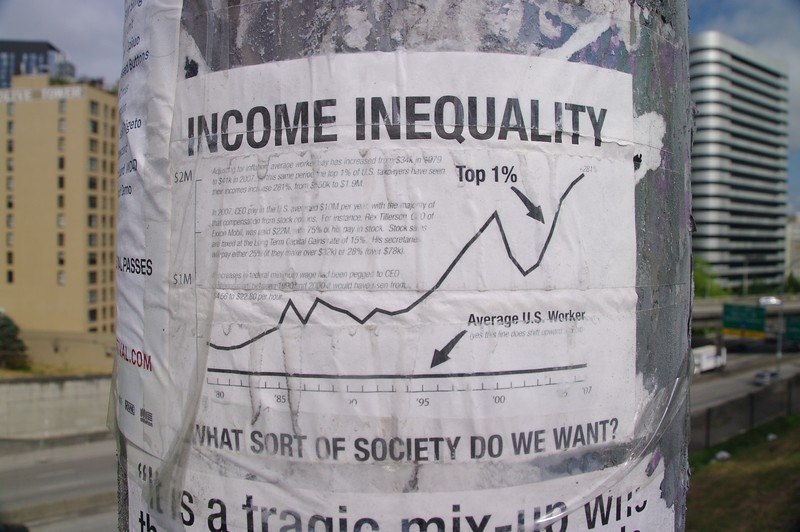
There is widespread concern about increasing or high economic inequality in many countries, both rich and poor. At a global level, according to the World Inequality Report 2018, the richest 1% in the world reaped 27% of the growth in world income between 1980 and 2016, while bottom 50% of the population got only 12%. Over roughly the same period, however, absolute poverty by standard measures has generally been on the decline in most countries. By the widely-used World Bank estimates, in 2015 only about 10 per cent of the world population lived below its common, admittedly rather austere, poverty line of $1.90 per capita per day (at 2011 purchasing power parity), compared to 36 per cent in 1990. This decline is by and large valid even if one uses broader measures of poverty that take into account some non-income indicators (like deprivations in health and education) for the countries for which such data are available.
If absolute poverty is declining, while measures of relative inequality (of income or wealth) show a significant rise (or remain very high), this implies that the conditions of the poor may be improving, but those for the rich may be improving much more. But if people are less poor than before, should we be concerned about high or rising inequality, about how much better-off the rich are, and, if so, why? This is an important question on which more clarity is needed, as quite often when people tell you why they dislike inequality many of the examples they cite are really about their aversion to the stark poverty around them.
Continue reading
There is widespread concern about increasing or high economic inequality in many countries, both rich and poor. At a global level, according to the World Inequality Report 2018, the richest 1% in the world reaped 27% of the growth in world income between 1980 and 2016, while bottom 50% of the population got only 12%. Over roughly the same period, however, absolute poverty by standard measures has generally been on the decline in most countries. By the widely-used World Bank estimates, in 2015 only about 10 per cent of the world population lived below its common, admittedly rather austere, poverty line of $1.90 per capita per day (at 2011 purchasing power parity), compared to 36 per cent in 1990. This decline is by and large valid even if one uses broader measures of poverty that take into account some non-income indicators (like deprivations in health and education) for the countries for which such data are available.
If absolute poverty is declining, while measures of relative inequality (of income or wealth) show a significant rise (or remain very high), this implies that the conditions of the poor may be improving, but those for the rich may be improving much more. But if people are less poor than before, should we be concerned about high or rising inequality, about how much better-off the rich are, and, if so, why? This is an important question on which more clarity is needed, as quite often when people tell you why they dislike inequality many of the examples they cite are really about their aversion to the stark poverty around them.
Continue reading
Monday, 19 August 2019
Morals ex Machina: Should we listen to machines for moral guidance?
an article by Michael Klenk published in 3 Quarks Daily

I live and work in two different cities; on the commute, I continuously ask my phone for advice: When’s the next train? Must I take the bus, or can I afford to walk and still make the day’s first meeting? I let my phone direct me to places to eat and things to see, and I’ll admit that for almost any question, my first impulse is to ask the internet for advice.
My deference to machines puts me in good company. Professionals concerned with mightily important questions are doing it, too, when they listen to machines to determine who is likely to have cancer, pay back their loan, or return to prison. That’s all good insofar as we need to settle clearly defined, factual questions that have computable answers.
Imagine now a wondrous new app. One that tells you whether it is permissible to lie to a friend about their looks, to take the plane in times of global warming, or whether you ought to donate to humanitarian causes and be a vegetarian. An artificial moral advisor to guide you through the moral maze of daily life. With the push of a button, you will competently settle your ethical questions; if many listen to the app, we might well be on our way to a better society.
Concrete efforts to create such artificial moral advisors are already underway. Some scholars herald artificial moral advisors as vast improvements over morally frail humans, as presenting the best opportunity for avoiding the extinction of human life from our own hands. They demand that we should take listen to machines for ethical advice. But should we?
Continue reading
I live and work in two different cities; on the commute, I continuously ask my phone for advice: When’s the next train? Must I take the bus, or can I afford to walk and still make the day’s first meeting? I let my phone direct me to places to eat and things to see, and I’ll admit that for almost any question, my first impulse is to ask the internet for advice.
My deference to machines puts me in good company. Professionals concerned with mightily important questions are doing it, too, when they listen to machines to determine who is likely to have cancer, pay back their loan, or return to prison. That’s all good insofar as we need to settle clearly defined, factual questions that have computable answers.
Imagine now a wondrous new app. One that tells you whether it is permissible to lie to a friend about their looks, to take the plane in times of global warming, or whether you ought to donate to humanitarian causes and be a vegetarian. An artificial moral advisor to guide you through the moral maze of daily life. With the push of a button, you will competently settle your ethical questions; if many listen to the app, we might well be on our way to a better society.
Concrete efforts to create such artificial moral advisors are already underway. Some scholars herald artificial moral advisors as vast improvements over morally frail humans, as presenting the best opportunity for avoiding the extinction of human life from our own hands. They demand that we should take listen to machines for ethical advice. But should we?
Continue reading
Thursday, 8 August 2019
Memories of Childhood: Aesop’s Fables are as Relevant Today as They Were 2,600 Years Ago
a post by Aleksa Vučković for the Ancient Origins blog

Aesop’s fables used animals as the characters in the story. ( Archivist / Adobe Stock)
The Frog and the Mouse, The Fox and the Stork, The Boy Who Cried Wolf – these, and many other wonderful fables, were a big part of childhood for many of us. But now that childhood is gone, did we stop to think about the man who wrote them and the deeper, important messages that they convey?
Well, here at Ancient Origins we always remember to touch up on history’s richest subjects and today we are uncovering the centuries of storytelling and the mysterious identity of the figure who wrote it all – Aesop.
Educational, witty, and inspirational, these short fables always had a ‘moral of the story’ – important small lessons that can be a big part of growing up. But we never realized that even in the 20th century, we were listening to the same tales as children from Classical Antiquity. And that is exactly what makes these fables so important – they are immortal.
Continue reading
Hazel’s comment
I would normally put posts from Ancient Origins into the “10 for Today” trivia posts that I create at weekends but I got really involved with this one and did not want you to miss it!
Take care – even the ads look interesting!
Aesop’s fables used animals as the characters in the story. ( Archivist / Adobe Stock)
The Frog and the Mouse, The Fox and the Stork, The Boy Who Cried Wolf – these, and many other wonderful fables, were a big part of childhood for many of us. But now that childhood is gone, did we stop to think about the man who wrote them and the deeper, important messages that they convey?
Well, here at Ancient Origins we always remember to touch up on history’s richest subjects and today we are uncovering the centuries of storytelling and the mysterious identity of the figure who wrote it all – Aesop.
Educational, witty, and inspirational, these short fables always had a ‘moral of the story’ – important small lessons that can be a big part of growing up. But we never realized that even in the 20th century, we were listening to the same tales as children from Classical Antiquity. And that is exactly what makes these fables so important – they are immortal.
Continue reading
Hazel’s comment
I would normally put posts from Ancient Origins into the “10 for Today” trivia posts that I create at weekends but I got really involved with this one and did not want you to miss it!
Take care – even the ads look interesting!
Tuesday, 19 March 2019
‘Playing the victim’ is politically vital and morally serious
a post by Ashwini Vasanthakumar for the Big Think blog
Victims are moral agents rather than moral patients.
Those who speak out against bad treatment are often dismissed as 'playing the victim', accused of dwelling on imagined slights or indulging in an exaggerated sense of grievance. In the face of ridicule or, worse, the threat of violence, it would be easier to keep quiet. And yet, victims of injustice often do speak up: far from any desire for glory, they are often morally motivated, and act from a sense of duty.
Someone who is subjected to demeaning treatment might owe it to herself to protest and to undermine the apparatus of assumptions, stereotypes and norms that enable this treatment. But, importantly, she might also owe it to others who are vulnerable to similar treatment — fellow victims — to resist the injustices they face collectively and repeatedly. This is especially the case for what the US political theorist Iris Marion Young in 2003 called structural injustices, which are perpetuated through seemingly benign institutions, everyday practices, background assumptions and expected behaviours. Even where there is no explicit discriminatory policy, in fact when such discrimination is publicly, repeatedly and earnestly disavowed, oppression on the basis of, for example, class, race and sex prevails.
Continue reading
Victims are moral agents rather than moral patients.
Those who speak out against bad treatment are often dismissed as 'playing the victim', accused of dwelling on imagined slights or indulging in an exaggerated sense of grievance. In the face of ridicule or, worse, the threat of violence, it would be easier to keep quiet. And yet, victims of injustice often do speak up: far from any desire for glory, they are often morally motivated, and act from a sense of duty.
Someone who is subjected to demeaning treatment might owe it to herself to protest and to undermine the apparatus of assumptions, stereotypes and norms that enable this treatment. But, importantly, she might also owe it to others who are vulnerable to similar treatment — fellow victims — to resist the injustices they face collectively and repeatedly. This is especially the case for what the US political theorist Iris Marion Young in 2003 called structural injustices, which are perpetuated through seemingly benign institutions, everyday practices, background assumptions and expected behaviours. Even where there is no explicit discriminatory policy, in fact when such discrimination is publicly, repeatedly and earnestly disavowed, oppression on the basis of, for example, class, race and sex prevails.
Continue reading
Wednesday, 20 February 2019
Misbehaving: being clever and wicked is a form of creativity
a post by Hansika Kapoor for the Big Think blog
Creativity can bring about unchecked harm, but it's up to us how we wield it.
Suppose you forgot it was your partner's birthday, but you know that they would appreciate the smallest of gestures, say a bouquet. It's late at night and no florists are open. The cemetery on your way home has recently had a funeral, and you walk across the site and pick up a good-looking bouquet of roses from someone's grave. You then head home, and the flowers are happily received by your partner.
Would you say that you hurt anyone?
This isn't so much a moral dilemma as it is a creative misbehaviour. More specifically, it is an instance of the dark side of creativity – the side that few people acknowledge or talk about. Variously referred to as malevolent or negative, dark creativity uses the creative process to do something socially unappealing and guided by self-interest. You might not intend to harm someone else, yet harm is often a byproduct of your actions. In the instance above, you found an original solution (stealing flowers from a graveyard) to a problem (upset partner) that was effective (happy partner).
That is what makes up the crux of creativity – originality and effectiveness in behaviour.
But can we call such an act truly creative? For one thing, it violates moral codes of conduct (stealing); for another, it involves deception (omitting the truth about where you got the flowers).
Continue reading
Creativity can bring about unchecked harm, but it's up to us how we wield it.
Suppose you forgot it was your partner's birthday, but you know that they would appreciate the smallest of gestures, say a bouquet. It's late at night and no florists are open. The cemetery on your way home has recently had a funeral, and you walk across the site and pick up a good-looking bouquet of roses from someone's grave. You then head home, and the flowers are happily received by your partner.
Would you say that you hurt anyone?
This isn't so much a moral dilemma as it is a creative misbehaviour. More specifically, it is an instance of the dark side of creativity – the side that few people acknowledge or talk about. Variously referred to as malevolent or negative, dark creativity uses the creative process to do something socially unappealing and guided by self-interest. You might not intend to harm someone else, yet harm is often a byproduct of your actions. In the instance above, you found an original solution (stealing flowers from a graveyard) to a problem (upset partner) that was effective (happy partner).
That is what makes up the crux of creativity – originality and effectiveness in behaviour.
But can we call such an act truly creative? For one thing, it violates moral codes of conduct (stealing); for another, it involves deception (omitting the truth about where you got the flowers).
Continue reading
Friday, 9 November 2018
What are we like? 10 psychology findings that reveal the worst of human nature
a post by Christian Jarrett for the Big Think blog
Are we doomed?
It's a question that's reverberated through the ages – are we humans, though imperfect, essentially kind, sensible, good-natured creatures?
Or deep down are we wired to be bad, blinkered, idle, vain, vengeful and selfish?
There are no easy answers and there's clearly a lot of variation between individuals, but this feature post aims to shine some evidence-based light on the matter. Here in the first part of a two-part feature – and deliberately side-stepping the obviously relevant but controversial and already much-discussed Milgram, Zimbardo and Asch studies – we digest 10 dispiriting findings that reveal the darker and less impressive aspects of human nature:
Continue reading
Are we doomed?
It's a question that's reverberated through the ages – are we humans, though imperfect, essentially kind, sensible, good-natured creatures?
Or deep down are we wired to be bad, blinkered, idle, vain, vengeful and selfish?
There are no easy answers and there's clearly a lot of variation between individuals, but this feature post aims to shine some evidence-based light on the matter. Here in the first part of a two-part feature – and deliberately side-stepping the obviously relevant but controversial and already much-discussed Milgram, Zimbardo and Asch studies – we digest 10 dispiriting findings that reveal the darker and less impressive aspects of human nature:
Continue reading
Friday, 10 August 2018
An indisputable “holy trinity”? On the moral value of equality, diversity, and inclusion
an article by Thomas Köllen (University of Bern, Switzerland), Marja-Liisa Kakkuri-Knuuttila (Aalto University School of Business, Helsinki, Finland) and Regine Bendl (Vienna University of Economics and Business, Austria) published in Equality, Diversity and Inclusion: An International Journal Volume 37 Issue 5 (2018)
Abstract
Purpose
There seems to exist a widespread, unquestioned and unquestionable consent, both in research and practice, that there is a moral value inherent in equality and related initiatives toward diversity and inclusion. However, this consent is primarily based on political convictions and emotional reasons, and is without any strong ethical grounding. Whilst a considerable volume of research has been carried out into different facets of the economic value of initiatives toward equality, diversity, and inclusion (EDI), comparatively little research has been undertaken into its moral value. Therefore, the purpose of this paper is to structure the moral perspectives on EDI more precisely and more critically.
Design/methodology/approach
After discussing the interrelation of the three concepts equality, diversity and inclusion, the authors discuss the way in which initiatives toward diversity and inclusion are justified morally in literature. The authors point out the crucial position of equality, and then, subsequently, outline how different approaches to equality try to achieve moral legitimacy. Being an important group of initiatives in this debate, the authors subsequently reflect upon the moral (il)legitimacy of affirmative action (AA). The concluding section of this paper provides a brief summary of the findings.
Findings
The moral evaluation of equality, diversity and inclusion remains an under-theorized field. Within the discourse on equality, diversity and inclusion, the term “justice” is largely used in an intuitive way, rather than being rooted in a specific moral philosophy. As there are several conceivable, differing moral perspectives on EDI, one cannot expect an indisputable answer to the question as to whether a given approach toward equality, diversity and inclusion is morally praiseworthy or just. However, the widespread assumption that equality is morally praiseworthy per se, and that striving for equality morally justifies any initiative toward diversity and inclusion, is untenable.
Originality/value
This paper addresses the lack of theorizing on the moral value of initiatives toward equality, diversity, and inclusion, such as diversity management, AA or various equal opportunity approaches. Future research could enrich the discourse on the moral evaluation of diversity management, inclusion programs and organizational equality approaches with new philosophical facets and perspectives, perspectives that might differ from those taken in the predominantly American discourse.
Abstract
Purpose
There seems to exist a widespread, unquestioned and unquestionable consent, both in research and practice, that there is a moral value inherent in equality and related initiatives toward diversity and inclusion. However, this consent is primarily based on political convictions and emotional reasons, and is without any strong ethical grounding. Whilst a considerable volume of research has been carried out into different facets of the economic value of initiatives toward equality, diversity, and inclusion (EDI), comparatively little research has been undertaken into its moral value. Therefore, the purpose of this paper is to structure the moral perspectives on EDI more precisely and more critically.
Design/methodology/approach
After discussing the interrelation of the three concepts equality, diversity and inclusion, the authors discuss the way in which initiatives toward diversity and inclusion are justified morally in literature. The authors point out the crucial position of equality, and then, subsequently, outline how different approaches to equality try to achieve moral legitimacy. Being an important group of initiatives in this debate, the authors subsequently reflect upon the moral (il)legitimacy of affirmative action (AA). The concluding section of this paper provides a brief summary of the findings.
Findings
The moral evaluation of equality, diversity and inclusion remains an under-theorized field. Within the discourse on equality, diversity and inclusion, the term “justice” is largely used in an intuitive way, rather than being rooted in a specific moral philosophy. As there are several conceivable, differing moral perspectives on EDI, one cannot expect an indisputable answer to the question as to whether a given approach toward equality, diversity and inclusion is morally praiseworthy or just. However, the widespread assumption that equality is morally praiseworthy per se, and that striving for equality morally justifies any initiative toward diversity and inclusion, is untenable.
Originality/value
This paper addresses the lack of theorizing on the moral value of initiatives toward equality, diversity, and inclusion, such as diversity management, AA or various equal opportunity approaches. Future research could enrich the discourse on the moral evaluation of diversity management, inclusion programs and organizational equality approaches with new philosophical facets and perspectives, perspectives that might differ from those taken in the predominantly American discourse.
Wednesday, 14 March 2018
Can moral virtues become outdated?
a post by Emrys Westacott for 3 Quarks Daily
A virtue is a quality that people consider valuable, admirable, or desirable. Human beings exhibit various kinds of virtues, many of which are specific to particular roles or activities. A strong throwing arm is a virtue in a baseball player. A good memory is a virtue in a stage actor. Some qualities, however, such as courage, kindness, or generosity, are typically viewed as moral virtues.
It isn’t easy to specify just what makes a virtue a moral virtue. Like certain talents, qualities such as empathy or cheerfulness may be gifts of nature or ingrained by a certain upbringing, and they can also be deliberately cultivated. So the difference between moral and non-moral virtues doesn’t lie in their origin, or in the degree to which one is responsible for possessing them.
Continue reading
A virtue is a quality that people consider valuable, admirable, or desirable. Human beings exhibit various kinds of virtues, many of which are specific to particular roles or activities. A strong throwing arm is a virtue in a baseball player. A good memory is a virtue in a stage actor. Some qualities, however, such as courage, kindness, or generosity, are typically viewed as moral virtues.
It isn’t easy to specify just what makes a virtue a moral virtue. Like certain talents, qualities such as empathy or cheerfulness may be gifts of nature or ingrained by a certain upbringing, and they can also be deliberately cultivated. So the difference between moral and non-moral virtues doesn’t lie in their origin, or in the degree to which one is responsible for possessing them.
Continue reading
Tuesday, 13 February 2018
Legal rights are not all right: when morality and the law collide
a post by Jens Beckert and Matias Dewey for the OUP [Oxford University Press] blog
In early November 2017, media outlets hailed the Paradise Papers as a major scoop: 13.4 million leaked documents revealed the financial details of some of the world’s leading brands, politicians, sports stars, and musicians. But this was to be no repeat of last year’s Panama Papers, in which well-known names appeared relating to criminal acts like “corruption,” “tax evasion,” and “money laundering”; the Paradise Papers failed to reveal a single crime.
So why was it considered news?
The general public’s views of “right” and “wrong” are on this and many other occasions at odds with lawful definitions of “legal” and “illegal.” While the latter express a state’s interests in sanctioning certain exchanges or behaviours (i.e., are an expression of power and an attempt to manufacture a specific type of social order), the former are social beliefs about the legitimacy of certain acts, which may or may not coincide with the legal definitions.
Bono buying a stake in a Lithuanian shopping mall, or Lewis Hamilton importing his private jet to the Isle of Man might be perfectly legal, but the general public does not accept it as moral or legitimate. These are extraordinarily wealthy people who, with the help of tax advisers, avoid their public duty of contributing the same rate as lower earners to the common pot.
When a private estate acting for the Queen invests in offshore private equity funds, operating in infamous tax havens like the Cayman Islands and Bermuda, it appears that she is maximizing financial gains by using a service closed to, and at the expense of, the majority of her own subjects.
Continue reading including several links to further information
In early November 2017, media outlets hailed the Paradise Papers as a major scoop: 13.4 million leaked documents revealed the financial details of some of the world’s leading brands, politicians, sports stars, and musicians. But this was to be no repeat of last year’s Panama Papers, in which well-known names appeared relating to criminal acts like “corruption,” “tax evasion,” and “money laundering”; the Paradise Papers failed to reveal a single crime.
So why was it considered news?
The general public’s views of “right” and “wrong” are on this and many other occasions at odds with lawful definitions of “legal” and “illegal.” While the latter express a state’s interests in sanctioning certain exchanges or behaviours (i.e., are an expression of power and an attempt to manufacture a specific type of social order), the former are social beliefs about the legitimacy of certain acts, which may or may not coincide with the legal definitions.
Bono buying a stake in a Lithuanian shopping mall, or Lewis Hamilton importing his private jet to the Isle of Man might be perfectly legal, but the general public does not accept it as moral or legitimate. These are extraordinarily wealthy people who, with the help of tax advisers, avoid their public duty of contributing the same rate as lower earners to the common pot.
When a private estate acting for the Queen invests in offshore private equity funds, operating in infamous tax havens like the Cayman Islands and Bermuda, it appears that she is maximizing financial gains by using a service closed to, and at the expense of, the majority of her own subjects.
Continue reading including several links to further information
Monday, 10 August 2015
Does It Pay to Be Moral? How Indicators of Morality and Competence Enhance Organizational and Work Team Attractiveness
an article by Anne-Marie van Prooijen (Solvay Brussels School of Economics and Management, Belgium) and Naomi Ellemers (Leiden University, the Netherlands) published in British Journal of Management Volume 26 Issue 2 (April 2015)
Abstract
Based on a social identity analysis, the authors argue that people are attracted to teams and organizations with positive features. Such features can refer to the competence and achievements of the organization, or to its moral values and ethical conduct.
However, in work contexts, ethics and achievements do not necessarily go together.
The paper reports three studies that examine the relative and combined impact of perceived competence vs morality of a team or organization on its attractiveness to individuals.
Study 1 (n = 44) reveals that students prefer to seek employment in a moral rather than a competent organization, when forced to choose between these organizational features on a bipolar scale.
Study 2 (n = 100) replicates these findings in a design where the competence and morality of a fictitious organization were manipulated orthogonally.
Study 3 (n = 89) examines responses to experimental task teams that systematically differed from each other in their competence and morality.
Results of all three studies converge to demonstrate that the perceived morality of the team or organization has a greater impact on its attractiveness to individuals than its perceived competence.
The authors discuss the theoretical and practical implications of these findings.
Abstract
Based on a social identity analysis, the authors argue that people are attracted to teams and organizations with positive features. Such features can refer to the competence and achievements of the organization, or to its moral values and ethical conduct.
However, in work contexts, ethics and achievements do not necessarily go together.
The paper reports three studies that examine the relative and combined impact of perceived competence vs morality of a team or organization on its attractiveness to individuals.
Study 1 (n = 44) reveals that students prefer to seek employment in a moral rather than a competent organization, when forced to choose between these organizational features on a bipolar scale.
Study 2 (n = 100) replicates these findings in a design where the competence and morality of a fictitious organization were manipulated orthogonally.
Study 3 (n = 89) examines responses to experimental task teams that systematically differed from each other in their competence and morality.
Results of all three studies converge to demonstrate that the perceived morality of the team or organization has a greater impact on its attractiveness to individuals than its perceived competence.
The authors discuss the theoretical and practical implications of these findings.
Subscribe to:
Posts (Atom)

