Showing posts with label philosophy. Show all posts

Tuesday, 12 November 2019

The Moral Robot

a post by Chris Horner for 3 Quarks Daily


The question of how to program AI to behave morally has exercised a lot of people, for a long time.

Most famous, perhaps, are the three rules for robots that Isaac Asimov introduced in his SF stories:
  1. A robot may not injure a human being or, through inaction, allow a human being to come to harm;
  2. A robot must obey orders given it by human beings except where such orders would conflict with the First Law;
  3. A robot must protect its own existence as long as such protection does not conflict with the First or Second Law.
These have been discussed, amended, extended and criticised at great length ever since Asimov published them in 1942, and with the current interest in ‘intelligent AI’ it seems they will be subject for debate for some time to come. But I think the difficulties of coming up with effective rules of this kind are more interesting for what they tell us about the difficulties of any rule or duty based morality for humans than they are for the question of ‘AI morality’.

Continue reading


Monday, 11 November 2019

How America's hatred of poor people ties back to Puritan work ethic

a post by Thom Dunn for the Boing Boing blog


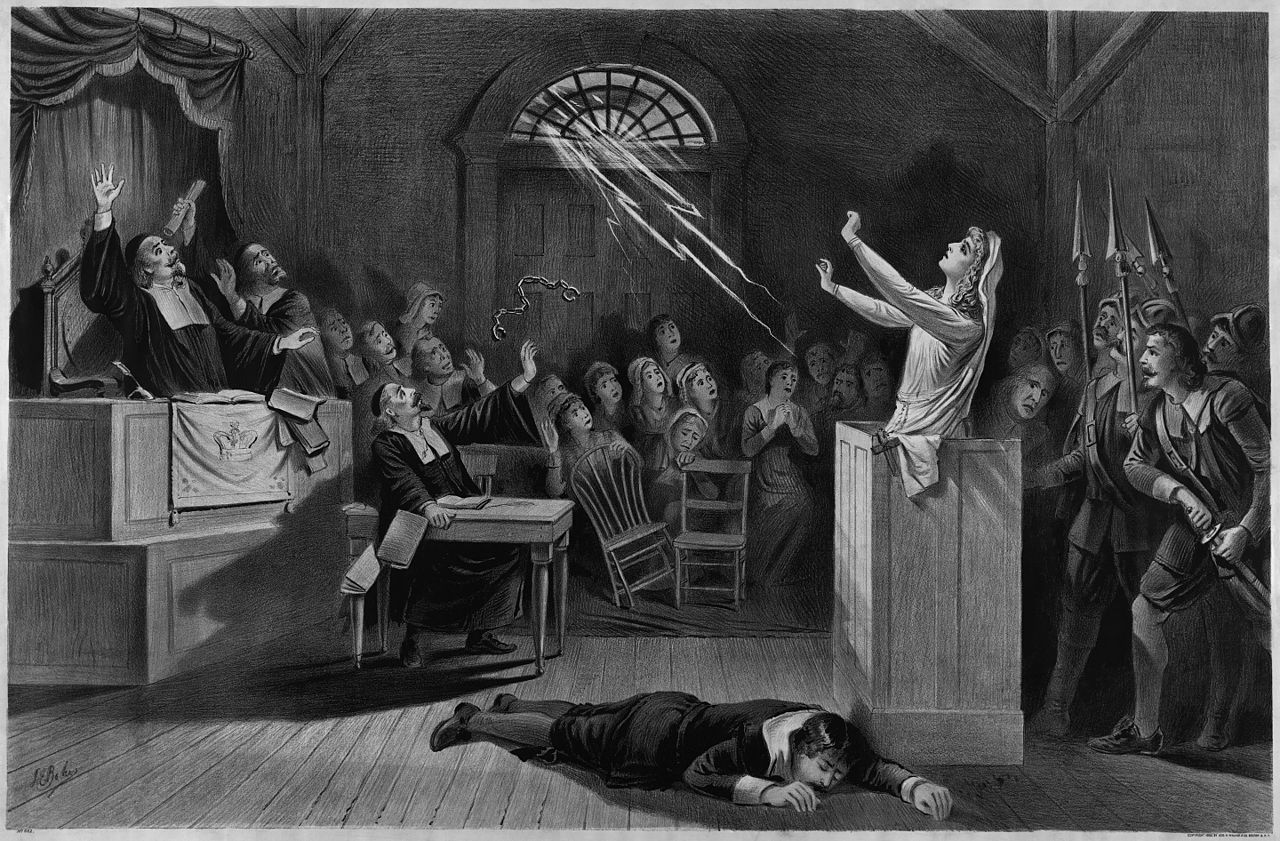
Image via Wikimedia Commons

Guggenheim and MacArthur fellowship-winning philosopher Elizabeth Anderson recently spoke with Joe Humphreys at the Irish Times about America's toxic obsession with by-your-bootstraps individualism, and specifically how it relates to poverty.

There are plenty of impactful quotes throughout the interview, but the parts that stuck out the most to me — as an agnostic born into an Irish Catholic family, whose mother worked for the church for a long time — were her observations about America's puritanical roots, and, later, the impacts of World War II. Anderson  essentially proposes the idea that early America Puritans like the Pilgrims were determined to distance themselves from the institutional power of the Catholic church — which, for all its faults, has at least had a longstanding commitment to helping and empathizing with those suffering from poverty. In addition to Manifest Destiny, these Puritans believed that hard work was the only promise of salvation, which eventually evolved into the whole "rugged individualism" idea that consumes so many American conservatives and Evangelicals. While Anderson acknowledges that this ethic is rooted in a very pro-worker mindset, it's clearly been secularized over time into a highly partisan hatred of the poor, with a nod towards its religious roots:

Continue reading and maybe link through to the comments, some of them are very enlightening.


Monday, 7 October 2019

For ethical reflection, establish a clear technical foundation

an article by Chuck Huff (St. Olaf College, Northfield, Minnesota, USA) published in Journal of Information, Communication and Ethics in Society Volume 17 Issue 3 (2019)

Abstract

Purpose
This viewpoint aims to highlight the necessarily technical nature of ethics in software development, propose a label (ethical bypassing) for ethical analysis that does not lead to ethical action and introduce a philosophical foundation for technical analysis that leads to ethical software development.

Design/methodology/approach
The methodological approach is one of technical analysis that is aware of social science and philosophical knowledge bases.

Findings
The findings establish a clear technical foundation that is crucial to ethical analysis that will actually inform software development.

Research limitations/implications
The idea that beginning with technical expertise is the best way to begin ethical reflection on a technical implementation has been often suggested, but not really empircally tested. Research using cases or other qualitative approaches would need to be done to add credibility to the claim.

Practical implications
This approach suggests that collaboration between technically informed ethicists and ethically informed technical experts should begin with the exploration of the technical questions rather than with ethical speculation.

Social implications
A common approach to ethical education is to concentrate on ethical theory and its application in technical contexts. This approach suggests that this may lead to ethical bypassing by the student, the avoidance of the making technical decisions by extensive ethical reflection.

Originality/value
This paper introduces a new term, ethical bypassing, to the literature on the ethics of software development.


Monday, 16 September 2019

What does self-actualization mean in different cultures?

a post by Matt Davis for the Big Think blog

Critics complain that Maslow's hierarchy of needs focuses too much on the West. Yet other cultures often have similar ideas about personal development.
  • When Abraham Maslow developed his hierarchy of needs, he focused entirely on students, peers, and historical figures, all of whom were from the West.
  • This led many critics to argue that his model of human development and the concept of self-actualization were not universal; they merely reflected Western ideas about development and self-improvement.
  • Other cultures ranging from Blackfoot Native Americans to the Chinese have similar ideas that run parallel to self-actualization. What are they, and how do they differ?

Just to remind myself, and you, of Maslow's Hierarchy

maslow's hierarchy of needs five stage pyramid

Thursday, 8 August 2019

Memories of Childhood: Aesop’s Fables are as Relevant Today as They Were 2,600 Years Ago

a post by Aleksa Vučković for the Ancient Origins blog


Aesop’s fables used animals as the characters in the story. ( Archivist / Adobe Stock)

The Frog and the Mouse, The Fox and the Stork, The Boy Who Cried Wolf – these, and many other wonderful fables, were a big part of childhood for many of us. But now that childhood is gone, did we stop to think about the man who wrote them and the deeper, important messages that they convey?

Well, here at Ancient Origins we always remember to touch up on history’s richest subjects and today we are uncovering the centuries of storytelling and the mysterious identity of the figure who wrote it all – Aesop.

Educational, witty, and inspirational, these short fables always had a ‘moral of the story’ – important small lessons that can be a big part of growing up. But we never realized that even in the 20th century, we were listening to the same tales as children from Classical Antiquity. And that is exactly what makes these fables so important – they are immortal.

Continue reading

Hazel’s comment
I would normally put posts from Ancient Origins into the “10 for Today” trivia posts that I create at weekends but I got really involved with this one and did not want you to miss it!
Take care – even the ads look interesting!


Thursday, 18 July 2019

Where are all the women in ancient philosophy?

an article by Peter Adamson published in the New Statesman

It’s complicated.

Here’s something about the history of philosophy that you’re more likely to learn by going to the movies than by studying philosophy at university: in antiquity, there were female philosophers.

The 2009 feature film Agora stars Rachel Weisz as astronomer and Platonist philosopher Hypatia, a pagan aristocrat who was murdered by a Christian mob in ancient Alexandria. Though the movie is occasionally specious, particularly in its depiction of Hypatia anticipating the astronomical discoveries of Johannes Kepler, it exposes an important truth: science and philosophy were not exclusively male enterprises, contrary to what university curricula might suggest.

Few philosophy students are given the chance to think or read about female philosophers in antiquity. Anne Conway, Margaret Cavendish, Émilie du Châtelet and other early modern women philosophers are slowly finding their way onto the syllabus. So why not Hypatia? Well, there’s a good reason – we don’t have any of her philosophical works.

Continue reading


Wednesday, 17 April 2019

Is it right to use intuition as evidence?

a post by Nevin Climenhaga for the OUP blog


“Lost in the Wilderness” by Stijn Swinnen. CCO via Unsplash

Dr. Smith is a wartime medic. Five injured soldiers are in critical need of organ transplants: one needs a heart, two need kidneys, and two need lungs. A sixth soldier has come in complaining of a toothache. Reasoning that it’s better that five people should live than one, Smith knocks out the sixth soldier with anesthetic, chops up his organs, and transplants them into his five other patients. In the chaos of the war, no one ever finds out. Does Smith act wrongly?

It seems to me that Smith has done something wrong. This feeling of mine is not the conclusion of any explicit argument. Instead, I just reflect on this situation and find myself with the intuition that Smith’s act is wrong. On this basis, I conclude that morality does not always require us to bring about the best outcome. It is better for five to survive than one, but it’s not permissible to murder someone to bring this outcome about.

Here, I use my intuition as evidence for a philosophical claim. I start with a claim about how things seem to me, intuitively, and I move from there to a claim about how things actually are. This is one of the primary ways in which philosophers answer questions about reality and our place in it—we think carefully about hypothetical scenarios or abstract principles, and see what claims then seem to us to be true about whether an action is immoral, or when our actions are free, or what we can know.

Continue reading

I have read this through three times and I am still not certain that I can answer the original question. Hazel


Tuesday, 19 March 2019

‘Playing the victim’ is politically vital and morally serious

a post by Ashwini Vasanthakumar for the Big Think blog

Victims are moral agents rather than moral patients.

Those who speak out against bad treatment are often dismissed as 'playing the victim', accused of dwelling on imagined slights or indulging in an exaggerated sense of grievance. In the face of ridicule or, worse, the threat of violence, it would be easier to keep quiet. And yet, victims of injustice often do speak up: far from any desire for glory, they are often morally motivated, and act from a sense of duty.

Someone who is subjected to demeaning treatment might owe it to herself to protest and to undermine the apparatus of assumptions, stereotypes and norms that enable this treatment. But, importantly, she might also owe it to others who are vulnerable to similar treatment — fellow victims — to resist the injustices they face collectively and repeatedly. This is especially the case for what the US political theorist Iris Marion Young in 2003 called structural injustices, which are perpetuated through seemingly benign institutions, everyday practices, background assumptions and expected behaviours. Even where there is no explicit discriminatory policy, in fact when such discrimination is publicly, repeatedly and earnestly disavowed, oppression on the basis of, for example, class, race and sex prevails.

Continue reading


Friday, 15 March 2019

Alan Watts and the art of meditation

a post by Mike Colagrossi for the Big Think blog

Forget everything you think you know about meditation.

  • Alan Watts cuts to the root of what meditation really is all about.
  • Meditative practice has no motive, except to experience the present moment.
  • Practice a guided meditation by focusing on the now.

Meditation has left the ashrams and become a fixture in the boardroom and livings rooms everywhere. The corporate analysts and Silicon Valley-types scramble for their next hit of improvement. Spiritual posturing and enlightened one-uppers fill our social feeds and make it seem like meditative bliss is just a hashtag away. Unfortunately as spiritual practices enter into the wide marketplace of ideas, there is a tendency for them to be degraded and repackaged into self-improvement drivel and self-serving nonsense.

Continue reading

Hazel’s comment:
I would not normally ask you to continue reading an item which contains grammatical errors (yes, I am pedantic about using what I view as correct punctuation and word usage). However, in this case, where tenant (someone who holds land or property by right or title) was substituted for tenet (a principle, belief or doctrine), I believe that what has been written is more important than my quibbles.
Do not get caught in the advertising!


Thursday, 21 February 2019

Hannah Arendt on why some people are immune to fact-checking

a post by Scotty Hendricks for the Big Think blog

Why do people buy into stories that are clearly lies? Hannah Arendt can help us understand.

  • People who don't believe facts or news that disagree with their worldviews can be impossible to deal with, and boy there are a lot of them lately.
  • Hannah Arendt tells us this isn't all new; it happened before around 1936.
  • It isn't easy to convince a person who has given up on facts that they really should face reality again, but it can be done.

A strange phenomenon has infected global politics. Fact-checking, once seen as a dull but effective way to figure out what is true and what is false, is now an extremely contentious business that often utterly fails to convince people that their views are based on falsehoods.

Most of us who care about being accurate and seeking truth from facts are, justly, shocked by this. How can it be that entire political movements are based around falsehoods and eagerly supported by people who claim all attempts at fact-checking are "fake news"?

Continue reading


Wednesday, 30 January 2019

Are our fantasies immune from morality?

a post by Anna Cremaldi and Christopher Bartel for the OUP blog


“Light, colour, bright and neon” by Efe Kurnaz. CC0 via Unsplash

Immoral fantasies are not uncommon, nor are they necessarily unhealthy. Some are silly and unrealistic, though others can be genuinely disturbing. You might fantasize about kicking your boss in the shins, or having an affair with your best friend’s spouse, or planning the perfect murder. Everyone enjoys a dark little fantasy at some time. Which leads us to wonder, is it ever morally wrong to do so? Or, a better way to put the question, under what conditions is it morally wrong to fantasize about something?

A natural response to these questions is to answer flatly: no. It can never be morally wrong to fantasize about something simply because it is a fantasy. My imagination is not a space where morality intrudes. Rather, what happens in my imagination is my business, and no one else’s moral qualms should have bearing on this most personal space.

Continue reading


Friday, 9 November 2018

What are we like? 10 psychology findings that reveal the worst of human nature

a post by Christian Jarrett for the Big Think blog

Are we doomed?

It's a question that's reverberated through the ages – are we humans, though imperfect, essentially kind, sensible, good-natured creatures?

Or deep down are we wired to be bad, blinkered, idle, vain, vengeful and selfish?

There are no easy answers and there's clearly a lot of variation between individuals, but this feature post aims to shine some evidence-based light on the matter. Here in the first part of a two-part feature – and deliberately side-stepping the obviously relevant but controversial and already much-discussed Milgram, Zimbardo and Asch studies – we digest 10 dispiriting findings that reveal the darker and less impressive aspects of human nature:

Continue reading


Tuesday, 12 February 2013

It’s not always the economy, stupid

via Eurozine Review
  • Spilne says it’s not the economy, at least not on the radical right
  • Kulturos barai learns to flourish within limits
  • Merkur declares solidarity sovereignty's foe
  • Esprit publishes Ricœur’s unpublished piece on God
  • Free Speech Debate won’t compromise: we must be able to talk about this
  • Dilema veche compiles a dossier on the dissidents of today
  • Osteuropa pays homage to Polish composer Witold Lutoslawski
  • Host hits the books fairs
  • Springerin enters the archives, and finds life
  • Sodobnost celebrates the symbiosis of law and literature
  • Ord&Bild tells of an outsourced dissertation
Full article (HTML) PDF (2pp)


Friday, 18 May 2007

Who says we know: an original essay for Edge by Larry Sanger

If you haven't come across Edge before allow me to introduce you to a non-academic, but never simplistic, source of philosophical debate. Edge's mission is to:
To arrive at the edge of the world's knowledge, seek out the most complex
and sophisticated minds, put them in a room together, and have them ask each
other the questions they are asking themselves.

In the most recent publication my mind stuck on "everybody knows". Sanger tells us that: "Everybody knows that Everest is the tallest mountain on Earth, that 2+2=4, that most people have two eyes." I will admit, however, that the reason I got stuck on this phrase was that I regularly say to the significant other in my life (aka husband not dog) "well, I'm not everybody". He seems to assume that the knowledge that in his head is also in mine. OK, 2+2=4. The inner workings of a computer? Forget it - I don't even understand the words he uses.

What is knowledge? How do we "know" what we know? Or, as Sanger titles his essay, "Who says we know".

In the Middle Ages, we were told what we knew by the Church; after the printing press and the Reformation, by state censors and the licensers of publishers; with the rise of liberalism in the 19th and 20th centuries, by publishers themselves, and later by broadcast media—in any case, by a small, elite group of professionals.
But we are now confronting a new politics of knowledge, with the rise of the Internet and particularly of the collaborative Web—the Blogosphere, Wikipedia, Digg, YouTube, and in short every website and type of aggregation that invites all comers to offer their knowledge and their opinions, and to rate content, products, places, and people. It is particularly the aggregation of public opinion that instituted this new politics of knowledge.