provides links to information management, information sources and other "useful stuff" with a strong bias towards the management of information in a careers guidance context.
As of 17 July 2017 I include mental health information and comment.
I tweet as @careersinfo and am on LinkedIn and Facebook as Hazel Edmunds
an article by Julian Brave NoiseCat for the Guardian
Elites who divorce climate policy from social justice are almost as out of touch as those who deny climate science altogether
Alexandria Ocasio-Cortez speaks about the Green New Deal at Howard University. The Democratic congresswoman says adequately addressing climate change would cost at least $10tn. Photograph: Cliff Owen/AP
If you set aside Republicans’ obsession with cow farts, perhaps the most prevalent criticism of the Green New Deal is its emphasis on social justice. Critics contend that the far-reaching climate agenda is far too concerned with extraneous issues such as jobs, infrastructure, housing, healthcare and civil and indigenous rights. Stick to greenhouse gases, they say; reforming the energy system is utopian enough.
a post by Kurt Smith for the World of Psychology blog
Daily we all experience a variety of emotions. Certain things make us happy, others sad. We may see certain people and feel love, or see other people who make us angry. And although most of us don’t go around discussing each emotion we are feeling, we aren’t really thinking about hiding them either. There is, however, one emotion that people sometimes feel and go to great lengths to avoid discussing, showing or admitting. Shame.
Shame is a painful emotion that causes us to feel inadequate, unworthy and as though we have failed at, well, likely everything. It’s often confused with embarrassment or guilt, but it’s actually very different than either one. Although there are similarities between the three emotions, shame is a much deeper and damaging emotion than the others.
Embarrassment is generally a short-lived and fairly superficial emotion. It certainly can cause distress, and we would all rather avoid feeling embarrassed than embrace it. But typically embarrassment occurs over relatively small events and is gotten over fairly quickly.
Guilt is the feeling of remorse over actions or behaviors that have caused harm to ourselves or someone else. The feeling pertains to the action and not ourselves. We may feel shame at the same time, but they are two different emotions. In short, guilt is how you feel about what you did and shame is how you feel about yourself.
a column by Pierre Cahuc, Franck Malherbet and Julien Prat for VOX: CEPR’s Policy Portal
Standard economic models predict that employment protection legislation reduces both job destruction and job creation, with the negative impact on job creation caused by the anticipation of separation costs.
This column shows that in France, this anticipation effect not only plays a key role in reducing job creation but also increases job destruction among low-skilled workers, an effect that is amplified by the presence of the minimum wage. This mechanism implies that job protection is strongly detrimental to employment in the French context.
an article by Sally M Gainsbury (The University of Sydney, Australia) and Matthew Browne and Matthew Rockloff (Central Queensland University, Australia) published in New Media & Society Volume 21 Issue 6 (June 2019)
Abstract
Experiencing negative outcomes online is increasingly common, with more people active online and the continued presence of aggressive online behaviours.
This study sought to uncover the underlying factor structure of negative online consequences. It investigated how experiencing negative outcomes is associated with engaging in specific online activities. Australian adult Internet users (N = 1773, mean age = 42.5 years, 54.8% female) completed an online survey.
An underlying factor structure was identified with subgroups of negative outcomes identified relating to hacking/identity theft, abuse/harassment, non-targeted scams and targeted scams. Victimisation was associated with engagement with online pornography and forums; use of multiple discussion forums, dating, and gaming sites; and expenditure on gaming, dating and pornography sites.
Results suggest that overall Internet involvement does not predict victimisation, but specific activities are linked to certain harms.
This research creates a framework to inform policy and practice to minimise online victimisation and guide ongoing research.
an article by Émilien Fargues (Centre de recherches politiques, Sciences Po Paris, France) published in Citizenship Studies Volume 23 Issue 4 (June 2019)
Abstract
Scholarship largely sees fraud-based citizenship stripping as a tool for guaranteeing the consistency of the naturalisation process against applicants who do not respect the rules. This implies that the line between ‘desirable’ and ‘undesirable’ citizens is drawn in accordance with procedural norms.
In contrast, this article argues that deprivation on grounds of fraud aims to create a virtuous and responsible political subject.
Drawing on the cases of France and the UK, the paper shows how government officials and judges understand citizenship deprivation not simply as a means to safeguard the procedural integrity of naturalisation, but as a mechanism for the moralisation and responsibilisation of applicants.
The article further contends that not everyone is made the subject of ‘renationalisation’. British and French deprivation policies reproduce suspicions and stereotypes against specific categories of migrants, constructing them as second-class citizens.
an article by Calvin Jones and Dylan Henderson (Cardiff Business School, UK published in Local Economy: The Journal of the Local Economy Policy Unit Volume 34 Issue 3 (May 2019)
Abstract
The internet and e-connectivity more generally are increasingly held to be an important element of business success. Evidence however suggests that the productive impacts of such technologies are contingent on factors that include firm size and sector, and human capital.
It follows that if companies with these characteristics are unevenly distributed across space, the increasing importance of broadband in economic activity might impact unevenly on economic outcomes across space.
We examine the Cardiff City-Region in South Wales, where the distribution of businesses and skills suggests that without policy intervention the roll-out of broadband might further increase economic disparities between the relatively prosperous coastal belt and the poorer post-industrial hinterland.
Design Matters: How One Typeface Came to Dominate Movie Posters
via The Scholarly Kitchen by David Crotty
As we’ve moved away from hand-lettering movie posters, design considerations have changed, both for better and for worse. The video below explores the visual clichés that let designers clue in an audience to tone through typography. It also looks at how one particular typeface, Trajan, became the default for movie posters, and in doing so, went from signifying an epic story to being more of a blank slate for any type of movie.
==============================
Syria–Lebanon Campaign in WWII
via About History by Alcibiades
The Syrian-Lebanese operation (code-named “Exporter”) was a strategic military operation of the British armed forces against Vichy France during World War II, with the aim of establishing control over the French colonies of Syria and Lebanon. Continue reading
==============================
How Two Thieves Stole Thousands of Prints From University Libraries
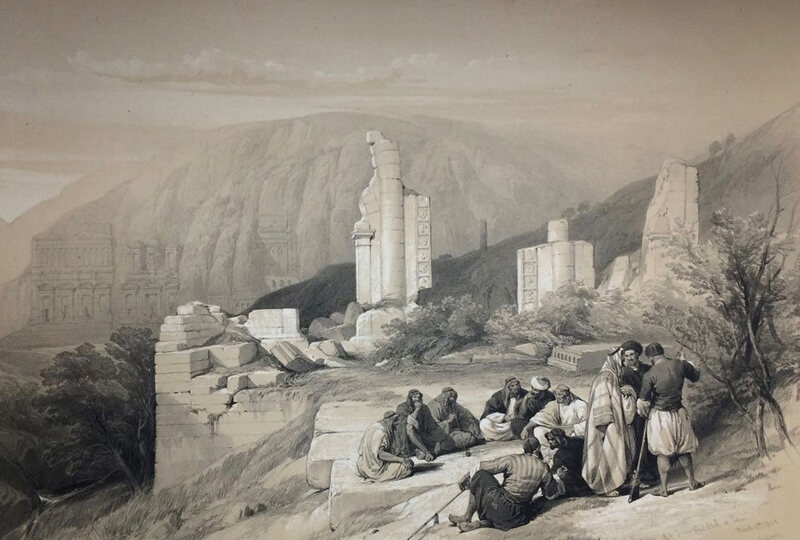
via Arts & Letters Daily: Travis McDade in Atlas Obscura An image from David Roberts’s The Holy Land, one of the stolen books. COURTESY OF TRAVIS MCDADE
In the summer of 1980, Robert Kindred was a 35-year-old high school dropout with no plans of going to college. Despite that, scattered in the backseat of his newly leased Cadillac Fleetwood Brougham were half a dozen guides to American college and university locations, each representing a region of the United States. He also had a single volume covering the entire country in his briefcase. A former Boy Scout, he liked to be prepared.
No major American crime requires as much travelling as that of stealing rare books from libraries, a fact Kindred knew from experience. Thanks to wealthy Americans, poor Europeans, two hot wars, and one cold one, the fruits of 500 years of printing came to be scattered across the United States in the second half of the 20th century. And almost all of it could be found on the shelves of some college or university library. Continue reading A fascinating read, allow yourself time!
==============================
Hottest of 'ultra-hot' planets is so hot its air contains vaporised metal
via the Guardian by Hannah Devlin Science correspondent Artist’s impression of the hot planet KELT9b with KELT-9 in background. Photograph: Denis Bajram/Center for Space and Habitability
New observations of the hottest known planet have revealed temperatures similar to those typically seen at the surface of a star, as well as an atmosphere of vaporised iron and titanium.
The findings add to the diverse and, in some cases, extreme conditions seen on planets far beyond our own solar system.
Kevin Heng, a professor at the University of Bern, and co-author of the latest work, said: “The temperatures are so insane that even though it is a planet it has the atmosphere of a star.”
“The main lesson that exoplanets are teaching us is that we can’t just look in the solar system,” Heng added. “There are really weird things out there.” Continue reading
==============================
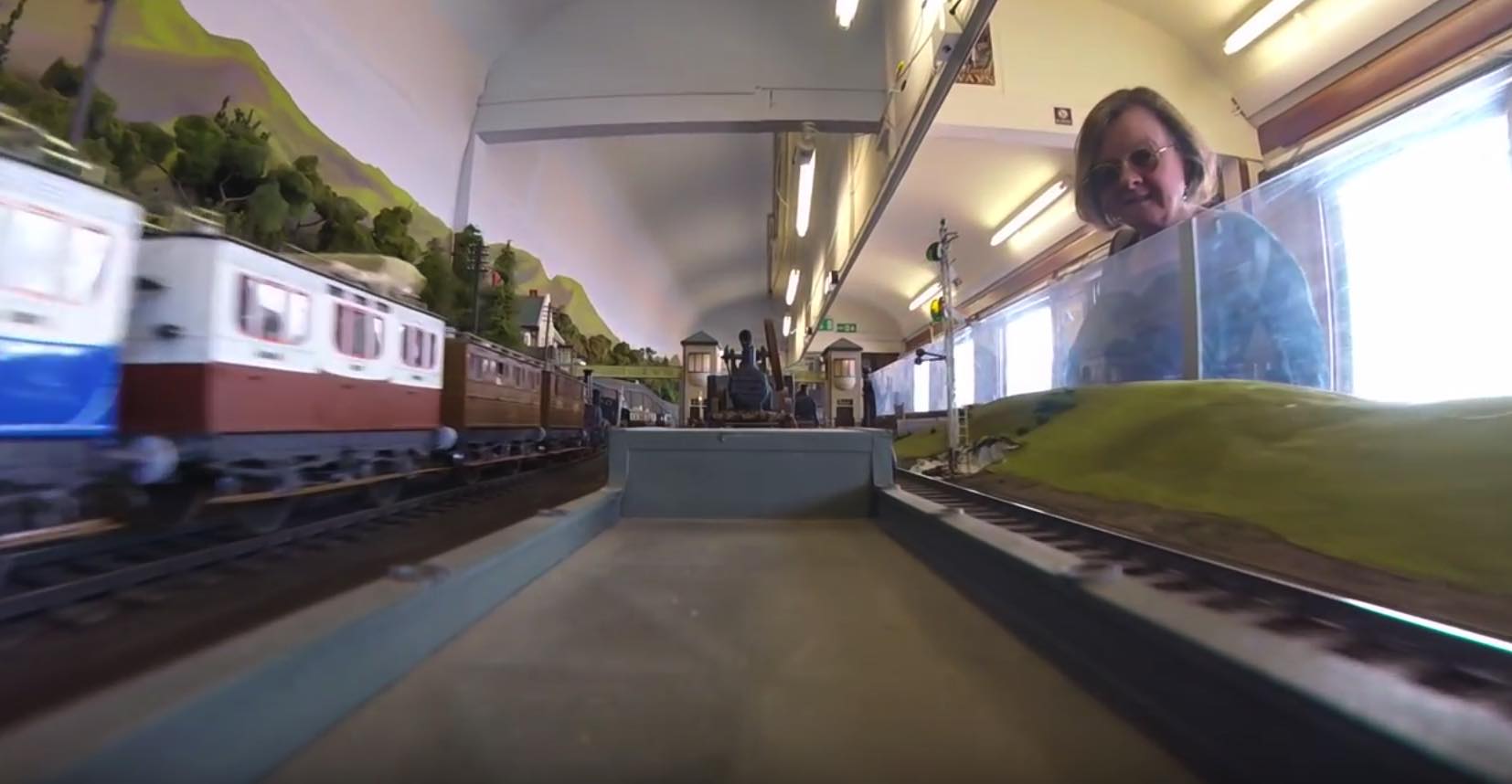
Action cam on a model train
via Boing Boing by Rob Beschizza
I'm not sure of the technical specifications going on here, but this calmed me down after seeing the latest from the Malabar Front this morning. Continue reading
==============================
12 new moons discovered around Jupiter; one of them could spell trouble
vua the Big THink blog by Brandon A Weber
Scientists just discovered 12 new moons orbiting the planet Jupiter, and they’re… interesting.
12 new moons have been discovered orbiting the planet Jupiter. They were not known until discovered via the 6.5-meter Magellan Telescopes. The data captured therein took a year to study, but was just confirmed.
“It takes several observations to confirm an object actually orbits around Jupiter. So, the whole process took a year,” said Gareth Williams of the International Astronomical Union’s Minor Planet Center. Continue reading
==============================
The Bad and the Beautiful
via Arts & Letters Daily: Graham Daseler in The American Conservative
#MeToo has forced the question: can we still enjoy the work of predatory artists? Michael Hogue
One of the many questions occasioned by the tsunami of allegations against men in the movie industry is whether we should reappraise their art in light of their misdeeds. Can we continue to laugh at The Cosby Show knowing that its star is a convicted sex offender? Can we continue to identify with Dustin Hoffman after hearing that he groped, flashed, and sexually humiliated underage girls on multiple occasions? Can we continue to enjoy the movies that Harvey Weinstein produced knowing that their creation helped cause so much pain to so many women? Continue reading
==============================
A Short Analysis of John Clare’s ‘I love to see the summer beaming forth’
via Interesting Literature
‘I love to see the summer beaming forth’ is a poem by the Romantic poet John Clare (1793-1864), although it’s not as famous as, say, ‘I Am’. But it’s a glorious evocation of the summertime, and deserves sharing here, with some notes towards an analysis. Continue reading
==============================
History of the Emirate of Sicily
via About History by Alcibiades
The Sicilian emirate was a Muslim state that controlled the entire island of Sicily from 965 to 1072. The Muslim community remained on the island until the 1240s, after which it was deported to the continent. Continue reading
==============================
The first "portable" computer fit in two trailer vans and weighed 20 tons
via Boing Boing by Cory Doctorow
The first electromechanical computers occupied whole buildings, making them rather unwieldy; in the 1950s, an effort to create a "portable" computer called the DYSEAC bore fruit in the form of a computer on wheels that could be relocated, provided you had the trucking logistics to move two trailers with a combined weight of 20 tons. Continue reading
My career in information management started back in 1987 working on the Training Access Points project. Nearly thirty years later I am still concerned to ensure that end users, and their mediators, have access to appropriate, relevant information in a form that they can understand, at a time and in a place that is right for them. The Internet seems to be for everyone and everywhere but the digital divide gets bigger. By pointing advisers in the direction of resources I hope to increase what can be done to help clients/customers.
I ran my own company for 16 years but am now a semi-retired freelancer.