Showing posts with label 10_for_today. Show all posts

Sunday, 22 December 2019

10 for Today (22 December) starts with some biology and ends with English Literature - not exam subjects thankfully

Group of biologists tries to bury the idea that plants are conscious
via the Guardian by Ian Sample, science editor
Environmental crisis clouding scientific objectivity about plants’ feelings, says botanist

The plant neurobiology debate is shaping up to be the biggest botanical bunfight since the Romantic era.
Photograph: Alamy
The gardening gloves are off. Frustrated by more than a decade of research which claims to reveal intentions, feelings and even consciousness in plants, more traditionally minded botanists have finally snapped. Plants, they protest, are emphatically not conscious.
The latest salvo in the plant consciousness wars has been fired by US, British and German biologists who argue that practitioners of “plant neurobiology” have become carried away with the admittedly impressive abilities of plants to sense and react to their environments.
Continue reading

==============================
Peel Castle: Centuries of History, a Mysterious Pagan Lady, and a Phantom Dog
via Ancient Origins by Ed Whelan

Peel Castle, Isle of Man. Source: vulcan57 / Adobe
The Isle of Man is a small island in the Irish Sea between Ireland and England and is a Crown Dependency of the United Kingdom. Because the island was settled approximately 8000 years ago, it has a long, diverse history and fascinating archaeological sites. A unique Celtic culture evolved alongside the local language, Manx, which is related to Gaelic Irish and Scottish. One of the most interesting sites on the Isle of Man is Peel Castle, which was built by the Vikings.
Continue reading

==============================
Ingmar Bergman, Novelist
via The New York Review of Books by Daniel Mendelsohn
  1. The Best Intentions
    by Ingmar Bergman, translated from the Swedish by Joan Tate
    Arcade, 298 pp., $16.99 (paper)
  2. Sunday’s Childrenby Ingmar Bergman, translated from the Swedish by Joan Tate
    Arcade, 153 pp., $14.95 (paper)
  3. Private Confessionsby Ingmar Bergman, translated from the Swedish by Joan Tate
    Arcade, 160 pp., $16.99 (paper)

ngmar Bergman on the set of Fanny and Alexander
Ingmar Bergman on the set of Fanny and Alexander, from the 1984 documentary The Making of Fanny and Alexander
Toward the beginning of Ingmar Bergman’s autobiographical film Fanny and Alexander, a beautiful young boy wanders into a beautiful room. The room is located in a rambling Uppsala apartment belonging to the boy’s widowed grandmother, Helena Ekdahl, once a famous actress and now the matriarch of a spirited and noisy theater family. As the camera follows the boy, Alexander, we note the elaborate fin-de-siècle decor, the draperies with their elaborate swags, the rich upholstery and carpets, the pictures crowding the walls, all imbued with the warm colors that, throughout the first part of the film, symbolize the Ekdahls’ warm (when not overheated) emotional lives. Later, after the death of Alexander’s kind-hearted father, Oscar, who is the lead actor of the family troupe, his widow rather inexplicably marries a stern bishop into whose bleak residence she and her children must move. At this point, the film’s visual palette will be leached of color and life; everything will be gray, black, coldly white.
Continue reading

==============================
Six of the Best Poems for Sundays
via Interesting Literature
Sunday morning is a great time to sit back, relax, and read a bit of poetry. And below we’ve gathered together six of the finest poems about Sunday: you might consider this poetry’s ‘Sunday best’. From meditations on prayer and church to staying at home and pondering the bigger questions of life, these six classic Sunday poems are ideal Sunday reading.
Continue reading

==============================
Why most scientists think birds are dinosaurs – and you should too
a post by Joyce C. Havstad

“Migratory birds” by Myriams-Fotos via Pixabay
We used to think – and many of us were taught in school – that the dinosaurs went extinct many millions of years ago. But now it seems like this might not be the case. Today’s biologists tend to think birds are dinosaurs, which means that, if true, the dinosaurs did not go entirely extinct after all. Some of them survived.
Scientific ideas can change over time – just as scientific ideas about birds, dinosaurs and extinction have changed over time. Change like this means scientific experts can be wrong, and it also means they can disagree with one another. If scientists today think birds are dinosaurs, then current scientists think past scientists were wrong.
Continue reading

==============================
Prehistory Decoded at Gobekli Tepe: From a Cataclysmic Event Dawns the Origin and Perhaps the End of Civilization
via Ancient History by Martin Sweatman

Taurid meteor shower 13,000 years ago.
Taurid meteor shower 13,000 years ago. Source: IgorZh / Adobe .
Around 13,000 years ago, the Earth burned. A swarm of comet debris from the Taurid meteor stream had blasted the Americas and parts of Europe; the worst day in prehistory since the end of the ice age. Many species of large animal were exterminated by the conflagration and ensuing cataclysms. And those that survived the initial onslaught could do little against the floods, acid rain, and starvation that followed.
Continue reading

==============================
The Forbes Pigment Collection
via Boing Boing by Rob Beschizza
How do you know for sure if your carefully-recreated 18th-century paint would fool pass muster as art dealers a legitimate recreation long enough to get away with it? of the authentic originals? Tom Scott visits the Forbes Pigment Collection.

The Forbes Pigment Collection at the Harvard Art Museums is a collection of pigments, binders, and other art materials for researchers to use as standards: so they can tell originals from restorations from forgeries. It's not open to the public, because it's a working research library – and because some of the pigments in there are rare, historic, or really shouldn't be handled by anyone untrained

==============================
Peel’s Police: Raw Lobsters and Blue Devils!
via The National Archives Blog by Claire Kennan
On 19 June 1829, Sir Robert Peel’s Act for Improving the Police in and near the Metropolis received royal assent. Peel argued that there was a real need for the establishment of a new police force stating that:
"It is the duty of Parliament to afford the inhabitants of the Metropolis and its vicinity, the full and complete protection of the law and to take prompt and decisive measures to check the increase of crime, which is now proceeding at a frighteningly rapid pace."
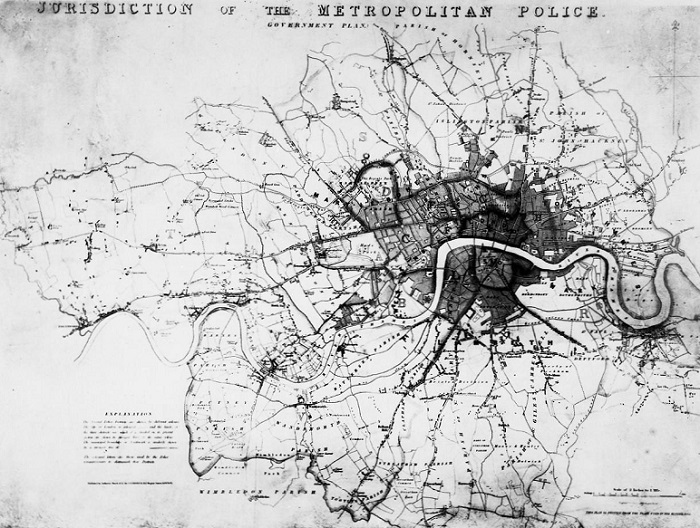
Map of Jurisdiction of the Metropolitan police 1837. Catalogue reference: MEPO 13/326
Map of Jurisdiction of the Metropolitan Police, 1837. Catalogue reference: MEPO 13/326
Continue reading

==============================
The Richness of Medieval English Literature
via Interesting Literature
In this week’s Dispatches from The Secret Library, Dr Oliver Tearle reviews Stephen Coote’s English Literature of the Middle Ages

Stephen Coote’s English Literature of the Middle Ages (Pelican) was published thirty years ago, in 1988. It’s taken me until this week to read it, but it’s one of the most illuminating and important introductions to medieval English literature you could hope to find. Clear, accessible, and endlessly informative, Coote’s book covers everything from Beowulf to the Morte Darthur, taking in alliterative and rhyming verse, courtly dream-visions and Arthurian narratives, Anglo-Saxon kennings and Middle English prose.
Continue reading
And I simply had to look up “kennings” – a word I did not recognise.
Here you go


10 for Yesterday (21 December 2019) starts with a eclipse and ends with Shakespeare

The eclipse that proved Einstein’s theories
via the OUP blog by Steven Carlip

“Solar Eclipse” by Taylor Smith. CC0 via Unsplash.
“Lights all askew in the heavens”, read the New York Times front page, “Men [sic] of science more or less agog”. The Times of London was more decorous: “Revolution in science. Newtonian ideas overthrown”.
The confirmation of Albert Einstein’s new general theory of relativity on the 29th of May 1919 made headlines around the world. Arthur Stanley Eddington‘s measurement of the gravitational deflection of starlight by the Sun was a triumph of experimental and theoretical physics. Scientists are good at celebrating triumphs. Sometimes we’re a little too good – students can be left thinking that one crucial experiment is all it takes to make or break a theory. So it’s worth using this anniversary as an occasion to reflect on how science advances.
Continue reading

==============================
Drug paraphernalia that's 1,000-years-old still contains traces of coke and DMT
via Boing Boing by David Pescovitz

In a Bolivian rock shelter likely used 1,000 years ago for religious rituals, archaeologists found a collection of drug paraphernalia that still contains traces of psychoactive plants. A pouch made from three fox snouts likely contained a stash of leaves and seeds.
Continue reading

==============================
What is Chauvinism? Tracing the Term from the Legendary Nicolas Chauvin to Misogyny
via Ancient Origins by Wu Mingren
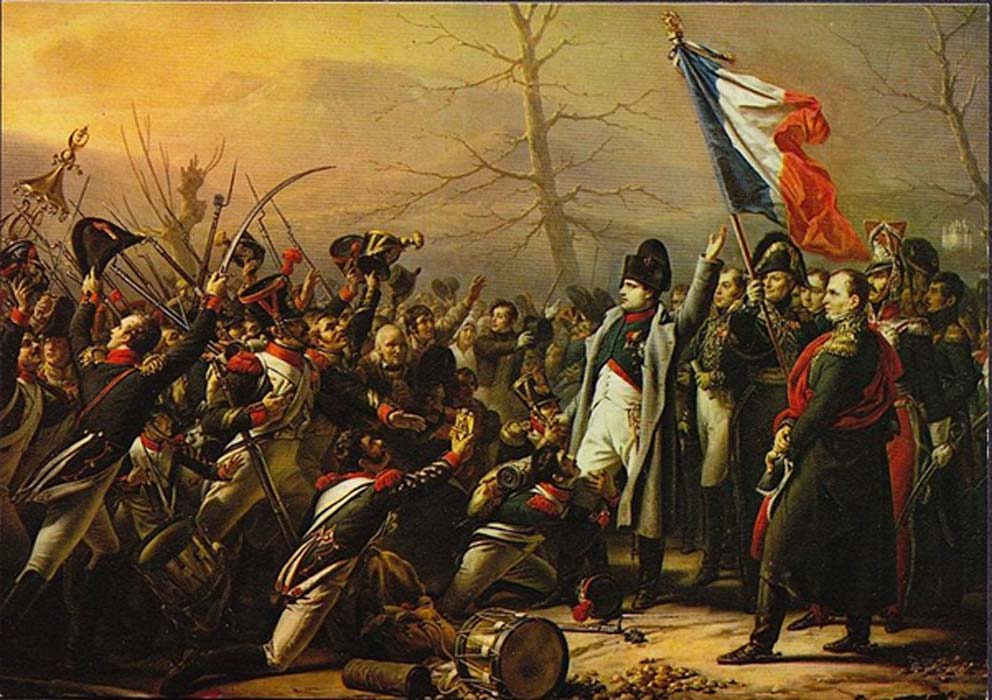
Napoleon's Return from Elba, by Charles Auguste Guillaume Steuben. Napoleon walk between the two forces and said if they were to kill their emperor; they were to do it now. Chauvinism was originally a term applied to veteran soldiers who served under Napoleon
Napoleon's Return from Elba, by Charles Auguste Guillaume Steuben. Napoleon walk between the two forces and said if they were to kill their emperor; they were to do it now. Chauvinism was originally a term applied to veteran soldiers who served under Napoleon. Source: Public Domain
In the modern world, a chauvinist is a person who has “excessive or prejudiced support for one's own cause, group, or sex”. Before this, the word ‘ chauvinism’ had a narrower scope, and was used specifically to indicate an “excessive or aggressive patriotism”. Even earlier still, the word was applied to the devoted veteran soldiers who served under Napoleon.
Continue reading

==============================
Ancient Christian manuscripts digitised at monastery beneath Mount Sinai
via ResearchBuzz Firehose: Mohamed Zaki at Reuters
At St. Catherine’s Monastery at the foot of Egypt’s Mount Sinai, the silence in the library is broken only by low electrical humming, as an early manuscript is bathed in green light.
A team from Greece are photographing thousands of fragile manuscripts, including some of the earliest copies of the Christian gospels, using a complex process that includes taking images in red, green and blue light and merging them with computer software to create a single high-quality colour picture.
There is a tangible sense of urgency to the mission.
Continue reading

==============================
Was the real Socrates more worldly and amorous than we knew?
via Arts and Letters Daily: Armand D’Angour in AEON
<p>Detail from <em>Socrates Dragging Alcibiades from the Embrace of Aspasia</em> (1785) by Jean-Baptiste Regnault. Louvre, Paris. <em>Courtesy Wikipedia</em></p>
Detail from Socrates Dragging Alcibiades from the Embrace of Aspasia (1785) by Jean-Baptiste Regnault. Louvre, Paris. Courtesy Wikipedia
Socrates is widely considered to be the founding figure of Western philosophy – a thinker whose ideas, transmitted by the extensive writings of his devoted follower Plato, have shaped thinking for more than 2,000 years. ‘For better or worse,’ wrote the Classical scholar Diskin Clay in Platonic Questions (2000), ‘Plato’s Socrates is our Socrates.’ The enduring image of Socrates that comes from Plato is of a man of humble background, little education, few means and unappealing looks, who became a brilliant and disputatious philosopher married to an argumentative woman called Xanthippe. Both Plato and Xenophon, Socrates’ other principal biographer, were born c424 BCE, so they knew Socrates (born c469 BCE) only as an old man. Keen to defend his reputation from the charges of ‘introducing new kinds of gods’ and ‘corrupting young men’ on which he was eventually brought to trial and executed, they painted a picture of Socrates in late middle age as a pious teacher and unremitting ethical thinker, a man committed to shunning bodily pleasures for higher educational purposes.
Continue reading

==============================
10 of the Best Rudyard Kipling Poems Everyone Should Read
via Interesting Literature
The best Kipling poems selected by Dr Oliver Tearle
Rudyard Kipling (1865-1936) was a tireless experimenter with the short story form, a novelist, a writer who could entertain children and adults alike with such books as The Jungle BookPlain Tales from the HillsThe Just So StoriesPuck of Pook’s Hill, and countless others. But as well as being a prolific author of fiction, Rudyard Kipling was also a hugely popular poet. But what are Kipling’s very best poems?
Continue reading
Unusually for a collection I have actually read all of the ten poems Dr Tearle thinks are the best. And what is more I can probably still recite at least two of them in part.

==============================
Finding Canaan: Ancient Roots of the Lost Phoenician Civilization
via Ancient Origins by Jim Willis
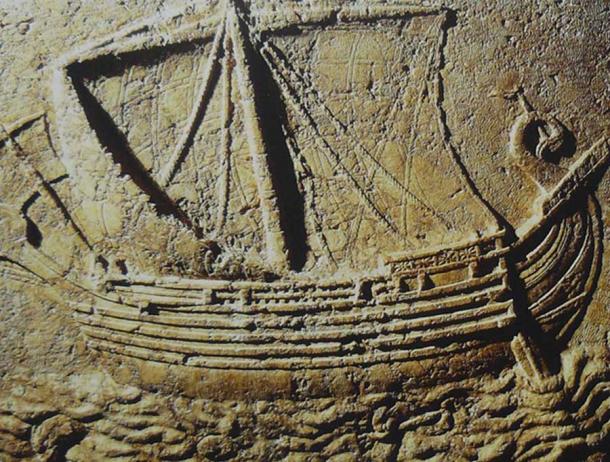
Phoenician ship carved on the face of a sarcophagus. 2nd century AD (Elie Plus/ CC BY-SA 3.0)
Phoenician ship carved on the face of a sarcophagus. 2nd century AD ( Elie Plus CC BY-SA 3.0 )
Of all the seafaring civilizations who, to our knowledge, first explored the vast oceans, none are more mysterious than the ancient Phoenicians. How far did their voyages take them? What lands did they discover and explore? How did they navigate? What forgotten influence did they have upon the history of the world? And most importantly, where did they come from?
Continue reading

==============================
Mistaken identity: Elizabeth Burley and the Contagious Diseases Acts
via The National Archives Blog by Claire Kennan
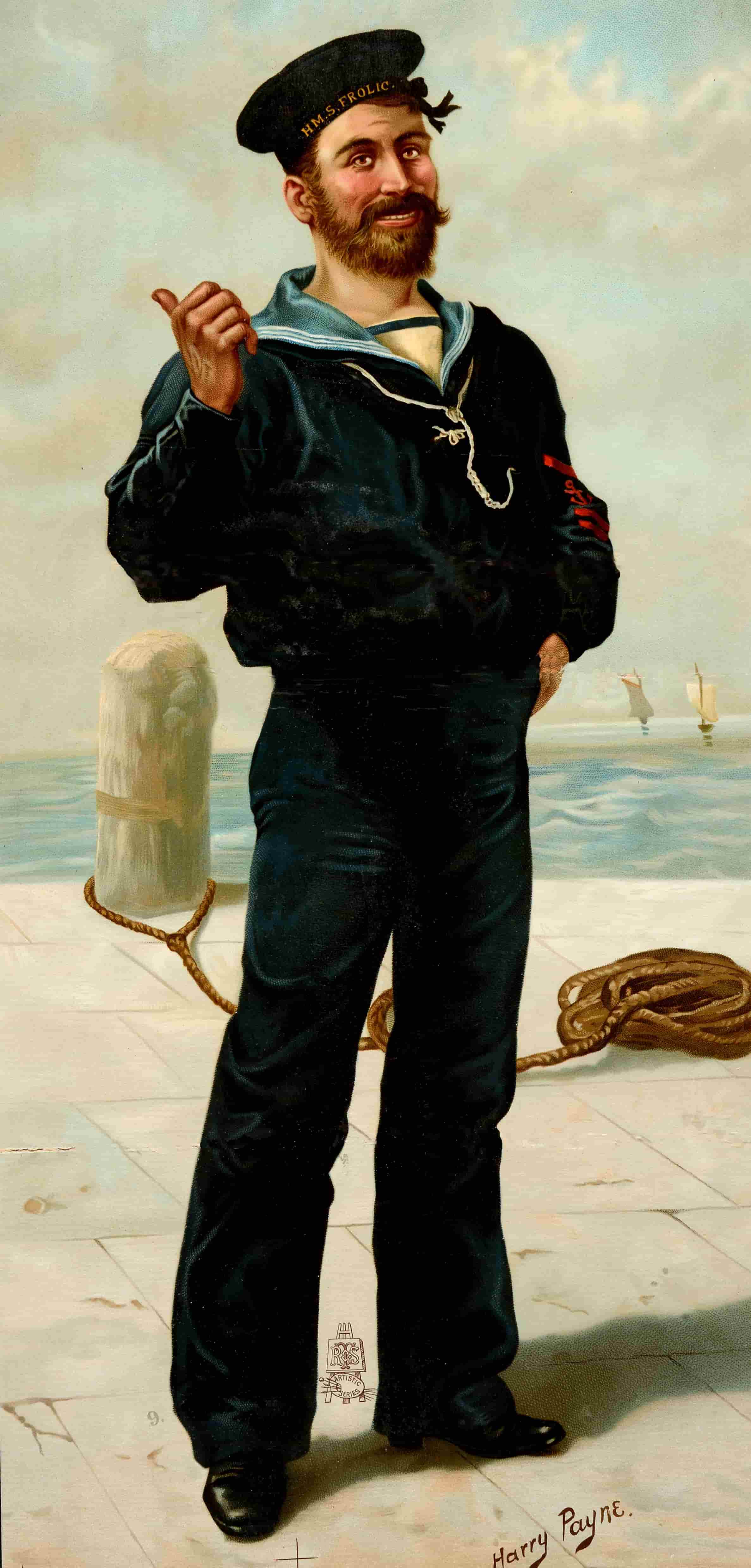
Image of 'Jack Tar' (a common term for sailors) by Harry Payne, 1893. Catalogue reference: COPY 1/108/436
Image of ‘Jack Tar’ (a common term for sailors) by Harry Payne, 1893. Catalogue reference: COPY 1/108/436
Let those who have never seen a ship of war, picture to themselves a very large and very low room with 500 men and probably 300 or 400 women of the vilest description shut up in it, and giving way to every excess of debauchery that the grossest passions of human nature can lead them to […]
At a time when the health of Britain’s armed forces was crucial if they were to continue to control the Empire, scenes such as the one described above were causing great alarm within the government. Between 1864 and 1869 three laws – which became known as the Contagious Diseases Acts – were passed in an attempt to prevent the spread of sexually transmitted diseases which were seen to be debilitating Britain’s army and navy. According to government sources, nothing short of the security of the nation itself was at stake.
Continue reading

==============================
Why do homo sapiens include so much variety?
via the OUP Blog by Felipe Fernández-Armesto

Shibuya Nights by Andre Benz. Worldwide Copyright License via Unsplash
The past is a mess. To pick a path through the mire, historians have appealed to providence, progress, environmental determinism, class struggle, biology and fate. No explanation has worked – so far. But try shifting perspective: look for the broadest possible context, the most suggestive comparisons. Climb the cosmic crow’s nest. Imagine what history might look like from an immense distance of time and space, with objectivity we cannot attain. The Galactic Observer – I suggest – would notice some of the other cultural creatures with whom we share our planet. “You,” she will say, “are a puny, short-lived species on a dreary little rock. But by comparison even with other very similar species, you have an amazing range of culture: vastly, astonishingly more ways of living, getting food, communicating, worshipping and dealing with each other.”
Continue reading

==============================
‘Full Fathom Five’: Ariel’s Song from Shakespeare’s The Tempest
via Interesting Literature
More properly known as Ariel’s song from The Tempest, ‘Full fathom five thy father lies’ is about Ferdinand’s father, who is believed to have been the victim of a shipwreck and lie at the bottom of the ocean in Shakespeare’s play. We won’t say anything further about this here as we don’t want to offer any spoilers for those who haven’t read or seen the play, but wanted to share this song here because it is so well-known and yet not necessarily always carefully read. For instance, although it’s often known as ‘Full fathom five thy father lies’, the song actually begins quite differently…
Continue reading

Sunday, 15 December 2019

10 for Today (15 December 2019) starts with that perennial favourite (with some people), trains and wanders through history to end with steam-punk clocks

So this is why train wheels are conical
via Boing Boing by Mark Frauenfelder

Watch this short video to understand why train wheels are conical instead of cylindrical and why they have rigid axles.

==============================
Why the universe's ancient galaxies were extra bright
via the Big Think blog by Matt Davis
New research based on observational data from the Spitzer telescope provides clues as to how the universe first emerged from its dark age.
  • Researchers using the Spitzer telescope were able to analyze some of the most distant and ancient galaxies in the universe.
  • They discovered that these galaxies were far brighter than anticipated, shedding clues into how the universe first emerged from the "dark ages" that lasted until about a billion years after the Big Bang.
  • This research serves as a stepping stone for future work to be conducted with the James Webb Space Telescope, scheduled to be launched in early 2021.
Continue reading
My belief is that God said "Let there be light" and there was light. And no, I do not believe in a day as we understand it today. 

==============================
Gordon Murray’s online museum is virtually brilliant
via ResearchBuzz: Firehose: Gavin Braithwaite-Smith at Motoring Research
Gordon Murray McLaren F1 LM
Warning: if you intend to immerse yourself in the virtual world of Gordon Murray’s online exhibition, a lunch-hour won’t be enough. Tell your boss you need to spend the afternoon researching. Or something.
Continue reading

==============================
Persian Poets’ Fabled Family of Heroes
via Ancient Origins by Martini Fisher
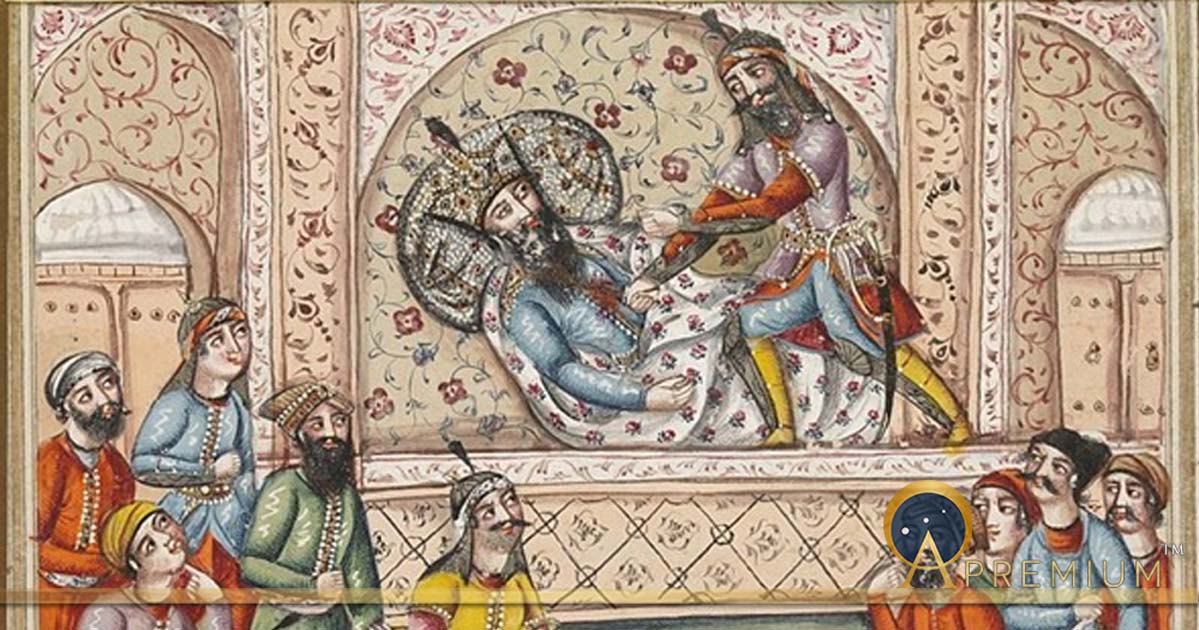
Scene from the Shahnameh. Afrasiyab (standing figure) executes Nauzar (lying down), while two groups look on.
Scene from the Shahnameh. Afrasiyab (standing figure) executes Nauzar (lying down), while two groups look on. (Wellcome Images / CC BY-SA 4.0 )
Star-crossed lovers, fathers killing sons and a warrior bride shackling her newlywed husband to the bed, all play a role in the legendary folklore of Persia’s most famous fabled family; that of Rostam and his ancestors and descendants.
Continue reading

==============================
Rudyard Kipling’s Detective Story: ‘The House Surgeon’
via Interesting Literature
In this week’s Dispatches from The Secret Library, Dr Oliver Tearle reviews Kipling’s foray into the mystery genre with a psychic detective story
Previously, I’ve blogged about the intriguing micro-genre of the psychic detective story, a crossover short story genre which fuses the ghost story or weird tale with the mystery, or detective fiction. Arguably beginning with the Irish author Sheridan Le Fanu’s 1869 story ‘Green Tea’, the form was pioneered by the late Victorian writing team of E. and H. Heron with their Flaxman Low stories, but became really popular during the Edwardian era, with characters such as Algernon Blackwood’s John Silence and, shortly after this, William Hope Hodgson’s Thomas Carnacki and Alice and Claude Askew’s Aylmer Vance.
Continue reading

==============================
Looking for Shakespeare’s Library
via Arts and Letters Daily: Stuart Kells in Lapham’s Quarterly
The Bard clearly read many books. Where did they go?

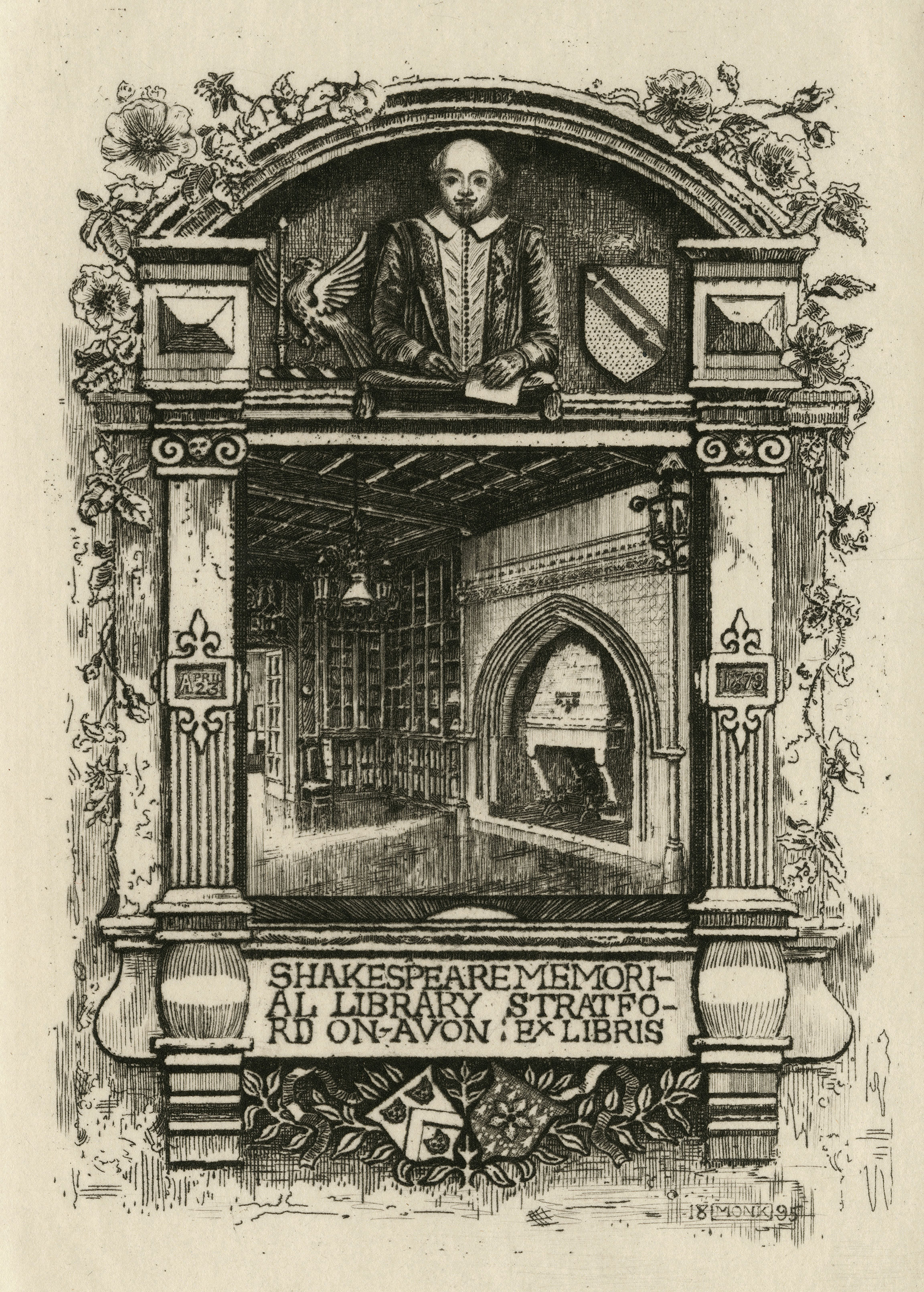
Shakespeare Memorial Library bookplate, 1895. Folger Shakespeare Library
None of William Shakespeare’s friends and associates left behind a description of his library. Nor is there a record of it being dispersed at the time of his death. His will refers neither to books nor manuscripts. In fact, it gives no sign of a literary career at all, or even a literate one. Contemporary dramatists such as Francis Beaumont, Thomas Dekker, John Fletcher, Robert Greene, Thomas Heywood, and Ben Jonson all left behind plays in manuscript. No Shakespeare playscript, though, has ever been found. (Part of the manuscript of a play about Sir Thomas More has been attributed to Shakespeare, but the part is small and the attribution contentious.)
Continue reading

==============================
Fall of the Western Roman Empire
via About History

The transition from the republic to the imperial form of government led to a gradual erosion of the institutions of civil society. The Senate gradually lost its significance, local government was limited, and judicial bodies were subordinated to the imperial administration. By the beginning of the III century, the state system became a military-bureaucratic monarchy. However, the cultural and technological level of the empire still allowed it to dominate the barbarian environment.
Continue reading

==============================
Rediscovering Francesco de’ Medici’s private Renaissance room
via the OUP blog by Lyndsay Alberts

“Florence, Italy” by OpenPics. CC0 via Pixabay.
Between 1570 and 1575, Francesco I de’ Medici, Grand Duke of Tuscany, commissioned a private studiolo – a small room – in Florence’s Palazzo Vecchio. Four centuries later, a discovery in the archive changes our understanding of one the last great Renaissance studies.
Continue reading
Two nights in Florence was long enough for me to fall in love with the city.

==============================
Writer’s Study: George Orwell’s Keep the Aspidistra Flying
via Interesting Literature
In this week’s Dispatches from The Secret Library, Dr Oliver Tearle reviews Orwell’s early novel about the struggles of the writer
Depending on your tastes, you can blame or congratulate George Orwell for Wetherspoons. When Tim Martin founded his chain of British pubs in the late 1970s, he took as his inspiration – a sort of unofficial literary blueprint, if you will – an essay of Orwell’s, ‘The Moon under Water’, published in the London Evening Standard in 1946. To this day, a number of Wetherspoon pubs are named The Moon under Water in honour of Orwell’s think piece, including the one in my hometown, Milton Keynes.
Continue reading

==============================
Roger Wood's latest haul of wheeled, steampunk clocks
via Boing Boing by Cory Doctorow

Roger Wood, the bonkers steampunk assemblage clock sculptor, just sent this to his Klockwerks mailing list: "This is what I created in February."
See Klockwerks

Saturday, 14 December 2019

10 for Today (14 December 2019) starts with a photograph of a one-hundred-year-old eclipse and ends with gender equality (or not)

What the Obsolete Art of Mapping the Skies on Glass Plates Can Still Teach Us
via ResearchBuss: Firehose: Elizabeth Landau at smithsonianmag.com
The first pictures of the sky were taken on glass photographic plates, and these treasured artefacts can still help scientists make discoveries today
Eclipse Plate
A photographic plate of the 1919 total solar eclipse, taken by Andrew Claude de la Cherois Crommelin and Charles Rundle Davidson during an expedition to Sobral, Brazil. The 1919 eclipse was used by Arthur Eddington, who observed it from the island of Principe off the west coast of Africa, to provide the first experimental evidence of Einstein's theory of relativity. (Niels Bohr Institute, University of Copenhagen)
Three stories beneath the telescope dome at the Hale Solar Laboratory in Pasadena, California, a rusty spiral staircase marks the top of a nearly 80-foot-deep pit, concealed by a wooden trapdoor in the basement floor. At the bottom lies a grating meant to split light into a rainbow to allow scientists to study the makeup of the sun. The building’s current owners dare not descend, deterred by the lack of oxygen and impenetrable darkness below.
Continue reading

==============================
The Colors of Our Dreams
via Arts and Letters Daily: Jesse Russell in CRB Digital from The Claremont Institute

French historian Michel Pastoureau, whose Blue: The History of a Color has just been re-released to English-speaking audiences, is one of our age’s great librarians of civilisation. On its surface, Blue is a dull exercise in scholarly record keeping – but in fact, it is an exhilarating and richly informing book on how the European peoples from the Iron Age until today have decorated themselves and their cultural artefacts with the colour blue.
Pastoureau argues that the colour blue is both a naturally occurring phenomenon and a complex cultural construct which is “first and foremost a social phenomenon.” His impressive scholarly narrative does not fall prey to postmodernism’s worse excesses; Blue offers a coherent raison d’être behind Western history, no matter how that story is coloured.
Continue reading

==============================
This is one of the world's tallest trees; and this is the arborist who climbed it
via Boing Boing by David Pescovitz

(image: Unding Jami)
Scientists have identified what is likely one of the world's tallest trees, a 330.7-foot (100.8 meter) yellow meranti tree in the rainforest on the island of Borneo. They spotted the tree growing in the Malaysian state of Sabah during an aerial laser scan of the forest. The rainforest is protected yet Yellow meranti trees are are highly endangered because they're relentlessly chopped down in other parts of Borneo for construction use. To accurately measure the tree, arborist Unding Jami of the South East Asia Rainforest Research Partnership climbed it with a tape measure in hand.
Continue reading

==============================
Saki’s Comic Genius: The Case of ‘Filboid Studge’
via Interesting Literature
In this week’s Dispatches from The Secret Library, Dr Oliver Tearle pays homage to the master of English comic fiction
Saki’s short stories have everything going for them. For one, they’re short: a few years before Virginia Woolf penned her series of very short sketches about modern life, such as ‘A Haunted House’, ‘The Mark on the Wall’, and ‘Kew Gardens’, Saki – no modernist, but decidedly modern – had reduced the short story form to three pages which contained everything the story needed to contain, with no filler but more wit per page than just about any other English writer, with the possible exception of P. G. Wodehouse (who must have been influenced by Saki). He’s also good on two things which it’s difficult to be good on, as the late Christopher Hitchens observed: children and animals. A number of Saki’s stories touch upon the weird or macabre, while others settle for making us laugh. Many manage both.
Continue reading

==============================
7 fascinating UNESCO World Heritage Sites
Here are 7 often-overlooked World Heritage Sites, each with its own history.
via the Big Think blog by Matt Davis
  • UNESCO World Heritage Sites are locations of high value to humanity, either for their cultural, historical, or natural significance.
  • Some are even designated as World Heritage Sites because humans don't go there at all, while others have felt the effects of too much human influence.
  • These 7 UNESCO World Heritage Sites each represent an overlooked or at-risk facet of humanity's collective cultural heritage.
1. The Buddhas of Bamiyan
Buddha of Bamiyan.jpg
Taller Buddha of Bamyan before 2001 (via Wikipedia)
The other sites are:
2. Petra (been there, got the photos)
3. The Rock Islands
4.  Hampi
5. Samarra
6. Gough and Inaccessible Islands
7. The Everglades National Park
Read about these places for yourself

==============================
The Truth Behind 5 Disney Movies That Are Based On Real Histories
via Ancient Origins by Sarah P Young
Snow White, one of the Disney Stories, possibly has origins in a German folktale. (Geagea / Public Domain)
Snow White, one of the Disney Stories, possibly has origins in a German folktale. (Geagea / Public Domain )
Many of us grew up watching Disney movies and their tales of fairy princesses and evil queens are undeniably a part of the modern zeitgeist.
Some of the movies are original to Disney, but at their core most Disney movies are inspired by ancient folklore. Snow White, Cinderella, and The Little Mermaid were all inspired by European fairytales, for example. But not every story has been adapted from sources like the Brothers Grimm – some of them are even based on real historical events and figures.
Continue reading

==============================
Tycho analysis
via The Royal Society – The Repository by Rupert Baker
Of all the portraits adorning the walls of the Royal Society’s home in Carlton House Terrace, this one is possibly my favourite:

Astronomer, supernova-spotter, alchemist, instrument-maker, Kepler’s mentor, keeper of a clairvoyant dwarf and a pet elk that died after drinking too much beer and falling down the stairs, the Danish nobleman Tycho Brahe was certainly quite a character. You’ll doubtless have spotted something rather curious about that face, too: his famous metal nose, made after he lost the original in a swordfight in the dark with his cousin, following an argument over who was the better mathematician.
Continue reading

==============================
A Hungarian cover of the Stones' "Honky Tonk Women"
via Boing Boing by Rusty Blazenhoff

"I met a gin soaked bar-room queen" in... Budapest?
Australian personality Greg Grainger is backed up by the Graingerettes, a group of women all decked out in traditional Hungarian dress, in this rousing cover of the Rolling Stones' "Honky Tonk Women." It was recorded sometime in 1990 and was downloaded from on old VHS tape.

==============================
Reviewing the Future: Will Self’s The Book of Dave
via Interesting Literature
In this week’s Dispatches from The Secret Library, Dr Oliver Tearle reviews a dystopian novel about a new religion
Toxic masculinity. Patriarchy. Incel. Words like these are all over the internet of late, describing a perceived rise in misogynistic behaviours and attitudes among young men growing up in Britain, America, and elsewhere. Coupled with this is the worryingly small percentage of people – women as well as men – who self-identify as ‘feminists’ (just 7% of Britons, according to one survey). Could the Utopian dream of gender equality, which appeared to be making some headway as the millennium came into sight, be retreating ever further into the distance?
Continue reading

Sunday, 8 December 2019

10 for Today starts with an item on women seeking peace and ends, via some weird and wonderful items, with the incredible

Four important women who championed peace
via the OUP Blog by Charis Edworthy

Woman Sitting on Bench by Tranmautritam, CC0 via Pexels
Throughout history women have struggled against adversity in order to enable future generations of women to have a greater freedom of choice. Though history favours the warriors, monarchs, and rebels, female pacifists and mediators behind the scenes were just as vital in the fight for equality. Female peacemakers are among those women who have made a substantial impact on the world, yet between 1990 and 2017 women represented only 2% of mediators and 8% of negotiators in major peace processes, despite the importance of women’s input in policy-related decisions.
In celebration of women committed to peace, here are four women from history who supported pacifism or who fought for women’s equality through nonviolent methods.
Continue reading

==============================
Wells’s Heir? John Wyndham’s The Seeds of Time
via Interesting Literature
In this week’s Dispatches from The Secret Library, Dr Oliver Tearle dusts off the half-forgotten science-fiction stories of John Wyndham

A good many of the books that feature in this weekly Friday column are found in charity shops while I’m looking for something else. So it was with this week’s featured book, or rather pile of books, by John Wyndham, who has been called the most successful British science-fiction writer after H. G. Wells. In his lifetime, Wyndham was a bestselling novelist. How many people read his novels and short stories now, I wonder?
Continue reading

==============================
Found in Antarctica: A 'weirdo particle' that predates the sun
A tiny grain found within a meteorite in Antarctica sheds light on how the solar system itself came to be.
via the Big Think blog by Matt Davis
  • Researchers cut open a small meteorite found in the LaPaz icefield in Antarctica to uncover a very surprising find.
  • Inside this meteorite was a small inclusion that they determined came directly from the nova of a white dwarf to Earth.
  • By studying the inclusion's composition, researchers were able to glean new insights into the thermodynamics of white dwarf novae, ultimately shedding light onto how solar systems like ours formed.
Continue reading

==============================
Archaeologists Identify First Prehistoric Figurative Cave Art in Balkans - It’s Symbolic!
via Ancient Origins
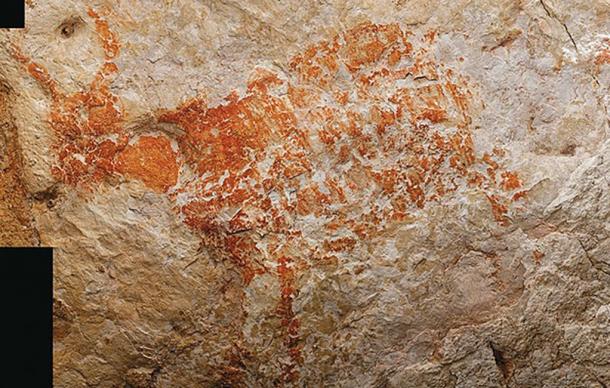
Representation of the cave art discovered in Balkans. (Drbug / Public Domain)
Representation of the cave art discovered in Balkans. (Drbug / Public Domain )
There was an explosion of symbolism in human culture during the Paleolithic period. Around the world, examples of cave art, some of it rather strange , began cropping up over 35,000 years ago. But some locations have been more willing to share their prehistoric artwork than others. One place where Paleolithic cave art is still relatively unknown, and thus highly valued, is the Balkans . It is there that an international team led by an archaeologist from the University of Southampton and the University of Bordeaux has finally unearthed the first example of Paleolithic figurative cave art in the region.
Dr. Aitor Ruiz-Redondo worked with researchers from the universities of Cantabria (Spain), Newfoundland (Canada), Zagreb (Croatia) and the Archaeological Museum of Istria (Croatia) to study the paintings, which could be up to 34,000 years old.
Continue reading

==============================
How this cute little steam-powered walker works
via Boing Boing by Mark Frauenfelder

I-Wei Huang (aka Crabfu) makes all sorts of cool steam-powered mini-robots. In this video, he explains how he made a walking robot.

==============================
Tracking radar
via The Royal Society: The Repository by Jon Bushell

John Hugh Westcott’s sketch of a radar display (from MS/858)
You may have missed the recent anniversary [26 February 2019] of the Daventry Experiment, the first successful test of radar technology in the UK. This prompted me to have a scan through our catalogue to see what I could discover about the early days of radar development. Quite a lot, as it turns out!
Continue reading

==============================
The Female Sherlock Holmes: C. L. Pirkis’ Loveday Brooke
via Interesting Literature
In this week’s Dispatches from The Secret Library, Dr Oliver Tearle applauds the 1890s short stories featuring an early female detective
The name Catherine Louisa Pirkis is relatively unknown now, but Pirkis left two legacies of interest. The first arose out of her animal charity work: with her husband, Pirkis was one of the founders of the National Canine Defence League in 1891. This is undoubtedly a worthwhile legacy in itself, but it’s the second legacy of C. L. Pirkis which concerns us here: her small but nonetheless notable contribution to detective fiction.
Continue reading

==============================
The Great Famine (1315-1317)
via About History

Reminiscent of the art of Bruegel but since About History does not attribute its images I do not know whether it is by the master or simply "of the age".
The Great Famine of 1315–1317 (sometimes the period of 1315–1322 is given) is the first in a series of large-scale disasters of the late Middle Ages that befell Europe at the beginning of the XIV century. The great famine caused millions of deaths (according to estimates, around 10 to 25% of the urban population died) and marked the end of the previous period of growth and prosperity of the 11th — 13th centuries. It covered almost the whole of Northern Europe – the current territory of Ireland, Great Britain, France, Scandinavia, the Netherlands, Germany and Poland. Europe south of the Alps (Italy) and the Pyrenees (Southern Spain), as well as lands east of the Kingdom of Poland and much of Byzantium avoided this disaster.
Continue reading

==============================
The Lobster War
via The National Archives Blog by Anne-Sophie Grollemund
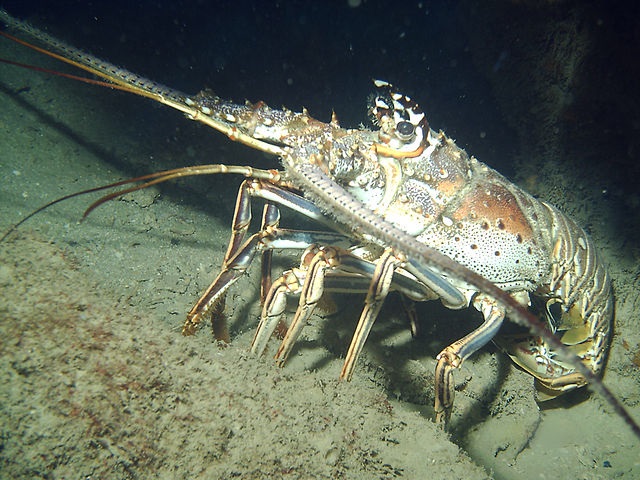
An innocent Spiny Lobster (image: Wikimedia Commons)
Diving deep in the archive, you can find some stories which really stand out. Looking at Foreign Office papers about the relations between France and the United Kingdom, one particular item caught my attention. The main title was: ‘Lobster fishing dispute with Brazil’. I couldn’t resist opening it, and I discovered how a simple fishing incident could escalate into a territorial dispute between two countries and become an international issue.
To understand how the whole dispute evolved so quickly from a local incident into a serious matter, you have to look back at the relations between Brazil and France at the end of the 1950s.
Continue reading
A fascinating story and well within living memory for many people although I have to admit to ignorance and blame pregnancy and then the birth of my first child for my lack of knowledge of a war about lobsters!

==============================
Archive of the incredible mid-1960s magazine, "fact:"
via Boing Boing by Mark Frauenfelder

In 1963 Attorney General Robert Kennedy prosecuted Eros magazine publisher Ralph Ginzburg for violating federal obscenity laws when Eros ran 8-pages of photos of a naked black man and naked white woman embracing each other (see page 72 of the fourth and final issue of Eros). After a long trial, which went to the Supreme Court, Ginzburg was found guilty and in 1972 was sent to federal prison. He was released on parole eight months later. (Arthur Miller said of the conviction, a man is going to prison for publishing and advertising stuff a few years ago that today would hardly raise an eyebrow in your dentist's office.")
Continue reading

Saturday, 7 December 2019

10 for Today (7 December 2019) starts with "green" church carvings and moves around to end with Virginia Woolf

In churches I find an array of wildlife: from carvings of beavers, stags and herons to medieval Green Men myths
via the New Statesman by Richard Mabey
I’m not a conventional church-crawler. But I am intrigued by their iconography, especially the considerable proportion that is nature-based.
In churches I find an array of wildlife: from carvings of beavers, stags and herons to medieval Green Men myths
COLORS HUNTER - CHASSEUR DE COULEURS
The village of Woolpit (an Old English word for wolf-trapping pits) could stake a good claim to being the folkloric epicentre of Suffolk. The village sign depicts the legend of the Green Children, a 12th-century story of a boy and girl who emerged from a parish wolf-pit into a field. Their skins were green and they refused to eat or speak until they were offered beans. When they learned English they said they came from a land of perpetual twilight, beyond a great river.
Continue reading

==============================
Why We Knock on Wood (and Other Common Superstitions)
via lifesavvy by Elyse Hauser
Woman's fist on wooden table
Yanawut Suntornkij/Shutterstock
Ever wondered why that hotel doesn’t have a 13th floor, or why you’re supposed to throw salt after you spill it? Here’s the history behind some of the most common superstitions.
Some superstitions are so common that it’s easy to forget they’re kind of strange practices. If an alien were to visit Earth, not many people would be able to explain to them why we reflexively say “Bless you” when somebody sneezes.
But whether you adhere to these traditions or not, it’s certainly fun to find out where they come from. Each one has a story behind it, so keep reading for some cool trivia that will impress your friends!
Continue reading

==============================
The Religion of Carthage

Carthage inherited the foundations of religion from Phoenicia.
The supreme pair of gods were Tanit and Baal Hammon, they are considered the most typical figures of the Carthaginian pantheon. The goddess Astarta was very popular in early times. In the midst of its cosmopolitan era, the pantheon of Carthage consisted of a large number of deities from the neighboring civilizations of Greece, Egypt and the city-states of the Etruscans.
Continue reading

==============================
A delightful snail takes a magic carpet ride full of wonder and joy
via Boing Boing by David Pescovitz

I can open your eyes
Take you wonder by wonder
Over sideways and under
On a magic carpet ride
Credits: Hiskm and Dahlek88 (r/Aquariums, thanks Dustin Hostetler!)

==============================
The Anxiety of the Thirties: Richard Aldington’s Life Quest
via Interesting Literature
In this week’s Dispatches from The Secret Library, Dr Oliver Tearle reads Richard Aldington’s Life Quest, the modernist long poem that time forgot
The standout modernist long poem of the 1920s was The Waste Land. T. S. Eliot’s poem redefined what modernism could do in poetry, influenced by James Joyce’s example of the ‘mythical method’ in his novel Ulysses and the various Symbolist and imagist experiments in French and English verse. It captured a moment and mood of post-war desolation and uncertainty, a world in ruin plagued by fears and anxieties, ennui and a lack of self-confidence. But what happened to the modernist long poem in the 1930s at another moment of anxiety and transition has been less well-covered by scholars and critics of modernism.
Continue reading

==============================
Ancient Curses: Five Ways to Create Calamity in the Ancient World
via Ancient Origins
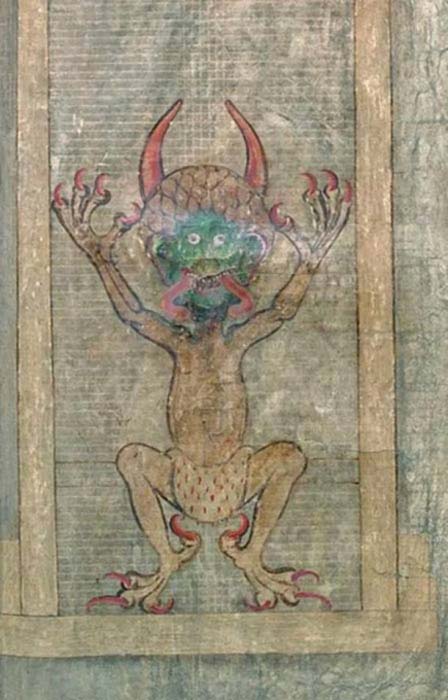
Detail of the Devil portrait in the Codex Gigas. (National Library of Sweden )
Detail of the Devil portrait in the Codex Gigas. ( National Library of Sweden )
Ever since the days when magic first arose, people have been looking to manipulate the world with supernatural means and divine intervention – often for positive ends, but also to punish or send misfortune to enemies. Archaeological evidence shows a plethora of ancient curses. The history of curses certainly varies between cultures, locations, religions or beliefs, and times; however, such beliefs and practices have continued to the present day.
Continue reading

==============================
Why Robinson Crusoe is really an urban tale
via the OUP blog by Thomas Keymer

Dickey Beach by texaus1. CC BY 2.0 via Flickr[that’s in Queensland, Australia]
Robinson Crusoe (1719) was Daniel Defoe’s first novel and remains his most famous: a powerful narrative of isolation and endurance that’s sometimes compared to FaustDon Quixote or Don Juan for its elemental, mythic quality. Published 300 years ago this month, the work was an immediate popular success, and as one envious rival sneered, “there is not an old Woman that can go to the Price of it, but buys thy Life and Adventures.” It took longer to gain a foothold in the literary canon, in part because of Defoe’s lasting reputation as a political incendiary who had spent several months in prison for seditious libel. But in later generations Robinson Crusoe was championed by Jean-Jacques Rousseau, Samuel Taylor Coleridge, Walter Scott and others, and its vivid combination of exotic adventure and pious introspection made it a classic for Victorian readers.
Continue reading

==============================
History of Belarus in The Polish-Lithuanian Commonwealth
via About History

During the Livonian War, the Grand Duchy of Lithuania, speaking in 1561 in support of the Livonian Order, found itself in difficult conditions. In 1563, Ivan the Terrible took Polotsk, the largest city of the principality. There was a threat to the capital of the state of Vilna. In search of an ally, the Grand Duchy of Lithuania turned to the Kingdom of Poland, with which it had long-standing ties. However, the conditions proposed by the Polish crown, actually leading to the elimination of the statehood of the Grand Duchy, could not suit the Lithuanian side. Then the Kingdom of Poland annexed a significant part of the lands of the Grand Duchy of Lithuania (the territory of modern Ukraine ), which put Lithuanian statehood on the brink of destruction.
Continue reading

==============================
Great 10-minute video about the history of movie poster design
via Boing Boing by Mark Frauenfelder

James Verdesoto is the movie poster designer responsible for some of the more memorable posters of recent decades, including Pulp Fiction, Girl, Interrupted, and Training Day. In this short video, he gives a terrific presentation about the design aesthetics of movie posters from the 1930s to present day. I learned a lot from this; it was 10 minutes well-spent.

==============================
A Series of Selves
How Virginia Woolf’s diaries chronicle the push and pull of her private and public lives.
via Arts and Letters Daily: Colin Dickey in The New Republic

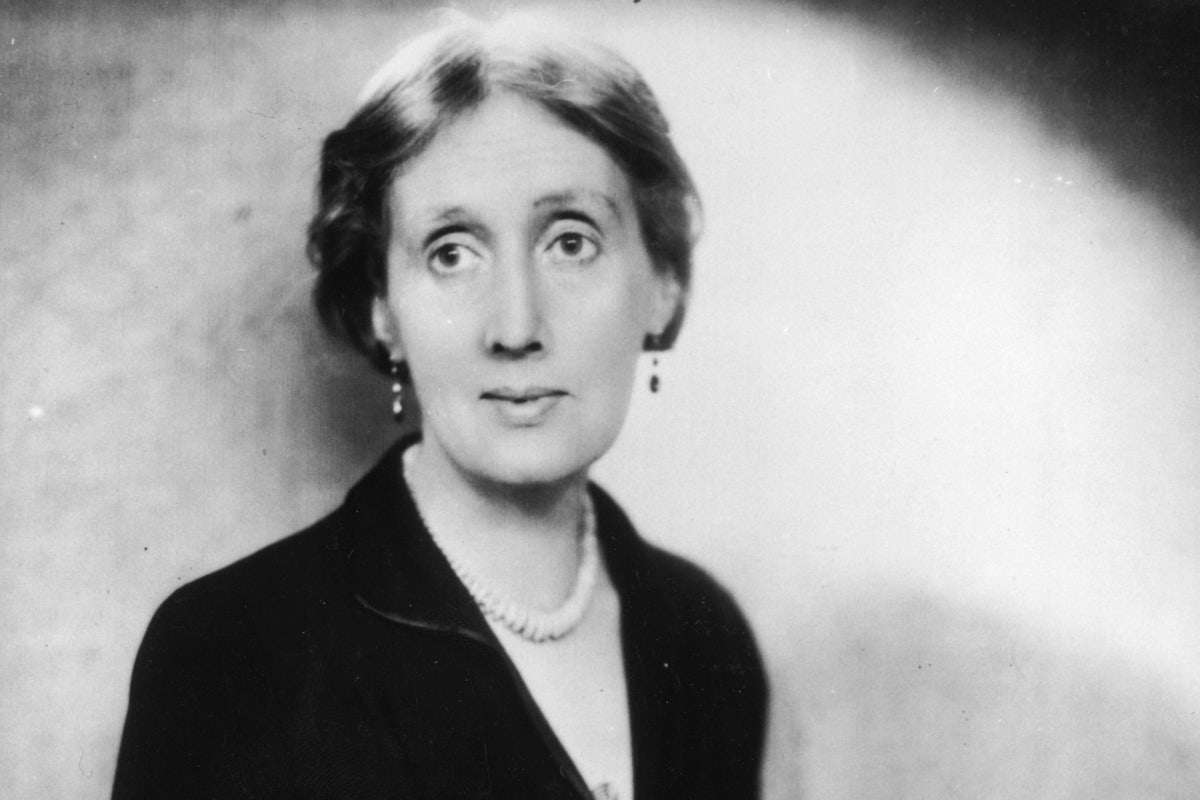
Central Press / Getty Images
Every so often a book comes along and changes the way you see a classic of literature. The Diary of Virginia Woolf, published between 1977 and 1984, came out decades after Woolf’s death in 1941, and added a stunning lens through which to view her long and dynamic career. Her husband Leonard had carefully edited a volume initially in 1953, one that focused entirely on Woolf’s writing process and avoided personal details, but it was only when Woolf’s diaries were released in their totality that readers gained a precious glimpse inside a complicated mind at work.
Continue reading


Sunday, 1 December 2019

10 for Today (1 December 2019) starts with Namibian prehistoric art and time-travels to the 1980s via various means

Namibia’s Apollo 11 Cave – How We Gained Insight Into The Minds Of Our Ancestors
via Ancient Origins by Ed Whelan
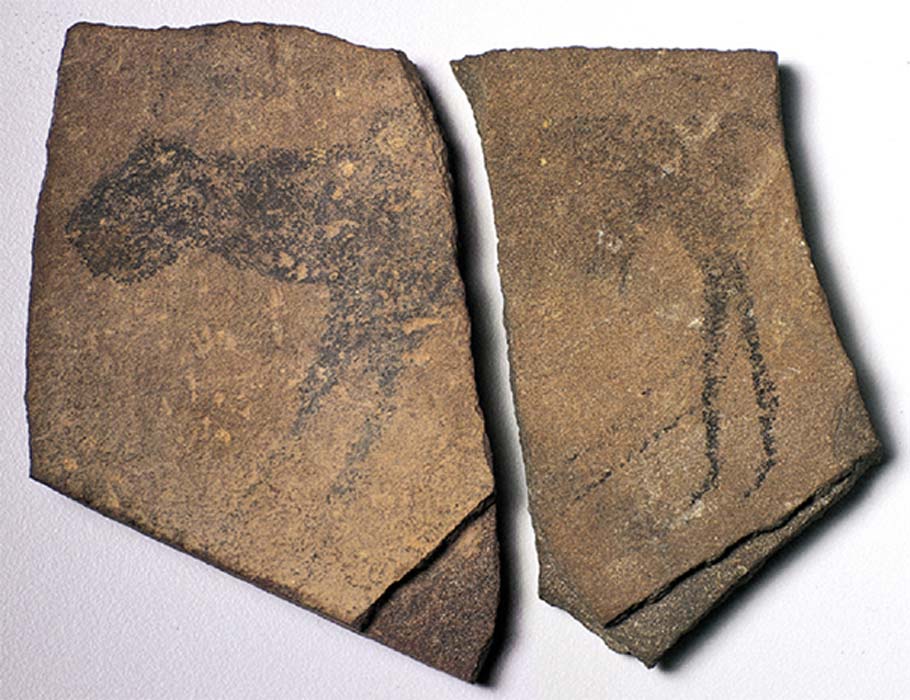
Apollo 11 Cave Stones, Namibia
Apollo 11 Cave Stones, Namibia,        Source: Courtesy of State Museum of Namibia.  
Despite its name, the Apollo 11 cave in Namibia has nothing to do with space exploration. It’s the location of prehistoric art, some of the earliest examples of art in human history, and it has provided us with a unique insight into the history and development of humans.
Continue reading

==============================
A Summary and Analysis of Hans Christian Andersen’s ‘The Little Match Girl’
via Interesting Literature
‘The Little Match Girl’ is one of Hans Christian Andersen’s most famous fairy tales for children. It is also one of his shortest, running to just a few pages. In any case, below we’ve offered a brief summary of the tale that highlights some of its salient points, before moving on to a brief commentary on, or analysis of, the key themes of ‘The Little Match Girl’. What is the meaning of this intriguing little tale?
Continue reading

==============================
Humans have a sixth sense for Earth's magnetic field
via Boing Boing by David Pescovitz

A new study suggests that humans can subconsciously sense Earth's magnetic field. While this capability, called magnetoreception, is well known in birds and fish, there is now evidence that our brains are also sensitive to magnetic fields. The researchers from Caltech and the University of Tokyo measured the brainwaves of 26 participants who were exposed to magnetic fields that could be manipulated. Interestingly, the brainwaves were not affected by upward-pointing fields.
Continue reading

==============================
Remembering George Dantzig: The real Will Hunting
via the Big Think blog by Matt Davis
How the story of a statistics student being late to class became the inspiration for the protagonist of Good Will Hunting.

  • One of the iconic scenes from Good Will Hunting shows Matt Damon's character anonymously solving a nigh-impossible math problem on a blackboard at the university where he works as a janitor.
  • This story, while modified for the purposes of the film, actually happened.
  • George Dantzig, who would later become a famous mathematician, was late to his graduate statistics class one day when he saw two statistical problems on a blackboard that he mistook for homework.

Continue reading

==============================
The ‘Female Byron’
The celebrity poet Letitia Elizabeth Landon mesmerized a 19th-century public with hints of dark secrets.
via Arts & Letters Daily: Nicholas Dames in The Atlantic
L.E.L.: The Lost Life and Scandalous Death of Letitia Elizabeth Landon, the Celebrated “Female Byron” BY LUCASTA MILLER KNOPF
The story ended in October 1838 in modern-day Ghana, at Cape Coast Castle, a British commercial garrison and a former slave-trading post. There, the recently married 36-year-old wife of the chief British official, George Maclean, was found by her maid dead on the floor of her dressing room, an empty prescription bottle of highly toxic prussic acid in her hand. Nearby, probably in Accra, were the governor’s “country wife” and her several children; upon the new wife’s arrival from the literary precincts of London, they had been discreetly removed from the castle. Rumors would soon circulate in Britain that the governor’s previous consort was the murderer, though no evidence emerged to support those suspicions. On the desk was an unsent letter, banal and cheerful, rather than a suicide note.
Continue reading

==============================
Scientific study shows that adults sleep better when rocked as they snooze
via Boing Boing by David Pescovitz
Here's another fine development in sleep science today! A new study shows that young adults, like babies, sleep better when rocked. University of Geneva neuroscientist Laurence Bayer and colleagues built a gently rocking bed and used EEG to monitor adults' brain activity as they slept.
Continue reading

==============================
Prehistoric Ireland – Neolithic, Cooper, Bronze and Iron Age
via About History

Neolithic
In 6 thousand B.C. almost simultaneously, in different extremities of Europe, a new, neolithic cultural tradition arises, associated with the cultivation of cereals, the grazing of domestic animals (cattle, goats, sheep), the extensive use of ceramics, and permanent dwellings. In central Europe, the Neolithic was associated with the culture of linear-tape ceramics, which for several centuries reached the Atlantic coast of northern France. Another Neolithic culture, La Hoguette, arrived in the eastern regions of France as the successor to the Impresso culture that emerged in the Ibero-Italian region. In the culture of La Hoguette, as in the preceding western version of the culture of impresso, sheep and goat breeding prevailed. There is evidence that around 5100 B.C. in the south of England, milk begins to be consumed and livestock appear – descendants of livestock domesticated in the Aegean region shortly after the Holocene. Apparently, these animals were brought to Britain by representatives of the culture of linear-tape ceramics. Around 4300 B.C. livestock appears in Northern Ireland, and after it appears the red deer.
Continue reading

==============================
The Trial of Charles I
via The National Archives Blog by Neil Johnston
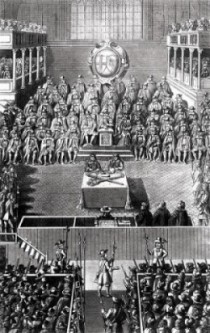
The Court of Charles I
The execution of Charles I on 30 January 1649 still arouses strong emotions in many people. Controversial during his lifetime, the king was both vilified and exculpated in the immediate years after his execution, and he remains a source of significant debate among scholars, students and the general public alike.
His public trial at Westminster, for crimes of treason against his own subjects, and his public execution outside the Banqueting House in Whitehall are among the defining moments of early modern British history. By any standards, these moments were shocking for many across the Stuart dominions and beyond. Nor is it surprising that generations of historians have drawn upon the dramatic events of the trial, while in recent years plays and television dramas have reinterpreted the trial for new audiences.
Continue reading

==============================
A Short Analysis of Shakespeare’s ‘To be or not to be’ soliloquy from Hamlet
via Interesting Literature
‘To be, or not to be, that is the question’: perhaps one of the most famous lines in all of English literature, but arguably also one of the most mysterious – and one of the most misread. Hamlet’s soliloquy from William Shakespeare’s play is rightly celebrated for being a meditation on the nature of life and death, but some analyses and interpretations of the soliloquy serve to reduce the lines to a more simplistic meaning. So what does ‘To be or not to be’ really mean?
Continue reading

==============================
These videos of Radio Shacks and Furry Conventions in the 1980s are incredible time capsules
via Boing Boing by Mark Frauenfelder

Watching this 1987 video of two Radio Shacks (one with Madonna music in the background) makes it clear that 30 years can be a long, long time ago. Prancing Skiltaire (the person who uploaded this video) said, "This was shot in Garden Grove, CA and Buena Park Mall, CA. The person who recorded was an employee working with a regional manager who was inspecting under performing Radio Shacks they were going to renovate." I was fascinated for all 15 minutes of this spellbinding video.
Be sure to check out Prancing Skiltaire's other amazing videos, like the Equicon Costume Presentation (1988):

And the first Furry Convention! (1989):


Sunday, 17 November 2019

10 for Today (17 November 2019) starts with smoke bombs -- not safe for children! and ends with ancient history and robots

How to make colored smoke bombs
via Boing Boing by Mark Frauenfelder

As a kid I set my friend's kitchen on fire melting potassium nitrate and sugar on the stove, so be careful when making these cool colored smoke bombs, which use oil pastels as pigment.

==============================
The great green expansion: how ring-necked parakeets took over London
via the Guardian by Nick Hunt

A parakeet in blossoming trees near Victoria Park. Photograph: Courtney Hopf
Was Jimi Hendrix responsible for the bright-green tropical birds’ presence in the capital? Or was it Katharine Hepburn?
Electric Ladyland wasn’t the only thing Jimi Hendrix released in 1968. One day in that tumultuous year he left his flat on Brook Street, Mayfair, and strolled down nearby Carnaby Street with a birdcage in his hands. I like to think that he was dressed in a tasselled jacket and flares, his favourite Fender Stratocaster slung across his back. Or perhaps he travelled incognito, in a trenchcoat and dark glasses. Either way, somewhere on that street, the heart of Swinging London at the height of peace and love, he opened the door of the cage and unleashed two bright green birds: Adam and Eve, a breeding pair of ring-necked parakeets.
Continue reading

==============================

Timothy O’Sullivan and the Shoshone Falls
via Picture This (Library of Congress Pictures and Photos by Kristi FinefieldMr. Sullivan [i.e. O'Sullivan]. Photo by Wheeler & Angerman, circa 1873. //hdl.loc.gov/loc.pnp/ppmsca.31600
Details about the life of Irish American photographer Timothy O’Sullivan are sparse. He was either born in New York or emigrated with his parents at the age of 2 from Ireland in 1842. He died at the age of 42 from tuberculosis. He left few documents in his own hand, but the photographs he took during his relatively short life speak volumes.O’Sullivan worked for Mathew Brady and with Alexander Gardner documenting the U.S. Civil War as a photographer in the field. His photographs populate just under half the pages of Gardner’s landmark work, the Photographic Sketch Book of the War. After the war, O’Sullivan would spend years traveling as the photographer for geographical and geological surveys as the U.S. government sought to document parts of the vast western part of the continent.Continue reading and see some superb photographs.

==============================
When a river is dammed, is it damned forever?
via the OUP blog by Jeff Duda, Ryan Bellmore and George PessmarchGlines Canyon Dam and Lake Mills post dam removal. CC0 via U.S. Geological Survey.Since the dawn of advanced civilizations, humanity has sought to manage the flow of rive. Protection from floods, water for drinking and irrigating crops, and extraction of resources like food and energy are among the most popular reasons for building dams. Early successes in controlling the flow of rivers for society’s benefit led to more construction, reaching the point that in Europe and North America today most prime locations for placing dams have been taken. Additionally, many large river systems in the developed world have at least one but often multiple dams on them. Estimates suggest that water in reservoirs has increased the world’s lake environments by nearly ten percent. In parts of the developing world, new dam construction is now booming as well, as emerging economies try to make up for lost time.Continue reading


==============================
Street Art Used To Be the Voice of the People. 
Now It’s the Voice of Advertisers.Corporations like Red Bull and Stella Artois are co-opting graffiti art.
via Arts and Letters Daily: Christine MacDonald at In These Times
Street murals, often used for political messaging, are becoming increasingly co-opted by corporations and developers.
For some artists, the only way to avoid a corporate takeover of the mind, so to speak, is by steering clear of commercial commissions altogether.
Los Angeles, a city once known as the mural capital of the world, issued a citywide mural moratorium in 2002 to crack down on the growing issue of outdoor advertising passing as street art. The ban remained in place until a 2013 ordinance overturned it and set down strict new rules prohibiting commercial messages in street murals.
Continue reading

==============================
The latest marble chain reaction video is the best so far
via Boing Boing by Mark FrauenfelderMarble 3 is Kaplamino's latest marble chain reaction video. I like the way that many parts of the track are formed as needed by the energy of rubber bands, deflating balloons, magnets, and even a firecracker. (near the end)

==============================
The world's watersheds, mapped in gorgeous detail
via the Big Think blog by Frank Jacobs
Hungarian cartographer travels the world while mapping its treasures.
  • Simple idea, stunning result: the world's watersheds in glorious colors.
  • The maps are the work of Hungarian cartographer Robert Szucs.
  • His job: to travel and map the world, one good cause at a time.
Continue reading to see the maps (I tried but none of them will reproduce themselves here)

==============================
Swallows and Armenians: Arthur Ransome’s forgotten inspirations revealed
via the Guardian by Alison FloodA new art project is exploring how the characters in the English children’s classic were modelled on a family from Aleppo
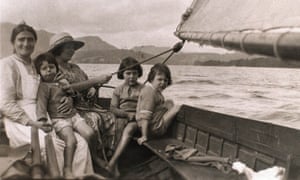
Mavis Guzelian (née Altounyan), the inspiration for the character Titty in Arthur Ransome’s Swallows and Amazons, on the lap of a nanny while boating with her sisters Taqui (left) and Susie on Coniston Lake in the early 1920s.
Mavis, Taqui and Susie Altounyan, three of the five children who inspired Arthur Ransome’s Swallows and Amazons, boating with a nanny in the early 1920s. Photograph: Guzelian
Arthur Ransome’s fictional Walker children – John, Susan, Titty and Roger – are quintessentially English, enjoying summers sailing in the Lake District with bread and marmalade for tea, and peppering their talk with regular “jolly good”s. But the Anglo-Armenian family who inspired the Walkers deserves to be more widely acknowledged, says artist Karen Babayan, who hopes to re-establish the connection through an Arts Council England-funded project spanning stories, dance, theatre and art.
Continue reading

==============================
The History of the Balkan Soldiers – Stratioti
via About History
Stratiots were mercenaries from the Balkan Peninsula, hired mainly by states of southern and central Europe from the XV to the Middle. XVIII century.
If you can work out what this image represents then you are a lot better at art interpretaion than I am.
Stratioti were recruited from the population of Albania, Dalmatia, Greece, Serbia, and later Cyprus. Most modern historians believe that Albanians made up about 80% of the total contingent, while the officer corps was mainly of Greek and South Slavic origin. Among them were the descendants of the ancient Byzantine noble families – Palaiologos and Komnenos.
Continue reading

==============================
Ancient civilisations' fascination with AI, robots, and synthetic life
via Boing Boing by David Pescovitz
Stanford folklorist and science historian Adrienne Mayor has a fascinating-sounding new book out, titled "Gods and Robots: Myths, Machines, and Ancient Dreams of Technology." It's a survey of how ancient Greeks, Romans, Indian, and Chinese myths imagined and grappled with visions of synthetic life, artificial intelligence, and autonomous robots.
Continue reading