Monday, 3 December 2018

Using information security to explain why disinformation makes autocracies stronger and democracies weaker

a post by Cory Doctorow for the Boing Boing blog


The same disinformation campaigns that epitomize the divisions in US society – beliefs in voter fraud, vaccine conspiracies, and racist conspiracies about migrants, George Soros and Black Lives Matter, to name a few – are a source of strength for autocracies like Russia, where the lack of a consensus on which groups and views are real and which are manufactured by the state strengthens the hand of Putin and his clutch of oligarchs.

In a new Harvard Berkman Center paper, Common-Knowledge Attacks on Democracy, political scientist Henry Farrell (previously and security expert Bruce Schneier (previously) team up to explore this subject by using information security techniques, and come to a very plausible-seeming explanation and a set of policy recommendations to address the issue.

Continue reading

Please take your time over this. The author is someone I trust to say it as it is.
Trust can, of course, be misplaced but over time I have not found this to be true of Cory Doctorow.


Aid: it’s not just about the money

For more than a decade, CEP research associate Peter Boone and his colleagues at Effective Intervention have been running health and education programmes in some of the poorest parts of the world. As he recounts here, there have been successes and failures – but the one clear lesson is that while financing is an issue in foreign aid projects, it is by no means the most important one for saving lives or educating young children.

Published in CentrePiece Autumn 2018

Read the whole article here

Peter Boone is the executive chair of Effective Intervention (http://www.effint.org).

Further Reading

Peter Boone, Ila Fazzio, Kameshwari Jandhyala, Chitra Jayanty, Gangadhar Jayanty, Simon Johnson, Vimala Ramachandran, Filipa Silva and Zhaoguo Zhan (2013) ‘The Surprisingly Dire Situation of Children’s Education in Rural West Africa: Results from the CREO (Comprehensive Review of Education Outcomes) Study in Guinea-Bissau’,
CEP Discussion Paper No. 1201 (http://cep.lse.ac.uk/pubs/download/dp1201.pdf).

Peter Boone, Alex Eble, Diana Elbourne, Chris Frost, Chitra Jayanty, Rashmi Lakshminarayana, Vera Mann, Rohini Mukherjee, Gilda Piaggio and Padmanabh
Reddy (2017) ‘Community Health Promotion and Medical Provision for Neonatal Health– CHAMPION Cluster Randomised Trial in Nagarkurnool District, Telangana (formerly Andhra Pradesh), India’, PLoS Medicine 14(7):
e1002324
(http://doi.org/10.1371/journal.pmed.1002324)

Rashmi Lakshminarayana, Alex Eble, Preetha Bhakta, Chris Frost, Peter Boone, Diana Elbourne and Vera Mann (2013) ‘The Support to Rural India’s Public Education System (STRIPES) Trial: A Cluster Randomised Controlled Trial of Supplementary Teaching, Learning Material and Material Support’,
PLoS ONE 8(7): e65775
(http://doi.org/10.1371/journal.pone.0065775).

Vera Mann, Ila Fazzio, Rebecca King, Polly Walker, Albino dos Santos, Jose Carlos de Sa, Chitra Jayanty, Chris Frost, Diana Elbourne and Peter Boone (2009) ‘The EPICS Trial: Enabling Parents to Increase Child Survival through the Introduction of Community-based Health Interventions in Rural Guinea-Bissau’,
BMC Public Health 9: 279
(http://doi.org/10.1186/1471-2458-9-279).


Correlating social mobility and economic outcomes

a column by Maia Güell, Michele Pellizzari, Giovanni Pica and Sevi Rodriguez Mora for VOX: CEPR’s Policy Portal

Measuring intergenerational mobility and understanding its drivers is key to removing the obstacles to equal opportunities and assuring a level playing field in access to jobs and education.

This column uses the informational content of Italian surnames to show that social mobility varies greatly across regions in the country, and that it correlates positively with economic activity, education and social capital, and negatively with inequality. The findings suggest that policies and political institutions are unlikely to be the main drivers of geographical differences in social mobility.

Continue reading


5 Self-Care Apps and Sites for Positive and Healthy Reminders

a post by Dann Allbright for the MakeUseOf blog

In the rush of looking after your family, meeting your work requirements, and getting things done, it’s easy to neglect your own well-being. These websites, apps, and social accounts will ensure you remember to take care of yourself.

Even five minutes of self-care is enough to make a big difference in how you feel. Whether it’s a reminder to take a break from work or an uplifting message that puts you in a positive frame of mind, there’s something for everyone here.

Continue reading

Not a usual source for self-help advice but at least one of the ideas looked interesting. Nothing new, of course, but perhaps a slightly different way of looking at "the same old".


The big house as home: roots tourism and slavery in the USA

an article by Jodi Skipper and Suzanne Renee Davidson (The University of Mississippi, USA) published in International Journal of Tourism Anthropology Volume 6 Number 4 (2018)

Abstract

The dominant discourse preferences the experiences of African Americans who take trips to sites linked to slavery outside of the USA.

This paper expands research on roots tourism, by centring the experiences of those who travel to slavery-related sites in the USA. Documenting the case of the Behind the Big House Tour as a response to the Annual Pilgrimage Tour of Historic Homes and Churches in Holly Springs, Mississippi, this study examines evidence for African diasporic roots tourists who acknowledge sites at which their ancestors were enslaved as home sites.

Results suggest that this level of acceptance occurs when African Americans come to feel a sense of belonging.

The study identifies two general conditions needed to facilitate this process: access to slavery-related sites encouraged by historic site owners or managers and reunion with enslaved ancestors and descendants of those who historically lived and worked at slavery-related sites.


Sunday, 2 December 2018

10 for today starts with Lionel, Duke of Clarence and wanders via Russian History through to detective fiction,

Royal weddings in history: The forgotten prince and his Milanese bride
via The National Archives Blog by Benjamin Trowbridge
For Lionel his sonne with theim to send
The duke his doughter of Melayn for to wed
Promysing then hym so to recommend
That of Itale the rule sholde all be led
By hym and his frendes of Italye bred
19th century drawing of the bronze effigy of Lionel of Antwerp, Duke of Clarence on the tomb of his father Edward III, Westminster Abbey (source: Wikicommons)
19th century drawing of the bronze effigy of
Lionel of Antwerp, Duke of Clarence on the 
tomb of his father Edward III, Westminster Abbey
(source: Wikicommons)

==============================
Rewriting Russian history
via Eurozine by Dagmara Moskwa

Cover of New Eastern Europe
In 2015 the 70th anniversary of the Soviet victory over Nazi Germany was celebrated in grand style. During that time, a larger than usual number of Stalin monuments was erected in several cities especially in south-western parts of the country upon the proposal of the communist party. The communists’ call came after a 2014 law passed by the Duma introduced a criminal penalty for rehabilitating Nazism and criticising Soviet activities during the Second World War. The law stipulates up to five years in prison for ‘lying about history’. Similar steps have been taken with regards to teaching history in schools.
Continue reading

==============================
Is Sugar Good For Concentration?
via Big Think by Teodora Zareva
Article Image
Should you or shouldn’t you bring that chocolate bar to your next exam? Scientific studies have been inconclusive when it comes to the cognitive effects of sugar. Some suggest that sugar has positive effects on brain function while others disagree. Very few, however, have compared the effects of different types of sugar.
A new study from New Zealand published in the journal Physiology and Behaviour set out to do just that. It tested the cognitive effects of different sugars – glucose, fructose and sucrose – to see if they affected information processing, executive functioning and attention differently.
Sucrose, or table sugar, is broken down in the body to glucose and fructose which are metabolized quite differently. Fructose is metabolized much more slowly and is almost entirely absorbed by the liver, while glucose is metabolized widely in the body and distributed (with the help of insulin) to the muscles, kidneys, adipose tissue and brain. Notably, the brain can only use two substrates for energy – glucose and ketones (which is why ketogenic diets are touted for their cognitive benefits).
Continue reading

==============================
What the Stoics did for us
via 3 Quarks Daily: Massimo Pigliucci in New Humanist
Let me then introduce you to three fundamental ideas of Stoicism – one theoretical, the other two practical – to explain why I’ve become what I call a secular Stoic. To begin with, the Stoics – a school of philosophers who flourished in the Greek and Roman worlds for several hundred years from the third century BCE – thought that, in order to figure out how to live our lives (what they called ethics), we need to study two other topics: physics and logic. “Physics” meant an understanding of the world, as best as human beings can grasp it, which is done by way of all the natural sciences as well as by metaphysics. The reason that physics is considered so important is that attempting to live while adopting grossly incorrect notions about how the world works is a recipe for disaster. “Logic” meant not only formal reasoning, but also what we would today call cognitive science: if we don’t know how to use our mind correctly, including an awareness of its pitfalls, then we are not going to be in a position to live a good life.
Continue reading

==============================
Rare fan painting of Bath gives glimpse of life in Georgian England
via the Guardian by Maev Kennedy

The fan painted in watercolour by Thomas Loggan of Harrison’s Walk, now Parade Gardens, Bath.
A hand-painted fan showing a long-lost view of a Bath landmark that Jane Austen would have known has been acquired by the city’s Holburne Museum, where it will go on display for the first time.
The rare fan, which had been in a private collection, shows elegantly dressed people strolling in Harrison’s Walk, a tree-lined riverside walk kept exclusive by paid subscription. The building in the background contained Bath’s first assembly rooms, known as Harrison’s Rooms, built for an entrepreneur in 1708 at the urging of Beau Nash, who became the arbiter of good taste and genteel behaviour as Bath became the most fashionable spa in Georgian England.
Continue reading

==============================
Westminster Abbey's attics yield a treasure trove of stained glass
via the Guardian by Maev Kennedy
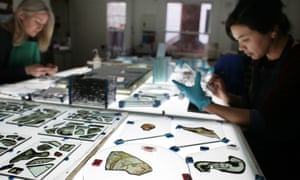
Fragments of glass from Westminster Abbey are inspected by Canterbury Cathedral's glass studio
When the archaeologist Warwick Rodwell scooped up a handful of dust from the attics of Westminster Abbey and saw dozens of tiny fragments of glass glittering in the grime, he realised they were dealing with excavation, not house clearance.
The salvaged glass – some dating back to the 13th century, including stars, flowers and sun rays, fierce little mythical animals and beautiful medieval faces – is being recycled into dazzling new windows being made for the abbey at the stained glass studio at Canterbury Cathedral, where some of the original medieval glass artists may have worked.
Continue reading

==============================
A Short Analysis of Shakespeare’s Sonnet 129: ‘The expense of spirit in a waste of shame’
via Interesting Literature
When we reach no. 129 in Shakespeare’s Sonnets (‘The expense of spirit in a waste of shame’), we come across a rarity: two classic sonnets one after the other (we’ll come to Sonnet 130 next week). This first one is famous for its analysis of the psyche (particularly the male psyche) after sexual gratification has been achieved. What explains the feeling of sadness, and even self-loathing, which often ensues?
Continue reading

==============================
Natural-born existentialists
Ethics cannot be based on human nature because, as evolutionary biology tells us, there is no such thing
via Arts & Letters Daily: Ronnie de Sousa in AEON

Nature, Mr Allnut, is what we were put in the world to rise above.

Katherine Hepburn to Humphrey Bogart in African Queen (1951)
Questions about what matters, and why, and what exists in the world, are quintessentially philosophical. The answers to many of these questions are informed by how we conceive of ourselves. How has what is often described as the ‘Copernican revolution’ effected by Charles Darwin changed our self-conception? One particularly surprising feature of evolutionary biology is that it lends significant support to existentialism.
To make the journey from evolutionary biology to existentialism, let’s start with one of the oldest and most profound of philosophical questions: how do we decide what is right or wrong, good or bad? Many philosophers have warned that no facts about nature can ever provide grounds for claims about values. In A Treatise of Human Nature (1739-40), David Hume made a compelling argument that an unbridgeable gap separates fact from value, ‘is’ from ‘ought’. To attempt to bridge that gap is to commit the ‘naturalistic fallacy’: no argument from factual premises can ever secure a conclusion about what is valuable, or about what to do.
Continue reading

==============================
A saving breath: The history of respiratory care
via Tara at ResearchBuzz Firehose: Erin BLakemore in the Washington Post
American Association for Respiratory Care Virtual Museum
Stethoscopes. CPR. Oxygen tanks.
All make it possible for doctors to diagnose and treat conditions of the lungs, including tuberculosis and other diseases that claimed millions of lives before advances in respiratory medicine and therapy. There's a fascinating history here.
You can delve into that history — and learn more about the researchers and medical professionals who help people catch their breath today — at the American Association for Respiratory Care's online museum.
The website introduces topics you may not have known could be so interesting. Take the weird-looking inhalers that gave asthma patients relief during the early 20th century. Or the story of tuberculosis treatment, which once involved such things as TB colonies on boats that isolated patients and tent settlements where patients in search of relief lived outdoors even during harsh winters.
Continue reading

==============================
New Renaissance: how Florence is freeing its great female artists
via the Guardian by Joanna Moorhead

Ready in 2019 … a detail of Jesus and Saint John from Plautilla Nelli’s Last Supper. Photograph: Kirsten Hills
In a dark cluttered studio in central Florence, restorer Rossella Lari is working on a little-known jewel of the Renaissance. It’s vast: a seven metre by five metre depiction of the Last Supper, with figures that are almost lifesize, that was painted in the 1560s.
As she works, Lari says she thinks often of the person who painted it. “You get to know an artist when you restore their painting,” she says. “You learn about them from the way they use the paint, from their brushstrokes, from their attention to detail.” This artist, she says, was strong, confident and determined. She had to be, because she was also female, the earliest significant female Renaissance artist.
Her name was Plautilla Nelli (1524‑1588), and the painting Lari is working on is her masterpiece. When it’s finished, in 2019, it will go on show at the Santa Maria Novella Museum in Florence, the first time it will have been publicly exhibited in 450 years. “That is a very significant moment, not only for Nelli but for all the forgotten women artists of the Renaissance, as well as for artists today who don’t realise how rich a contribution women made to that era,” says Linda Falcone of Advancing Women Artists (AWA), an organisation championing forgotten works.
Continue reading

==============================
Curious Facts about the Golden Age of Detective Fiction
via Interesting Literature
In this week’s Dispatches from The Secret Library, Dr Oliver Tearle investigates the fascinating facts behind some of the greatest detective novels
The rise of detective fiction is a fascinating topic (previously, I’ve chosen 10 of the greatest examples of the genre), and it’s no surprise that a book telling the story of classic crime fiction in 100 books should yield many surprising and interesting facts. This is certainly the case with Martin Edwards’ The Story of Classic Crime in 100 Books (British Library Crime Classics), a beautifully produced book from the British Library which charts the rise of crime fiction during the genre’s ‘Golden Age’ of the first half of the twentieth century.
Continue reading


Saturday, 1 December 2018

10 fr today starts with a fascinating hedge cutter and does, of course, include some poetry.

Watch this cool machine trim hedges into perfect spheres
via Boing Boing by Andrea James

If you thought you might live out your days without seeing an industrial hedge clipper form shrubs into perfect spheres while accompanied by Wagner, everything changes today.
Continue reading and watch the video

==============================
Life Should Be Widespread Throughout the Universe, Study Finds
via the Big Think blog by Philip Perry
Researchers used the same method that would be employed to detect life on Mars.
If the sheer number of Earth-like planets wasn’t enough to convince you there’s life elsewhere in the universe, this might. Scientists studying the oldest ever discovered fossils, found that microbes actually lived very early on in our planet’s history, when it wasn’t what we traditionally consider hospitable to life. The results of this study were published in the Proceedings of the National Academy of Sciences (PNAS).
Continue reading

==============================
The Dawn Watch review: a reminder of Joseph Conrad’s artistic greatness
via Arts & Letters Daily:Ed O’Loughlin in The Irish Times
Maya Jasanoff views Conrad’s troubled life through the lenses of his four greatest novels
The years have not been kind to Joseph Conrad, feted in his lifetime as the greatest writer of English-language fiction. Although he is still a historical literary titan, these days his most widely read novel, Heart of Darkness, is, tellingly, also his shortest, better known to many through its Vietnam War retread, the movie Apocalypse Now. Hailed in the West as an early shot against white colonialism, the novel found much less favour among its African subjects. The celebrated Nigerian writer Chinua Achebe denounced Conrad as a “thoroughgoing racist” who portrayed Africans only as rudimentary savages. The title of Conrad’s 1897 novella, The Nigger of the ‘Narcissus’, speaks for itself – although seldom now aloud, or in public.
Conrad’s leading characters are almost all white males, his women often little more than plot points (although Emilia Gould, in Nostromo, and Winnie Verloc, in The Secret Agent, are notable exceptions). The casual anti-Semitism that was a feature of so many great works of contemporary English fiction is present, too, in some of Conrad’s work.
Continue reading

==============================
Vera Lynn: 'Mum was determined to put me on stage. I didn't complain'
via the Guardian by Angela Wintle
The singer, 100 this year[2017], talks about her childhood, earning more than her dad, meeting her musician husband and why she had a small family
Dame Vera Lynn at home in Sussex.
Dame Vera Lynn at home in Sussex. Photograph: Heathcliff O'Malley/Rex/Shutterstock
I nearly died before I got started. When I was a toddler, I fell ill with diphtheritic croup and was taken to an isolation unit. One of my earliest memories is of being on my own in a tent surrounded by steaming kettles. I was discharged after three months, just in time for my third birthday. As I’d missed Christmas, I had my Christmas and birthday all in one – in March. Mum even found a Christmas tree.
Perhaps this explains why Mum was overly protective. For a long time after I started school I wasn’t allowed to play in the street or visit friends. She wasn’t as strict with my brother, Roger, who was three years older, but fortunately I didn’t mind my own company or feel the lack of friends.
Mum worked for a London dressmaker before she married. When she was forced to give up work after her marriage, she carried on dressmaking for people at home. She was the one with the get-up-and-go. Dad, who worked as a plumber, was a quiet and undemanding man who liked to laugh – and he was a very good dancer.
Continue reading

==============================
A Short Analysis of Gerard Manley Hopkins’s ‘Carrion Comfort’
via Interesting Literature
A commentary on one of Hopkins’s ‘Terrible Sonnets’
The mid-1880s was not a good time for Gerard Manley Hopkins. Lonely in Ireland, the poet fell into a black pit of depression, out of which came the ‘Terrible Sonnets’ which represent, after his flurry of creativity in 1876-77, the most productive time of his poetic career. ‘Carrion Comfort’ is perhaps the most famous of these sonnets.
Continue reading

==============================
Bonnie Greer on Cheap Thrills and Janis Joplin: "You could hear the bourbon in her veins"
via the New Statesman
Janis Joplin
Everyone has a time when childhood ends and this thing called “on your own” begins. This time was the summer of 1968, not long after the assassination of Martin Luther King, and it was my gap year before beginning university. I was the eldest child and eldest daughter of two people who worked hard to better the lives of all of us kids. And being two African Americans whose origins were in the South, our parents wanted to have a safe and “proper” life. We were raised carefully, shielded against the various pitfalls, accidents of society and the flotsam and jetsam of African-American life. Our little house, with its neatly cultivated lawn in front and garden in the back, its two-car garage and swept front steps, was the replica of all of the houses in our street. Church on Sundays, school uniforms, no blaring music – all of this was to help us be the opposite of what society assumed about us.
In my case this was all going to plan until the year 1968 arrived, and a series of national catastrophes and opportunities presented themselves and I seized the moment and flew away. One of my landing places was the campus of the University of Chicago where a friend was an undergrad. One afternoon, I saw an album lying on a bed. It was called Cheap Thrills by something called Big Brother and the Holding Company. Its cover was a lurid cartoon landscape, and the record itself provided the leitmotif for the life I was about to live.
Continue reading

==============================
What Britons are worried about
via Boing Boing by Rob Beschizza

Wired UK created a beautiful chart to illustrate the miseries of Britain's current occupants. Debt, divorce, welfare cuts and housing prevail, but further down the threads become more tangled. Parking fines?

==============================
Elizabeth I's suspicion of Mary, Queen of Scots writ large in donated letters
vie the Guardian by Alison Flood
A batch of letters given to the British Library throws light on the English monarch’s growing frustration with her exiled cousin
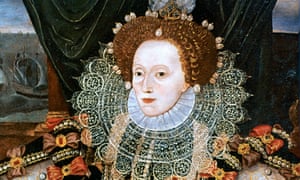
Poison pen … Elizabeth I painted by George Gower circa 1588.
An icy missive from Elizabeth I to the imprisoned Mary, Queen of Scots, in which the monarch makes full use of the royal “we” as she discusses how “greeved” she is to “behold the alteration and interuptuion” of Mary’s “frendshippe”, forms part of a new donation of letters to the British Library.
The letter is dated 31 October 1584 – less than three years before Mary was executed at the age of 44 on 8 February 1587. Mary had fled Scotland for England in 1568, after an uprising against her. She had sought help from her cousin, Elizabeth, but the queen felt Mary was a threat and imprisoned her for years, latterly with Sir Ralph Sadler, who kept her in custody at Tutbury Castle in Staffordshire between 1584 and 1585.
Continue reading

==============================
There Is No Case for the Humanities
via Arts & Letters Daily: Justin Stover in American Affairs

The humanities are not just dying. By some measures, they are almost dead. In Scotland, the ancient Chairs in Humanity (which is to say, Latin) have almost disappeared in the last few decades: abolished, left vacant, or merged into chairs of classics. So too in the same period, the University of Oxford revised its famed Literae Humaniores course, “Greats,” into something resembling a technical classics degree. Both of these were long survivors, throwbacks to an era in which Latin in particular played the central, organizing role in the constellation of disciplines that we call the humanities. The loss of these “vestigial structures” reveals a long and slow realignment, in which the humanities have become a loosely defined collection of technical disciplines, with some genealogical connection to the old arts curriculum and the humanistic curriculum of the new universities of the Renaissance.
The result of this is deep conceptual confusion about what the humanities are and the reason for studying them in the first place. I do not intend to address the former question here, nor the related question about whether there can indeed by any coherent description of the humanities without Literae Humaniores, nor the question about which specific current academic disciplines are included. After all, most of us know the humanities when we see them.
Continue reading

==============================
The Best Villanelles in English Poetry
via Interesting Literature
The best villanelles everyone should read
As its name suggests, the villanelle is a French verse form, yet English has become its natural home. The villanelle is the greatest immigrant verse form. This intriguing verse form comprises 19 lines made up of five tercets (three-line stanzas) and a concluding quatrain. As the Oxford English Dictionary summarises it, ‘The first and third lines of the first stanza are repeated alternately in the succeeding stanzas as a refrain, and form a final couplet in the quatrain.’ Although the form dates back to a late sixteenth-century poem ‘Villanelle (J’ay perdu ma Tourterelle)’ by Jean Passerat, it was in the twentieth century that it became a great English verse form. (Indeed, it appears that Passerat invented the form himself with this poem). As the following eight poems suggest, this poetic form has been tried out by some of the major poets of the twentieth century, with memorable results.
Continue reading