Sunday, 3 February 2019

10 for today starts geographically in Calais and historically in the 14th century

The day an English king covertly avoided catastrophe: Calais 1350
via The National Archives Blog by Benjamin Trowbridge
‘…so ought not this event in any history to be forgotten. Then it is well that I tell it to you!’
A piece of art showing the French attempt to recapture Calais from England on 1/2 January 1350 in the Chronicle of Jean Froissart. Note the man on the drawbridge wearing the green and red cape with gold trimming receiving a sack of money. He is one of the central characters in this story. (source: Wikicommons)
The French attempt to recapture Calais from England on 1/2 January 1350 in the Chronicle of Jean Froissart. Note the man on the drawbridge wearing the green and red cape with gold trimming receiving a sack of money. He is one of the central characters in this story. (source: Wikicommons)
This noteworthy historical event described by the Black Prince’s biographer was in fact the little known attempt by French forces during the Hundred Years War to recapture the English held town of Calais by means of bribery and subterfuge.
Calais was only a recently won prize for King Edward III, who had paid a high price in military and financial resources to secure its surrender in August 1347.
Continue reading

==============================
A Short Analysis of Edgar Allan Poe’s ‘To My Mother’
via Interesting Literature
Edgar Allan Poe’s mother died in 1811, when Poe was only two years old. His father had walked out the year before, so Poe became an orphan with his mother’s death. He was taken in by John and Frances Allan of Richmond, Virginia, and would live with them until he had reached adulthood, although the Allans never formally adopted him. His middle name (really a second surname) was derived from his ‘adopted’ parents. He was probably named Edgar, by the way, after Edgar in King Lear: his (biological) parents were both actors, who were starring in a production of Shakespeare’s play when their son was born. Poe wrote ‘To My Mother’ in 18.
Continue reading

==============================
DNA analysis reveals the 'extinct' Taino people never died out
via the Big Think blog by Robby Berman
DNA analysis reveals the Taino people who welcomed Columbus to the New World were not eradicated after all.
When Columbus arrived, the Caribbean islands were populated by people known now as the “Taino.” Most likely they were descendants of the Arawaks of South America, and Taino was actually just their language — at the time, they were known as Lucayans locally in the Bahamas, Greater Antilles, and the northern Lesser Antilles areas they dominated. They courteously greeted Christopher Columbus when he landed in the New World, but within 30 years, according to Spanish accounts, the Taino were all gone, victims of European pathogens — smallpox in particular — and the brutality of the newcomers. Locals have long insisted that this isn’t true, that they were simply written out of history. Now a DNA analysis reveals the locals were right, and at least one modern Caribbean population includes Lucayan Taino descendants.
Continue reading

==============================
Watch this guy turn wood into an extremely sharp knife
via Boing Boing by Andrea James

Lignum vitae is an extraordinarily dense and hard wood, so kiwami japan wanted to see if a knife made of the wood could maintain a sharp blade. An interesting and relaxing experiment.

==============================
Homo erectus may have been a sailor – and able to speak
via the Guardian by Nicola Davis in Austin
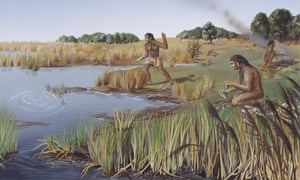
Language was necessary for the spread of toolmaking technology, as well as for boat-building and sailing, researchers suggest.
Language was necessary for the spread of toolmaking technology, as well as for boat-building and sailing, researchers suggest. Illustration: Alamy Stock Photo
They had bodies similar to modern humans, could make tools, and were possibly the first to cook. Now one expert is arguing that Homo erectus might have been a mariner – complete with sailing lingo.
Homo erectus first appeared in Africa more than 1.8m years ago and is thought to be the first archaic human to leave the continent.
Continue reading

==============================
10 Types of Medieval Armor
via About History by Alcibiades
10 Types of Medieval Armor
1) GAMBESON:
The gambeson is a full body jacket armor made out of quilted linen or wool, stuffed with cloth or horsehair and was the most cheap and easy to make armor, allowing any peasant equipped with it to become a decently armored soldier on the battlefield. Offering a decent defense against slash attacks, near immunity to bludgeoning its weak point were thrust attacks and piercing. As mail armor became more dominantly used, as well as plate later on, the gambeson essentially became what was worn beneath those two to provide even more defense for the soldier, and prevented injuries inflicted upon the skin by being a buffer zone between the body and armor, yet it was highly hated to be worn as it was insulatory and uncomfortable during any season apart from winter.
Continue reading

==============================
A Short Analysis of Edmund Spenser’s Amoretti LXXV: ‘One day I wrote her name upon the strand’
via Interesting Literature
Edmund Spenser’s Amoretti is one of the greatest of the Elizabethan sonnet sequences; after Sir Philip Sidney’s Astrophil and Stella (which was the first great sonnet sequence in English), it is perhaps the greatest of all. Sonnet LXXV from Amoretti, beginning ‘One day I wrote her name upon the strand’, is probably the most famous poem in the cycle, and deserves closer analysis for its innovative use of a popular conceit.
Continue reading

==============================
Dwarf planetary systems will transform the hunt for alien life
via the Big Think blog: Amaury Triaud and Michaël Gillon in AEON
It would be disappointing and surprising if Earth were the only template for habitability in the Universe.
Written speculation about life beyond the confines of Earth dates back thousands of years, to the time of the Greek philosophers Epicurus and Democritus. Unrecorded curiosity about this question undoubtedly goes back much further still. Remarkably, today’s generation seems about to get an answer from the study of exoplanets – planets orbiting other stars than the Sun. The early results are upending many assumptions from that long history.
Continue reading

==============================
For Mark Twain, It Was Love At First Sight
via Arts & Letters Daily: Richard Gunderman in the Smithsonian
The wife and daughters of Mark Twain
The aspiring author knew Olivia Langdon was the one when he first laid eyes on a photograph of her
The year 2018 marks the 150th anniversary of one of the great courtships in American history, the wooing of an unenthusiastic 22-year-old Olivia Langdon by a completely smitten 32-year-old Samuel Langhorne Clemens, better known as Mark Twain.
Continue reading Another fascinating time-waster for you!

==============================
Amateur radio astronomer discovers long-lost satellite
via Boing Boing by Andrea James

In December 2005, NASA lost contact with the IMAGE satellite. After trying to reconnect for two years, the agency gave up. Over a decade later, hobbyist Scott Tilley was able to confirm that IMAGE is not only still in orbit, but also transmitting data.
Continue reading

Saturday, 2 February 2019

10 for today starts with some tap dancing and ends with ancient multiplication methods

Fred Astaire said this was “the greatest dancing he had ever seen on film”
via Boing Boing by Mark Frauenfelder

Watch the Nicholas Brothers dance the “Jumpin' Jive” in the 1943 musical, Stormy Weather. Fred Astaire said it was “the greatest dancing he had ever seen on film”.
Continue reading and if you liked this then do scroll down to the comments. Some really great stuff IMO.

==============================
A Short Analysis of John Greenleaf Whittier’s ‘Tribute to Mother’
via Interesting Literature
A delightful little paean to the poet’s mother
‘Tribute to Mother’ is a short poem in which the American Quaker poet John Greenleaf Whittier (1807-92) recalls the time when he was a small child and sat beside his mother’s knee.
Continue reading

==============================
History of the 10 Most Famous Sports
via the About History blog by Alciblades
History of the 10 Most Famous Sports
1) WRESTLING:
Perhaps the oldest sport to have been recorded in any shape or form in history would be wrestling. The earliest form of combat became one of the most well-known sports, depicted in cave paintings in Lascaux, France, hieroglyphed in Egypt, written in the Illiad etc. Requiring a decent amount of strength, dexterity and a lot of maneuverability alongside tactics to pin your opponent down and keep him or her locked for a short countdown for the match to be over, it offered contestants to test their chances of winning dating back all the way to 15,300 BC.
Continue reading

==============================
A Lab of One’s Own: the forgotten female scientists who shed stereotypes about women’s abilities
via the New Statesman by Angela Saini
Women working in the laboratory of a cordite explosive factory, built in Gretna in 1915
SCIENCE AND SOCIETY PICTURE LIBRARY
You might assume that there’s not much left to be written about the suffragette movement. But what has been ignored is that in the quiet corridors of university science departments, important battles were fought by women whose names were quickly forgotten. They weren’t always high-profile campaigners, but by forcing open the gates to the male-dominated worlds of science and engineering they helped shed stereotypes about women’s abilities.
In A Lab of One’s Own, the Cambridge historian Patricia Fara documents these scientists’ stories, painting a picture of a world that clearly wanted to remain male. It was the First World War that gave women unprecedented access to careers for which they had until then been deemed unsuitable. From all walks of life, they began working in munitions factories, developing chemical weapons (at one point, 90 per cent of industrial chemists were women) and building war machinery, while male scientists were on the battlefield.
Continue reading

==============================
Sex on the canvas: Picasso’s most erotic year laid bare
The year 1932 saw Picasso at the height of his fame and painting his most explicitly sexual work, fuelled by his torrid affair with his young model, Marie-Thérèse Walter
via Arts & Letters Daily: Lara Marlowe, Paris Correspondent, in The Irish Times
Reclining Nude, Musée national Picasso, Paris
By 1932, Pablo Picasso was already the most famous artist in the world. He was 50 years old, lived in a luxurious apartment in central Paris, owned a château in Normandy, and commuted between the two in a chauffeur-driven Hispano-Suiza.
Picasso had a wife, a son and a mistress. The wife, Russian ballet dancer Olga Khokhlova, aged 41, had given up dancing after an ankle injury to devote herself to home-making. Their son Paulo was 11 years old and already taller than his 5ft 3in father. From the outside, the Picassos looked like a happy, bourgeois family. Pablo attended his son’s first communion in Paris and worked less during school holidays, to be with Paulo. In September, the three travelled together to Switzerland when the first Picasso retrospective, organised in Paris in June, moved to Zurich.
Continue reading

==============================
10 of the Best Poems about Darkness
via Interesting Literature
The greatest dark poems
Poetry isn’t all sweetness and light, of course. In fact, much of it is concerned with the darker aspects of the natural world, whether it’s the mystery or solemnity of night-time darkness or some other, more abstract or metaphorical kind of darkness (‘O dark dark dark’, as T. S. Eliot put it in Four Quartets). Here, we offer ten of the best poems about darkness of various kinds.
Continue reading

==============================
Caffeine reduces brain blood flow. So how does it energize our minds?
via the Big Think blog by Orion Jones
Caffeine is the world's most popular psychostimulant. In the United States, more than 90 percent of adults regularly consume caffeine and the average 'user' takes in about 300 milligrams per day, the equivalent of 3 cups of coffee.
Beverages infused with caffeine are by far the most common way the chemical is administered. As a mild stimulant, caffeine is prized for its effects on cognition, attention and alertness. Drinking coffee, tea or soda is an essential and acceptable part of the day for many adults while other psychostimulants—like amphetamines and cocaine—remain highly controlled.
Continue reading

==============================
The Lost World Between Scotland And England
via 3 Quarks Daily: Alan Taylor at Literary Review
Like the much-mythologised Wild West, the Debatable Land was terra nullius, where the writ of law was by and large ignored and bad men roamed at will. Situated where the northwest of England meets the southwest of Scotland, it was long an inhospitable, inhuman corner of the country: hilly, boggy, inaccessible and, five centuries and more ago, a tapestry of trees. The weather was similarly forbidding. When it rains in these parts, which it does more often than not, it is with torrential relentlessness.
Continue reading

==============================
How the horse helped shape our world — at great expense to itself
via Arts & Letters Daily: Melissa Holbrook Pierson in The Washington Post

A farmer in Iowa still used draft horses to work his property last year, but such scenes are increasingly rare in the United States. (Michael S. Williamson/The Washington Post)
One animal was so decisive in shaping human history that the eminent historian Reinhart Koselleck proposed it as the sole organizing principle in a schema outlining the world’s three great epochs. These three ages, he believed, should be called pre-horse, horse and post-horse. The middle era lasted some 6,000 years. Transition to the post-horse period dates to the mid-20th century. In “Farewell to the Horse,” Ulrich Raulff has composed nothing less than a requiem Mass for this long-suffering, noble creature — a complex and lyrical argument that places the horse in a central role in the creation of the modern world. In his excavations of the 150-year period that makes up this long farewell, the author discovered something marvelous: “Horses had more meanings than bones.”
Continue reading

==============================
Watch how 19th-century Genaille-Lucas calculating rulers work
via Boing Boing by Andrea James

Multiplying large numbers before calculators led to a number of ingenious inventions to make things easier, like these Genaille-Lucas rulers demonstrated by the fine folks at DONG.
Continue reading
Reminds me of my father trying to teach me how to use a slide rule. I never did get the hang of it.

Friday, 1 February 2019

The End of Economics?

an article by Fareed Zakaria for Foreign Policy via Arts & Letters Daily

Human beings are rarely rational—so it’s time we all stopped pretending they are.

The Fearless Girl statue looks up at Wall Street's Charging Bull sculpture in New York on March 29, 2018.  (Volkan Furuncu/Anadolu Agency/Getty Images)
The Fearless Girl statue looks up at Wall Street's Charging Bull sculpture in New York on March 29, 2018. (Volkan Furuncu/Anadolu Agency/Getty Images) 

In 1998, as the Asian financial crisis was ravaging what had been some of the fastest-growing economies in the world, the New Yorker ran an article describing the international rescue efforts. It profiled the super-diplomat of the day, a big-idea man the Economist had recently likened to Henry Kissinger. The New Yorker went further, noting that when he arrived in Japan in June, this American official was treated “as if he were General [Douglas] MacArthur.” In retrospect, such reverence seems surprising, given that the man in question, Larry Summers, was a disheveled, somewhat awkward nerd then serving as the U.S. deputy treasury secretary. His extraordinary status owed, in part, to the fact that the United States was then (and still is) the world’s sole superpower and the fact that Summers was (and still is) extremely intelligent. But the biggest reason for Summers’s welcome was the widespread perception that he possessed a special knowledge that would save Asia from collapse. Summers was an economist.

During the Cold War, the tensions that defined the world were ideological and geopolitical. As a result, the superstar experts of that era were those with special expertise in those areas. And policymakers who could combine an understanding of both, such as Kissinger, George Kennan, and Zbigniew Brzezinski, ascended to the top of the heap, winning the admiration of both politicians and the public. Once the Cold War ended, however, geopolitical and ideological issues faded in significance, overshadowed by the rapidly expanding global market as formerly socialist countries joined the Western free trade system. All of a sudden, the most valuable intellectual training and practical experience became economics, which was seen as the secret sauce that could make and unmake nations. In 1999, after the Asian crisis abated, Time magazine ran a cover story with a photograph of Summers, U.S. Treasury Secretary Robert Rubin, and U.S. Federal Reserve Chairman Alan Greenspan and the headline “The Committee to Save the World.”

Continue reading


The Impact of Management Consultants on Public Service Efficiency

an article by Ian Kirkpatrick (Warwick Business School, UK), Andrew J Sturdy and Gianluca Veronesi (University of Bristol) and Nuria Reguera Alvarado and Antonio Blanco-Oliver (Universidad de Sevilla, Spain) published in Policy & Politics Volume 47 Number 1 (January 2019)

Abstract

Public sector organisations often make use of management consultants in policy implementation, but we know little about the outcomes.

The paper reports one of the first quantitative evaluations of the impact of consulting advice on efficiency of public sector organisations.

We employ an extensive dataset covering English NHS acute care hospital trusts over a four-year period. Based on PCSEs estimations, the findings show a significantly positive relationship between consulting expenditure and organisational inefficiency.

These results lend support to critical accounts of management consulting, highlighting the need for organisations to be circumspect in deciding whether and how to use these services.


Dancing in the Rain: On Becoming More Emotionally Resilient

a post by Therese J Borchard for the World of Psychology blog


During the first half of my life, I tried to find THE solution to my depression and anxiety — a cure that would forever eradicate my symptoms. I was a gullible consumer of dogmatic books and advice promising Nirvana: by balancing my gut bacteria, by committing to a daily meditation practice, by taking fish oil and vitamin D, or by sweating out my toxins through hot yoga six times a week.

While those are all pieces of my recovery program today, none of them alone provided the answer. After years of meandering down dead-end paths, I arrived at the hard realization that I would forever be with some symptoms. My mood disorder is simply complex and chronic.

So instead I attached myself to the words of Vivian Green: “Life isn’t about waiting for the storm to pass. It’s about learning to dance in the rain.” Instead of fretting the sadness and panic, the interruption in sleep and concentration, I try to manage them. I try to live AROUND them.

This critical shift in my philosophy has resulted in more emotional resilience. However, it takes work to sustain. Here are some strategies that help me to keep dancing in the rain.

Continue reading


Economic uncertainty and fertility cycles: The case of the post-WWII baby boom

a column by Bastien Chabé-Ferret and Paula Gobbi for VOX: CEPR’s Policy Portal

Between the early 1940s and the late 1960s, the secular decline in fertility that started at the turn of the 19th century in most developed countries was interrupted by a massive baby-boom.

This column argues that although much attention has focused on this boom, fertility rates preceding it were abnormally low. The evidence suggests that economic uncertainty can explain a substantial part of the major swings in fertility over the 20th century.

Continue reading


The Safe Face Pledge: an ethical code of conduct for facial recognition scientists and developers

a post by Cory Doctorow for the Boing Boing blog


The Safe Face Pledge launched last month [December 2018] as a “pledge to mitigate abuse of facial analysis technology”, with four themes:
  • “Show Value for Human Life, Dignity, and Rights”;
  • “Address Harmful Bias”; 
  • “Facilitate Transparency”; and 
  • “Embed Commitments into Business Practices” (SAFE).
The full pledge is inspirational and comprehensive, covering bias, secret and discriminatory state surveillance, risking human life, law enforcement abuse, auditing customer compliance, communicating the systems’ workings, and making your legal documents (from vendor contracts to terms of service) reflective of your values.

The pledge’s announcement describes how the UK’s notoriously inaccurate police facial recognition systems are more likely to falsely accuse black people of being a match for a criminal than people of different ethnic or racial backgrounds.

Continue reading