an article by Jette Kofoed (Aarhus University, Denmark) and Elisabeth Staksrud (University of Oslo, Norway) published in New Media & Society Volume 21 Issue 4 (April 2019)
Abstract
In this article, we investigate the power of prevailing definitions within the research field of cyber-bullying. We address how these definitions, mostly deriving from developmental psychology, have had a problematic influence on the way researchers, policymakers, practitioners working with interventions, and children and young people themselves approach the challenge of understanding and preventing cyber-bullying and its consequences.
We analyse how the definition of cyber-bullying stemming from developmental psychology is inadequate in addressing the complexities of technologically mediated exclusionary processes in educational- and peer-group settings.
The dominant research paradigm has suppressed such complexity by deeming irrelevant the extensive experience with cyber-bullying of many children and young people. Thus, we argue that it is necessary for the research field to refine definitional work.
Research on cyberbullying needs to draw on a broad spectrum of empirical data and incorporate multiple and diverse theoretical perspectives.
Showing posts with label children. Show all posts
Showing posts with label children. Show all posts
Friday, 26 April 2019


Friday, 5 April 2019
Evening and night work schedules and children's social and emotional well-being
an article by Till Kaiser (Ruhr-Universität Bochum, Germany; WZB Berlin Social Science Center, Germany), Jianghong Li (WZB Berlin Social Science Center, Germany; The University of Western Australia, Perth; Curtin University, Perth, Australia) and Matthias Pollmann-Schult (Otto-von-Guericke-University Magdeburg, Germany) published in Community, Work & Family Volume 22 Issue 2 (2019)
Abstract
An emerging body of evidence shows that parents’ non-standard work schedules have a detrimental effect on children's well-being. However, only a limited number of studies have investigated mediating factors that underpin this association. Likewise, only a few studies have examined the impact of fathers’ non-standard work schedules on children's well-being.
Based on data from the Families in Germany Study (FiD), this study aimed to address these research gaps. The sample consists of parents and their children at ages 7–8 and 9–10 (n = 838 child observations in dual-earner families). The data were collected in the years 2010–2013. Non-standard work hours were defined as working in evenings and or at night (every day, several times a week, or changing as shifts).
Children's social and emotional well-being was measured with the Strengths and Difficulties Questionnaire (SDQ).
The findings show that both mothers’ and fathers’ evening and night work schedules are linked to an increase in children's externalizing and internalizing behavior and that this association is partially mediated by mothers’ and fathers’ harsh and strict parenting, with a stronger mediation effect for fathers parenting.
Abstract
An emerging body of evidence shows that parents’ non-standard work schedules have a detrimental effect on children's well-being. However, only a limited number of studies have investigated mediating factors that underpin this association. Likewise, only a few studies have examined the impact of fathers’ non-standard work schedules on children's well-being.
Based on data from the Families in Germany Study (FiD), this study aimed to address these research gaps. The sample consists of parents and their children at ages 7–8 and 9–10 (n = 838 child observations in dual-earner families). The data were collected in the years 2010–2013. Non-standard work hours were defined as working in evenings and or at night (every day, several times a week, or changing as shifts).
Children's social and emotional well-being was measured with the Strengths and Difficulties Questionnaire (SDQ).
The findings show that both mothers’ and fathers’ evening and night work schedules are linked to an increase in children's externalizing and internalizing behavior and that this association is partially mediated by mothers’ and fathers’ harsh and strict parenting, with a stronger mediation effect for fathers parenting.
Wednesday, 20 February 2019
Contextualizing connectivity: how internet connection type and parental factors influence technology use among lower-income children
an article by Vikki S. Katz and Katherine Ognyanova (Rutgers University, New Brunswick, NJ, USA) and Meghan B. Moran (Johns Hopkins University Bloomberg School of Public Health, Baltimore, MD, USA) published in Information, Communication & Society Volume 22 Issue 3 (2019)
Abstract
This project links research on digital inequality, which focuses on connection quality and its outcomes for under-connected individuals, and parental mediation, which focuses on the influence of parents on children’s technology experiences.
We examine the internet connection type used by families, the technology experiences of lower-income parents, and their perceptions of opportunities that technology use offers their children. We then determine how these factors influence the frequency and scope of their school-age children’s technology use.
Findings show that contextualizing children’s connectivity to account for infrastructural, socio-demographic, and relational influences provides new insights into the technology experiences of lower-income children. One set of findings suggests that direct benefit from increased connectivity is most evident for lower-income parents – those with the lowest household incomes, lowest levels of education, and whose dominant language is not English.
These effects remain after controlling for other socio-demographic factors. The second set of results shows that greater connectivity increases how frequently both children and parents use the internet, but is associated only with a greater scope of internet activities for parents.
Parents’ online activity scope is important for their children’s online experiences, directly predicting the scope of their online activities. High-scope parents were also significantly more likely to see digital opportunities in their children’s internet use, which in turn also predicted more frequent and broader internet use by their children. We conclude by considering the practical implications of these findings for digital equity initiatives targeting lower-income families.
Abstract
This project links research on digital inequality, which focuses on connection quality and its outcomes for under-connected individuals, and parental mediation, which focuses on the influence of parents on children’s technology experiences.
We examine the internet connection type used by families, the technology experiences of lower-income parents, and their perceptions of opportunities that technology use offers their children. We then determine how these factors influence the frequency and scope of their school-age children’s technology use.
Findings show that contextualizing children’s connectivity to account for infrastructural, socio-demographic, and relational influences provides new insights into the technology experiences of lower-income children. One set of findings suggests that direct benefit from increased connectivity is most evident for lower-income parents – those with the lowest household incomes, lowest levels of education, and whose dominant language is not English.
These effects remain after controlling for other socio-demographic factors. The second set of results shows that greater connectivity increases how frequently both children and parents use the internet, but is associated only with a greater scope of internet activities for parents.
Parents’ online activity scope is important for their children’s online experiences, directly predicting the scope of their online activities. High-scope parents were also significantly more likely to see digital opportunities in their children’s internet use, which in turn also predicted more frequent and broader internet use by their children. We conclude by considering the practical implications of these findings for digital equity initiatives targeting lower-income families.
Thursday, 7 February 2019
Growing up in dirty air 'quadruples chances of developing depression'
an article for the Guardian by Damian Carrington Environment editor
Young people more likely to have depression at 18 if exposed to dirtier air at age 12

75% of mental health problems begin in childhood or adolescence.
Photograph: Alicia Canter/The Guardian
Children who lived in areas with higher air pollution when younger are significantly more likely to have developed major depression by the age of 18, according to research.
In the first analysis of how common air pollutants affect teenage mental health, researchers found young people were three to four times more likely to have depression at 18 if they had been exposed to dirtier air at age 12. Comparison with earlier work indicates that air pollution is a greater risk factor than physical abuse in raising the risk of teenage depression.
The scientists said their findings are particularly significant because 75% of mental health problems begin in childhood or adolescence, when the brain is developing rapidly. The work also suggests a link between toxic air and antisocial behaviour, but more work is needed to confirm this. A larger study is expected later this year.
“High levels of air pollution are just not good for you, and particularly for your children, whether that be physical or mental health,” said Helen Fisher at Kings College London, who led the research. “It is sensible to try to avoid the areas with the highest levels of air pollution. We really should be pushing for local and national government to reduce those levels.”
Continue reading
Young people more likely to have depression at 18 if exposed to dirtier air at age 12
75% of mental health problems begin in childhood or adolescence.
Photograph: Alicia Canter/The Guardian
Children who lived in areas with higher air pollution when younger are significantly more likely to have developed major depression by the age of 18, according to research.
In the first analysis of how common air pollutants affect teenage mental health, researchers found young people were three to four times more likely to have depression at 18 if they had been exposed to dirtier air at age 12. Comparison with earlier work indicates that air pollution is a greater risk factor than physical abuse in raising the risk of teenage depression.
The scientists said their findings are particularly significant because 75% of mental health problems begin in childhood or adolescence, when the brain is developing rapidly. The work also suggests a link between toxic air and antisocial behaviour, but more work is needed to confirm this. A larger study is expected later this year.
“High levels of air pollution are just not good for you, and particularly for your children, whether that be physical or mental health,” said Helen Fisher at Kings College London, who led the research. “It is sensible to try to avoid the areas with the highest levels of air pollution. We really should be pushing for local and national government to reduce those levels.”
Continue reading
Tuesday, 5 February 2019
Technology need not be the enemy in the fight for better mental health
an article by Emily Reynolds published in the Guardian
New digital technology is being touted as a quick, cost-effective way to deliver therapy. But it mustn’t become the only option

‘Digital interventions are a useful tool, but are not sufficient on their own – they’re simply one weapon in what should be an arsenal of options for young people.’ Photograph: Christopher Thomond
Effective treatment for children with mental illnesses is a pressing issue – so much so, in fact, that a huge chunk of the recent NHS long-term plan was dedicated to it. It’s long overdue: child and adolescent mental health services (CAMHS) are suffering from both lack of funding and under resourcing, with young people subsequently forced to wait months or even years for treatment.
The plan has numerous suggestions: more money pumped into services, for one, an overhaul of crisis care, early intervention. But, according to the National Institute for Health and Care Excellence (Nice), there could be another way to combat the issue: apps. They’re recommending that the NHS administer cognitive behavioural therapy via phones and computers – therapy specifically designed to help five- to eight-year-olds.
Continue reading
New digital technology is being touted as a quick, cost-effective way to deliver therapy. But it mustn’t become the only option
‘Digital interventions are a useful tool, but are not sufficient on their own – they’re simply one weapon in what should be an arsenal of options for young people.’ Photograph: Christopher Thomond
Effective treatment for children with mental illnesses is a pressing issue – so much so, in fact, that a huge chunk of the recent NHS long-term plan was dedicated to it. It’s long overdue: child and adolescent mental health services (CAMHS) are suffering from both lack of funding and under resourcing, with young people subsequently forced to wait months or even years for treatment.
The plan has numerous suggestions: more money pumped into services, for one, an overhaul of crisis care, early intervention. But, according to the National Institute for Health and Care Excellence (Nice), there could be another way to combat the issue: apps. They’re recommending that the NHS administer cognitive behavioural therapy via phones and computers – therapy specifically designed to help five- to eight-year-olds.
Continue reading
Monday, 10 September 2018
How do children and their families experience food poverty according to UK newspaper media 2006‐15?
an article by Abigail Knight, Julia Brannen, Rebecca O’Connell and Laura Hamilton (University College London Institute of Education, UK) published in Journal of Poverty and Social Justice Volume 26 Number 2 (June 2018)
Abstract
This paper contributes to scholarship concerned with media representations of poverty by exploring newspaper coverage of food poverty as experienced by UK children and families.
Our content analysis of six contrasting print newspapers from 2006‐15 finds that reporting of children’s and families’ food poverty begins in 2011, peaks in 2014 and is dominated by articles about foodbanks.
Narrative analysis identifies differences as well as similarities in the ways the problem is constructed in papers with different political stances as well as notable absences in the coverage, including the broader dimensions of food poverty and the views of children themselves.
Abstract
This paper contributes to scholarship concerned with media representations of poverty by exploring newspaper coverage of food poverty as experienced by UK children and families.
Our content analysis of six contrasting print newspapers from 2006‐15 finds that reporting of children’s and families’ food poverty begins in 2011, peaks in 2014 and is dominated by articles about foodbanks.
Narrative analysis identifies differences as well as similarities in the ways the problem is constructed in papers with different political stances as well as notable absences in the coverage, including the broader dimensions of food poverty and the views of children themselves.
Monday, 13 August 2018
There Are a Gazillion Little Ways to Be Kind (and It Benefits You Too)
a post by Sheila Burke for the Tiny Buddha blog
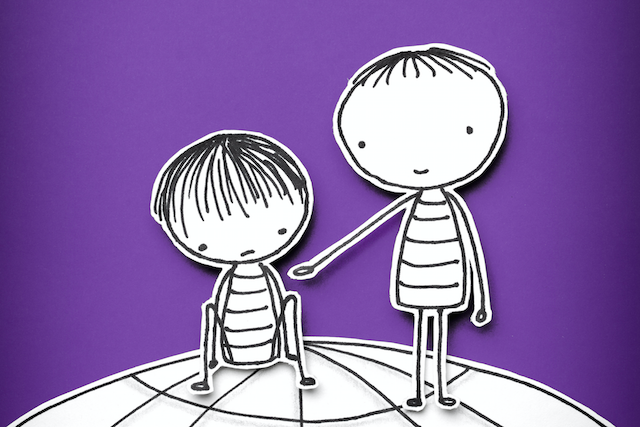
One day while grocery shopping I was reaching for a head of lettuce when I heard a shrill, high-pitched wail from a few aisles over. It sent shivers up my spine. It was one of those sounds that grabs your breath and pulls it to your heart.
It brought me back to a time I had long forgotten—a memory engrained in my brain from about twenty-two years ago when my children were toddlers. I remember those days of being exhausted and trying to wrap up the weekly shopping trip before the tantrum.
Most people in the store tried to ignore it, but the shrieks came like contractions about every six minutes. People started rolling their eyes. One lady commented that children shouldn't be allowed in stores. I felt really bad for this parent. I mean, we were all children once, right? It’s pretty rude to fault the parent for something that occurs naturally as a part of being human.
Eventually, as I filled my cart, I ended up in the same aisle as the mom and child. Mom was spent. There was a Ziploc bag of Cheerios tucked next to the child and a stuffed animal that had probably been picked up off the floor of the aisle about fifty times.
Continue reading
“The place to improve the world is first in one’s own heart and head and hands.”
Robert M. Pirsig
One day while grocery shopping I was reaching for a head of lettuce when I heard a shrill, high-pitched wail from a few aisles over. It sent shivers up my spine. It was one of those sounds that grabs your breath and pulls it to your heart.
It brought me back to a time I had long forgotten—a memory engrained in my brain from about twenty-two years ago when my children were toddlers. I remember those days of being exhausted and trying to wrap up the weekly shopping trip before the tantrum.
Most people in the store tried to ignore it, but the shrieks came like contractions about every six minutes. People started rolling their eyes. One lady commented that children shouldn't be allowed in stores. I felt really bad for this parent. I mean, we were all children once, right? It’s pretty rude to fault the parent for something that occurs naturally as a part of being human.
Eventually, as I filled my cart, I ended up in the same aisle as the mom and child. Mom was spent. There was a Ziploc bag of Cheerios tucked next to the child and a stuffed animal that had probably been picked up off the floor of the aisle about fifty times.
Continue reading
Sunday, 17 June 2018
Mom I want it: impact of anthropomorphism on pester power among children
an article by Vandana (Jagannath International Management School, New Delhi, India) and Vinod Kumar (International Management Institute, New Delhi, India) published in International Journal of Business Innovation and Research Volume 16 Number 2 (2018)
Abstract
The present research investigated the impact of anthropomorphised product and animal on pester power among children.
To achieve this objective, a scale on anthropomorphism is developed and two independent studies have been carried out to test the reliability and validity of the developed scale taking children and parents as respondents. Findings of the study revealed a significant impact of anthropomorphism on pester power.
However, anthropomorphic animals are found to be more impactful than anthropomorphic products in influencing pester behaviour among children. Moreover, parent respondents revealed that anthropomorphic stimuli create significant impact in generating pester behaviour among children.
On the contrary, child respondents did not disclose their impact on their behaviour in similar way. The study thus provides implications for marketers, academician and government.
Abstract
The present research investigated the impact of anthropomorphised product and animal on pester power among children.
To achieve this objective, a scale on anthropomorphism is developed and two independent studies have been carried out to test the reliability and validity of the developed scale taking children and parents as respondents. Findings of the study revealed a significant impact of anthropomorphism on pester power.
However, anthropomorphic animals are found to be more impactful than anthropomorphic products in influencing pester behaviour among children. Moreover, parent respondents revealed that anthropomorphic stimuli create significant impact in generating pester behaviour among children.
On the contrary, child respondents did not disclose their impact on their behaviour in similar way. The study thus provides implications for marketers, academician and government.
Sunday, 11 March 2018
Powerful Ways to Be More Patient with Your Kids
a post by Margarita Tartakovdsky for the World of Psychology blog

It’s hard to be patient when your child is turning the color of the tomatoes you just passed because you won’t let them fling produce out of your shopping cart. It’s hard to be patient when your child is taking forever to get ready for preschool or finish their homework or eat their food or do their chores. It’s hard to be patient when your child is being silly, and you need them to be serious. It’s especially hard to be patient when you’re stressed, anxious or overworked, when you’re yearning for 30 minutes to sit down in silence.
When we start unraveling, we’re more likely to snap at our kids and say things we regret. We’re more likely to yell and criticize. We’re more likely to erupt and shatter, sometimes not even recognizing ourselves.
Our patience can wear thin with pressure and big expectations. “The high demands of busy schedules, the pressure to ‘do it all’ and achieve can lead us to become so caught up in daily tasks that the richness of raising children becomes reduced to managing family life, instead of simply being with our children,” said Deniz Ahmadinia, PsyD, a psychologist who specializes in mindful parenting, stress and trauma at the West Los Angeles VA.
Continue reading
It’s hard to be patient when your child is turning the color of the tomatoes you just passed because you won’t let them fling produce out of your shopping cart. It’s hard to be patient when your child is taking forever to get ready for preschool or finish their homework or eat their food or do their chores. It’s hard to be patient when your child is being silly, and you need them to be serious. It’s especially hard to be patient when you’re stressed, anxious or overworked, when you’re yearning for 30 minutes to sit down in silence.
When we start unraveling, we’re more likely to snap at our kids and say things we regret. We’re more likely to yell and criticize. We’re more likely to erupt and shatter, sometimes not even recognizing ourselves.
Our patience can wear thin with pressure and big expectations. “The high demands of busy schedules, the pressure to ‘do it all’ and achieve can lead us to become so caught up in daily tasks that the richness of raising children becomes reduced to managing family life, instead of simply being with our children,” said Deniz Ahmadinia, PsyD, a psychologist who specializes in mindful parenting, stress and trauma at the West Los Angeles VA.
Continue reading
Saturday, 3 February 2018
Smoking bans: Good for us, good for our kids
a column by Brandy Lipton, Kerry Anne McGeary, Dhaval Dave and Timothy Roeper for VOX: CEPR’s Policy Portal
Many regions in the US have enacted 100% smoke-free laws in public places to reduce harmful second-hand smoke exposure, but if these laws simply displace smoking to the home, the children of smokers may suffer. The column uses data on infant and child health since the first ban in 1990 to show that children are healthier in many dimensions when there is a 100% smoke-free law. Partial smoking bans have a much smaller impact.
Continue reading
Many regions in the US have enacted 100% smoke-free laws in public places to reduce harmful second-hand smoke exposure, but if these laws simply displace smoking to the home, the children of smokers may suffer. The column uses data on infant and child health since the first ban in 1990 to show that children are healthier in many dimensions when there is a 100% smoke-free law. Partial smoking bans have a much smaller impact.
Continue reading
Tuesday, 2 January 2018
Children, time allocation, and consumption insurance
a column by Richard Blundell, Luigi Pistaferri and Itay Saporta Eksten for VOX: CEPR’s Policy Portal
Households can insure their living standards against shocks to wages or employment through the allocation of goods and time. This column presents a model for couples’ decisions on how much to consume or save and how to allocate their available time to three activities – work, leisure, and the care of children – and uses the model to simulate behaviour in response to new policies. The results suggest that the reduction of the mother's childcare time should be an important part of any analysis of the consequences of policies or external shocks that incentivise mothers with young children into work.
Continue reading
Households can insure their living standards against shocks to wages or employment through the allocation of goods and time. This column presents a model for couples’ decisions on how much to consume or save and how to allocate their available time to three activities – work, leisure, and the care of children – and uses the model to simulate behaviour in response to new policies. The results suggest that the reduction of the mother's childcare time should be an important part of any analysis of the consequences of policies or external shocks that incentivise mothers with young children into work.
Continue reading
Thursday, 12 October 2017
The influence of grandparents’ social class on children’s aspiration
an article by Vanessa Moulton, Eirini Flouri, Heather Joshi and Alice Sullivan (UCL Institute of Education, London, UK) published in British Journal of Sociology of Education Volume 38 Issue 4 (2017)
Abstract
Social class mobility from grandparent to grandchild is a relatively neglected topic. Grandparents today are often healthier and more active, and have longer relationships with their grandchildren than in previous generations.
We used data from the UK’s Millennium Cohort Study (n = 8570) to investigate the influence of maternal and paternal grandparents’ social class on the aspirations of children at age seven. Using path analysis and controlling for family income, mother’s and father’s education, lone motherhood, and child’s ethnicity and gender, we found very small direct effects from the paternal grandmother’s social class to the grandchild’s classed aspirations, and small, indirect effects, via parents’ class, of grandparents’ class on child’s classed aspirations.
Multi-group analyses found few differences by ethnicity and gender. There was no evidence that, at this age, mixed-class parentage raises the aspirations of working-class children (the ‘sunken middle-class’ hypothesis).
Full text (HTML)
Abstract
Social class mobility from grandparent to grandchild is a relatively neglected topic. Grandparents today are often healthier and more active, and have longer relationships with their grandchildren than in previous generations.
We used data from the UK’s Millennium Cohort Study (n = 8570) to investigate the influence of maternal and paternal grandparents’ social class on the aspirations of children at age seven. Using path analysis and controlling for family income, mother’s and father’s education, lone motherhood, and child’s ethnicity and gender, we found very small direct effects from the paternal grandmother’s social class to the grandchild’s classed aspirations, and small, indirect effects, via parents’ class, of grandparents’ class on child’s classed aspirations.
Multi-group analyses found few differences by ethnicity and gender. There was no evidence that, at this age, mixed-class parentage raises the aspirations of working-class children (the ‘sunken middle-class’ hypothesis).
Full text (HTML)
Monday, 16 January 2017
Household Instability and Unpredictable Earnings Hinder Coping in Households with Food Insecure Children
an article by Karla L. Hanson, Leah Connor and Christine M. Olson (Cornell University, Ithaca, New York) and Gregory Mills (The Urban Institute, Washington, DC, USA) published in Journal of Poverty Volume 230 Issue 4 (2016)
Abstract
This mixed-methods study explored the circumstances and coping strategies of households at risk of food insecurity among children. Quantitative analyses guided the selection of two samples of households: (1) at risk for food insecure children, yet children were food secure (n = 19) and (2) with food insecure children (n = 54). Qualitative interviews with parents revealed that households with food insecure children were complex and fluctuating in composition and had unpredictable earnings.
Coping strategies were similar in both samples, except that households with at risk yet food secure children described home cooking, a household coping strategy that may be attributed to their stable household composition and resources.
Abstract
This mixed-methods study explored the circumstances and coping strategies of households at risk of food insecurity among children. Quantitative analyses guided the selection of two samples of households: (1) at risk for food insecure children, yet children were food secure (n = 19) and (2) with food insecure children (n = 54). Qualitative interviews with parents revealed that households with food insecure children were complex and fluctuating in composition and had unpredictable earnings.
Coping strategies were similar in both samples, except that households with at risk yet food secure children described home cooking, a household coping strategy that may be attributed to their stable household composition and resources.
Thursday, 12 January 2017
Factors influencing attainment of CEO position for women
an article by Dene Hurley and Amod Choudhary (Lehman College, City University of New York, USA) published in Gender in Management: An International Journal Volume 31 Issue (2016)
Abstract
Purpose
This paper aims to determine possible differences in causes or characteristics between men and women in attaining the CEO position in large publicly listed companies in the USA.
Design/methodology/approach
T-test statistic, correlation analyses and logit model were used to determine the role individual factors (tenure in management roles, age of CEOs, number of children, years of education) and the firm-level factor (number of employees, net income) play in determining the likelihood of having a female CEO.
Findings
The research results show that years of education, the number of children and the number of employees in the business play significant roles in determining the likelihood of having a female CEO. An increase in the number of children and years spent in education lower the probability of the CEO being a woman, while having greater number of employees raises the likelihood of having a woman CEO.
Research limitations/implications
The findings are applicable to only the largest publicly traded firms in the USA and are not applicable to mid to small publicly listed, private or non-for-profit companies or institutions. This research is a starting point for future research of women and men CEOs of small and mid-size publicly traded and non-publicly traded firms in the USA.
Originality/value
Prior research has shown that having children is detrimental for women in management positions; this research specifically identifies this problem for the CEO position. It also reveals that having more of education does not translate to getting to the CEO position for women.
Abstract
Purpose
This paper aims to determine possible differences in causes or characteristics between men and women in attaining the CEO position in large publicly listed companies in the USA.
Design/methodology/approach
T-test statistic, correlation analyses and logit model were used to determine the role individual factors (tenure in management roles, age of CEOs, number of children, years of education) and the firm-level factor (number of employees, net income) play in determining the likelihood of having a female CEO.
Findings
The research results show that years of education, the number of children and the number of employees in the business play significant roles in determining the likelihood of having a female CEO. An increase in the number of children and years spent in education lower the probability of the CEO being a woman, while having greater number of employees raises the likelihood of having a woman CEO.
Research limitations/implications
The findings are applicable to only the largest publicly traded firms in the USA and are not applicable to mid to small publicly listed, private or non-for-profit companies or institutions. This research is a starting point for future research of women and men CEOs of small and mid-size publicly traded and non-publicly traded firms in the USA.
Originality/value
Prior research has shown that having children is detrimental for women in management positions; this research specifically identifies this problem for the CEO position. It also reveals that having more of education does not translate to getting to the CEO position for women.
Tuesday, 25 August 2015
Cyber bullying and teachers’ awareness
an article by
Baris Sezer (Hacettepe University, Ankara, Turkey)
Ramazan Yilmaz and Fatma Gizem Karaoglan Yilmaz (Bartin University, Bartin, Turkey)
published in Internet Research Volume 25 Issue 4 (2015)
Abstract
Purpose
The purpose of this paper is to determine the awareness levels of teachers with regard to cyber bullying. In line with this purpose, the extent of awareness levels of teachers in general, regarding the issue of personal cyber security in their daily lives and the precautions that can be taken in this context have been measured.
Design/methodology/approach
Survey method is used in this study. The participants of this research were 184 teachers working at various provinces in Turkey during 2012-2013 academic year. A scale was used in this study.
Findings
The findings of the study reveal that the teachers in the sample group of the study have an average level of awareness on cyber bullying, in general. According to the findings of the study, based on branch, gender and frequency of internet use, there are statistically significant differences among teachers’ awareness levels on cyber bullying.
Research limitations/implications
The data collection tool used for the study is a self-report scale and it is restricted to determining the awareness levels of teachers with respect to personal cyber security within the context of cyber bullying awareness and the precautions that need to be taken in this respect.
Practical implications
The data obtained from the study, the authors have conducted, can contribute to updating in-service and pre-service educational contents developed for teachers and prospective teachers, by providing insight for the policy makers.
Originality/value
It is believed that this research will contribute to the literature. On the other hand, this study will guide the policy makers/implementers in Turkey, as well.
Abstract
Purpose
The purpose of this paper is to determine the awareness levels of teachers with regard to cyber bullying. In line with this purpose, the extent of awareness levels of teachers in general, regarding the issue of personal cyber security in their daily lives and the precautions that can be taken in this context have been measured.
Design/methodology/approach
Survey method is used in this study. The participants of this research were 184 teachers working at various provinces in Turkey during 2012-2013 academic year. A scale was used in this study.
Findings
The findings of the study reveal that the teachers in the sample group of the study have an average level of awareness on cyber bullying, in general. According to the findings of the study, based on branch, gender and frequency of internet use, there are statistically significant differences among teachers’ awareness levels on cyber bullying.
Research limitations/implications
The data collection tool used for the study is a self-report scale and it is restricted to determining the awareness levels of teachers with respect to personal cyber security within the context of cyber bullying awareness and the precautions that need to be taken in this respect.
Practical implications
The data obtained from the study, the authors have conducted, can contribute to updating in-service and pre-service educational contents developed for teachers and prospective teachers, by providing insight for the policy makers.
Originality/value
It is believed that this research will contribute to the literature. On the other hand, this study will guide the policy makers/implementers in Turkey, as well.
Thursday, 9 July 2015
Fostering Social and Emotional Skills for Well-Being and Social Progress
an article by Koji Miyamoto, Maria C. Huerta and Katarzyna Kubacka (OECD, Paris, France) published in European Journal of Education Volume 50 Issue 2 (June 2015)
Abstract
Children need a balanced set of cognitive, social and emotional capabilities to adapt to today’s demanding, changing and unpredictable world.
OECD countries and partner economies recognise the importance on the holistic development of individuals. However, there are big gaps between stakeholders’ knowledge, expectations and practices on how to foster such skills.
This paper presents evidence on the importance of social and emotional skills; on how policy makers and schools are currently enhancing and monitoring such skills; and, on the existing gaps between knowledge, expectations and practices to mobilise these skills. The paper concludes by pointing ways in which education stakeholders can do more to better develop and mobilise the skills that drive individual’s well-being and social progress.
The paper draws on findings and frameworks that are being published in a full OECD report entitled Skills for Social Progress: the Power of Social and Emotional Skills in the first half of 2015.
JEL codes: J13, I12, I21
Abstract
Children need a balanced set of cognitive, social and emotional capabilities to adapt to today’s demanding, changing and unpredictable world.
OECD countries and partner economies recognise the importance on the holistic development of individuals. However, there are big gaps between stakeholders’ knowledge, expectations and practices on how to foster such skills.
This paper presents evidence on the importance of social and emotional skills; on how policy makers and schools are currently enhancing and monitoring such skills; and, on the existing gaps between knowledge, expectations and practices to mobilise these skills. The paper concludes by pointing ways in which education stakeholders can do more to better develop and mobilise the skills that drive individual’s well-being and social progress.
The paper draws on findings and frameworks that are being published in a full OECD report entitled Skills for Social Progress: the Power of Social and Emotional Skills in the first half of 2015.
JEL codes: J13, I12, I21
Thursday, 18 July 2013
Supporting the educational transitions of looked after children at Key Stage 4: the role of virtual schools and designated teachers
an article by Jennifer Driscoll (Programme Director at the Department of Education and Professional Studies, King's College London, UK) published in Journal of Children’s Services Volume 8 Issue 2 (2013)
Abstract
Purpose
There has been little research on the education of looked after children over the current school leaving age of 16, although the underperformance of this cohort at Key Stage 4 (age 14-16) has been the subject of considerable academic commentary. This paper aims to contribute to understanding of the ways in which looked after young people nearing the end of compulsory education can be supported and encouraged to continue in education and training.
Design/methodology/approach
Interviews were undertaken with 12 designated teachers for looked after children and four virtual school heads, as part of the first stage of a three-year longitudinal study following 20 looked after children in England from years 11-13 (ages 15-18).
Findings
Participants identified particular challenges in ensuring a successful educational transition for looked after young people in year 11 and expressed concern at the cumulative effect of multiple transitions at this stage on young people’s lives. There appears, however, to be an increasing focus on and commitment to giving young people a “second chance” to acquire qualifications commensurate with their potential post-16. The comparative advantages and disadvantages of school and further education colleges for this cohort at Key Stage 5 are considered.
Practical implications
The implications of the forthcoming extension of the school leaving age for professionals supporting looked after young people post-16 are discussed.
Originality/value
The designated teacher for looked after children became a statutory role in 2009, and to date there has been little research on the role of these professionals, or the work of virtual schools.
Abstract
Purpose
There has been little research on the education of looked after children over the current school leaving age of 16, although the underperformance of this cohort at Key Stage 4 (age 14-16) has been the subject of considerable academic commentary. This paper aims to contribute to understanding of the ways in which looked after young people nearing the end of compulsory education can be supported and encouraged to continue in education and training.
Design/methodology/approach
Interviews were undertaken with 12 designated teachers for looked after children and four virtual school heads, as part of the first stage of a three-year longitudinal study following 20 looked after children in England from years 11-13 (ages 15-18).
Findings
Participants identified particular challenges in ensuring a successful educational transition for looked after young people in year 11 and expressed concern at the cumulative effect of multiple transitions at this stage on young people’s lives. There appears, however, to be an increasing focus on and commitment to giving young people a “second chance” to acquire qualifications commensurate with their potential post-16. The comparative advantages and disadvantages of school and further education colleges for this cohort at Key Stage 5 are considered.
Practical implications
The implications of the forthcoming extension of the school leaving age for professionals supporting looked after young people post-16 are discussed.
Originality/value
The designated teacher for looked after children became a statutory role in 2009, and to date there has been little research on the role of these professionals, or the work of virtual schools.
Monday, 21 January 2013
New PSI research reveals the erosion of children’s independence
- Unique study covering the last 40-years reveals a dramatic loss of children’s independence outside the home.
- Only 25 per cent of primary school children in England are allowed to travel home from school alone compared with 86 per cent in 1971.
- Primary school children in England have far less freedom than they do in Germany.
Read the full report (PDF 248pp)
Children’s independent mobility: a comparative study in England and Germany (1971-2010) by Ben Shaw, Ben Watson, Bjorn Frauendienst, Andreas Redecker, Tim Jones, with Mayer Hillman is licensed under a Creative Commons Attribution-NonCommercial-NoDerivs 3.0 Unported License.
Thursday, 18 October 2012
The Transferable Scars: A Longitudinal Evidence of Psychological Impact of Past Parental Unemployment on Adolescents in the United Kingdom
CEP Discussion Paper No 1165 by Nattavudh Powdthavee and James Vernoit (Centre for Economic Performance, London School of Economics) published September 2012
Abstract
Using a longitudinal data of British youths, this paper explores the consequences of past parental unemployment on the current happiness and self-esteem of the children.
We find that a past unemployment spell of the father has important consequences for their children and leads to them having both lower subjective well-being and self-confidence.
In addition, this paper also presents evidence that both subjective well-being and self-confidence responds differently to maternal unemployment compared to paternal unemployment.
In our final table, we show changes in adolescents’ well-being and self-esteem predicts educational attainments at 16. Together these findings offer new evidence of unemployment scarring on children’s livelihood.
JEL Classifications: D1, I3, J6
Full text (PDF 43pp)
Abstract
Using a longitudinal data of British youths, this paper explores the consequences of past parental unemployment on the current happiness and self-esteem of the children.
We find that a past unemployment spell of the father has important consequences for their children and leads to them having both lower subjective well-being and self-confidence.
In addition, this paper also presents evidence that both subjective well-being and self-confidence responds differently to maternal unemployment compared to paternal unemployment.
In our final table, we show changes in adolescents’ well-being and self-esteem predicts educational attainments at 16. Together these findings offer new evidence of unemployment scarring on children’s livelihood.
JEL Classifications: D1, I3, J6
Full text (PDF 43pp)
Sunday, 22 August 2010
Children missing from education
This publication from OfSTED (HMI: 100041) evaluates the effectiveness of actions taken by local authorities in relation to children and young people who are missing from education.
It considers whether legislation and guidance effectively support the authorities in protecting them.
Children and young people who are not receiving education and whose whereabouts are unknown may be particularly at risk of physical, emotional and psychological harm.
Download the full publication and available documents
Children missing from education (Word) 531.50 kB
Children missing from education (PDF) 255.25 kB
Children missing from education summary (Word) 400.50 kB
Children missing from education summary (PDF) 66.50 kB
It considers whether legislation and guidance effectively support the authorities in protecting them.
Children and young people who are not receiving education and whose whereabouts are unknown may be particularly at risk of physical, emotional and psychological harm.
Download the full publication and available documents
Children missing from education (Word) 531.50 kB
Children missing from education (PDF) 255.25 kB
Children missing from education summary (Word) 400.50 kB
Children missing from education summary (PDF) 66.50 kB
Subscribe to:
Posts (Atom)

