Showing posts with label cedefop. Show all posts

Friday, 20 December 2019

Global inventory of regional and national qualifications frameworks 2019

Volume 2: national and regional cases


This two-volume publication provides an update on the progress made in establishing and implementing national and regional qualifications frameworks around the world since 2017.

It includes information on national and regional developments, challenges and success factors, as well as selected cross-cutting themes. It is the result of cooperation between Cedefop, the ETF, UNESCO and the UNESCO Institute for Lifelong Learning.

Full text (PDF 744pp)

Not available as hard copy.


Monday, 2 December 2019

Apprenticeship for adults: Results of an explorative study


This report is the result of an explorative study, carried out at a time when interest in apprenticeship for adults was on the rise and research and evidence on the topic was scarce and fragmented.

It has explored the topic from a conceptual and theoretical point of view, reviewing relevant existing research. It has also considered a practical perspective, exploring policies EU countries and four non-EU countries have in place in relation to apprenticeship for adults. It is the first report that addresses the topic from an EU-wide perspective.

Largely based on data collected in 2017-18, the report includes findings from a literature review and field work. It confirms that adults increasingly participate in apprenticeship training, often due to policy interventions and measures that have removed barriers to such participation and provided incentives. The study also confirms that EU countries are fundamentally divided into two main apprenticeship function groups, with two different approaches in aiding participation of adults in apprenticeship.

Full text (PDF 100pp)

Note that this report is available only in electronic format.


Wednesday, 24 July 2019

Refugee skills and labour market needs: How matching can support lawful adult refugee mobility

Information about a cedefop project


Most refugees live in developing countries of asylum, struggling to prove themselves in economies which are unable to absorb and make full use of their labour market potential. As a result, their skills often remain unused and become obsolete over time. Key challenges for Europe include sharing the global responsibility for refugees fairly with major countries of asylum and meeting existing and future skill gaps and labour market needs.

The project seeks to contribute to these challenges by identifying and piloting a skills-based complementary pathway that allows lawful and safe pathways to protection of adult refugees by drawing on their human capital potential and labour market needs. The central element of this pathway is matching refugees’ skills and qualifications to the labour market needs of a potential host country; this will allow refugees to move from a major country of asylum to a new destination country based.

Downloads

Refugee skills and labour market needs


Monday, 8 April 2019

The online job vacancy market in the EU: Driving forces and emerging trends

With the project Real-time labour market information on skill requirements: setting up the EU system for online vacancy analysis, Cedefop is using online job vacancies to develop real-time labour market and skills intelligence in the EU.

Drawing meaningful conclusions from these data and turning them into policy-relevant labour market intelligence requires sound understanding of online job markets and their importance in employers’ recruitment strategies. The mapping of the online job portal landscape in all EU Member States presented in this report helps identify the main features of online job markets and signal important trends impacting them.

The report analyses the drivers influencing the use of online job vacancy portals in recruitment and job search, the structure of the online job markets, the role of public and private players and the factors shaping the format and content of online job vacancies.

Full report (PDF 96pp)


Tuesday, 26 March 2019

The changing nature and role of vocational education and training in Europe. Volume 6

This publication is the sixth in a series produced as part of the Cedefop project The changing nature and role of VET (2016-18).

Based on analysis of developments over the past two decades (1995-2015), the report provides important insights into developments and change processes related to vocationally oriented education and training at higher levels (levels 5 to 8 of the European qualifications framework).

Building on detailed national case studies, the report demonstrates the expansion and diversification of vocationally oriented education and training offered at higher levels in European countries and the variations in how countries use the higher levels: there is evidence for strengthening vocational principles at higher levels in various ways as well as for strengthening academic principles.

It also covers current debates and potential future challenges, including juggling labour market demands and wider societal values, finding the right balance between academic and vocational principles, and achieving parity of esteem between academically oriented and vocationally oriented qualifications at higher levels, by improving awareness and visibility of the latter.

Full text (PDF 162pp)


Sunday, 17 December 2017

The changing nature and role of vocational education and training in Europe

Volume 1: conceptions of vocational education and training: an analytical framework

This research paper is the first in a series produced as part of the Cedefop project The changing nature and role of VET (2016-18).

The aim of the paper is to review scholarly attempts to define or explain vocational education and training and to develop a theoretical model to analyse national definitions or conceptions of VET and how they have changed over time.

VET takes many forms and is, perhaps, the least unitary of education sectors. Based on a literature review of previous attempts to characterise VET, the paper suggests using a multi-perspective framework which combines:
  1. an epistemological and pedagogical perspective;
  2. a system and institutional perspective;
  3. a socioeconomic and labour market perspective to analyse VET.
These perspectives can help to identify appropriate learning approaches, institutional solutions and forms of cooperation to work towards.

In Volume 2 of this series, the approach is empirically tested and the different understandings of VET in 30 European countries are illustrated.

Volume 1 in English
DOI: 10.2801/532605TI-BC-17-005-EN-NISBN: 978-92-896-2488-606/12/20171.38 MB


Tuesday, 25 July 2017

Towards age-friendly work in Europe: a life-course perspective on work and ageing from EU Agencies

The EU’s population and workforce are ageing. This has implications for employment, working conditions, living standards and welfare.

A new report shows how information from four agencies, including Cedefop, can support policy-making that is both complementary and greater than the sum of its parts.

The report draws on the agencies’ expertise in each of their areas and covers the different challenges associated with the ageing workforce and considers innovative solutions.
  • Cedefop explores how vocational education and training can be used to support active ageing at work.
  • EU-OSHA presents policy examples of integrated approaches to occupational safety and health for an ageing workforce.
  • Eurofound examines working conditions for workers of all ages, related work sustainability outcomes and how the right policies can foster longer working lives.
  • EIGE provides a gender perspective on the issue of the ageing workforce and discusses the different challenges that men and women face.
Full report Towards Age-friendly Work in Europe(PDF 90pp)


Thursday, 8 June 2017

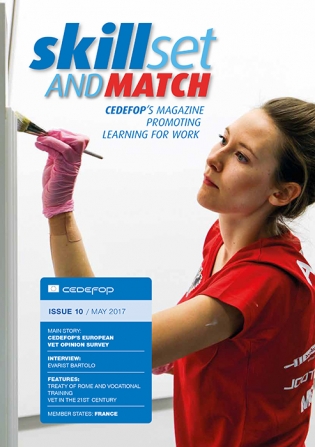
Skillset and match (Cedefop’s magazine promoting learning for work) – May 2017 issue 10


The May 2017 issue of Skillset and match, Cedefop’s magazine promoting learning for work, is now available to read and download.

In this issue, we present the findings of the first Cedefop opinion survey on vocational education and training (VET) in Europe.

Malta’s Minister for Education Evarist Bartolo, whose country holds the rotating EU Presidency in the first semester of 2017, tells us that education must be considered strategic investment to human capital.

Cedefop Deputy Director Mara Brugia writes about the roots of today’s European VET policy in the Treaty of Rome, as 2017 marks the 60th anniversary of the treaty that laid the foundation of the European Union.

Also, don’t miss articles on:
  • VET in the 21st century;
  • skills and employment for refugees and asylum seekers; and
  • skill mismatch in the European labour market.
The Member State contribution this time comes from France.

And, as usual, you can browse through the latest Cedefop publications and upcoming events.

It is all here


Thursday, 2 March 2017

On the way to 2020: data for vocational education and training policies

Country statistical overviews – 2016 update

European policy-making in vocational education and training (VET) needs to be supported by sound evidence. In this report, Cedefop has selected 36 indicators to quantify key aspects of VET and lifelong learning. The selection is based on their policy relevance and their importance in achieving the Europe 2020 objectives.

The report accounts for challenges and opportunities arising from recent developments in the international statistical infrastructure and includes updated comparable data from the European statistical system.

This publication should be regarded as a tool to help policy-makers better understand and assess VET developments in each country. While these indicators do not claim to assess national systems or policies, they could be used to reflect on countries’ situations and progress towards the strategic objectives set for Europe.

The indicators present statistical overviews from all European Union Member States, along with the former Yugoslav Republic of Macedonia, Iceland, Norway, Switzerland and Turkey.

Downloads

PDF On the way to 2020: data for vocational education and training policies
DOI: 10.2801/414017 TI-BC-17-001-EN-N ISBN: 978-92-896-2411-4 15/02/2017 16.12 MB
Epub On the way to 2020: data for vocational education and training policies
DOI: 10.2801/959840 TI-BC-17-001-EN-E ISBN: 978-92-896-2410-7 15/02/2017 10.67 MB
Annex Masterfile indicators EN 15/02/2017 515.53 KB


Tuesday, 2 July 2013

Roads to recovery: three skill and labour market scenarios for 2025

A cedefop briefing note

Cedefop’s latest skill demand and supply forecasts for the European Union (EU) extend the forecast period from 2020 to 2025. The forecast covers the 27 EU Member States plus Iceland, Norway and Switzerland, shown in the figures as EU-27+.

The three scenarios take account of global economic developments up to October 2012, the European Commission’s short-term macroeconomic forecast and the latest Eurostat population projections. The different assumptions of each scenario are set out below.

Baseline scenario:
a modest economic recovery slowly increases confidence. Credit is more easily available, helping investment and consumer spending to increase. Steadily rising demand outside Europe increases exports, and inflation remains within target range. Governments continue to reduce debt, but higher tax revenues relieve pressure to cut spending. Interest rates remain low. The baseline scenario is used for the forecasts’ main findings.

Optimistic scenario:
a speedier economic recovery, greater confidence and widespread bank lending increase investment and consumer spending. Strong economic recovery outside Europe benefits all sectors and boosts exports. Rising global demand increases inflation, but higher tax revenue makes it easier for governments to balance budgets, which eases pressure on interest rates.

Pessimistic scenario:
a prolonged economic slump lowers confidence. Limited access to credit and job insecurity depress investment and consumer spending. Global economic recovery is slow and export markets fragile. Subdued demand lowers inflation, but public debt problems persist, adding pressure to raise taxes and cut spending. Interest rates rise to avoid currency crises.

Full text (PDF 4pp)


Tuesday, 25 June 2013

Benefits of vocational education and training in Europe for people, organisation

A cedefop publication in the information series number 4121

Summary

This publication summarises Cedefop’s work on benefits of vocational education and training (VET) contrasting, whenever possible, VET outcomes with those from general education.

The research spans how education and training generate their perceived benefits and looks at a wide range of outcomes some related to labour market success (employability and wages) others affecting quality of life and well-being (health, quality of participation in public life and satisfaction with life and leisure).

The analysis is extended to investigate VET’s impact in organisations. It observes that organisations are communities with their own cultures. Consequently, VET’s benefits in developing skills and influencing positively well-being and behaviour in the workplace can interact, directly and indirectly, to improve productivity, notable through greater cooperation. However, certain circumstances need to be in place to create this effect and maximise VET’s benefits.

Interaction between VET’s different benefits should also change the way investment in it is understood, if VET is to be a strategic tool for excellence and competitive advantage.

Full text (PDF 72pp)


Thursday, 16 May 2013

Empowering vulnerable adults to tackle labour market challenges

A Cedefop publication (number 4122)

This publication presents findings from 25 study visits, in 2010/11 and 2011/12, related to empowering vulnerable adults to tackle labour-market challenges. It focuses on ways to support vulnerable adults to exploit their knowledge, skills and competences to the full, to get information and guidance, to participate in vocational training, to recognise their skills and competences, and to have access to meaningful and rewarding employment.

Group reports prepared by study visit participants were the main source of information; 29 successful initiatives are featured. These were presented at a Cedefop seminar on 6 and 7 June 2012 in Thessaloniki, Greece.

This publication aims at enriching the awareness and understanding of decision-makers and practitioners on how European countries deal with the specific challenges of education, training and employment. It should also help them find partners for cooperation projects and networks at national and European levels.

Full text (PDF 86pp)


Wednesday, 3 April 2013

Monitoring ECVET implementation strategies in Europe

Cedefop Working Paper Number 18

Abstract

The European credit system for vocational education and training (ECVET) Council recommendation calls on Member States to ‘create the necessary conditions and adopt measures so that as from 2012 it is possible for ECVET to be gradually applied to VET qualifications at all levels of the EQF’.

This report is the third Cedefop monitoring exercise and analyses developments in ECVET from June 2011 to September 2012. Its main objective is to provide an overview of the situation regarding the necessary conditions for ECVET in 32 countries.

The results are varied: although most countries are committed to ECVET implementation and are progressing in developing necessary conditions, there is still progress to be made.

The report shows that it is necessary to mainstream efforts, bringing together different developments and working on synergies with other European tools.


Wednesday, 6 February 2013

More effective VET and lifelong learning policies: awareness raising, analysis and advice

a Cedefop Briefing Note

Cedefop’s achievements in 2012 and plans for 2013

Reform of vocational education and training (VET) in Europe is complex, especially at a time of economic crisis. Cedefop raises awareness and provides analysis and advice to policy-makers at European level and in Member States to help them decide on policies and actions. Cedefop’s work supports the European policy agenda for VET and lifelong learning.

Cedefop’s medium-term priorities 2012-14 guide its work. They reflect the European Union’s (EU’s) priorities for VET and include tasks that the Council of Ministers, European Commission, Member States and social partners have specifically asked Cedefop to carry out.

Cedefop’s impact depends largely on the value and trust stakeholders place on the authority, reliability and usefulness of its results. This depends on solid analysis and effective communication. Performance indicators show that stakeholders value Cedefop’s work and demand for its expertise is rising.

Full note (PDF 4pp)


Tuesday, 18 December 2012

New report shows recent developments in skills and labour demand during the recession

via Social Europe: a publication from the European Commission, Social Affairs & Inclusion

The overall labour demand is still affected by the recession, yet vacancies are hard to fill in the health, ICT, engineering, sales and finance sectors, the new European Vacancy and Recruitment Report says.
A graph and a pen
This is the first of a set of biennial reports to be launched by the European Commission, focusing on labour demand and skills requirements, thus providing a better insight into the functioning of labour markets.

Some of the key findings in this edition:
  • The number of vacancies in 15 EU countries fell slightly in the first quarter of 2011. But there were still 12 million job-finders in the third quarter of 2011.
  • Private sector recruitment responded faster and stronger to the business cycle than the public sector, where austerity measures are growing.
  • Growth in major occupational groups (2007-2010) was strongest for a number of high skilled occupations, such as business professionals, some teaching occupations, health professionals, but also personal care and related workers and for a small number of elementary occupations.
  • Recent recruitment patterns reflect a trend of educational upgrading in general and rising skills requirements across all occupational groups.
  • However most people found a job in low to intermediate skilled services, such as shop salespersons, waiters, personal care workers, etc. due to high labour turnover.
  • Recruitment difficulties in certain areas exist in all countries independently of the labour market situation, including in Greece, Romania and Spain.
  • Bottleneck occupations with talent shortages are concentrated in the health (e.g. nursing and midwifery associate professionals and medical doctors), ICT (e.g. computing professionals) engineering (e.g. physical and engineering science technicians), sales (e.g. sales representatives) and finance (e.g. accountants) sectors.
The European Vacancy and Recruitment Report is one of the main information sources of the EU Skills Panorama.

More about the European Vacancy and Recruitment Report


Wednesday, 14 November 2012

Skills supply and demand in Europe: methodological framework

a research publication (No. 25) from cedefop (European Centre for the Development of Vocational Training)

Summary

This publication provides an overview of the methodology underpinning the Cedefop skills supply and demand forecast. The aim is to share the knowledge acquired during the development of the different systems, modules and models and to highlight the results, which have already aroused considerable interest.

The structure and robustness of the methods used increases the clarity and reliability of the results.

Cedefop’s forecast is not intended to replace forecasting efforts in individual countries. However, sharing the knowledge and experience from the European level can help to improve the methods used in those countries and to resolve issues that may be faced there.

At the same time, Cedefop’s forecast can inspire new forecasting initiatives and initiate further discussion. The feedback received can help to improve Cedefop’s methods and make the European forecast even more precise and reliable.

Available in English only (PDF 146pp)


Wednesday, 3 October 2012

Payback clauses in Europe: supporting company investment in training

CEDEFOP (European Centre for the Development of Vocational Training) Research Paper No 23 published by the Publications Office of the European Union (2012)

Summary

Payback clauses are a legal instrument that may encourage companies to invest in training by allowing them to bind employees for a certain period of time after training in return for providing the training. In fact, employees are free to move to another company but may be requested to reimburse the cost of the training, or part of the cost.

This Cedefop report provides an overview of whether payback clauses for employer-financed training are regulated in 33 European countries, and if so how they are regulated. In-depth analysis is carried out for eight selected countries: Germany, Italy, Luxembourg, the Netherlands, Romania, Slovakia, Sweden and the UK.

The report is largely based on information collected in surveys of key national stakeholders – representatives of ministries, employers’ organisations and trade unions – and from company cases.

The analysis of legal framework covers aspects such as: the level of regulation (national law, collective/sectoral level agreements and individual/company level agreements) and the conditions laid down in law (contractual retention period, types of training and categories of employees/contracts that payback clauses may apply to, costs to be reimbursed by employees, redemption form, etc).

The results of research show that there is relatively little information on the practical use of payback clauses: their implementation (the extent to which the payback clauses are actually included in employment contracts and training agreements) and enforceability (when reimbursement of training costs was indeed requested by employer). On the basis of information collected, the strengths and weaknesses of the instrument are discussed. Finally, recommendations for policy, research and practice are formulated.

Full text (PDF 122pp)


Monday, 29 August 2011

Vocational education and training is good for you: …

The social benefits of VET for individuals

Cedefop (European Centre for the Development of Vocational Training) Research Paper No 17

The Executive Summary is four pages long so I’ve chosen to pick the Foreword for you.

Foreword

The Europe 2020 strategy for smart, sustainable, and inclusive growth, foresees increasing people’s knowledge, skills and competences as one of the main growth engines to propel Europe out of the present deep economic crisis.

Vocational education and training (VET) plays a central role in Europe’s response to the unparalleled socioeconomic and technological challenges facing it. VET systems have to endow workers with the right mix of skills and competences, as preventing skill shortages will enable Europe to achieve its full growth potential.

To fulfil their role, VET providing institutions will have to reach out to workers and learners of all ages and social backgrounds. The Bruges communiqué recognises that a new impetus for VET in Europe is needed and that a key strategic objective lies in improving the quality and efficiency of VET as well as its attractiveness and relevance to learners.

The magnitude of the economic and social returns associated with it is an important determinant of attractiveness of VET. While there is extensive evidence on the economic returns on education, only a small, but distinguished, set of findings exists on the social returns. Very little is known about the social and economic returns associated specifically with VET.

The present study is part of a wider research effort by Cedefop to fill this knowledge gap. Over the past four years, Cedefop has investigated the social and economic returns on VET for economic systems, workplaces and individuals. This report complements Cedefop’s findings on the economic benefit of VET accruing to individuals, by focusing on wider social benefits such as health, civic participation, and satisfaction with job and income.

This report provides evidence of positive social outcomes generated by VET in terms of increased civic participation and improved health, and that workers in their early career can experience strong positive returns from VET participation. National institutional set-ups are, however, identified as key mediating factors for the realisation of social benefits of VET, i.e. the nature of the social benefits of VET will change depending on the type of system and, hence, according to country. Comparing the social outcomes of continuing vocational training with other types of adult learning (of a general nature) demonstrates that all forms of continuing education and training generate positive social outcomes for individuals and that these are of the same nature and magnitude whatever the type of adult learning.

I trust this research paper, and Cedefop’s work on VET benefits, will help policy-makers in continuing to make the case for increasing the attractiveness of VET among learners of all ages and demonstrating that VET is a crucial pillar of European productivity growth and social cohesion.

Christian F. Lettmayr
Acting Director of Cedefop

Full paper (PDF 116pp)

Despite the length of this paper I believe that it is worth reading in full. If you really can't face that then do, please, read the Executive Summary.