a report published by Eurofound by Daphne Ahrendt, Eszter Sándor, Adam Revello, Jean-Marie Jungblut and Robert Anderson
The ‘working poor’ are a substantial group, the latest estimate putting 10% of European workers at risk of poverty, up from 8% in 2007. This report describes the development of in-work poverty in the EU since the crisis of 2008, picking up where an earlier Eurofound report on this subject, published in 2010, ended and looks at what countries have done to combat the problem since.
This endeavour is complicated by the policy focus on employment as a route out of poverty, underplaying the considerable financial, social and personal difficulties experienced by the working poor.
The increase in non-standard forms of employment in many countries appears to have contributed to rising in-work poverty.
The report argues the case for greater policy attention and action on the part of governments, employers and social partners, not only through direct measures associated with both the minimum and living wage, progressive taxation, in-work benefits and social assistance, but also and more importantly through indirect measures such as more flexible working arrangements, housing, upgrading of skills and childcare.
PDF (66 pages) and print copy (free) are available
Sunday, 29 October 2017


Refugees and asylum seekers, the crisis in Europe and the future of policy
an article by Timothy J. Hatton (University of Essex, UK) published in Economic Policy Volume 32 Issue 91 (July 2017)
Summary
The recent asylum crisis has highlighted the inadequacies of European asylum policies. The existing asylum system, which encourages migrants to make hazardous maritime or overland crossings to gain access to an uncertain prospect of obtaining refugee status, is inefficient, poorly targeted and lacks public support. In the long run it should be replaced by a substantial joint programme of refugee resettlement that would help those most in need of protection, that would eliminate the risks to refugees, and that would command more widespread public support.
Analysis of key facts and data includes the determinants of asylum applications and trends in public opinion.
In this light I evaluate the feasibility of three elements for reform:
Full text (HTML)
Summary
The recent asylum crisis has highlighted the inadequacies of European asylum policies. The existing asylum system, which encourages migrants to make hazardous maritime or overland crossings to gain access to an uncertain prospect of obtaining refugee status, is inefficient, poorly targeted and lacks public support. In the long run it should be replaced by a substantial joint programme of refugee resettlement that would help those most in need of protection, that would eliminate the risks to refugees, and that would command more widespread public support.
Analysis of key facts and data includes the determinants of asylum applications and trends in public opinion.
In this light I evaluate the feasibility of three elements for reform:
- first, implementing tougher border controls to reduce unauthorised entry;
- second, promoting direct resettlement of refugees from countries of first asylum; and
- third, expanding refugee-hosting capacity through enhanced burden-sharing among destination countries.
Full text (HTML)
Differences in access to information and communication technologies: Voices of British Muslim teenage girls at Islamic faith schools
Glenn Hardaker and Atika Qazi (Universiti Brunei Darussalam, Gadong, Brunei), Aishah Sabki, (Beyond Labels Ltd, Huddersfield, UK) and Javed Iqbal, (Independent Researcher, London, UK) published in The International Journal of Information and Learning Technology Volume 34 Issue 4 (2017)
Abstract
Purpose
Most research on information and communication technologies (ICT) differences has been related to gender and ethnicity, and to a lesser extent religious affiliation. The purpose of this paper is to contribute to this field of research by situating the discussion in the context of British Muslims and extending current research into ICT differences beyond gender and ethnicity.
Design/methodology/approach
This paper explores the ICT differences in access and use by British Muslim teenage girls at Islamic faith schools, and ICTs’ perceived influence on learning. The qualitative research was undertaken by conducting 45 semi-structured interviews with British Muslim teenage girls in Islamic faith schools.
Findings
The study provides tentative findings that Islamic faith schools are not only framed by the wider diverse Muslim community, but also by the supplementary schooling of madrasahs. The findings suggest that the home use of ICTs was reinforced rather than compensated for by the Islamic faith schools. This seemed to inhibit many pupils’ access to online educational resources. The authors found that didactic instruction was prevalent and this provided tentative insights into the types of digital inequity experienced by many pupils.
Originality/value
The research into ICT differences in the UK adopted the premise that the unity in Muslim identity increasingly transcends ethnicity and gender in the Muslim community.
7 Reasons to Abandon Your Comfort Zone and Why You’ll Never Regret It
a post by Elliott Pak for the Tiny Buddha blog

Imagine with me for a second. You wake up, roll over, and blindly reach to hit your alarm to start the routine of the day. Make the same thing for breakfast. Maybe go to a new coffee place…nah. Same place. Go to work on the same route to the same job you've been at for years.
and so it goes on
“The safety of my comfort zone was what was holding my growth and happiness back.”
The points which Mr Pak makes are all elaborated. I know he is right. I am sure he is right. I am not sure that I can follow his lead.
“Everything you want is on the other side of fear.” ~Jack Canfield
and so it goes on
“The safety of my comfort zone was what was holding my growth and happiness back.”
The points which Mr Pak makes are all elaborated. I know he is right. I am sure he is right. I am not sure that I can follow his lead.
- All development comes from outside your comfort zone, especially from failure.
- You'll discover passions you never knew existed before.
- You'll become more open-minded and understanding, making you appear wiser and more intelligent.
- You'll gain clarity once you ditch mindless comfort-zone distractions.
- You'll become a more confident and sociable person.
- You'll become a better storyteller without even trying.
- You'll discover entire worlds you never knew existed before and the communities that go along with them.
Educating Teacher and Students about OCD
a post by Janet Singer for the World of Psychology blog
As many of us are well aware, obsessive-compulsive disorder is often misunderstood.
Though I do believe progress is being made (albeit slowly) there is still a serious lack of understanding surrounding OCD. Most upsetting to me is when I come across professionals such as doctors, social workers, therapists, and teachers, who have little to no knowledge of what OCD entails.
Imagine this scenario: After a teacher admonishes a student for continuously “playing” with her pencils, markers, and other items on her desk, the eight-year-old girl musters the courage to confide in the teacher that she fears she might seriously harm her classmates if she doesn’t arrange these things “just so.”
The distraught girl must place the items on her desk in a particular way to keep anything horrible from happening. The teacher, alarmed, feels the child might be a threat to others and follows the school’s protocol. Before you know it, the “authorities” are involved, the girl is traumatized, her parents are upset and confused, and goodness knows what else happens.
Now imagine this same scenario, except the teacher in question has a basic understanding of various brain disorders, including OCD. After asking the girl a few questions, it is obvious to the teacher that this child is terrified of her obsessions, has no desire to hurt her classmates but rather desperately wants to keep them safe, and organizes her desk as a compulsion to make sure everything is “all right.” The teacher strongly suspects the girl has OCD and arranges a meeting with the appropriate counselors, as well as the girl’s parents. A referral is then made to a therapist who specializes in treating OCD, an official diagnosis is made, and treatment begins.
Continue reading
Saturday, 28 October 2017
How do different stakeholders utilise the same data? The case of school leavers’ and graduates’ information systems in three European countries
an article by Rita Hordósy (University of Sheffield, UK) published in International Journal of Research & Method in Education Volume 40 Issue 4 (2017)
Abstract
This paper analyses how three European countries produce and use data within a specific educational policy field, that of school leaving and graduation. It compares how stakeholders in England, Finland and the Netherlands know what happens to the leavers from schools and universities.
Through gathering evidence about the methodological underpinnings of the school leavers’ and graduates’ information systems (SLGIS) and whose data needs they aim to satisfy, this research provides insight into the discrepancies of data production. Moreover, as stakeholders from the policy and the institutional level are represented to a different extent when SLGIS are set up, the utility of the resulting data in their work is of differing degrees.
The paper models the problems of how SLGIS are set up and utilised, thus suggesting some of the possible solutions.
Using this particular example, the paper highlights the discrepancies of data production and utilisation in terms of the focus, the timing, the methodology and sampling as well as the processes of dissemination.
To provide a wider relevance, the paper outlines key issues around the utility of research evidence.
10 for today: from marble-powered computing to curious maps of London
Cool marble-powered mechanical computer to solve logic problems
via Boing Boing by Mark Frauenfelder

Turing Tumble is a mechanical computer with switches that are activated by rolling marbles down an inclined plane. To program it, you attach plastic switches and components to it. The Kickstarter launched today and it's off to a great start.
Continue reading
=============================
Ramesses II, victor of Kadesh: a kindred spirit of Trump?
via the Guardian by Alex Loktionov

Papyrus Sallier III (col. 11), BM10181,11, which contains a poem praising Ramesses II at the Battle of Kadesh. Photograph: ©Trustees of the British Museum
In 1274BCE, near the Levantine town of Kadesh, a miracle occurred: Ramesses II of Egypt, isolated from his forces due to faulty intelligence, single-handedly destroyed a Hittite army. Out of the 2,500 chariots attacking him, not one survived. The pharaoh subsequently threw countless enemies into the river Orontes, only sparing the Hittite king after he begged for mercy. It was a mighty victory – and a mighty mix of fact and fiction.
Continue reading
=============================
Punishing Peccadilloes? Illicit sex at the early Stuart courts
via OUP Blog by Johanna Luthman

16:58 Hampton Court Palace by brian gillman. CC BY 3.0 via Wikimedia Commons.
At the Tudor and early Stuart royal courts, the careers of influential politicians and courtiers often depended on the preferences of the monarchs: being in the king’s good graces often mattered as much or more for advancements than ability and training. The personality and quirks of the rulers affected many aspects of a courtier’s life, including what today might be considered the most private: their sex lives. When King James I died in 1625, ambitious persons jostling for positions in the formation of Charles’s court would soon learn that the son had different tastes from the father, and expected different behaviors from those around him. While James mostly ignored or tacitly accepted the philandering of his courtiers as long as they kept up a modicum of discretion, Charles was not so forgiving. Under his reign, courtiers soon learned that they had to “keep their virginities,” or “at least lose them not avowedly,” as one courtier wryly remarked. If Charles found out, offenders could face serious consequences.
Continue reading
=============================
How much would a star destroyer cost?
via Boing Boing by Andrea James
 Generation Tech has done a few fun videos estimating the costs of items in the Star Wars universe. In the latest installment, they calculate the cost of a star destroyer.
Continue reading and find out for yourself
=============================
A purple pursuit
via The National Archives blog by Isabella Whitworth
In 2008, friends invited me to look at a collection of family documents relating to dye manufacture in 19th and 20th century Leeds. As a professional artist and tutor working with textiles I had considerable practical experience using natural dyes and was interested in their individual histories, but had never taken it further. An invitation to view an archive changed the course of my life.
Continue reading it is a fascinating story.
=============================
Bosch & Bruegel: From Enemy Painting to Everyday Life
via 3 Quarks Daily: Tim Smith-Laing at Literary Review
They might seem an incongruous pair at first, but historically speaking Hieronymus Bosch and Pieter Bruegel the Elder are a natural duo for comparative study. When Bruegel entered the painters’ guild of Antwerp in 1551, Bosch, who had died in 1516, was still the most famous and imitated artist of the age. Antwerp, the centre of European art production at the time, was home to a whole mini-industry of Bosch imitation and forgery, and Bruegel himself cashed in on the continuing demand for his predecessor’s characteristic style. Look at the Boschian pastiches of his ‘Seven Deadly Sins’ series (1558) or 1557’s Big Fish Eat Little Fish, printed with the misleading inscription ‘Hieronymus Bos inventor’, and you can see why a contemporary dubbed Bruegel a ‘second Hieronymus’.
Continue reading
=============================
Painting reveals interior of Bruegel's Tower of Babel
via Boing Boing by Rob Beschizza
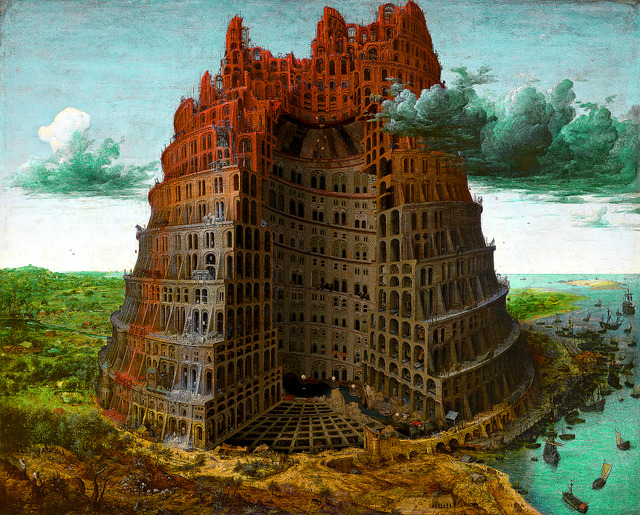
Artist and animator Katsuhiro Otomo of Akira fame, with collage artist Kōsuke Kawamura, painted this view of the inside of the Tower of Babel, a perfectly fascinating pastiche of Bruegel's original.
Continue reading to compare this to the original
=============================
What Explains the Bursts of Innovation in the Archaeological Record?
via Big Think by Stephen Johnson
When paleontologists looked closely at the archaeological record from the transition from the Middle to Upper Paleolithic, they noticed it was punctuated by brief periods during which many new tools, art, and technologies suddenly appeared on the scene. They’ve tended to think these “bursts” of innovation were caused by changes in climate or biology. A new paper, however, suggests sudden innovations were triggered mainly by population growth and migration – a theory that might also explain why some cultures actually lost technologies, like how the Tasmanians mysteriously forgot how to fish.
Continue reading
=============================
A French Philosopher Considers the Kids
via Arts & Letters Daily: Malcolm Harris in New Republic

French philosopher Alain Badiou is, by his own admission, a strange voice to be addressing the youth. “Let’s start with the realities:” he begins his new pamphlet The True Life, “I am 79 years old.” Badiou is also a Maoist of May ’68 vintage, an ontologist who uses set theory, and an advocate for a resurrection of “communism.” Now, skateboard over his shoulder, he has a message for the kids. And some of it is pretty good.
Continue reading
=============================
Some Very Curious Maps of London
via Big Think by Frank Jacobs
As humans migrate to cities, the list of megacities that dot the globe grows longer each year. But London is a special kind of metropolis. Not as old as Rome, nor as big as Beijing, it can still claim to be the true capital of the world – it has the right configuration of history, charm and global appeal.
No wonder a place like London generates a metric ton of guidebooks every year. - to the frustration of londonists everywhere, because most of these mostly repeat the same old highlights.
Curiocity does not fall into that trap. It leaves the tired tropes to those other guides, and provides London with the trivia-rich compendium that befits the British capital so well.
Continue reading
via Boing Boing by Mark Frauenfelder
Turing Tumble is a mechanical computer with switches that are activated by rolling marbles down an inclined plane. To program it, you attach plastic switches and components to it. The Kickstarter launched today and it's off to a great start.
Continue reading
=============================
Ramesses II, victor of Kadesh: a kindred spirit of Trump?
via the Guardian by Alex Loktionov
Papyrus Sallier III (col. 11), BM10181,11, which contains a poem praising Ramesses II at the Battle of Kadesh. Photograph: ©Trustees of the British Museum
In 1274BCE, near the Levantine town of Kadesh, a miracle occurred: Ramesses II of Egypt, isolated from his forces due to faulty intelligence, single-handedly destroyed a Hittite army. Out of the 2,500 chariots attacking him, not one survived. The pharaoh subsequently threw countless enemies into the river Orontes, only sparing the Hittite king after he begged for mercy. It was a mighty victory – and a mighty mix of fact and fiction.
Continue reading
=============================
Punishing Peccadilloes? Illicit sex at the early Stuart courts
via OUP Blog by Johanna Luthman
16:58 Hampton Court Palace by brian gillman. CC BY 3.0 via Wikimedia Commons.
At the Tudor and early Stuart royal courts, the careers of influential politicians and courtiers often depended on the preferences of the monarchs: being in the king’s good graces often mattered as much or more for advancements than ability and training. The personality and quirks of the rulers affected many aspects of a courtier’s life, including what today might be considered the most private: their sex lives. When King James I died in 1625, ambitious persons jostling for positions in the formation of Charles’s court would soon learn that the son had different tastes from the father, and expected different behaviors from those around him. While James mostly ignored or tacitly accepted the philandering of his courtiers as long as they kept up a modicum of discretion, Charles was not so forgiving. Under his reign, courtiers soon learned that they had to “keep their virginities,” or “at least lose them not avowedly,” as one courtier wryly remarked. If Charles found out, offenders could face serious consequences.
Continue reading
=============================
How much would a star destroyer cost?
via Boing Boing by Andrea James
Generation Tech has done a few fun videos estimating the costs of items in the Star Wars universe. In the latest installment, they calculate the cost of a star destroyer.Continue reading and find out for yourself
=============================
A purple pursuit
via The National Archives blog by Isabella Whitworth
In 2008, friends invited me to look at a collection of family documents relating to dye manufacture in 19th and 20th century Leeds. As a professional artist and tutor working with textiles I had considerable practical experience using natural dyes and was interested in their individual histories, but had never taken it further. An invitation to view an archive changed the course of my life.
Continue reading it is a fascinating story.
=============================
Bosch & Bruegel: From Enemy Painting to Everyday Life
via 3 Quarks Daily: Tim Smith-Laing at Literary Review
They might seem an incongruous pair at first, but historically speaking Hieronymus Bosch and Pieter Bruegel the Elder are a natural duo for comparative study. When Bruegel entered the painters’ guild of Antwerp in 1551, Bosch, who had died in 1516, was still the most famous and imitated artist of the age. Antwerp, the centre of European art production at the time, was home to a whole mini-industry of Bosch imitation and forgery, and Bruegel himself cashed in on the continuing demand for his predecessor’s characteristic style. Look at the Boschian pastiches of his ‘Seven Deadly Sins’ series (1558) or 1557’s Big Fish Eat Little Fish, printed with the misleading inscription ‘Hieronymus Bos inventor’, and you can see why a contemporary dubbed Bruegel a ‘second Hieronymus’.
Continue reading
=============================
Painting reveals interior of Bruegel's Tower of Babel
via Boing Boing by Rob Beschizza
Artist and animator Katsuhiro Otomo of Akira fame, with collage artist Kōsuke Kawamura, painted this view of the inside of the Tower of Babel, a perfectly fascinating pastiche of Bruegel's original.
Continue reading to compare this to the original
=============================
What Explains the Bursts of Innovation in the Archaeological Record?
via Big Think by Stephen Johnson
When paleontologists looked closely at the archaeological record from the transition from the Middle to Upper Paleolithic, they noticed it was punctuated by brief periods during which many new tools, art, and technologies suddenly appeared on the scene. They’ve tended to think these “bursts” of innovation were caused by changes in climate or biology. A new paper, however, suggests sudden innovations were triggered mainly by population growth and migration – a theory that might also explain why some cultures actually lost technologies, like how the Tasmanians mysteriously forgot how to fish.
Continue reading
=============================
A French Philosopher Considers the Kids
via Arts & Letters Daily: Malcolm Harris in New Republic
French philosopher Alain Badiou is, by his own admission, a strange voice to be addressing the youth. “Let’s start with the realities:” he begins his new pamphlet The True Life, “I am 79 years old.” Badiou is also a Maoist of May ’68 vintage, an ontologist who uses set theory, and an advocate for a resurrection of “communism.” Now, skateboard over his shoulder, he has a message for the kids. And some of it is pretty good.
Continue reading
=============================
Some Very Curious Maps of London
via Big Think by Frank Jacobs
As humans migrate to cities, the list of megacities that dot the globe grows longer each year. But London is a special kind of metropolis. Not as old as Rome, nor as big as Beijing, it can still claim to be the true capital of the world – it has the right configuration of history, charm and global appeal.
No wonder a place like London generates a metric ton of guidebooks every year. - to the frustration of londonists everywhere, because most of these mostly repeat the same old highlights.
Curiocity does not fall into that trap. It leaves the tired tropes to those other guides, and provides London with the trivia-rich compendium that befits the British capital so well.
Continue reading
Subscribe to:
Posts (Atom)

