a column by Wendy C.Y. Li, Makoto Nirei and Kazufumi Yamana for VOX: CEPR’s Policy Portal
Online platforms that provide services at zero monetary cost benefit greatly from the data these transactions generate.
This column proposes a new method to value these data, based on firm investments in organisational capital. The method also captures the social value of consumer data. Accurate estimates may guide investment and improve national accounts.
Continue reading
Showing posts with label Google. Show all posts
Showing posts with label Google. Show all posts
Friday, 9 August 2019


Thursday, 27 June 2019
Like it or not? Online platforms and productivity
a column by Alberto Bailin Rivares, Peter Gal, Valentine Millot and Stéphane Sorbe for VOX: CEPR’s Policy Portal
While the innovative features of online platforms offer the potential to improve the performance of service sectors, they raise many new challenges for policymakers.
Using Google search data on service industries in ten OECD countries, this column shows that platforms generally stimulate the productivity of incumbent service firms, but the impact crucially depends on the type of platform considered. Productivity gains tend to be lower when a platform is persistently dominant on its market, suggesting that the contestability of platform markets should be promoted in order to maximise their economic benefits.
Continue reading
While the innovative features of online platforms offer the potential to improve the performance of service sectors, they raise many new challenges for policymakers.
Using Google search data on service industries in ten OECD countries, this column shows that platforms generally stimulate the productivity of incumbent service firms, but the impact crucially depends on the type of platform considered. Productivity gains tend to be lower when a platform is persistently dominant on its market, suggesting that the contestability of platform markets should be promoted in order to maximise their economic benefits.
Continue reading
Wednesday, 3 April 2019
What is platform governance?
an article by Robert Gorwa (University of Oxford, UK) published in Information, Communication & Society Volume 22 Issue 6 (2019)
Abstract
Following a host of high-profile scandals, the political influence of platform companies (the global corporations that that operate online ‘platforms’ such as Facebook, WhatsApp, YouTube, and many other online services) is slowly being re-evaluated.
Amidst growing calls to regulate these companies and make them more democratically accountable, and a host of policy interventions that are actively being pursued in Europe and beyond, a better understanding of how platform practices, policies, and affordances (in effect, how platforms govern) interact with the external political forces trying to shape those practices and policies is needed.
Building on digital media and communication scholarship as well as governance literature from political science and international relations, the aim of this article is to map an interdisciplinary research agenda for platform governance, a concept intended to capture the layers of governance relationships structuring interactions between key parties in today's platform society, including platform companies, users, advertisers, governments, and other political actors.
Abstract
Following a host of high-profile scandals, the political influence of platform companies (the global corporations that that operate online ‘platforms’ such as Facebook, WhatsApp, YouTube, and many other online services) is slowly being re-evaluated.
Amidst growing calls to regulate these companies and make them more democratically accountable, and a host of policy interventions that are actively being pursued in Europe and beyond, a better understanding of how platform practices, policies, and affordances (in effect, how platforms govern) interact with the external political forces trying to shape those practices and policies is needed.
Building on digital media and communication scholarship as well as governance literature from political science and international relations, the aim of this article is to map an interdisciplinary research agenda for platform governance, a concept intended to capture the layers of governance relationships structuring interactions between key parties in today's platform society, including platform companies, users, advertisers, governments, and other political actors.
Saturday, 10 March 2018
Four companies dominate our daily lives unlike any other in human history: Amazon, Apple, Facebook, and Google
an article by Scott Galloway published in Esquire [via 3 Quarks Daily]
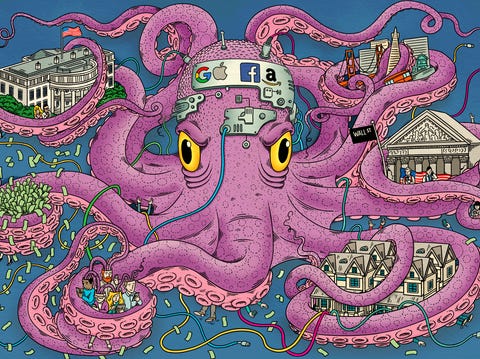
Four companies dominate our daily lives unlike any other in human history: Amazon, Apple, Facebook, and Google. We love our nifty phones and just-a-click-away services, but these behemoths enjoy unfettered economic domination and hoard riches on a scale not seen since the monopolies of the gilded age. The only logical conclusion? We must bust up big tech.
Continue reading
Hazel’s comment
Really scary.
Four companies dominate our daily lives unlike any other in human history: Amazon, Apple, Facebook, and Google. We love our nifty phones and just-a-click-away services, but these behemoths enjoy unfettered economic domination and hoard riches on a scale not seen since the monopolies of the gilded age. The only logical conclusion? We must bust up big tech.
Continue reading
Hazel’s comment
Really scary.
Sunday, 17 December 2017
It’s time to stop trusting Google search already
a post by Adi Robertson for The Verge: via Library Link
:no_upscale()/cdn.vox-cdn.com/uploads/chorus_image/image/57551477/DSC_0047.0.jpg)
Last weekend, in the hours after a deadly Texas church shooting, Google search promoted false reports about the suspect, suggesting that he was a radical communist affiliated with the antifa movement. The claims popped up in Google’s “Popular on Twitter” module, which made them prominently visible – although not the top results – in a search for the alleged killer’s name. Of course, the was just the latest instance of a long-standing problem: it was the latest of multiple similar missteps. As usual, Google promised to improve its search results, while the offending tweets disappeared. But telling Google to retrain its algorithms, as appropriate as that demand is, doesn’t solve the bigger issue: the search engine’s monopoly on truth.
Surveys suggest that, at least in theory, very few people unconditionally believe news from social media. But faith in search engines – a field long dominated by Google – appears consistently high. A 2017 Edelman survey found that 64 percent of respondents trusted search engines for news and information, a slight increase from the 61 percent who did in 2012, and notably more than the 57 percent who trusted traditional media. (Another 2012 survey, from Pew Research Center, found that 66 percent of people believed search engines were “fair and unbiased,” almost the same proportion that did in 2005.) Researcher Danah Boyd has suggested that media literacy training conflated doing independent research with using search engines. Instead of learning to evaluate sources, “[students] heard that Google was trustworthy and Wikipedia was not.”
Continue reading
Last weekend, in the hours after a deadly Texas church shooting, Google search promoted false reports about the suspect, suggesting that he was a radical communist affiliated with the antifa movement. The claims popped up in Google’s “Popular on Twitter” module, which made them prominently visible – although not the top results – in a search for the alleged killer’s name. Of course, the was just the latest instance of a long-standing problem: it was the latest of multiple similar missteps. As usual, Google promised to improve its search results, while the offending tweets disappeared. But telling Google to retrain its algorithms, as appropriate as that demand is, doesn’t solve the bigger issue: the search engine’s monopoly on truth.
Surveys suggest that, at least in theory, very few people unconditionally believe news from social media. But faith in search engines – a field long dominated by Google – appears consistently high. A 2017 Edelman survey found that 64 percent of respondents trusted search engines for news and information, a slight increase from the 61 percent who did in 2012, and notably more than the 57 percent who trusted traditional media. (Another 2012 survey, from Pew Research Center, found that 66 percent of people believed search engines were “fair and unbiased,” almost the same proportion that did in 2005.) Researcher Danah Boyd has suggested that media literacy training conflated doing independent research with using search engines. Instead of learning to evaluate sources, “[students] heard that Google was trustworthy and Wikipedia was not.”
Continue reading
Tuesday, 12 December 2017
How to Tame Google, Facebook, Amazon and Apple
via ResearchBuzz Firehose: an article by Peter Coy for Bloomberg
There hasn’t been a concerted effort to stop the runaway tech giants—yet. Would today’s laws even be up to the challenge?

It’s harder to fix a problem than to identify it. That goes quadruple for Apple Inc., Alphabet Inc.’s Google, Amazon.com Inc., and Facebook Inc.
On the upside, these U.S. tech giants provide some of the world’s best-loved products and services. Investors love them, too. They’re the first-, second-, fourth-, and fifth-most-valuable companies. (Microsoft Corp. places third.)
Yet the four, taken together, also stand widely accused of the sins associated with corporate bullies: crushing competition, avoiding taxes, undermining democracy and invading privacy. Russian operatives have used American social media companies as a playground. Executives of Facebook, Google, and Twitter Inc. told Congress on Oct. 31 that they can’t even measure the extent of Russia’s manipulation of the U.S. presidential election and don’t yet have the tools to stop it the next time.
The result, so far, has been threats of new taxes, regulations, laws and antitrust actions—not only in Europe, where the giants have long been treated as problems, but increasingly from what has been long seen as the more hands-off U.S. government. Some experts see the Justice Department’s lawsuit to block AT&T Inc.’s purchase of Time Warner Inc. as a possible precursor of actions against the tech giants. Even the experts are confused. Are these companies our friends, enemies or frenemies? Are they basically familiar entities that can be dealt with using tried-and-true remedies—or something new that requires a fresh approach?
Continue reading
There hasn’t been a concerted effort to stop the runaway tech giants—yet. Would today’s laws even be up to the challenge?
It’s harder to fix a problem than to identify it. That goes quadruple for Apple Inc., Alphabet Inc.’s Google, Amazon.com Inc., and Facebook Inc.
On the upside, these U.S. tech giants provide some of the world’s best-loved products and services. Investors love them, too. They’re the first-, second-, fourth-, and fifth-most-valuable companies. (Microsoft Corp. places third.)
Yet the four, taken together, also stand widely accused of the sins associated with corporate bullies: crushing competition, avoiding taxes, undermining democracy and invading privacy. Russian operatives have used American social media companies as a playground. Executives of Facebook, Google, and Twitter Inc. told Congress on Oct. 31 that they can’t even measure the extent of Russia’s manipulation of the U.S. presidential election and don’t yet have the tools to stop it the next time.
The result, so far, has been threats of new taxes, regulations, laws and antitrust actions—not only in Europe, where the giants have long been treated as problems, but increasingly from what has been long seen as the more hands-off U.S. government. Some experts see the Justice Department’s lawsuit to block AT&T Inc.’s purchase of Time Warner Inc. as a possible precursor of actions against the tech giants. Even the experts are confused. Are these companies our friends, enemies or frenemies? Are they basically familiar entities that can be dealt with using tried-and-true remedies—or something new that requires a fresh approach?
Continue reading
Friday, 7 August 2015
Google decision leaves data controllers “exposed and vulnerable”
An article in Privacy & Data Protection Volume 15 Issue 5 (April/May 2015) briefly covers the decision in the UK Court of Appeal.
pdp journals does not make its articles available for free and there are no abstracts.
I have, however, found an article in Practical Law which will, I believe, set out the issues covered.
and also access a copy of the decision here
pdp journals does not make its articles available for free and there are no abstracts.
I have, however, found an article in Practical Law which will, I believe, set out the issues covered.
The Court of Appeal has held that individual users who claimed that their data were collected by Google without their consent for the purposes of more effectively targeting advertising are entitled to seek damages, despite not suffering any pecuniary loss. The decision effectively opens up a potential flood of litigation from individuals whose data are collected or processed unlawfully.Continue reading
Christopher Knight, 11KBW
and also access a copy of the decision here
Subscribe to:
Posts (Atom)

