Showing posts with label Amazon. Show all posts

Tuesday, 25 June 2019

Structural Separation: antitrust's tried-and-true weapon for monopolists who bottleneck markets

a post by Cory Doctorow for the Boing Boing blog


Back in 2017, a law student named Lena Khan made waves in policy circles with the publication of her massive, brilliant, game-changing 24,000-word article in the Yale Law Journal, Amazon's Antitrust Paradox, which revisited the entirety of post-Ronald-Reagan antitrust orthodoxy to show how it had allowed Amazon to become a brutal, harmful monopoly without any consequences from the regulators charged with ensuring competition in our markets.

Now, Khan (who is now a Columbia Law fellow) is back with The Separation of Platforms and Commerce – clocking in at 61,000 words with footnotes! – that describes the one-two punch of contemporary monopolism, in which Reagan-era deregulation enthusiasts took the brakes off of corporate conduct but said it would be OK because antitrust law would keep things from getting out of control, while Reagan-era antitrust “reformers” (led by Robert Bork and the Chicago School) dismantled antitrust).

Continue reading


Friday, 17 May 2019

Your most sensitive data is likely exposed online. These people try to find it

a post by Laura Hautala for C|net [via ResearchBuzz: Firehose with grateful thanks]

Don’t worry. They want it to be safe.

Justin Paine sits in a pub in Oakland, California, searching the internet for your most sensitive data. It doesn't take him long to find a promising lead.

On his laptop, he opens Shodan, a searchable index of cloud servers and other internet-connected devices. Then he types the keyword "Kibana," which reveals more than 15,000 databases stored online. Paine starts digging through the results, a plate of chicken tenders and fries growing cold next to him.

"This one's from Russia. This one's from China," Paine said. "This one is just wide open."

From there, Paine can sift through each database and check its contents. One database appears to have information about hotel room service. If he keeps looking deeper, he might find credit card or passport numbers. That isn't far-fetched. In the past, he's found databases containing patient information from drug addiction treatment centers, as well as library borrowing records and online gambling transactions.

Continue reading


Monday, 18 June 2018

Monopsony in online labour markets

a column by Arindrajit Dube, Jeff Jacobs, Suresh Naidu and Siddharth Suri for VOX: CEPR’s Policy Portal

Monopsony refers to the market power that employers wield in labour markets. This column explores monopsony power in online labour markets, using observational and experimental data from Amazon’s Mechanical Turk platform.

Both datasets suggest an employer labour supply elasticity of close to 0.1, suggesting that a 10% reduction in wages would only see a 1% drop in willing labour. This points to substantial employer market power in a supposedly frictionless setting.

Continue reading


Saturday, 10 March 2018

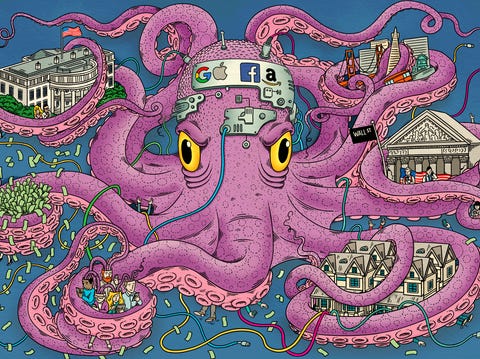
Four companies dominate our daily lives unlike any other in human history: Amazon, Apple, Facebook, and Google

an article by Scott Galloway published in Esquire [via 3 Quarks Daily]


Four companies dominate our daily lives unlike any other in human history: Amazon, Apple, Facebook, and Google. We love our nifty phones and just-a-click-away services, but these behemoths enjoy unfettered economic domination and hoard riches on a scale not seen since the monopolies of the gilded age. The only logical conclusion? We must bust up big tech.

Continue reading

Hazel’s comment
Really scary.


Sunday, 17 December 2017

It’s time to stop trusting Google search already

a post by Adi Robertson for The Verge: via Library Link


Last weekend, in the hours after a deadly Texas church shooting, Google search promoted false reports about the suspect, suggesting that he was a radical communist affiliated with the antifa movement. The claims popped up in Google’s “Popular on Twitter” module, which made them prominently visible – although not the top results – in a search for the alleged killer’s name. Of course, the was just the latest instance of a long-standing problem: it was the latest of multiple similar missteps. As usual, Google promised to improve its search results, while the offending tweets disappeared. But telling Google to retrain its algorithms, as appropriate as that demand is, doesn’t solve the bigger issue: the search engine’s monopoly on truth.

Surveys suggest that, at least in theory, very few people unconditionally believe news from social media. But faith in search engines – a field long dominated by Google – appears consistently high. A 2017 Edelman survey found that 64 percent of respondents trusted search engines for news and information, a slight increase from the 61 percent who did in 2012, and notably more than the 57 percent who trusted traditional media. (Another 2012 survey, from Pew Research Center, found that 66 percent of people believed search engines were “fair and unbiased,” almost the same proportion that did in 2005.) Researcher Danah Boyd has suggested that media literacy training conflated doing independent research with using search engines. Instead of learning to evaluate sources, “[students] heard that Google was trustworthy and Wikipedia was not.”

Continue reading

Tuesday, 12 December 2017

How to Tame Google, Facebook, Amazon and Apple

via ResearchBuzz Firehose: an article by Peter Coy for Bloomberg

There hasn’t been a concerted effort to stop the runaway tech giants—yet. Would today’s laws even be up to the challenge?


It’s harder to fix a problem than to identify it. That goes quadruple for Apple Inc., Alphabet Inc.’s Google, Amazon.com Inc., and Facebook Inc.

On the upside, these U.S. tech giants provide some of the world’s best-loved products and services. Investors love them, too. They’re the first-, second-, fourth-, and fifth-most-valuable companies. (Microsoft Corp. places third.)

Yet the four, taken together, also stand widely accused of the sins associated with corporate bullies: crushing competition, avoiding taxes, undermining democracy and invading privacy. Russian operatives have used American social media companies as a playground. Executives of Facebook, Google, and Twitter Inc. told Congress on Oct. 31 that they can’t even measure the extent of Russia’s manipulation of the U.S. presidential election and don’t yet have the tools to stop it the next time.

The result, so far, has been threats of new taxes, regulations, laws and antitrust actions—not only in Europe, where the giants have long been treated as problems, but increasingly from what has been long seen as the more hands-off U.S. government. Some experts see the Justice Department’s lawsuit to block AT&T Inc.’s purchase of Time Warner Inc. as a possible precursor of actions against the tech giants. Even the experts are confused. Are these companies our friends, enemies or frenemies? Are they basically familiar entities that can be dealt with using tried-and-true remedies—or something new that requires a fresh approach?

Continue reading