provides links to information management, information sources and other "useful stuff" with a strong bias towards the management of information in a careers guidance context.
As of 17 July 2017 I include mental health information and comment.
I tweet as @careersinfo and am on LinkedIn and Facebook as Hazel Edmunds
The philosopher Alan Watts always said that life is like a song, and the sole purpose of the song is to dance.
He said that when we listen to a song, we don’t dance with the goal of getting to the end of the music. We dance to enjoy it.
This isn’t always how we live our lives. Instead, we rush through our moments, thinking there’s always something better, there’s always some goal we need to achieve. This is my journey through a song without the dance and the lessons I’ve learned, from Alan Watts, along the way.
“Existence is meant to be fun. It doesn't go anywhere it just is.”
I sat in my car, fixated on my hands. Hot tears welled in my eyes and slowly streamed down my cheeks. I lost focus of the very thing that held the answer to my problem.
I remember thinking about how my nails grow on their own, how my hair grows and my heart beats, and the tears fall. All without effort or pain, these things happen. They’re effortless. Why was life so difficult?
an article by Christopher French, Alice M Gregory and Dan Denis for the Guardian As well as explosions, other types of loud noise perceived during episodes of EHS include gunshots, fireworks, thunder, doors slamming, clapping, shouting, and the clash of cymbals. Photograph: Ryan J Lane/Getty Images
Of all the sleep disorders, “exploding head syndrome” (EHS) has arguably the most intriguing name. EHS has been described as “a sensory parasomnia characterised by the perception of loud noises and/or a sense of explosion in the head when transitioning to or from sleep. These noises are not associated with significant pain, but lead to abrupt arousal and feelings of fright”.
Although this phenomenon was first described as long ago as 1876, it was not given its colourful title until 1988. Despite its long history, it has received very little systematic research attention, with most of our knowledge being based upon small samples of case histories as opposed to large-scale investigations. We, the authors of this piece, along with the world’s leading authority on EHS, Dr Brian Sharpless of Argosy University, Northern Virginia, are hoping to rectify that situation by carrying out a large-scale survey of EHS. We’re also interested in the equally intriguing phenomenon of sleep paralysis, which involves a temporary period of paralysis occurring between sleep and wakefulness, often accompanied by hallucinations.
an article by Tommaso Frattini (University of Milan) published in Social Policy and Society Volume 16 Issue 4 (October 2016)
Abstract
This article analyses the labour market integration of newly arrived immigrants in the UK labour market, based on data from the UK Labour Force Survey. We focus on immigrants who arrived in the United Kingdom since 2000 and distinguish different cohorts based on the year of their arrival in the country.
We examine the extent to which these new arrivals were able to enter work and move up into skilled jobs, and analyse the sectors of the economy that have proved most amenable to this progression.
The analysis indicates that these new arrivals fared relatively well in the workforce. In part as a result of their relative youth and high education levels, many new arrivals (especially those from the European Union and in particular the EU10 countries) moved straight into work.
Smartphone addiction creates many problems: car accidents, poor educational performance, insomnia, relationship issues, anxiety, and depression. As with any technology—as with anything, really—too much is too much. Inattentiveness is a chronic problem. Yet the benefits to technology are also undeniable, which is why medical app makers are using this medium to fight back.
Smartphones may help provoke depression and anxiety, but new research from top Australian institutes explores apps that are helping users reduce the symptoms and even combat the roots of these disorders. Researchers chose eighteen randomized controlled trials, fourteen of which were published in the last two years, which cover 3,414 men and women between the ages of 18-59. Participants suffered from depression, insomnia, bipolar disorder, anxiety, and other related disorders.
In this meta-analysis the researchers discovered these apps have a moderate positive effect over inactive controls and a small positive effect over active control conditions. In terms of apps themselves, cognitive training apps proved more efficient than apps focused on mental health.
When combined with traditional methods such psychotherapy and pharmaceuticals, this new wave of apps could become standard protocol in an integrative approach to battling depression, anxiety, and related disorders. Regardless of each app’s specific focus, researchers conclude “smartphone devices are a promising self-management tool for depression.”
“It's not a matter of letting go, you would if you could. Instead of ‘Let it go,' we should probably say ‘Let it be.'” ~Jon Kabat-Zinn
I always believed that a busy mind was a bad thing.
And for a large part of my life, it was.
Looking back, I don’t ever recall a time when I wasn’t caught up in my thoughts. There was always a “narrator” in my head. A constant commentary.
I tried meditating but would spend ten agonizing minutes trying desperately to push my thoughts away or make them stop, which we know is impossible. Not thinking wasn’t unlike attempting to separate a limb from my body. Yup, such was my attachment to my thoughts.
Yoga presented yet another futile attempt at mindfulness. I’d notice the other participants perfectly present and focused, while my mind would be hammering away, comparing me to others, debating why I was actually there, or criticizing my performance.
The uninformed might think that only “negative” overthinking is the problem. However, in my experience over analysis or overthinking of any topic or event (even really happy ones) generally leads to a bad feeling place.
Continue readingPLEASE because even if you are not an over-thinker you will learn something from Jacky’s post.
a post by Shawn and Chris Kernes for the World of Psychology blog
Even if we see ourselves as advocates for increasing acceptance and understanding of people dealing with mental health issues, most of us are probably unconsciously contributing to mental health stigma.
We talk about being “depressed” on gloomy days, or “OCD” about the cleanliness of our homes. We remark that our friend has “PTSD” from a bad work week, or is “paranoid” about germs.
Most of us are guilty of having spoken these terms and phrases in everyday conversation. If not, then we’ve definitely heard others use them colloquially. We aren’t being literal, and there’s no real harm, right? Wrong – and the damage we are doing is probably much more significant than we realize.
This misappropriation of such terms belittles mental health conditions and frames them in a negative light. And it impairs the ability of all of us, including those actually confronted with mental illness, to discern between critical mental health issues and exaggerated expressions.
Pretty drone footage of San Francisco Bay's vibrant salt ponds
via Boing Boing by Andrea James
If you've ever approached San Francisco's airport from the south during landing, you may have noticed the colorful salt ponds along the southern shore of San Francisco Bay.
In this lovely drone footage, they look like modern art:
=============================
The Illuminating Geometry of Viruses
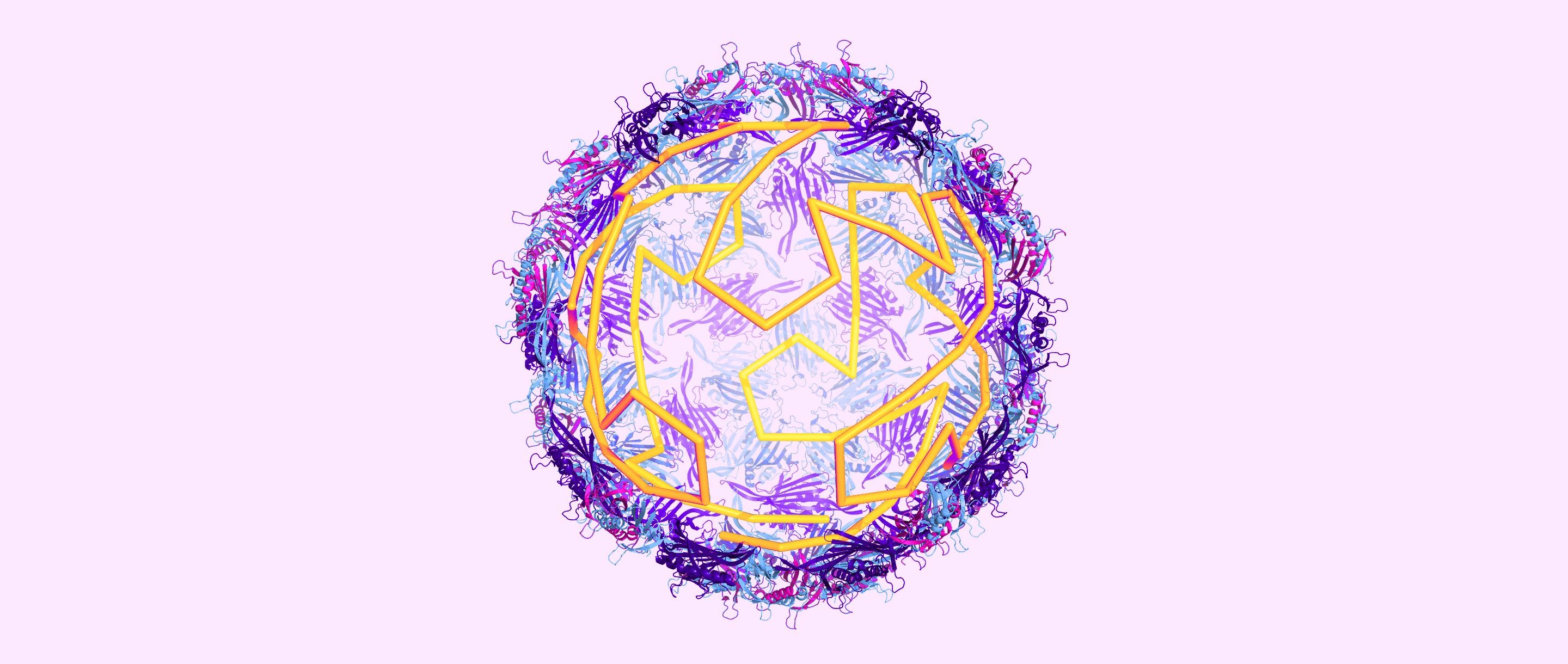
via 3 Quarks Daily: Jordana Cepelewicz in Quanta Olena Shmahalo/Quanta Magazine, source: Reidun Twarock
More than a quarter billion people today are infected with the hepatitis B virus (HBV), the World Health Organization estimates, and more than 850,000 of them die every year as a result. Although an effective and inexpensive vaccine can prevent infections, the virus, a major culprit in liver disease, is still easily passed from infected mothers to their newborns at birth, and the medical community remains strongly interested in finding better ways to combat HBV and its chronic effects. It was therefore notable last month when Reidun Twarock, a mathematician at the University of York in England, together with Peter Stockley, a professor of biological chemistry at the University of Leeds, and their respective colleagues, published their insights into how HBV assembles itself. That knowledge, they hoped, might eventually be turned against the virus. Continue reading
=============================
10 of the Best Sacred Poems in English Literature
via Interesting Literature
The best religious poems
What are the best religious poems in English literature? Obviously religious faith – and, indeed, religious doubt – has loomed large in English poetry, whether it’s in the devotional lyrics of John Donne and George Herbert or the modern, secular musings of Philip Larkin in ‘Church Going’. We’ve excluded longer works such as John Milton’s epic Paradise Lost, although naturally that’s a must-read work of English religious poetry, just conceived on a different scale from what we have here. Continue reading
=============================
Drugs that are 30 years past their expiration date “still as potent as they were when they were manufactured”
via Boing Boing by Mark Frauenfelder
Throwing away expired medicine is a waste of money, according to the results of a recent test on a cache of pills predating the 1969 moon landing. Continue reading Unfortunately we will never be told which drugs are perfectly safe and as potent as when originally dispensed unless the manufacturers tell us. And why would they? =============================
Half of All Languages Come from One Root Language. How it Spread Is Something of Debate
via Big Think by Philip Perry Nomads in Kazakhstan near the Chinese border. Getty Images.
The sheer variety of languages on Earth is dizzying in their array and divergence. What’s more intriguing, is that about half of them spoken today by some three billion people, come from a single root language, used thousands of years ago. Hindi, Bengali, Persian, English, German, Spanish, and Greek, all come from the same root, known as Proto-Indo-European (PIE). In total, 400 languages and dialects originate from PIE. Continue reading =============================
Koh-i-Noor by William Dalrymple and Anita Anand review – an infamous diamond and imperial bloodshed
A dynamic and gory history of the celebrated gem, from emperor Shah Jahan’s peacock throne in the 1600s to present-day demands for its return
via the Guardian by Maya Jasanoff Duleep Singh, the last Indian owner of the Koh-i-Noor. Photograph: Alamy
Investigative journalists know that the way into a great story is to “follow the money”. In this vivid history of one of the world’s most celebrated gemstones, the Indian diamond known as the Koh-i-Noor, Anita Anand and William Dalrymple put an inventive twist on the old maxim. “Follow the diamond,” they realise, and it can lead into a dynamic, original and supremely readable history of empires. Continue reading
=============================
Colorizing this early 1900s photo of New York brings it to life
via Boing Boing by Mark Frauenfelder
Before the streets were taken over by cars and taxis, pedestrians ruled.
This photo of old New York was colorized by Sanna Dullaway. Sanna is a Swedish artist who uses technology to colourise old photographs but my Great-Aunt Amy made a living for herself and her older sister by hand colouring in the days before colour photography. =============================
You Have a Surprising Amount of Control Over Your IQ
via 3 Quarks Daily: Alexandra Ossoli in Tonic
What has become clearer in recent years, is that intelligence, like many facets of health and even complex diseases, is the result of a complex interaction of genetics and the environment. Several studies over the past five years have identified hundreds of genes that may be involved in intelligence. The results of IQ tests can even vary depending on a person's state of development, which is usually triggered by genetics—the greatest fluctuation usually happens during adolescence, when the brain is still developing. But non-genetic factors can drastically affect IQ. There are elements of a person's childhood environment that can depress IQ scores later in life, such as poverty, poor at-home intellectual environment, and exposure to toxic chemicals such as lead. Repeated head injuries lower IQ in the long run. Some things can also raise them, such as hanging out with smarter people—moving a child from an impoverished household to a middle- or upper-class one can result in sizable gains in IQ scores. "The brain seems to be rather like a muscle—the more you use it, the stronger it gets. That means you can upgrade your own intelligence all through life," intelligence researcher James Flynn told The Australian. For an individual, it's easier to depress the score of IQ tests over a lifetime than to boost them, especially after adolescence. "You don't see many reports of significant increases in IQ unless someone had screwed up the testing," Silverman says. Continue reading
=============================
How Science Got Women Wrong: Angela Saini’s witty book debunks gender stereotypes
via The New Statesman by Helen Lewis
Researchers have often fitted the evidence to their theories, rather than the other way round.
There are a few things we just know about the difference between the sexes. Men are strong, tough, prone to promiscuity but better at parking; women are more empathetic, less intellectual, better suited to caring roles and less interested in casual sex. Some of these views are so ingrained that they seem natural, immutable and preordained. Others are supported by superficially convincing evidence – either from human history (where’s the female Mozart, eh?) or the animal kingdom (chimps live in male-dominated groups, you know). But many of our most firmly held assumptions do not stand up to detailed scrutiny. Continue reading
=============================
Incredible Bowie, Dalí, and Tintin portraits made from trash
via Boing Boing by David Pescovitz
Assemblage artist Bernard Pras creates incredible 3D installation portraits from trash. (via @saatchi_gallery Instagram) See more
My career in information management started back in 1987 working on the Training Access Points project. Nearly thirty years later I am still concerned to ensure that end users, and their mediators, have access to appropriate, relevant information in a form that they can understand, at a time and in a place that is right for them. The Internet seems to be for everyone and everywhere but the digital divide gets bigger. By pointing advisers in the direction of resources I hope to increase what can be done to help clients/customers.
I ran my own company for 16 years but am now a semi-retired freelancer.