eurostat news release 55/2017 (3 April 2017)
February 2017
Euro area unemployment at 9.5%
EU28 at 8.0%
The euro area (EA19) seasonally-adjusted unemployment rate was 9.5% in February 2017, down from 9.6% in
January 2017 and from 10.3% in February 2016. This remains the lowest rate recorded in the euro area since May
2009. The EU28 unemployment rate was 8.0% in February 2017, down from 8.1% in January 2017 and from 8.9%
in February 2016. This remains the lowest rate recorded in the EU28 since January 2009. These figures are
published by Eurostat, the statistical office of the European Union.
Eurostat estimates that 19.750 million men and women in the EU28, of whom 15.439 million were in the euro area,
were unemployed in February 2017. Compared with January 2017, the number of persons unemployed decreased
by 153 000 in the EU28 and by 140 000 in the euro area. Compared with February 2016, unemployment fell by
1.852 million in the EU28 and by 1.246 million in the euro area.
Continue reading (downloadable PDF)
Tuesday, 4 April 2017


The poor and the poorest, 50 years on: evidence from British Household Expenditure Surveys of the 1950s and 1960s
an article by Ian Gazeley, Hector Gutierrez Rufrancos, Kevin Reynolds and Rebecca Searle (University of Sussex, Brighton, UK) and Andrew Newell (University of Sussex and Institute for the Study of Labor, Bonn, Germany) published in Journal of the Royal Statistical Society: Series A (Statistics in Society) Volume 180 Issue 2 (February 2017)
Summary
We re-explore Abel-Smith and Townsend’s landmark study of poverty in early post World War 2 Britain. They found a large increase in poverty between 1953-1954 and 1960, which was a period of relatively strong economic growth.
Our re-examination is a first exploitation of the data extracted from the recent digitization of the Ministry of Labour’s ‘Enquiry into household expenditure’ in 1953–1954.
First we closely replicate their results. We find that Abel-Smith and Townsend’s method generated a greater rise in poverty than other reasonable methods. Using contemporary standard poverty lines, we find that the relative poverty rate grew only a little at most, and the absolute poverty rate fell, between 1953–1954 and 1961, as might be expected in a period of rising real incomes and steady inequality.
We also extend the poverty rate time series of Goodman and Webb back to 1953–1954.
Two-Child Limit For Universal Credit: 200,000 More Children Put In Poverty
via the CPAG blog on 3 April 2017
New cuts limiting universal credit to the first two children in a family – starting Thursday April 6th - will push another 200,000 children below the official poverty line, new analysis from the Child Poverty Action Group (CPAG) and the Institute for Public Policy Research (IPPR) shows (1)
The biggest group affected will be working families with three children, who will miss out on up to £2,780 per year as a result of the cut. Larger, non-working families already have their benefit awards limited by the benefit cap so are not the main target of the policy.
Overall, upwards of an estimated 850,000 families with more than two children are likely to be affected, around two thirds of whom will be working. Approximately two thirds will have only three children. (2)
Continue reading and get all the links
Monday, 3 April 2017
Underemployment and well-being in the UK before and after the Great Recession
an article by
Jason Heyes ,
Mark Tomlinson and Adam Whitworth (University of Sheffield, UK) published in
Work, employment and society
Volume 31 Issue 1 (February 2017)
Abstract
Since the start of the economic crisis in 2008 there has been widespread concern with changes in the level and composition of unemployment. The phenomenon of underemployment has, however, received markedly less attention, although it too increased in extent following the start of the crisis.
This article considers the consequences of underemployment for the subjective well-being of UK employees.
Drawing on data from the 2006 and 2012 Employment and Skills Surveys, the article assesses how the Great Recession affected relationships between different dimensions of underemployment and well-being. The findings demonstrate that the negative well-being consequences of workers’ dissatisfaction with opportunities to make use of their abilities became more substantial, as did the consequences of being ‘hours constrained’ and having an unsatisfactory workload.
The article also shows that the economic crisis had a negative impact on the well-being of employees who work very long hours.
Welfare conditionality, benefit sanctions and homelessness in the UK: ending the 'something for nothing culture' or punishing the poor?
an article by Kesia Reeve (Sheffield Hallam University, UK) published in Journal of Poverty and Social Justice Volume 25 Number 1 (February 2017)
Abstract
In 2012 the UK government introduced the harshest régime of conditionality and sanctions in the history of the benefits system. The government insists sanctions are not punitive, but critics call this into question.
In particular, the régime has been charged with disproportionately affecting vulnerable people. Based on a survey and qualitative interviews with homeless people, this paper shows that homeless people are disproportionately sanctioned, and argues that it is difficult to see the régime as anything but punishment – punishment not for refusing to participate in the labour market, but for being unable to do so through homelessness, poverty and ill-health.
Full Text (PDF)
Sunday, 2 April 2017
10 items ranging from the ridiculous to the sublime
Oldest fossil of bird’s voicebox gives new hint at soundscape of the Cretaceous
via The Guardian by Nicola Davis
66m-year-old syrinx of Vegavis iaai suggests that creature could honk and quack and confirms some modern bird groups lived alongside the dinosaurs
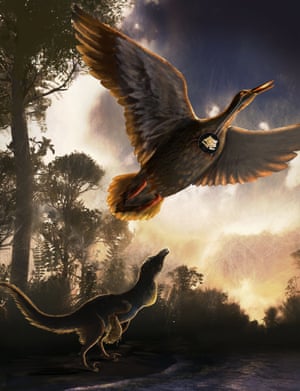
A mid-sized raptor dinosaur is shown using close-mouth vocal behaviour and Vegavis iaai, whose fossilised voicebox has been found, is shown flying overhead. Illustration: Nicole Fuller/Sayo Art for UT Austin
The oldest evidence of a bird’s voice box has been found among the fossilised remains of a duck-like creature that lived more than 66 million years ago.
The discovery suggests that the animal was able to make a variety of sounds similar to those of current day ducks, including quacks.
The human voice box, or larynx, sits near the top of the windpipe. However, the vocal organ of birds - known as a syrinx - lies deep within the chest near the heart, where the windpipe branches to the lungs. Composed of cartilage rings and soft tissue, it allows birds to make a wide variety of calls, from songs to honks.
But little is known about the origin of the organ.
Continue reading
===================================
Insanely detailed model tree made of wire
via Boing Boing by Andrea Jame
Luke Towan makes a lot of gorgeous model railroad items, but his tutorial on making tiny trees using wire, latex, glue, and paint is especially cool to watch from start to finish.
Continue reading and then watch the video.
===================================
Leibniz and Europe
via OUP Blog by Maria Rosa Antognazza

At the turn of the seventeenth and eighteenth centuries, national states were on the rise. Versailles was constructed as a stage on which the Sun King, Louis XIV, acted out the pageant of absolute sovereignty, while his armies annexed neighbouring territories for the greater glory of France. At the death of Charles II of Spain in November 1700, the Spanish throne and its extensive possessions in Italy, the Low Countries, and the New World passed to his grandson, Philip, Duke of Anjou. To the east and south, the Ottoman Empire, which already controlled most of the Balkans, Greece, Turkey, the Middle East, and North Africa, once again threatened Vienna. To the north, Sweden consolidated its empire on the shores of the Baltic while the union of the crowns of England and Scotland in 1707 under Queen Anne established Great Britain as a single kingdom.
Continue reading
===================================
How to raise a genius: lessons from a 45-year study of super-smart children
A long-running investigation of exceptional children reveals what it takes to produce the scientists who will lead the twenty-first century.
via Arts & Letters Daily: Tom Clynes in Nature
On a summer day in 1968, professor Julian Stanley met a brilliant but bored 12-year-old named Joseph Bates. The Baltimore student was so far ahead of his classmates in mathematics that his parents had arranged for him to take a computer-science course at Johns Hopkins University, where Stanley taught. Even that wasn't enough. Having leapfrogged ahead of the adults in the class, the child kept himself busy by teaching the FORTRAN programming language to graduate students.
Continue reading
===================================
Old book, new look: why the classics are flying off the shelves
via The Guardian by John Walsh
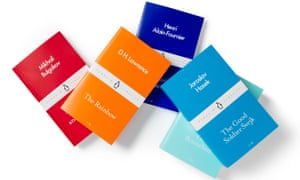
Stripped-back simplicity … the new-look Penguin Pocket Classics. Photograph: Penguin Books
Imagine you have a sudden burning desire to read David Copperfield, Charles Dickens’s favourite of all his novels. Thanks to Project Gutenberg, you could read it for nothing online but, correctly reasoning that it would be tedious to scroll through 600 pages on a screen, you go to a bookshop. There you find that David Copperfield is available as an Everyman Classic hardback, a Penguin Classic paperback, an Oxford University Press paperback and a Vintage Classic paperback, all designed in pleasing formats, heftily branded and with paintings or artful imagery on their covers, along with introductory essays by university professors, a chronology of Dickens’s life and a scholarly trove of explanatory notes.
Continue reading
I get stopped on the first line. I am not a fan of Mr Dickens's writing. Should I be ashamed? I am not.
===================================
Rock tumblers are annoying, loud gifts
via Boing Boing by Jason Weisburger

Perfect for the kid of someone you don't like very much is a Rock Tumbler.
Continue reading
===================================
A Nazi, a Fascist, a Communist, a Novelist, a Countrywoman, a Duchess – All Mitford Sisters
via Arts & Letters Daily: Tina Brown in New York Times Book Review

The Mitford sisters (and, second from left, brother) in Oxfordshire, 1935.The Illustrated London News Picture Library, London, UK, via Bridgeman Images
Oh no! Not another book about the Mitfords! That was my instant reaction when Laura Thompson’s “The Six,” a group biography of the notorious sisters, all half-dozen of them, landed on my desk. …
How wrong I was. “The Six” is riveting. It captures all the wayward magnetism and levity that have enchanted countless writers without neglecting the tragic darkness of many of the sisters’ life choices and the savage sociopolitical currents that fuelled them.
Continue reading
===================================
The Ruins of Palmyra
via 3 Quarks Daily: Ingrid D. Rowland at the NY Review of Books

Valley of the Tombs, Palmyra
In September 2015, the Getty Research Institute in Los Angeles acquired the first photographs ever taken of Palmyra, the great trading oasis in the heart of the Syrian desert. Louis Vignes was a young lieutenant in the French navy whose interest in photography earned him a place on a scientific expedition to the Dead Sea region in 1863. The twenty-nine photographs he made of Palmyra during his visit in 1864 (including two panoramic shots) were finally printed in Paris by the pioneering photographer Charles Nègre (who had taught Vignes) between 1865 and 1867.
Continue reading
===================================
Humpback whales sure love ruining orcas’ hunting
via Boing Boing by Andrea James
A paper published this summer looked into over 100 times humpbacks were observed disrupting orcas who are hunting, like these humpbacks trying to save a grey whale and calf. But why do they do it?
Scientists propose the whales either mob like this to save a fellow humpback then stick around to help whatever is being hunted, or they just hate orcas and love their fellow sea friends, formally known as “interspecies altruism”.
Continue reading and view video
===================================
Dodgy dossiers in the Middle Ages
via OUP Blog by Richard Sowerby

Government advisers don’t regularly admit to handling doctored evidence. The extent to which the actions of recent governments may have depended on documents which had been ‘sexed up’ have – quite rightly – become matters for close scrutiny in recent decades. But the modern world has no monopoly over the spurious, the doubtful, and the falsified. Over one thousand years ago, a curious pamphlet arrived at the palace of the Frankish emperor, Louis the Pious (r. 814–840). It claimed to contain a complete and infallible report of the state of Louis’ kingdom. Along with it came a story that seems to epitomize all our stereotypes about the credulity of the Middle Ages. The pamphlet addressed to the emperor was in fact a message from heaven.
Continue reading
via The Guardian by Nicola Davis
66m-year-old syrinx of Vegavis iaai suggests that creature could honk and quack and confirms some modern bird groups lived alongside the dinosaurs
A mid-sized raptor dinosaur is shown using close-mouth vocal behaviour and Vegavis iaai, whose fossilised voicebox has been found, is shown flying overhead. Illustration: Nicole Fuller/Sayo Art for UT Austin
The oldest evidence of a bird’s voice box has been found among the fossilised remains of a duck-like creature that lived more than 66 million years ago.
The discovery suggests that the animal was able to make a variety of sounds similar to those of current day ducks, including quacks.
The human voice box, or larynx, sits near the top of the windpipe. However, the vocal organ of birds - known as a syrinx - lies deep within the chest near the heart, where the windpipe branches to the lungs. Composed of cartilage rings and soft tissue, it allows birds to make a wide variety of calls, from songs to honks.
But little is known about the origin of the organ.
Continue reading
===================================
via Boing Boing by Andrea Jame
Luke Towan makes a lot of gorgeous model railroad items, but his tutorial on making tiny trees using wire, latex, glue, and paint is especially cool to watch from start to finish.
Continue reading and then watch the video.
===================================
via OUP Blog by Maria Rosa Antognazza
At the turn of the seventeenth and eighteenth centuries, national states were on the rise. Versailles was constructed as a stage on which the Sun King, Louis XIV, acted out the pageant of absolute sovereignty, while his armies annexed neighbouring territories for the greater glory of France. At the death of Charles II of Spain in November 1700, the Spanish throne and its extensive possessions in Italy, the Low Countries, and the New World passed to his grandson, Philip, Duke of Anjou. To the east and south, the Ottoman Empire, which already controlled most of the Balkans, Greece, Turkey, the Middle East, and North Africa, once again threatened Vienna. To the north, Sweden consolidated its empire on the shores of the Baltic while the union of the crowns of England and Scotland in 1707 under Queen Anne established Great Britain as a single kingdom.
Continue reading
===================================
A long-running investigation of exceptional children reveals what it takes to produce the scientists who will lead the twenty-first century.
via Arts & Letters Daily: Tom Clynes in Nature
On a summer day in 1968, professor Julian Stanley met a brilliant but bored 12-year-old named Joseph Bates. The Baltimore student was so far ahead of his classmates in mathematics that his parents had arranged for him to take a computer-science course at Johns Hopkins University, where Stanley taught. Even that wasn't enough. Having leapfrogged ahead of the adults in the class, the child kept himself busy by teaching the FORTRAN programming language to graduate students.
Continue reading
===================================
via The Guardian by John Walsh
Stripped-back simplicity … the new-look Penguin Pocket Classics. Photograph: Penguin Books
Imagine you have a sudden burning desire to read David Copperfield, Charles Dickens’s favourite of all his novels. Thanks to Project Gutenberg, you could read it for nothing online but, correctly reasoning that it would be tedious to scroll through 600 pages on a screen, you go to a bookshop. There you find that David Copperfield is available as an Everyman Classic hardback, a Penguin Classic paperback, an Oxford University Press paperback and a Vintage Classic paperback, all designed in pleasing formats, heftily branded and with paintings or artful imagery on their covers, along with introductory essays by university professors, a chronology of Dickens’s life and a scholarly trove of explanatory notes.
Continue reading
I get stopped on the first line. I am not a fan of Mr Dickens's writing. Should I be ashamed? I am not.
===================================
via Boing Boing by Jason Weisburger
Perfect for the kid of someone you don't like very much is a Rock Tumbler.
Continue reading
===================================
via Arts & Letters Daily: Tina Brown in New York Times Book Review
The Mitford sisters (and, second from left, brother) in Oxfordshire, 1935.The Illustrated London News Picture Library, London, UK, via Bridgeman Images
Oh no! Not another book about the Mitfords! That was my instant reaction when Laura Thompson’s “The Six,” a group biography of the notorious sisters, all half-dozen of them, landed on my desk. …
How wrong I was. “The Six” is riveting. It captures all the wayward magnetism and levity that have enchanted countless writers without neglecting the tragic darkness of many of the sisters’ life choices and the savage sociopolitical currents that fuelled them.
Continue reading
===================================
via 3 Quarks Daily: Ingrid D. Rowland at the NY Review of Books
Valley of the Tombs, Palmyra
In September 2015, the Getty Research Institute in Los Angeles acquired the first photographs ever taken of Palmyra, the great trading oasis in the heart of the Syrian desert. Louis Vignes was a young lieutenant in the French navy whose interest in photography earned him a place on a scientific expedition to the Dead Sea region in 1863. The twenty-nine photographs he made of Palmyra during his visit in 1864 (including two panoramic shots) were finally printed in Paris by the pioneering photographer Charles Nègre (who had taught Vignes) between 1865 and 1867.
Continue reading
===================================
via Boing Boing by Andrea James
A paper published this summer looked into over 100 times humpbacks were observed disrupting orcas who are hunting, like these humpbacks trying to save a grey whale and calf. But why do they do it?
Scientists propose the whales either mob like this to save a fellow humpback then stick around to help whatever is being hunted, or they just hate orcas and love their fellow sea friends, formally known as “interspecies altruism”.
Continue reading and view video
===================================
via OUP Blog by Richard Sowerby
Government advisers don’t regularly admit to handling doctored evidence. The extent to which the actions of recent governments may have depended on documents which had been ‘sexed up’ have – quite rightly – become matters for close scrutiny in recent decades. But the modern world has no monopoly over the spurious, the doubtful, and the falsified. Over one thousand years ago, a curious pamphlet arrived at the palace of the Frankish emperor, Louis the Pious (r. 814–840). It claimed to contain a complete and infallible report of the state of Louis’ kingdom. Along with it came a story that seems to epitomize all our stereotypes about the credulity of the Middle Ages. The pamphlet addressed to the emperor was in fact a message from heaven.
Continue reading
Saturday, 1 April 2017
10 stories selected for your amusement and information
Jack White: Acoustic Recordings 1998-2016 review – stripped back but still elusive
via the Guardian by Alexis Petridis

The cover of Jack White’s first ever career-spanning compilation seems significant. Long-term watchers of the former White Stripe’s career might sigh: so what else is new? Virtually every album White has released thus far has come wrapped in a sleeve rich in meaningful imagery: the crowds of shadowy photographers supposedly representing the White Stripes’ conflicted attitude to fame on 2001’s White Blood Cells; the shot of him brooding, with a vulture on his shoulder, that heralded his post-divorce solo debut Blunderbuss. But what’s striking about the cover of Acoustic Recordings 1998-2016 is that there’s nothing striking about it at all. White is dressed, for once, like a relatively normal human being: not a pearly king outfit nor gaucho hat in sight. There are no props laden with oblique import, no animals. Just White, looking a little pensive in front of a microphone, guitar in hand.
Continue reading
===================================
Losing the thread: Older than bronze and as new as nanowires, textiles are technology – and they have remade our world time and again
via Arts & Letters Daily: Virginia Postrel in aeon
In February 1939, Vogue ran a major feature on the fashions of the future. Inspired by the soon-to-open New York World’s Fair, the magazine asked nine industrial designers to imagine what the people of ‘a far Tomorrow’ might wear and why. (The editors deemed fashion designers too of-the-moment for such speculations.) A mock‑up of each outfit was manufactured and photographed for a lavish nine-page colour spread.
Continue reading
===================================
4 Animated Movies That Make People Cry The Most
via Lifehack by Esther Rivers

There is something seriously comforting about watching a good animated movie. Perhaps it brings back memories of your childhood, reminiscing about sweets long gone from the modern shelves, and feeling eager anticipation about the experience you are about to have with your family or friends. Watching animated films is often a special time where you experience joy with your own children as they embark on adventures that fill them with wonder.
Find out which are the tear-jerkers (obviously including Bambi)
===================================
The truth behind the French Resistance myth
via Arts & Letters Daily: Nicholas Shakespeare in The Telegraph
Thirstily swallowed by a humiliated France, the dominant narrative of the French Resistance was cooked up by General de Gaulle – “Joan of Arc in trousers”, Churchill testily called him – when he addressed the crowds outside the Hôtel de Ville on August 25, 1944. “Paris liberated! Liberated by its own efforts, liberated by its people with the help of the armies of France, with the help of all of France.”
Continue reading
===================================
Brain’s “reward system” also tied to sleep-wake states
via Boing Boing by David Pescovitz

According to Stanford University researchers, a primary circuit in the brain's reward involving the chemical "feel-good" chemical dopamine, is also essential for controlling our sleep-wake cycles.
Continue reading
===================================
Beer Archaeologist: How Alcohol Shaped Our Civilization
via Big Think by Paul Ratner
Patrick McGovern, a biomolecular archaeologist at the University of Pennsylvania, has one of the coolest jobs in the world. Some have called him “the Indiana Jones of Alcohol” or “the beer archaeologist”. What he does is recreate the world’s oldest drinks by finding and utilizing organic material at archaeological sites. A world authority on ancient alcoholic beverages, he’s found humanity’s oldest drinks and re-made some of them, like a beer from the legendary King Midas’s court and a 9,000-year-old Chinese rice and honey drink from the Neolithic period.
Continue reading
===================================
This garden can kill you
via Boing Boing by David Pescovitz

The delightful grounds of Alnwick Castle in Northumberland, England contain such alluring settings as the Poison Garden, home to more than 100 species of plants that are deadly to humans. Please meet the head gardener, Trevor Jones, who must wear protective gear when he's digging in the dirt.
Continue reading but be aware that the first image contains a model of a spider.
===================================
The Princess and the Spy
via 3 Quarks Daily by Michael Liss
===================================
The spores of club moss have magical powers
via Boing Boing by David Pescovitz

Lycopodium powder, made from dry spores of clubmoss plants, is used by magicians and special effects artists as flash powder (aka "dragon's breath"), as a lubricant on latex gloves and condoms, and of course to do the impressive science experiments seen in the video.
Continue reading (check out the video)
===================================
15 surprising facts about Guglielmo Marconi, the man behind radio communication
via OUP Blog by Marc Raboy
Guglielmo Marconi is popularly known as “the inventor of radio,” a mischaracterization that critics and supporters of his many rivals are quick to seize upon. Marconi was actually the first person to use radio waves to communicate. His first patent was for “Improvements in Transmitting Electrical Impulses and Signals and in Apparatus Therefor,” and he considered what he was doing to be a form of wireless telegraphy.
Continue reading
via the Guardian by Alexis Petridis
The cover of Jack White’s first ever career-spanning compilation seems significant. Long-term watchers of the former White Stripe’s career might sigh: so what else is new? Virtually every album White has released thus far has come wrapped in a sleeve rich in meaningful imagery: the crowds of shadowy photographers supposedly representing the White Stripes’ conflicted attitude to fame on 2001’s White Blood Cells; the shot of him brooding, with a vulture on his shoulder, that heralded his post-divorce solo debut Blunderbuss. But what’s striking about the cover of Acoustic Recordings 1998-2016 is that there’s nothing striking about it at all. White is dressed, for once, like a relatively normal human being: not a pearly king outfit nor gaucho hat in sight. There are no props laden with oblique import, no animals. Just White, looking a little pensive in front of a microphone, guitar in hand.
Continue reading
===================================
Losing the thread: Older than bronze and as new as nanowires, textiles are technology – and they have remade our world time and again
via Arts & Letters Daily: Virginia Postrel in aeon
In February 1939, Vogue ran a major feature on the fashions of the future. Inspired by the soon-to-open New York World’s Fair, the magazine asked nine industrial designers to imagine what the people of ‘a far Tomorrow’ might wear and why. (The editors deemed fashion designers too of-the-moment for such speculations.) A mock‑up of each outfit was manufactured and photographed for a lavish nine-page colour spread.
Continue reading
===================================
4 Animated Movies That Make People Cry The Most
via Lifehack by Esther Rivers
There is something seriously comforting about watching a good animated movie. Perhaps it brings back memories of your childhood, reminiscing about sweets long gone from the modern shelves, and feeling eager anticipation about the experience you are about to have with your family or friends. Watching animated films is often a special time where you experience joy with your own children as they embark on adventures that fill them with wonder.
Find out which are the tear-jerkers (obviously including Bambi)
===================================
The truth behind the French Resistance myth
via Arts & Letters Daily: Nicholas Shakespeare in The Telegraph
Thirstily swallowed by a humiliated France, the dominant narrative of the French Resistance was cooked up by General de Gaulle – “Joan of Arc in trousers”, Churchill testily called him – when he addressed the crowds outside the Hôtel de Ville on August 25, 1944. “Paris liberated! Liberated by its own efforts, liberated by its people with the help of the armies of France, with the help of all of France.”
Continue reading
===================================
Brain’s “reward system” also tied to sleep-wake states
via Boing Boing by David Pescovitz
According to Stanford University researchers, a primary circuit in the brain's reward involving the chemical "feel-good" chemical dopamine, is also essential for controlling our sleep-wake cycles.
Continue reading
===================================
Beer Archaeologist: How Alcohol Shaped Our Civilization
via Big Think by Paul Ratner
Patrick McGovern, a biomolecular archaeologist at the University of Pennsylvania, has one of the coolest jobs in the world. Some have called him “the Indiana Jones of Alcohol” or “the beer archaeologist”. What he does is recreate the world’s oldest drinks by finding and utilizing organic material at archaeological sites. A world authority on ancient alcoholic beverages, he’s found humanity’s oldest drinks and re-made some of them, like a beer from the legendary King Midas’s court and a 9,000-year-old Chinese rice and honey drink from the Neolithic period.
Continue reading
===================================
This garden can kill you
via Boing Boing by David Pescovitz
The delightful grounds of Alnwick Castle in Northumberland, England contain such alluring settings as the Poison Garden, home to more than 100 species of plants that are deadly to humans. Please meet the head gardener, Trevor Jones, who must wear protective gear when he's digging in the dirt.
Continue reading but be aware that the first image contains a model of a spider.
===================================
The Princess and the Spy
via 3 Quarks Daily by Michael Liss
Our commitment to academic freedom means that we do not support so-called ‘trigger warnings,' we do not cancel invited speakers because their topics might prove controversial, and we do not condone the creation of intellectual ‘safe spaces' where individuals can retreat from ideas and perspectives at odds with their own.Continue reading
John Ellison, Dean of Students, University of Chicago
===================================
The spores of club moss have magical powers
via Boing Boing by David Pescovitz
Lycopodium powder, made from dry spores of clubmoss plants, is used by magicians and special effects artists as flash powder (aka "dragon's breath"), as a lubricant on latex gloves and condoms, and of course to do the impressive science experiments seen in the video.
Continue reading (check out the video)
===================================
15 surprising facts about Guglielmo Marconi, the man behind radio communication
via OUP Blog by Marc Raboy
Guglielmo Marconi is popularly known as “the inventor of radio,” a mischaracterization that critics and supporters of his many rivals are quick to seize upon. Marconi was actually the first person to use radio waves to communicate. His first patent was for “Improvements in Transmitting Electrical Impulses and Signals and in Apparatus Therefor,” and he considered what he was doing to be a form of wireless telegraphy.
Continue reading
Subscribe to:
Posts (Atom)

