Showing posts with label industrial_robotics. Show all posts

Sunday, 22 July 2018

Britain’s problem is not too many robots – it’s too few

an article by Liam Byrne for the New Statesman

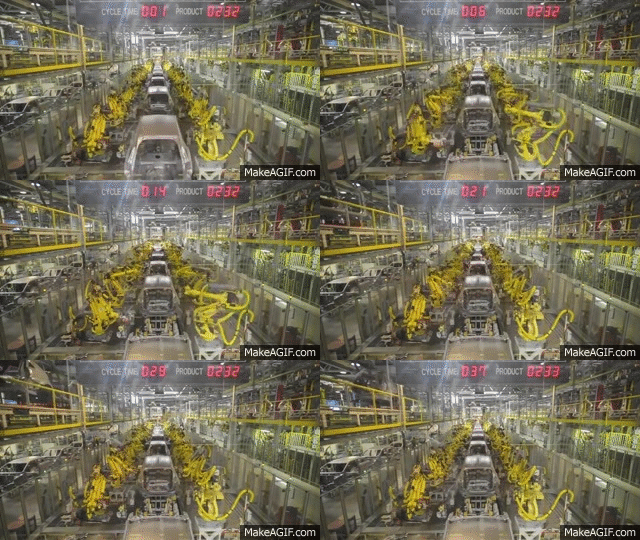
Robots weld vehicle panels in the Body Shop at the Nissan Sunderland Plant
Robots weld vehicle panels at the Nissan Sunderland plant

Harry Bridges was the legendary president of the American dockers' union who won his spurs organising through the bloody strike of 1934. But it was the mechanisation revolution of the Sixties that really put him to the test. Bridges knew he couldn't turn back the tide. So he set out a different question: how to win for his members “a piece of the machine”. The challenge, said Bridges, was how to get the machines working for the workers and not against them.

That question – the “Bridges test” – is once again the challenge for progressives as we face the future of work.

There is much to alarm us. Think of James Bloodworth's chilling account of life in an Amazon warehouse, where ubiquitous monitors have become what my friend Clive Efford calls the digital “butty man”; deciding who gets paid what at the end of the week. Or the death of DPD driver Don Lane, who worked himself to death in fear of the firm's penalties for slowness. Or Deliveroo's court-won freedom not to pay minimum wage or holiday pay.

The statistics behind the stories are even worse: 10 per cent of UK jobs are at risk of significant change. But the sectors hit fastest and hardest – retail and transportation – are those that employ the majority of the British working class. We could lose more working-class jobs than during the shutdown of coal, steel and shipbuilding combined.

Continue reading


Thursday, 23 November 2017

Industrial robotics security is really, really terrible

a post by Cory Doctorow for the Boing Boing blog


Researchers from Politecnico di Milano and Trend Micro conducted an audit of the information security design of commonly used industrial robots and found that these devices are extremely insecure:

  • robots could be easily reprogrammed to violate their safety parameters, both by distorting the robots' ability to move accurately and by changing the movements the robots attempt to perform;
  • hacked robots can also be made to perform movements with more force than is safe;
  • normal safety measures that limit speed and force can be disabled;
  • robots can be made to falsify their own telemetry, fooling human operators;
  • emergency manual override switches can be disabled or hidden;
  • robots can be silently switched from manual to automatic operation, making them move suddenly and forcefully while dangerously close to oblivious, trusting humans; and of course,
  • robots can be caused to manufacture faulty goods that have to be remanufactured or scrapped.

Continue reading