Showing posts with label biodiversity. Show all posts

Tuesday, 25 June 2019

What biodiversity loss means for our health

a post by Aaron Bernstein for the OUP blog


“The sun sets over Nature Valley in South Africa.” by redcharlie. Public domain via Unsplash.

Among the great lies I learned in medical school was that a human being was the product of a sperm and an egg. Yes, these gametes are necessary, but they are hardly sufficient to create and sustain a human life. Each one of us stays alive only with the help of trillions of other organisms – the human microbiome – that live on and in every surface of our body exposed to the outside world. Of all the cells that comprise a human body, only two-thirds derive from a sperm and an egg. We can see inklings of what a massive disruption to our relationship with the microorganisms that live within us means to health with the overuse of antibiotics. Antibiotic disruption can foster antimicrobial resistance, weight gain, autoimmune disease, and even perhaps mental health disorders.

Continue reading


Sunday, 25 March 2018

What is biodiversity and why does it matter to us?

an article by Damian Carrington published in the Guardian

The air you breathe, the water you drink and the food you eat all rely on biodiversity, but right now it is in crisis – because of us. What does this mean for our future and can we stop it?

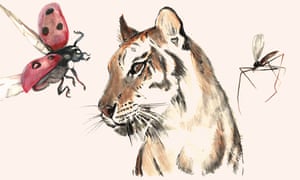
 Bugs illustration
            Bugs are the base of the many wild food chains
that support ecosystems. Illustration: Frances Marriott

What is biodiversity?

It is the variety of life on Earth, in all its forms and all its interactions. If that sounds bewilderingly broad, that’s because it is. Biodiversity is the most complex feature of our planet and it is the most vital. “Without biodiversity, there is no future for humanity,” says Prof David Macdonald, at Oxford University.

The term was coined in 1985 – a contraction of “biological diversity” – but the huge global biodiversity losses now becoming apparent represent a crisis equalling – or quite possibly surpassing – climate change.

More formally, biodiversity is comprised of several levels, starting with genes, then individual species, then communities of creatures and finally entire ecosystems, such as forests or coral reefs, where life interplays with the physical environment. These myriad interactions have made Earth habitable for billions of years.

A more philosophical way of viewing biodiversity is this: it represents the knowledge learned by evolving species over millions of years about how to survive through the vastly varying environmental conditions Earth has experienced. Seen like that, experts warn, humanity is currently “burning the library of life”.

Continue reading and be terrified.