an article by Christof Van Mol (Tilburg University,The Netherlands / Netherlands Interdisciplinary Demographic Institute, The Hague / Universiteit Antwerpen, Belgium), Erik Snel (Erasmus Universiteit Rotterdam (EUR), The Netherlands), Kenneth Hemmerechts (Vrije Universiteit Brussels, Belgium) and Christiane Timmerman (Universiteit Antwerpen, Belgium) published in Population, Space and Place Volume 24 Issue 5 (July 2018)
Abstract
An abundant body of research focused on macrolevel, mesolevel, and microlevel factors explaining why individuals move across international borders.
In this paper, we aim to complement the existing literature by exploring how, within a single country, mesolevel factors differently impact migration aspirations, focusing on a case study of Ukraine. We particularly focus on how migration aspirations of individuals in two different regions can be explained by their international social networks with family members, on the one hand, and with friends, on the other.
Furthermore, we explore whether regional migration characteristics play a role, as well as the interaction of such characteristics with individuals' frequency of contact with transnational networks.
Our analyses are based on the EUMAGINE project and suggest that the interplay between regional migration characteristics and transnational social contact are key for explaining the decline of migration systems over time.
Full text (PDF 11pp)
Showing posts with label Ukraine. Show all posts
Showing posts with label Ukraine. Show all posts
Tuesday, 21 August 2018


Friday, 9 March 2018
Why is the world at war?
an article by Jason Burke for the Observer [published online by the Guardian]
Syria, the Democratic Republic of Congo, Yemen, Afghanistan, Ukraine – the globe is scarred by violence
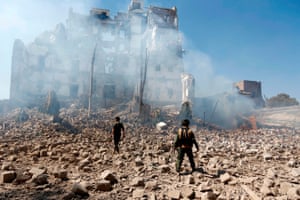
The aftermath of an air strike by the Saudi-led coalition on the Yemeni capital Sana’a.
Photograph: Mohammed Huwais/AFP/Getty Images
We live in a world of trouble. Conflicts today may be much less lethal than those that scarred the last century, but this brings little comfort. We remain deeply anxious. We can blame terrorism and the fear it inspires despite the statistically unimportant number of casualties it inflicts, or the contemporary media and the breathless cycle of “breaking news”, but the truth remains that the wars that seem to inspire the fanatics or have produced so many headlines in recent years prompt deep anxiety. One reason is that these wars appear to have no end in sight.
To explain these conflicts we reach for easy binary schema – Islam v the west; haves against have-nots; nations that “play by the rules” of the international system against “rogues”. We also look to grand geopolitical theories – the end of the Westphalian system, the west faced by “the rise of the rest” – or even just attribute the violence to “geography”. None of these explanations seems to adequately allay our concerns.
Continue reading
Syria, the Democratic Republic of Congo, Yemen, Afghanistan, Ukraine – the globe is scarred by violence
The aftermath of an air strike by the Saudi-led coalition on the Yemeni capital Sana’a.
Photograph: Mohammed Huwais/AFP/Getty Images
We live in a world of trouble. Conflicts today may be much less lethal than those that scarred the last century, but this brings little comfort. We remain deeply anxious. We can blame terrorism and the fear it inspires despite the statistically unimportant number of casualties it inflicts, or the contemporary media and the breathless cycle of “breaking news”, but the truth remains that the wars that seem to inspire the fanatics or have produced so many headlines in recent years prompt deep anxiety. One reason is that these wars appear to have no end in sight.
To explain these conflicts we reach for easy binary schema – Islam v the west; haves against have-nots; nations that “play by the rules” of the international system against “rogues”. We also look to grand geopolitical theories – the end of the Westphalian system, the west faced by “the rise of the rest” – or even just attribute the violence to “geography”. None of these explanations seems to adequately allay our concerns.
Continue reading
Thursday, 10 November 2011
Tymoshenko: Wake-up call for the EU
a paper by Mykola Riabchuk published in eurozine articles on 28 October 2011
The EU shouldn’t be surprised by the Tymoshenko verdict: its support of anything nominally reformist has been perceived as acceptance of a range of repressions. Tough measures are now needed if another authoritarian regime is to be prevented from forming on the EU’s eastern border.
Read about the EU failure in Ukraine, which could lead to future problems, here.
The EU shouldn’t be surprised by the Tymoshenko verdict: its support of anything nominally reformist has been perceived as acceptance of a range of repressions. Tough measures are now needed if another authoritarian regime is to be prevented from forming on the EU’s eastern border.
Read about the EU failure in Ukraine, which could lead to future problems, here.
Subscribe to:
Posts (Atom)

