an article by Stephen Hincks (University of Manchester, UK) published in Urban Studies Volume 54 Issue 4 (March 2017)
Abstract
Many studies of neighbourhood change adopt a ‘bookend’ mode of analysis in which a baseline year is identified for a chosen outcome variable from which the magnitude of change is calculated to a determined endpoint typically over bi-decadal or decadal timeframes.
However, this mode of analysis smoothes away short-run change patterns and neighbourhood dynamics.
The implications of this practice could be far reaching if it is accepted that as neighbourhoods change they are liable to cross a threshold and transition from one state to another in the short- as well as longer-term.
In a case study of deprived neighbourhoods in the Greater Manchester city-region, this paper aims to contribute to neighbourhood change debates in two ways.
The first is by isolating transition pathways for individual neighbourhoods using annual change data.
The second is by testing the thesis that the more deprived a neighbourhood is, the more likely it is to respond with greater volatility to short-run shocks when compared with less-deprived neighbourhoods.
Four indicators collected annually between 2001 and 2010 are used to develop a typology of neighbourhood change and a subsequent typology of neighbourhood transition. The analysis exposed 260 different transition pathways that deprived neighbourhoods followed over the study period.
Multinomial logistic regression was then used to determine the odds of a neighbourhood undergoing transition along a specific pathway owing to its level of deprivation. The model revealed that the most deprived neighbourhoods were likely to follow more volatile transition pathways compared with the less-deprived neighbourhoods especially during periods of economic difficulty.
Tuesday, 21 March 2017


Statistical learning: a powerful mechanism that operates by mere exposure
an article by Richard N. Aslin (University of Rochester, NY, USA) published in Wiley Interdisciplinary Reviews: Cognitive Science Volume 8 Issue 1-2 (January-April 2017)
Abstract
How do infants learn so rapidly and with little apparent effort? In 1996, Saffran, Aslin, and Newport reported that 8-month-old human infants could learn the underlying temporal structure of a stream of speech syllables after only 2 min of passive listening.
This demonstration of what was called statistical learning, involving no instruction, reinforcement, or feedback, led to dozens of confirmations of this powerful mechanism of implicit learning in a variety of modalities, domains, and species. These findings reveal that infants are not nearly as dependent on explicit forms of instruction as we might have assumed from studies of learning in which children or adults are taught facts such as math or problem solving skills.
Instead, at least in some domains, infants soak up the information around them by mere exposure. Learning and development in these domains thus appear to occur automatically and with little active involvement by an instructor (parent or teacher).
The details of this statistical learning mechanism are discussed, including how exposure to specific types of information can, under some circumstances, generalize to never-before-observed information, thereby enabling transfer of learning.
For further resources related to this article, please visit the WIREs website.
Full text (PDF)
Monday, 20 March 2017
Is the data on your wearable device secure? An Android Wear smartwatch case study
an article by Quang Do, Ben Martini and Kim-Kwang Raymond Choo (University of South Australia, Adelaide, Australia) published in Journal of Software: Practice and Experience Volume 47 Issue 3 (March 2017)
Summary
The increasing convergence of wearable technologies and cloud services in applications, such as health care, could result in new attack vectors for the ‘Cloud of Things’, which could in turn be exploited to exfiltrate sensitive user data.
In this paper, we analyze the types of sensitive user data that may be present on a wearable device and develop a method to demonstrate that they can be exfiltrated by an adversary. To undertake this study, we select the Android Wear smartwatch operating system as a case study and, specifically, the Samsung Gear Live smartwatch.
We present a technique that allows an adversary to exfiltrate data from smartwatches. Using this technique, we determine that the smartwatch stores a relatively large amount of sensitive user data, including SMS messages, contact information, and biomedical data, and does not effectively protect this user data from physical exfiltration.
Copyright © 2016 John Wiley & Sons, Ltd.
The moral frontiers of English education policy: governmentality and ethics within an alternative provision free school
an article by Francis Farrell, Vicky Duckworth, Monika Reece and Philip Rigby (Edge Hill University, Ormskirk, UK) published in Educational Review Volume 69 Issue 3 (2017)
Abstract
This article is a critical poststructuralist analysis of Conservative led free school policy in England focusing on claims made by the New Schools Network and in the 2010 White Paper that free school provision promotes social justice.
The article presents an empirical study of an alternative provision free school as a lens through which these claims can be interrogated. Drawing from Foucault’s concept of governmentality the article analyses the narratives of teachers working in the school in order to gain insights into the microphysics of the policy rationalities mobilised within the discursive site of the free school and claims that such provision promotes social justice.
The teachers interviewed demonstrate a strong alignment to free school policy discourse, but also a blurring of pastoral and disciplinary rationalities expressed in terms of the rehabilitation of students on the educational boundaries of the “normal”.
The article concludes that the school is a tactical move within neoliberal education policy in which the state responsibilises a new polity of actors, including teachers, sponsors and communities contracting out its interventions in order to govern the ungovernable.
The article calls for further empirical research of free school provision in order to contest neoliberal discourses which obfuscate complex systemic failure and the social reality of intergenerational unemployment and disadvantage.
Sunday, 19 March 2017
Sunday's offering of trivial items for your delectation
Woolly mammoths’ demise blamed on freshwater shortage
via The Guardian by Nicola Davis

A model of a woolly mammoth. Researchers say they have solved the mystery of what killed a small group of the creatures. Photograph: Andrew Nelmerm/Getty Images/Dorling Kindersley
One of the last known populations of woolly mammoths was wiped out 5,600 years ago by a lack of freshwater, research suggests.
Woolly mammoths became extinct in North America and mainland Asia around 10,000 years ago, but a small number survived on islands lying between Siberia and Alaska which, before sea-level rises, were part of the Bering Land Bridge.
Continue reading
=============================
Richmond: the lost palace
via The National Archive Blog by Marcus Goringe
As a lifelong resident of Richmond I have been surrounded by the remnants of a lost palace, hidden in almost plain sight, but like most others never given it more than a passing thought.
Since starting work at The National Archive ten weeks ago I have found myself drawn to the history of Richmond Palace and its importance over the last 900 years: where did this palace go and what happened there?
Continue reading
=============================
There Is No Scientific Method
via 3 Quarks Daily: James Blachowicz in the New York Times

A reproduction of Kepler’s illustration to explain his discovery of the elliptical orbit of Mars. Universal History Archive/Getty Images
In 1970, I had the chance to attend a lecture by Stephen Spender. He described in some detail the stages through which he would pass in crafting a poem. He jotted on a blackboard some lines of verse from successive drafts of one of his poems, asking whether these lines (a) expressed what he wanted to express and (b) did so in the desired form. He then amended the lines to bring them closer either to the meaning he wanted to communicate or to the poetic form of that communication.
I was immediately struck by the similarities between his editing process and those associated with scientific investigation and began to wonder whether there was such a thing as a scientific method. Maybe the method on which science relies exists wherever we find systematic investigation. In saying there is no scientific method, what I mean, more precisely, is that there is no distinctly scientific method.
Continue reading
============================
Why we are unaware of how unaware we are
via Boing Boing by David McRaney
Each one of us has a relationship with our own ignorance, a dishonest, complicated relationship, and that dishonesty keeps us sane, happy, and willing to get out of bed in the morning.
Part of that ignorance is a blind spot we each possess that obscures both our competence and incompetence.
Continue reading
=============================
The Battle of the Seine: Henry V's unknown naval triumph
via The National Archives Blog by Benjamin Trowbridge
With the limelight of the 600th anniversary of the Battle of Agincourt fading, the anniversary of a less well-known naval engagement fought in the mouth of the river Seine is approaching.
On 15 August 1416, a fleet of English ships under the command of the king Henry V’s brother the Duke of Bedford successfully defeated and scattered a Franco-Genoese naval force blockading the recently conquered port of Harfleur.
Continue reading
The anniversaries referred to were last year but I thought this was still of interest.
============================
Maps lie: countries that fit inside other countries
via Boing Boing by Rob Beschizza
We all know the traditional, navigator-friendly Mercator projection distorts the true sizes of Earth’s landmasses. But it’s fascinating to see how countries look next to one another when that distortion is, as far as possible, removed. The tininess of Britain against Japan, for example, or the vastness of Alaska against France, become specific in this video from RealLifeLore. As for Greenland…
Continue reading
============================
Tales of the Psammead
via An Awfully Big Blog Adventure by Lynne Benton
One of my favourite books from childhood was E. Nesbit’s “5 Children and It” – It being the Psammead, or Sand-Fairy, a strange creature with a round furry body and eyes out on stalks who says he can grant one wish a day. In the book, published in 1902, he does indeed give the five children (or more accurately, four children: Cyril, Anthea, Robert and Jane, and their baby brother, the Lamb) a wish every day. Unfortunately the children don’t necessarily think their ideas through, and every wish brings unexpected problems with it. However, the wishes only last until sunset, after which the children can think more carefully about what they will wish for the next day.
Continue reading
============================
A collection of Victorian profanities
via OUP Blog
Euphemisms, per their definition, are used to soften offensive language. Topics such as death, sex, and bodily functions are often discussed delicately, giving way to statements like, “he passed away,” “we’re hooking up,” or “it’s that time of the month”.
Continue reading
=============================
Watch this helpful “Kids Guide to the Internet”
via Boing Boing by David Pescovitz
…from 1997.
On your mark, get set
Now we’re riding on the Internet
Cyberspace, sets us free
Hello virtual reality
Interactive appetite
Searching for a Web site…
Continue reading
============================
Captain Fryatt: forgotten martyr of the First World War
via The National Archives Blog by Stephen Twigge
On 27 July 1916, Charles Algernon Fryatt, the Captain of the SS Brussels – a passenger ferry that ran between Harwich and neutral Holland – was executed by the Germans. He was only the second British civilian to be executed during the war; the other was nurse Edith Cavell, who was shot on the morning of 12 October 1915.
At the time, the executions of Cavell and Fryatt caused international outcry; their funerals were attended by thousands of enraged and patriotic mourners. While Nurse Cavell is now considered a martyr and a victim of German barbarism, the case of Captain Fryatt has all but disappeared from public consciousness.
Continue reading
via The Guardian by Nicola Davis
A model of a woolly mammoth. Researchers say they have solved the mystery of what killed a small group of the creatures. Photograph: Andrew Nelmerm/Getty Images/Dorling Kindersley
One of the last known populations of woolly mammoths was wiped out 5,600 years ago by a lack of freshwater, research suggests.
Woolly mammoths became extinct in North America and mainland Asia around 10,000 years ago, but a small number survived on islands lying between Siberia and Alaska which, before sea-level rises, were part of the Bering Land Bridge.
Continue reading
=============================
Richmond: the lost palace
via The National Archive Blog by Marcus Goringe
As a lifelong resident of Richmond I have been surrounded by the remnants of a lost palace, hidden in almost plain sight, but like most others never given it more than a passing thought.
Since starting work at The National Archive ten weeks ago I have found myself drawn to the history of Richmond Palace and its importance over the last 900 years: where did this palace go and what happened there?
Continue reading
=============================
There Is No Scientific Method
via 3 Quarks Daily: James Blachowicz in the New York Times
A reproduction of Kepler’s illustration to explain his discovery of the elliptical orbit of Mars. Universal History Archive/Getty Images
In 1970, I had the chance to attend a lecture by Stephen Spender. He described in some detail the stages through which he would pass in crafting a poem. He jotted on a blackboard some lines of verse from successive drafts of one of his poems, asking whether these lines (a) expressed what he wanted to express and (b) did so in the desired form. He then amended the lines to bring them closer either to the meaning he wanted to communicate or to the poetic form of that communication.
I was immediately struck by the similarities between his editing process and those associated with scientific investigation and began to wonder whether there was such a thing as a scientific method. Maybe the method on which science relies exists wherever we find systematic investigation. In saying there is no scientific method, what I mean, more precisely, is that there is no distinctly scientific method.
Continue reading
============================
Why we are unaware of how unaware we are
via Boing Boing by David McRaney
Each one of us has a relationship with our own ignorance, a dishonest, complicated relationship, and that dishonesty keeps us sane, happy, and willing to get out of bed in the morning.
Part of that ignorance is a blind spot we each possess that obscures both our competence and incompetence.
Continue reading
=============================
The Battle of the Seine: Henry V's unknown naval triumph
via The National Archives Blog by Benjamin Trowbridge
With the limelight of the 600th anniversary of the Battle of Agincourt fading, the anniversary of a less well-known naval engagement fought in the mouth of the river Seine is approaching.
On 15 August 1416, a fleet of English ships under the command of the king Henry V’s brother the Duke of Bedford successfully defeated and scattered a Franco-Genoese naval force blockading the recently conquered port of Harfleur.
Continue reading
The anniversaries referred to were last year but I thought this was still of interest.
============================
Maps lie: countries that fit inside other countries
via Boing Boing by Rob Beschizza
We all know the traditional, navigator-friendly Mercator projection distorts the true sizes of Earth’s landmasses. But it’s fascinating to see how countries look next to one another when that distortion is, as far as possible, removed. The tininess of Britain against Japan, for example, or the vastness of Alaska against France, become specific in this video from RealLifeLore. As for Greenland…
Continue reading
============================
Tales of the Psammead
via An Awfully Big Blog Adventure by Lynne Benton
One of my favourite books from childhood was E. Nesbit’s “5 Children and It” – It being the Psammead, or Sand-Fairy, a strange creature with a round furry body and eyes out on stalks who says he can grant one wish a day. In the book, published in 1902, he does indeed give the five children (or more accurately, four children: Cyril, Anthea, Robert and Jane, and their baby brother, the Lamb) a wish every day. Unfortunately the children don’t necessarily think their ideas through, and every wish brings unexpected problems with it. However, the wishes only last until sunset, after which the children can think more carefully about what they will wish for the next day.
Continue reading
============================
A collection of Victorian profanities
via OUP Blog
Euphemisms, per their definition, are used to soften offensive language. Topics such as death, sex, and bodily functions are often discussed delicately, giving way to statements like, “he passed away,” “we’re hooking up,” or “it’s that time of the month”.
Continue reading
=============================
Watch this helpful “Kids Guide to the Internet”
via Boing Boing by David Pescovitz
…from 1997.
On your mark, get set
Now we’re riding on the Internet
Cyberspace, sets us free
Hello virtual reality
Interactive appetite
Searching for a Web site…
Continue reading
============================
Captain Fryatt: forgotten martyr of the First World War
via The National Archives Blog by Stephen Twigge
On 27 July 1916, Charles Algernon Fryatt, the Captain of the SS Brussels – a passenger ferry that ran between Harwich and neutral Holland – was executed by the Germans. He was only the second British civilian to be executed during the war; the other was nurse Edith Cavell, who was shot on the morning of 12 October 1915.
At the time, the executions of Cavell and Fryatt caused international outcry; their funerals were attended by thousands of enraged and patriotic mourners. While Nurse Cavell is now considered a martyr and a victim of German barbarism, the case of Captain Fryatt has all but disappeared from public consciousness.
Continue reading
Saturday, 18 March 2017
Another ten items of varying degrees of interest
All hail the humble moss, bringer of oxygen and life to Earth
via the Guardian by Tim Radford
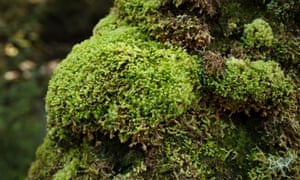
Low-growing moss drew carbon from the air, created topsoil for the first vascular plants, and in 40 million years or so increased oxygen in the atmosphere to levels that endure today.
Photograph: Gareth Phillips/Gareth Phillips for the Guardian
A reconstruction using geological evidence, fossils and ancient spores has revealed the crucial role of moss in creating the conditions for life as we know it.
Continue reading
=============================
Sultana Morayma: the Last Queen of Al Andalus
via 3 Quarks Daily by Shadab Zeest Hashmi
At the end of the story, in its final pages, is a queen. Not the pious despot Isabella of Castille who is about to command the Inquisition, or the embittered, vengeful Sultana Aixa la Horra who is inciting war within the house of Nasrid, but the queen who is obscured from view on this history’s chessboard, whose life and death will come to be a veritable symbol of the paradox that is Al Andalus, the queen who prevails as the enduring shadow of a legend. Her name is Morayma.
Continue reading
=============================
Why cooperate?
via OUP Blog by Judith L. Bronstein
Birds do it. Bees do it. Microbes do it, and people do it. Throughout nature, organisms cooperate. Humans are undeniably attracted by the idea of cooperation. For thousands of years, we have been seeking explanations for its occurrence in other organisms, often imposing our own motivations and ethics in an effort to explain what we see.
Continue reading
=============================
Everything is illuminated: the wonder of medieval manuscripts – in pictures
via The Guardian
The Fitzwilliam Museum has brought together some dazzling, intricate manuscripts, whose colours foreshadow modern art … in the middle ages.
That’s it. Pictures and pictures. And what pictures. I think that this was my favourite.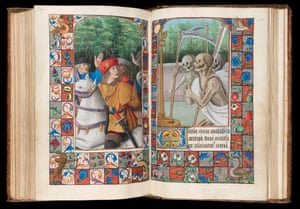
See for yourself
=============================
What Fear Does to Your Brain And How to Stop It
via Big Think by Laurie Vazquez

From our televisions to our political conversations, we are inundated with messages of fear. We feel more afraid of the world and our own neighbors now than we have in decades. But all that fear isn’t good for us. In fact, according to neuroscience, fear is killing us.
Continue reading
=============================
Ten facts about the bass guitar
via OUP Blog by Scott Gleason
The bass guitar is often thought to be a poor musician’s double bass or a poor musician’s guitar. Nonetheless, luthiers and performers have explored its expressive possibilities within a wide range of musical styles and performance traditions, some of which we chart below.
Continue reading
=============================
Food for thought? Rationing and the Second World War
via The National Archives Blog by Lauren Willmott and Annie Davis
What did you eat for lunch today? Cheese sandwiches? Sushi, salad, chips? Have you ever given any thought as to what your food reveals about society in 2016?
Perhaps that wilted spinach you put in the bin earlier reveals more than just your absent-mindedness; instead it might represent our fast-paced, throw-away culture. Maybe your mid-morning kale smoothie is not only a tasty beverage but also in fact evidence of a modern fascination with #cleaneating and the market power of Instagrammable foodstuffs.
Continue reading
=============================
The visualizations transforming biology
via 3 Quarks Daily: Ewen Callaway in Nature
A smart visualization can transform biologists’ understanding of their data. And now that it’s possible to sequence every RNA molecule in a cell or fill a hard drive in a day with microscopy images, life scientists are increasingly seeking inventive visual ways of making sense of the glut of raw data that they collect. Some of the visualizations that are currently exciting biologists were presented at a conference at the European Molecular Biology Laboratory in Heidelberg, Germany, in March [2016]. Called Visualizing Biological Data (VIZBI), the meeting was co-organized by Seán O'Donoghue, a bioinformatician at the Garvan Institute of Medical Research in Sydney, Australia. The gathering attracts an eclectic mix of lab researchers, computer scientists and designers and is now in its seventh year.
Continue reading
Hazel’s comment:
I may not understand the science but I can appreciate the illustrations!
=============================
Supernatural Shakespeare
via OUP Blog by Diane Purkiss
How do you make fairytales into realism? Everyone agrees that doing this work means supplying them with material forms. This is not, however, a novelist’s novelty. Shakespeare’s fairies are small plant flowers and seeds, and his monster knows how to dig pignuts. His witch likes chestnuts, and his ghosts rise out of real graves. The writer’s problem is how to make the fantastic seem real. But there is more to it than that. If Titania’s ‘small elves’ need coats, then they – and we – walk a shivery line between real and imaginary. If they need coats, are they as real as we are? Are we as fantastical as they? Not merely a collage of real thrown at a concept, but writing, itself.
Continue reading
=============================
Why medieval monks filled manuscript margins with murderous rabbits
via Boing Boing by Cory Doctorow
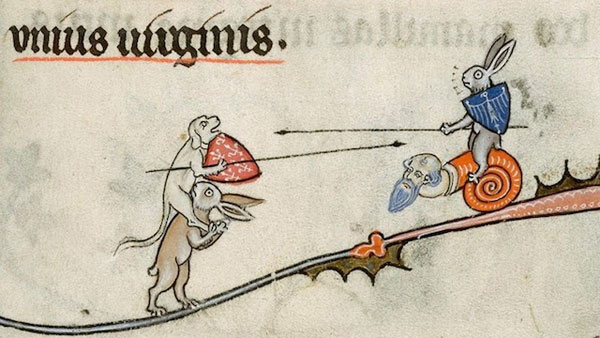
Long before Sergio Aragonés filled the margins of MAD Magazine with tiny, weird cartoons, the margins of medieval manuscripts were a playground for bored monks with crude senses of humor.
While some monks expressed themselves with flat-out crudity, a more common motif was the ubiquitous, triumphant armed rabbit, often shown killing dogs, humans, and other enemies of bunnykind.
Continue reading
via the Guardian by Tim Radford
Low-growing moss drew carbon from the air, created topsoil for the first vascular plants, and in 40 million years or so increased oxygen in the atmosphere to levels that endure today.
Photograph: Gareth Phillips/Gareth Phillips for the Guardian
A reconstruction using geological evidence, fossils and ancient spores has revealed the crucial role of moss in creating the conditions for life as we know it.
Continue reading
=============================
Sultana Morayma: the Last Queen of Al Andalus
via 3 Quarks Daily by Shadab Zeest Hashmi
At the end of the story, in its final pages, is a queen. Not the pious despot Isabella of Castille who is about to command the Inquisition, or the embittered, vengeful Sultana Aixa la Horra who is inciting war within the house of Nasrid, but the queen who is obscured from view on this history’s chessboard, whose life and death will come to be a veritable symbol of the paradox that is Al Andalus, the queen who prevails as the enduring shadow of a legend. Her name is Morayma.
Continue reading
=============================
Why cooperate?
via OUP Blog by Judith L. Bronstein
Birds do it. Bees do it. Microbes do it, and people do it. Throughout nature, organisms cooperate. Humans are undeniably attracted by the idea of cooperation. For thousands of years, we have been seeking explanations for its occurrence in other organisms, often imposing our own motivations and ethics in an effort to explain what we see.
Continue reading
=============================
Everything is illuminated: the wonder of medieval manuscripts – in pictures
via The Guardian
The Fitzwilliam Museum has brought together some dazzling, intricate manuscripts, whose colours foreshadow modern art … in the middle ages.
That’s it. Pictures and pictures. And what pictures. I think that this was my favourite.
See for yourself
=============================
What Fear Does to Your Brain And How to Stop It
via Big Think by Laurie Vazquez
From our televisions to our political conversations, we are inundated with messages of fear. We feel more afraid of the world and our own neighbors now than we have in decades. But all that fear isn’t good for us. In fact, according to neuroscience, fear is killing us.
Continue reading
=============================
Ten facts about the bass guitar
via OUP Blog by Scott Gleason
The bass guitar is often thought to be a poor musician’s double bass or a poor musician’s guitar. Nonetheless, luthiers and performers have explored its expressive possibilities within a wide range of musical styles and performance traditions, some of which we chart below.
Continue reading
=============================
Food for thought? Rationing and the Second World War
via The National Archives Blog by Lauren Willmott and Annie Davis
What did you eat for lunch today? Cheese sandwiches? Sushi, salad, chips? Have you ever given any thought as to what your food reveals about society in 2016?
Perhaps that wilted spinach you put in the bin earlier reveals more than just your absent-mindedness; instead it might represent our fast-paced, throw-away culture. Maybe your mid-morning kale smoothie is not only a tasty beverage but also in fact evidence of a modern fascination with #cleaneating and the market power of Instagrammable foodstuffs.
Continue reading
=============================
The visualizations transforming biology
via 3 Quarks Daily: Ewen Callaway in Nature
A smart visualization can transform biologists’ understanding of their data. And now that it’s possible to sequence every RNA molecule in a cell or fill a hard drive in a day with microscopy images, life scientists are increasingly seeking inventive visual ways of making sense of the glut of raw data that they collect. Some of the visualizations that are currently exciting biologists were presented at a conference at the European Molecular Biology Laboratory in Heidelberg, Germany, in March [2016]. Called Visualizing Biological Data (VIZBI), the meeting was co-organized by Seán O'Donoghue, a bioinformatician at the Garvan Institute of Medical Research in Sydney, Australia. The gathering attracts an eclectic mix of lab researchers, computer scientists and designers and is now in its seventh year.
Continue reading
Hazel’s comment:
I may not understand the science but I can appreciate the illustrations!
=============================
Supernatural Shakespeare
via OUP Blog by Diane Purkiss
How do you make fairytales into realism? Everyone agrees that doing this work means supplying them with material forms. This is not, however, a novelist’s novelty. Shakespeare’s fairies are small plant flowers and seeds, and his monster knows how to dig pignuts. His witch likes chestnuts, and his ghosts rise out of real graves. The writer’s problem is how to make the fantastic seem real. But there is more to it than that. If Titania’s ‘small elves’ need coats, then they – and we – walk a shivery line between real and imaginary. If they need coats, are they as real as we are? Are we as fantastical as they? Not merely a collage of real thrown at a concept, but writing, itself.
Continue reading
=============================
Why medieval monks filled manuscript margins with murderous rabbits
via Boing Boing by Cory Doctorow
Long before Sergio Aragonés filled the margins of MAD Magazine with tiny, weird cartoons, the margins of medieval manuscripts were a playground for bored monks with crude senses of humor.
While some monks expressed themselves with flat-out crudity, a more common motif was the ubiquitous, triumphant armed rabbit, often shown killing dogs, humans, and other enemies of bunnykind.
Continue reading
Friday, 17 March 2017
Where gender equality remains a myth, minority representation of women in architecture
an article by Graham Cole (Halifax, UK) published in Human Resource Management International Digest Volume 25 Issue 2 (2017)
Abstract
Purpose
This paper aims to review the latest management developments across the globe and pinpoint practical implications from cutting-edge research and case studies.
Design/methodology/approach
This briefing is prepared by an independent writer who adds their own impartial comments and places the articles in context.
Findings
Achieving equal opportunity for all was one of the driving forces behind the creation of the European Union (EU) in the mid-twentieth century.
In its different guises since then, the constitution has issued various directives pertaining to the issue. Member nations are thus expected to comply with the principles outlined in them.
Key to this arrangement is that countries are empowered to choose their own way of meeting equality objectives. Where gender equality in the context of work is concerned, it appears that progress has been minimal at best.
One might argue that paying lip service to EU Directives is as good as it gets in many cases.
The number of professions which are still firmly male-dominated is ample testimony to such notions.
Originality/value
The briefing saves busy executives and researchers hours of reading time by selecting only the very best, most pertinent information and presenting it in a condensed and easy-to-digest format.
Subscribe to:
Posts (Atom)


