Saturday, 11 February 2017

A "voluptuous" process through to climate change and how wine might be affected

How ink is made: a voluptuous process revealed in a mouth-watering video
via Boing Boing by Mark Frauenfelder
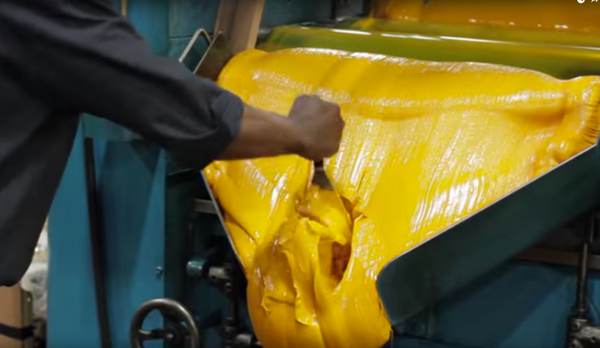
Ayun Halliday of Open Culture wrote about this luscious ink-making video. As depicted above, ink making is as voluptuous a process as making a high end candy bar. Having grown up around the printing floor of a daily newspaper, I know that ink’s pungent aroma is the opposite of chocolate-y, but my mouth still started to water. Was it the commercial-ready classical soundtrack or hearing Chief Ink Maker Peter Welfare comparing the pigment’s gooey “vehicle” to honey? I won’t be dipping my tongue in the ink pot any time soon, but the multistep four color process by which powdered cyan, magenta, yellow, and black hues become press-bound ink proved far more sensual than expected.
Continue reading

===================================
Disbelief in Belief
via 3 Quarks Daily by Maarten Boudry
A man walking in the forest at night arrives at a house with lights burning inside. Looking through the window, he sees people jumping frantically and flailing about. Poor fellows, thinks the man: they are having seizures, or they must be terribly ill, or they have become insane. What the man doesn't hear is the music playing inside. The people are dancing and singing for a wedding. Gershom Gorenberg recounts this Jewish-Chassidic parable in his splendid book The End of Days on the danger of apocalyptic belief systems. Its morale? If you don't hear the music of faith, you will conclude that the dancers are out of their mind.
Continue reading

===================================
Anything to Get the Shot: Itinerant Photographers
via Picture This by Kristi Finefield
County fair, tintype booth of Miss. F.B. Johnston, May 1903. Photo by Frances Benjamin Johnston, May 1903. hdl.loc.gov/loc.pnp/ds.06570
“Look! Look!! Look!!! Tintypes. Cheap. Beautiful. Lasting.” The sign posted by the entrance to an elaborate temporary booth at a 1903 county fair sums up in a handful of words much of the appeal of the simple tintype portrait photograph.
Continue reading

===================================
Why We Have Different Blood Types
via Big Think by Natalie Shoemaker
Article Image
I still remember when my mother told me I had O- blood. She said it meant I was a universal donor—anyone could receive my blood, but I could only take O- blood in return. I’ll admit feeling prideful of this distinction — as if I've been selected for a duty to help others. It’s a fact I’ve never questioned until recently. After all, what’s the evolutionary advantage for having such different blood types? It certainly doesn’t do us any favours when receiving a transfusion of a blood not of your type could very well kill you.
Continue reading

===================================
Man’s Pest Friend
via Arts & Letters Daily: Steve Donoghue in Open Letter Monthly, an Arts and Literature Review
What is a Dog?
By Raymond Coppinger and Lorna Coppinger (University of Chicago Press, 2016)
Look at the pictures in any issue of the National Geographic going back a hundred years, and you’ll see them. They’ll never be the actual subject of the photo, but behind every gap-toothed old sage in Kathmandu, behind every flirting young couple in Zanzibar, behind every struggling family in Ecuador, behind every black-eyed bush elder on the outskirts of the Amazon, behind every hunched team of Arctic explorers rimed in hoarfrost, behind every strutting Texas rodeo star … eating or sleeping or slinking or just standing incuriously in countless hundreds of photos will be dogs: scrappy, dun-colored pi dogs, village dogs, feral dogs, dump dogs.
Continue reading

===================================
How to construct a bow and arrows using only primitive stone tools
via Boing Boing by Mark Frauenfelder

I've been avidly watching these Primitive Technology videos. The fellow who makes the videos lives in "Far North Queensland, Australia," and so far has made a hut with a kiln-fired tiled roof, underfloor heating and mud pile walls, baskets, a stone hatchet, charcoal, and a sling using only his hands on primitive stone tools. In his latest video, he builds a bow and some arrows.
Continue reading

===================================
The revolutionary science of eighteenth century France
Steve Jones’ new book is an ingenious tour of scientific innovation in the age of the guillotine.
via New Statesman by Ruth Scurr
In his introduction to No Need for Geniuses the geneticist Steve Jones claims to be indulging in “what the French call, in an inelegant but precise phrase, vulgarisation scientifique”. What follows is an ingenious guidebook to the scientific past of Paris, written in lucid, erudite prose that is certainly not vulgar in the English sense.
Continue reading

===================================
Second North American Viking site suspected
via Boing Boing by Rob Beschizza

L'Anse Aux Meadows was the first, and until now the only site widely accepted as evidence of Viking settlement in the Americas. But then there were two – maybe.
Continue reading
I searched for “newfoundland viking settlement” to try for an update but could find nothing later than April/May of 2016

===================================
Horse Poop Helps Unravel the Mystery of Hannibal's Route Through the Alps
via 3 Quarks Daily: Jason Daley in Smithsonian Magazine
In 218 B.C. the Carthaginian general Hannibal led an army of 30,000 soldiers, 15,000 horses and mules and 37 war elephants across the Alps into Italy, a bold move that led to one of the greatest victories of the Second Punic War with Rome. It placed Hannibal in the pantheon of legendary ancient generals like Alexander the Great and Julius Caesar.
Continue reading

===================================
Does climate change spell the end of fine wine?
via OUP Blog by Orley Ashenfelter and Karl Storchmann
Fine wine is an agricultural product with characteristics that make it especially sensitive to a changing climate. The quality and quantity of wine, and thus prices and revenues, are extremely sensitive to the weather where the grapes were grown. Depending on weather conditions, the prices for wines produced by the same winemaker from fruit grown on the same plot of land can vary by a factor of 20 or more from year to year. Similarly, prices for wines from the same grape type vary enormously, with wines from more conducive climates fetching a much higher price.
Continue reading


Friday, 10 February 2017

Career choice and unemployment length: A study of graduates from a South African university

an article by Precious Mncayi and Steven Henry Dunga (North-West University, South Africa) published in Industry and Higher Education Volume 30 Number 6 (December 2016)

Abstract

Graduate unemployment is especially problematic in a country where much emphasis is placed on furthering academic studies for economic and personal rewards. This article investigates the relationship between career choice and unemployment length among graduates from a South African university.

Data were collected by means of a survey questionnaire distributed to graduates in the university’s alumni database. An analysis of variance model was estimated and various descriptive analyses and an ordinary least squares regression were employed.

The study finds that the specific majors held by graduates not only influence employment status but also the time taken to find employment. Although human resources, industrial psychology, labour relations management, public administration, public management and politics remain the most popular majors, many graduates in these areas have to wait a long time before securing a job.

In light of their findings, the authors recommend that university courses should be as practically oriented as possible in order to help graduates in the job market and consequently to make the transition from education to work an easier one.

For their part, graduates need to ensure that they make wise and informed career choices. The government needs to put into effect direct interventions that will enhance and augment teaching and learning throughout the educational system, bearing in mind that the choice to study a certain discipline may be affected by many factors, some of which are beyond the control of the student, such as the quality of school education or socio-economic background. 

Full text (PDF)


Do maternal health problems influence child's worrying status? Evidence from the British Cohort Study

an article by Xianhua Dai (Wuhan Institute of Technology, People’s Republic of China), Wolfgang Karl Härdle (Humboldt Universität zu Berlin, Germany and Singapore Management University) and Keming Yu (Brunel University, Uxbridge, UK)

Abstract

Conventional methods apply symmetric prior distributions such as a normal distribution or a Laplace distribution for regression coefficients, which may be suitable for median regression and exhibit no robustness to outliers. This work develops a quantile regression on linear panel data model without heterogeneity from a Bayesian point of view, i.e. upon a location-scale mixture representation of the asymmetric Laplace error distribution, and provides how the posterior distribution is summarized using Markov chain Monte Carlo methods.

Applying this approach to the 1970 British Cohort Study (BCS) data, it finds that a different maternal health problem has different influence on child’s worrying status at different quantiles. In addition, applying stochastic search variable selection for maternal health problems to the 1970 BCS data, it finds that maternal nervous breakdown, among the 25 maternal health problems, contributes most to influence the child’s worrying status.

JEL Classification: C11, C38, C63


Training as a social purpose: are economic and social benefits delivered?

an article by Allan Butler (Royal Agricultural University, Cirencester, UK) and Matt Lobley (University of Exeter, UK) published in International Journal of Training and Development Volume 20 Issue 4 (December 2016)

Abstract

This paper reports original research which measures the social and economic impact of training and skills development on individuals who participated in training provided by social purpose, nonprofit organizations. An implicit policy assumption is that such organizations contribute to social and economic regeneration.

Examining the costs and benefits of training to trainees, an adapted Return on Investment methodology measures any economic benefit, while an Index of Social Benefit measures changes in individual well-being.

The results demonstrate that while changes to both the economic and social well-being of trainees occur, it does not necessarily relate solely to the training they received.

Instead, changes reflect other, often complex, aspects of trainees’ lives, although training may facilitate change.

Furthermore, social purpose, nonprofit organizations need to evince the socioeconomic benefits of their training programmes to secure future funding, public or private, but proving their successful delivery may be difficult to determine.


How universities boost economic growth

a paper by Anna Valero (research economist in CEP’s growth programme) and John Van Reenen (professor of economics at MIT and formerly director of CEP) published in CentrePiece Volume 21 Issue 3 (Winter 2016) Paper No CEPCP488

Abstract

The expansion of higher education has helped to fuel economic growth around the world, according to research by Anna Valero and John Van Reenen.

Analysing data on 15,000 universities in 78 countries for the period since 1950, they find that there is a strong positive impact of university expansion on regional economic growth. Doubling the number of universities in a region raises future GDP per capita by 4%.

Focusing on the immediate challenges for the UK, they note that the benefits of university expansion far outweigh the costs, but Brexit poses significant risks.

Until now, UK universities have thrived in a climate of openness to international students, academics and collaboration.

JEL Classification: I23, I25, J24, O10, O31

Full paper

This paper summarises The Economic Impact of Universities: Evidence from Across the Globe by Anna Valero and John Van Reenen, CEP Discussion Paper No. 1444, August 2016

Full text (PDF 83pp)


Thursday, 9 February 2017

Wage inequality, skill inequality, and employment: evidence and policy lessons from PIAAC

an article by Sonja Jovicic (University of Wuppertal, Germany) published in IZA Journal of European Labor Studies Volume 5 Article 21 (2016)

Abstract

This paper investigates international differences in wage inequality and skills and whether a compressed wage distribution is associated with high unemployment across core OECD countries.

Wage dispersion and wage structure are widely debated among policymakers; compressed wage structure is often perceived as an important cause of high unemployment.

Firstly, this paper examines differences in wage dispersion across OECD countries and their link to skill dispersion. Some countries that have more compressed (dispersed) wage structures simultaneously have more compressed (dispersed) skill structures as well, and skill differences explain part of the differences in wage dispersion.

However, even when accounted for skills, some countries have a more compressed wage structure, most likely caused by labor market institutions. We do not find an effect of wage compression on the labor market performance in the low-skill sector.

Based on the Program for International Assessment of Adult Competencies (PIAAC) survey of adult skills for core OECD countries, this paper cannot confirm the skill compression nor wage compression hypotheses.

Rather than insisting on the deregulation of labor market institutions and reductions in public welfare policy as the main policy recommendations to achieve higher employment (and higher wage inequality), policymakers should reconsider aggregate demand deficiency and the variation in macroeconomic policies as potential explanations for the employment differences across countries.

JEL Classification: J31, J24, E24


University students’ unions: changing functions, a UK and comparative perspective

an article by Lu Guan Lingnan (Sun Yat-sen University, Guangzhou, People's Republic of China) and Michael Cole and Frank Worthington (University of Liverpool, UK) published in Studies in Higher Education Volume 41, 2016 - Issue 12

Abstract

In this article, we consider the functions of students’ unions (SUs) through a UK case study.

First, a functional classification of educational representation; wider representation; delivery of commercial services and faciliating a student community is outlined.

Second, we specify a theoretical framework in terms of neo-liberalism and therapeutic ideas of education.

Third, we discuss recent SU functional changes.

Fourth, we interpret those changes through the theories outlined above.

Our contribution to scholarship is threefold; first we study the evolution of UK SUs. Second, we apply theory to interpret these changes. Third, we generate findings that could be applied to develop a comparative international literature.