higher unemployment rates and increasing disparities in 2010
Issue number 60/2011 via Eurostat Statistics in focus
The latest estimates for 2010 show the continuing impact of the economic crisis in the EU labour market. The employment rate for the 20-64 age group in the EU-27 stood at 68.6 % in 2010, 0.5 percentage points (p.p.) lower than the previous year.
The unemployment rate (15-74 age group) rose by 0.7 p.p., reaching 9.6 %, the highest value in the past decade. This impact is evident in most of the Member States, and is affecting all population groups. However, the scale varies from country to country, and even more from region to region. While almost 70 % of the NUTS 2 regions in the EU-27 recorded higher unemployment rates, 10 % of the regions achieved significant reductions.
As a result of differences in regional performance, cohesion in the labour market continued to deteriorate in 2010.
Full report (PDF 12pp)
For best results print in colour - the maps are really good.
Monday, 28 November 2011


Sunday, 27 November 2011
10 non-work-related items that I found fun or interesting
Why are rabbit’s feet considered lucky? via Boing Boing by Maggie Koerth-Baker on 10/26/11
At Anthropology in Practice, Krystal D’Costa looks at the cultural history of the rabbit's foot as a good luck charm, and attempts to figure out why bunny feet ended up being imbued with such significance. After all, owning that foot didn't turn out to be particularly lucky for the rabbit. But then, that may be part of the point.
It’s an interesting article, and D’Costa finds connections to both European hedge-witchery and African-American trickster legends.
via Arts & Letters Daily – ideas, criticism, debate
When Groucho Marx met T.S. Eliot. The antic Jewish wit and the morose anti-Semite shared a friendship and a compulsion: extreme frankness... more

The Scariest Zombies in Nature via 3quarksdaily by Azra Raza
Women by Robert McGinnis via HOW TO BE A RETRONAUT by Chris

I think this one is my favourite of those included in the post – view them all
via Arts & Letters Daily – ideas, criticism, debate
The biologist and the billionaire. What's E.O. Wilson doing on the southern edge of Africa's Great Rift Valley? Stirring up controversy, of course... more
James Gurney paints a mud puddle by Mark Frauenfelder via BoingBoing
One of many reasons I admire artist James Gurney so much: he finds beauty in almost everything.
Ten Mistresses Who Changed History via 3quarksdaily by Abbas Raza
Elizabeth Weingarten in Slate:
via Arts & Letters Daily – ideas, criticism, debate
5-by-8-inch cardstock, about to be thrown away: the trade-school report cards of strangers long dead. Paul Lukas delivered a precious few to where they belong... more
Before you click on the “more” I have to warn you – if you have any interest in social history you will a) want to look at http://www.slate.com/authors.paul_lukas.html and you will find that you’ve lost a lot of time enjoying yourself.
Inside the sea caves of Devil’s Island via Boing Boing by Maggie Koerth-Baker
Last year, when I posted here about the history of the lighthouse at Devil's Island, Wisconsin, several of you noticed the island's extensive network of sea caves, carved into the sandstone cliffs by splashing waves and moving water. This year, when some friends and I went on a little paddle through the caves, I took along a video camera. It doesn’t quite capture the eerie awesomeness of floating into the dark with Lake Superior behind you, but it’s still pretty neat.
Apologies in advance for the occasional sudden jerky movements and possible audible swearing. Devil’s Island is also home to a large population of biting flies and my ankles are, apparently, quite tasty.
Video Link
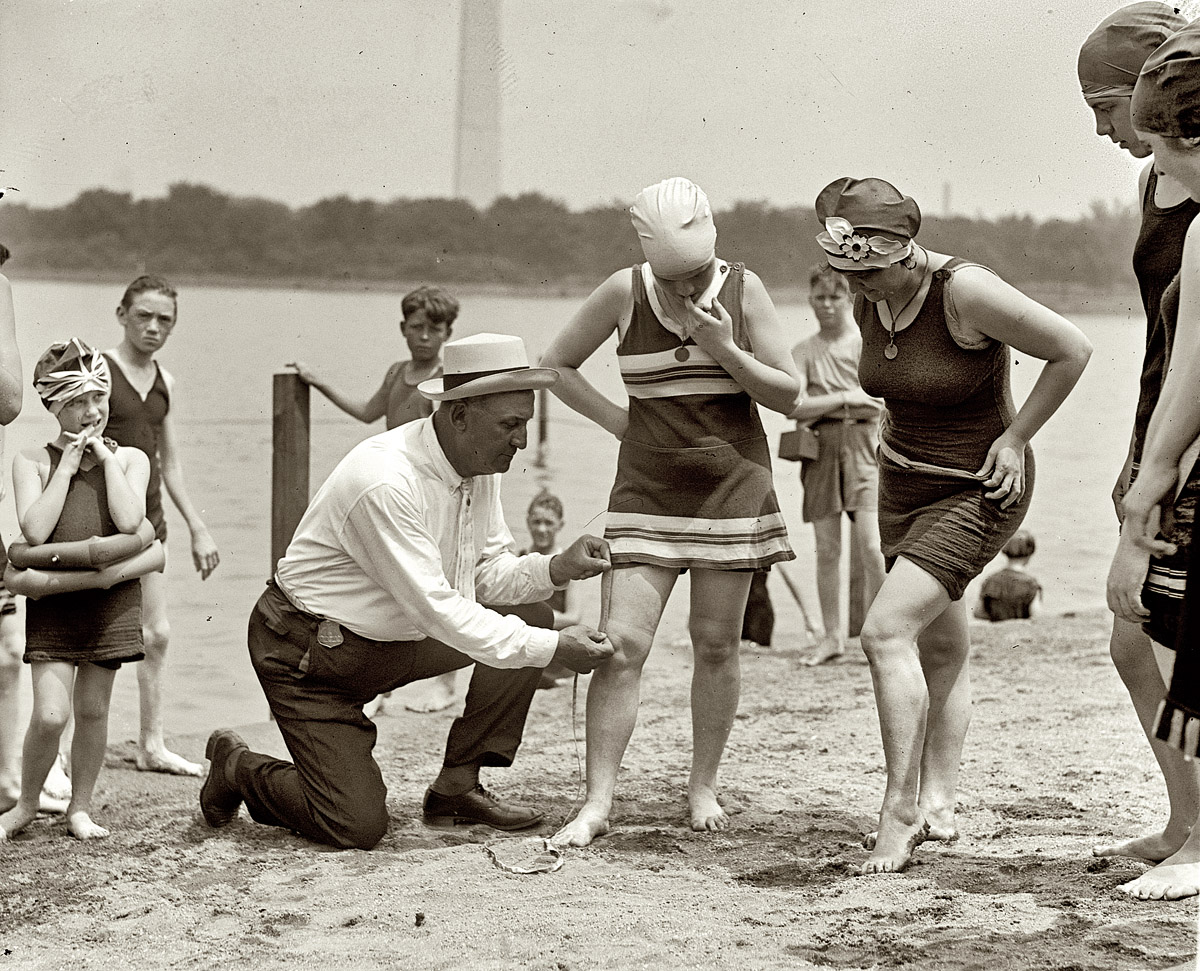
Bathing suit law, USA 1922

(Click here for full size resolution)
June 30, 1922. Washington policeman Bill Norton measuring the distance between knee and suit at the Tidal Basin bathing beach after Col. Sherrell, Superintendent of Public Buildings and Grounds, issued an order that suits not be over six inches above the knee.
National Photo Co.
from http://www.conradaskland.com/ via HOW TO BE A RETRONAUT
At Anthropology in Practice, Krystal D’Costa looks at the cultural history of the rabbit's foot as a good luck charm, and attempts to figure out why bunny feet ended up being imbued with such significance. After all, owning that foot didn't turn out to be particularly lucky for the rabbit. But then, that may be part of the point.
It’s an interesting article, and D’Costa finds connections to both European hedge-witchery and African-American trickster legends.
via Arts & Letters Daily – ideas, criticism, debate
When Groucho Marx met T.S. Eliot. The antic Jewish wit and the morose anti-Semite shared a friendship and a compulsion: extreme frankness... more
The Scariest Zombies in Nature via 3quarksdaily by Azra Raza
From Smithsonian:
Once the fungus invades its victim’s body, it’s already too late. The invader spreads through the host in a matter of days. The victim, unaware of what is happening, becomes driven to climb to a high spot. Just before dying, the infected body – a zombie – grasps a perch as the mature fungal invader erupts from the back of the zombie’s head to rain down spores on unsuspecting victims below, starting the cycle again. This isn't the latest gross-out moment from a George A. Romero horror film; it is part of a very real evolutionary arms race between a parasitic fungus and its victims, ants. More here.
Women by Robert McGinnis via HOW TO BE A RETRONAUT by Chris
Robert McGinnis (born 1926)is known for his illustrations of over 1200 paperback book covers, and over 40 movie posters, including Breakfast at Tiffanys (his first film poster assignment), Barbarella, and several James Bond films.Thank you to The Painted Anvil
Wikipedia
I think this one is my favourite of those included in the post – view them all
via Arts & Letters Daily – ideas, criticism, debate
The biologist and the billionaire. What's E.O. Wilson doing on the southern edge of Africa's Great Rift Valley? Stirring up controversy, of course... more
James Gurney paints a mud puddle by Mark Frauenfelder via BoingBoing
One of many reasons I admire artist James Gurney so much: he finds beauty in almost everything.
Yesterday I took my car to the shop because it needed an inspection. The rain was pouring down. There wasn't much space in the waiting room. So I sat under the awning out back between an old rusty engine and a forklift.James Gurney gets his car inspected
While I waited, I sketched the mud puddle beside me. The rain streamed off the corrugated roof and splashed the water, making big bubbles. The puddle was a sea of overlapping ripples.
Ten Mistresses Who Changed History via 3quarksdaily by Abbas Raza
Elizabeth Weingarten in Slate:
Before Monica Lewinsky, Camilla Parker Bowles, or Marilyn Monroe, there was Hagar – the world's first known mistress.More here.
According to the Bible, Hagar was an Egyptian slave sent to the bed of her master, Abraham, by his barren wife, Sarah.
Several millenniums later, the mistress remains a tenuous position, as historian Elizabeth Abbott explores in her new book, Mistresses: A History of the Other Woman, out this week [of 31 August]. Since Hagar's era, however, a handful of women have learned to parlay their scandalous relationships into positions of power – and some have changed history in doing so.
via Arts & Letters Daily – ideas, criticism, debate
5-by-8-inch cardstock, about to be thrown away: the trade-school report cards of strangers long dead. Paul Lukas delivered a precious few to where they belong... more
Before you click on the “more” I have to warn you – if you have any interest in social history you will a) want to look at http://www.slate.com/authors.paul_lukas.html and you will find that you’ve lost a lot of time enjoying yourself.
Inside the sea caves of Devil’s Island via Boing Boing by Maggie Koerth-Baker
Last year, when I posted here about the history of the lighthouse at Devil's Island, Wisconsin, several of you noticed the island's extensive network of sea caves, carved into the sandstone cliffs by splashing waves and moving water. This year, when some friends and I went on a little paddle through the caves, I took along a video camera. It doesn’t quite capture the eerie awesomeness of floating into the dark with Lake Superior behind you, but it’s still pretty neat.
Apologies in advance for the occasional sudden jerky movements and possible audible swearing. Devil’s Island is also home to a large population of biting flies and my ankles are, apparently, quite tasty.
Video Link
Bathing suit law, USA 1922
(Click here for full size resolution)
June 30, 1922. Washington policeman Bill Norton measuring the distance between knee and suit at the Tidal Basin bathing beach after Col. Sherrell, Superintendent of Public Buildings and Grounds, issued an order that suits not be over six inches above the knee.
National Photo Co.
from http://www.conradaskland.com/ via HOW TO BE A RETRONAUT
Saturday, 26 November 2011
10 non-work-related items that I found fun or interesting
Why your cat's eyes have slit pupils rather than round ones via 3quarksdaily by Abbas Raza
Yfke van Bergen in The Times of London:
Arts & Letters Daily – ideas, criticism, debate
Has Jürgen Habermas – gasp! – found God? The neo-Marxist philosopher who once viewed religion as an alienating reality now credits Christianity with spreading egalitarianism... more
The Psychology Behind Yogurt via Big Think by Big Think Editors
Experiments at University College Cork in Ireland have shed light onto the mind-body connection through yoghurt, specifically the probiotic bacteria it contains. When researchers fed yoghurt to mice and measured their behaviour changes, they found that “when probiotic …
Read More
Alcoholics May Wobble Forever via Big Think by Big Think Editors
Researchers at Neurobehavioral Research Inc., in Honolulu, want to know how long the physical effects of alcoholism last. Scientists recently studied the balance abilities and gaits of diagnosed alcoholics who had been sober for several weeks, those who had been sober …
Read More
via Arts & Letters Daily – ideas, criticism, debate
Was he or wasn't he? Neoconservatives wrap themselves in the mantle of Lionel Trilling. But for a thinker of his subtlety, such labels are irrelevant... more
Stowaway mouse grounds Nepal Airlines flight for 11 hours via Boing Boing by Xeni Jardin
A Nepal Airlines flight was delayed for nearly 12 hours by a mouse that managed to find its way on-board a Boeing 757 9N-ACB Monday. It was discovered in of a box of drinks at 9:30am local time, and was found dead in a mousetrap a little after 8:30pm.
The plane could not have taken off with a mouse on board as the rodent can cut vital cables. It couldn´t even be poisoned and had to be captured for certain so that it would not die at some vulnerable location in the plane.
Full article here, includes a history of related incidents on other airlines (thanks, Miles O'Brien!)
Photo: “Mouse living in Logan Airport”, contributed to the Boing Boing Flickr Pool by Animal Detectors.
The King and I via Prospero
More than 30 years after his death, Elvis Presley has been reduced to the shorthand of iconography. In the September/October issue of Intelligent Life, Ray Connolly remembers meeting the man …

via Arts and Letters Daily – ideas, criticism, debate
The fate of "forsooth." Like other abandoned words, it is but an archaic fragment. Its history is distinguished, its future nonexistent... more
PG Wodehouse’s wartime mistakes via Reading Copy Book Blog by Richard Davies
PG Wodehouse was a great comedic writer but he wasn't the sharpest knife in the drawer. The creator of Jeeves and Wooster was living in France when the Germans invaded at the start of World War II, and was happy to do a little broadcasting for the Nazis. Poor Plum was surprised that he was viewed as a collaborator by many Brits. The Guardian dwells on this rather sad story.
Long live The Empress of Blandings
In the Shadow of Vesuvius (Picture of the Day) via Britannica Blog by Michael Ray
 On this day [23 August] in 79 CE, Mount Vesuvius erupted in spectacular and catastrophic fashion. Rising above the Bay of Naples, the volcano had been dormant for hundreds of years prior to the eruption. Ash and debris rained down on Pompeii, burying it to a depth of more than 9 feet. Additional debris fell over the following day, covering the city in a 20-foot-deep layer of pumice and ash that would protect and conceal it for the next 17 centuries. More info and pics at the link above
Yfke van Bergen in The Times of London:
The trouble is that single-focus lenses such as those in humans suffer from chromatic aberration. This means that different wavelengths of light are focused at different distances from the lens and, as a result, some colours are blurred.More here
In the latest issue of the Journal of Experimental Biology , the researchers reveal that many animals solve this problem by using multifocal lenses.
Arts & Letters Daily – ideas, criticism, debate
Has Jürgen Habermas – gasp! – found God? The neo-Marxist philosopher who once viewed religion as an alienating reality now credits Christianity with spreading egalitarianism... more
The Psychology Behind Yogurt via Big Think by Big Think Editors
Experiments at University College Cork in Ireland have shed light onto the mind-body connection through yoghurt, specifically the probiotic bacteria it contains. When researchers fed yoghurt to mice and measured their behaviour changes, they found that “when probiotic …
Read More
Alcoholics May Wobble Forever via Big Think by Big Think Editors
Researchers at Neurobehavioral Research Inc., in Honolulu, want to know how long the physical effects of alcoholism last. Scientists recently studied the balance abilities and gaits of diagnosed alcoholics who had been sober for several weeks, those who had been sober …
Read More
via Arts & Letters Daily – ideas, criticism, debate
Was he or wasn't he? Neoconservatives wrap themselves in the mantle of Lionel Trilling. But for a thinker of his subtlety, such labels are irrelevant... more
Stowaway mouse grounds Nepal Airlines flight for 11 hours via Boing Boing by Xeni Jardin
A Nepal Airlines flight was delayed for nearly 12 hours by a mouse that managed to find its way on-board a Boeing 757 9N-ACB Monday. It was discovered in of a box of drinks at 9:30am local time, and was found dead in a mousetrap a little after 8:30pm.
The plane could not have taken off with a mouse on board as the rodent can cut vital cables. It couldn´t even be poisoned and had to be captured for certain so that it would not die at some vulnerable location in the plane.
Full article here, includes a history of related incidents on other airlines (thanks, Miles O'Brien!)
Photo: “Mouse living in Logan Airport”, contributed to the Boing Boing Flickr Pool by Animal Detectors.
The King and I via Prospero
More than 30 years after his death, Elvis Presley has been reduced to the shorthand of iconography. In the September/October issue of Intelligent Life, Ray Connolly remembers meeting the man …
Elvis Presley changed my life. I’m old enough to admit it now. Actually he changed a lot of lives. That’s the point about him, the reason why we hear his name and see his face so often, why his record company still releases two or three albums of his songs every year, why his best work can still be given away with a newspaper looking for a sales boost, and why he is recognised by his first name as easily as anyone in the world. He’s been dead for 34 years, yet everyone knows about Elvis.Read more
via Arts and Letters Daily – ideas, criticism, debate
The fate of "forsooth." Like other abandoned words, it is but an archaic fragment. Its history is distinguished, its future nonexistent... more
PG Wodehouse’s wartime mistakes via Reading Copy Book Blog by Richard Davies
PG Wodehouse was a great comedic writer but he wasn't the sharpest knife in the drawer. The creator of Jeeves and Wooster was living in France when the Germans invaded at the start of World War II, and was happy to do a little broadcasting for the Nazis. Poor Plum was surprised that he was viewed as a collaborator by many Brits. The Guardian dwells on this rather sad story.
Long live The Empress of Blandings
Friday, 25 November 2011
How new media affords network diversity: …
Direct and mediated access to social capital through participation in local social settings
an article by Keith N. Hampton and Eun Ja Her (University of Pennsylvania, USA) and Chul-joo Lee (The Ohio State University, USA) published in New Media & Society Volume 13 Number 7 (November 2011)
Abstract
This study examines how information and communication technologies – mobile phone, social networking websites, blogging, instant messaging, and photo sharing – are related to the diversity of people’s social networks. We find that a limited set of technologies directly afford diversity, but many indirectly contribute to diversity by supporting participation in traditional settings such as neighborhoods, voluntary groups, religious institutions, and public spaces.
Only one internet activity, social networking websites, was related to lower levels of participation in a traditional setting: neighborhoods. However, when direct effects were included, the total influence of social networking services on diversity was positive.
We argue that a focus on affordances of new media for networked individualism fails to recognise the continued importance of place for the organisation of personal networks: networks, that as a result of the persistent and pervasive nature of some new technologies, may be more diverse than at any time in recent history.
an article by Keith N. Hampton and Eun Ja Her (University of Pennsylvania, USA) and Chul-joo Lee (The Ohio State University, USA) published in New Media & Society Volume 13 Number 7 (November 2011)
Abstract
This study examines how information and communication technologies – mobile phone, social networking websites, blogging, instant messaging, and photo sharing – are related to the diversity of people’s social networks. We find that a limited set of technologies directly afford diversity, but many indirectly contribute to diversity by supporting participation in traditional settings such as neighborhoods, voluntary groups, religious institutions, and public spaces.
Only one internet activity, social networking websites, was related to lower levels of participation in a traditional setting: neighborhoods. However, when direct effects were included, the total influence of social networking services on diversity was positive.
We argue that a focus on affordances of new media for networked individualism fails to recognise the continued importance of place for the organisation of personal networks: networks, that as a result of the persistent and pervasive nature of some new technologies, may be more diverse than at any time in recent history.
From education to the workplace: a global challenge
On 30 June 2011, a seminar on Youth and Employment was hosted by the Employment and Social Affairs Committee of the European Parliament, and jointly organised by four European agencies: Cedefop, ETF, EU-OSHA and Eurofound.
The agencies highlighted the complementarity of their work by each presenting different aspects and perspectives related to youth employment in Europe and its neighbourhood countries.
Topics included
Full speakers’ presentations are also available.
The agencies highlighted the complementarity of their work by each presenting different aspects and perspectives related to youth employment in Europe and its neighbourhood countries.
Topics included
- the transition from education to the workplace;
- guidance for young people at risk;
- safe and decent jobs for young people;
- the “NEETs” phenomenon and its economic costs;
- the active inclusion of disadvantaged young people in employment; and
- the global dimension of youth employment.
Full speakers’ presentations are also available.
Thursday, 24 November 2011
4 in every 10: Disabled children living in poverty
A recent report from the Children’s Society has revealed that 40% of disabled children in the UK live in poverty. Of those, 110,000 are experiencing severe poverty.
The report highlights four key recommendations for addressing poverty in families with disabled children.
The report highlights four key recommendations for addressing poverty in families with disabled children.
- Child poverty statistics should reflect the additional costs of raising a child with a disability
- The government needs to ensure all households with disabled children take up their full entitlement to disability benefits
- The Child Poverty and Social Mobility Commission and the Office for Disability Issues should work together to establish an implementation plan for eradicating poverty among disabled children by 2020
- The government must not cut rates of support for disabled children under the Universal Credit
Off the Map? The Geography of NEETs
A report by the Work Foundation and Private Equity (authored by Neil lee and Jonathan Wright) reveals ten blackspots of youth disengagement – cities where between one in five and one in four young people is not in education, employment or training (NEET).
A key finding is that geography matters. Different towns and cities have a varying range of organisational and financial potential to successfully support children and young people to reach their full potential. The report calls on all cities to take urgent action to improve the coordination of services for young people, by ensuring there are clear and viable pathways between school, education and the world of work.
Full report (PDF 18pp)
A key finding is that geography matters. Different towns and cities have a varying range of organisational and financial potential to successfully support children and young people to reach their full potential. The report calls on all cities to take urgent action to improve the coordination of services for young people, by ensuring there are clear and viable pathways between school, education and the world of work.
Full report (PDF 18pp)
Subscribe to:
Posts (Atom)