via 3 Quarks Daily: Chad Orzel in Forbes
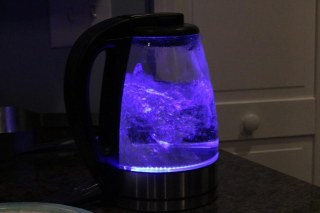
Boiling water. Photo by Chad Orzel.
As someone who has written a book about quantum physics and is at work on another, I get asked a fair number of questions about quantum phenomena. These are often portrayed as a kind of magic, but if you spend enough time thinking about the subject, it’s very clearly not magic. Quantum phenomena are weird, certainly, because they confound everyday intuition, but they follow very naturally from the application of fairly simple rules. Knowing more about it doesn't make the subject any less amazing, but the weirdness recedes a bit.
Continue reading
==============================
Researchers Discover How Animals First Appeared on Earth
via Big Think by Paul Ratner

Bacterium. Credit: ANU
Australian researchers say they solved “one of the greatest mysteries of science” – how large complex animals first appeared on Earth. It was a key milestone that led to humans. The scientists found that the rise of algae was instrumental in triggering one of the most transformative ecological revolutions in the planet's history.
The new study comes from the Australian National University and was based on examining ancient sedimentary rocks, gathered in central Australia. The lead researcher Associate Professor Jochen Brocks explained that the scientists crushed the rocks to extract molecules of ancient organisms.
Continue reading
==============================
This blind software developer's display is 450 word-a-minute speech synthesizer
via Boing Boing by Mark Frauenfelder
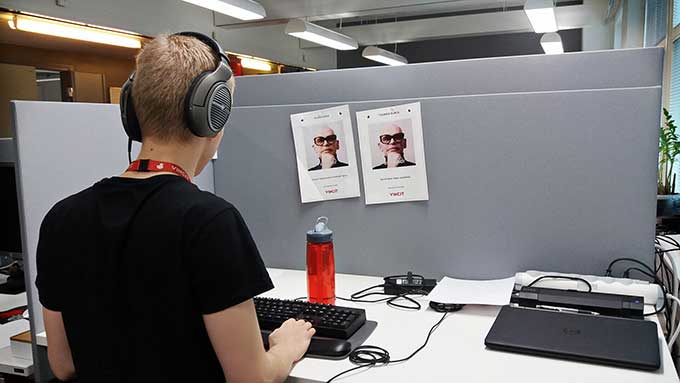
Tuukka Ojala is a blind software developer in Finland. When he works, he keeps his laptop closed (it has an external keyboard attached to it).
Continue reading
==============================
Blood, bookworms, bosoms and bottoms: the secret life of libraries
via the Guardian by Stuart Kells
Their history is full of remarkable discoveries that go well beyond the books themselves – they contain our flesh, our souls and ourselves
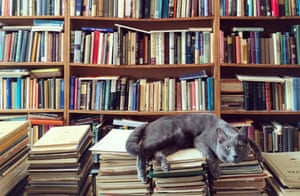
‘Two trends are changing how we think of old books and old libraries.’
Photograph: Alamy
I recently had the privilege of circling the world to write a book about libraries. My timing was excellent: after a short-lived e-books scare, physical books are back in fashion, and libraries are the place to be.
My trip was not unlike the pilgrimages made by 18th-century library tourists. On my journey I noticed two trends that are changing how we think of old books and old libraries.
The first is a stronger focus on provenance research. Through whose hands have the books passed? How did those handlers use and mark and protect their books? This branch of bibliography is helping to humanise it.
Continue reading
==============================
Rival Maps of India and Pakistan
via Big Think by Frank Jacobs
Pakistan and India are such quarrelsome twins that they don't even agree on their birthday. Both countries were born from British India, but Pakistan celebrates 14 August 1947 as its independence day; for India, it's 15 August.
In either case, that's just over 70 years ago. The media attention for those conjoined anniversaries earlier this year focused mainly on how the joy of independence remains indelibly mixed with the trauma of separation.
But there are many other stories to be told about this vast subcontinent. Here are two sets of maps that provide a different angle on the two nations, celebrating instead life's rich pageant through two categories for which the region is rightly famous – textiles and food.
In western media, the map of Pakistan is used mainly for three things: to highlight Taliban activity in the frontier zone with Afghanistan, to illustrate tensions over the disputed border with India, or to locate a terrorist attack in one of the country's big cities.
Continue reading
==============================
How black holes could delete the universe - new explainer video
via Boing Boing by Mark Frauenfelder
==============================
Scientists Have Enhanced Spider Silk Using Nanotubes
via Big Think by Philip Perry
Have you ever watched a spider make its web? What we consider lowly or for some (myself included) fear-inducing creatures, are actually master architects, hunters, and artists. It didn’t happen overnight. It’s a process spiders have been perfecting over the past 400 million years. No doubt, spider silk is strong, versatile stuff. There’s a rumor that it’s stronger than steel. Though it isn’t exactly (see video at the end), this enhanced version definitely is.
In a study published in the journal 2D Materials, UK and Italian researchers wanted to see if they could make spider silk stronger than its natural state. These scientists took spiders and put either graphene or nanotubes in their water supply. Graphene is one of the strongest artificial materials out there. And it’s just one atom thick.
Continue reading
NOTE: The image at the top of the post is of a web without the arachnid who made it but there is one of the eight-legged creatures further down and a fairly large one at the start of the video.
==============================
How to educate your child in the seventeenth century
via OUP Blog by Alyssa Russell

Book, read, reading, bookmark, and page by Ben White. CCO Public Domain via Unsplash.
The end of summer and beginning of autumn mean that children and young adults worldwide are heading back to school. While much has changed since the time of the seventeenth century, such as which children were allowed to go to school and which weren’t, and what they were taught there – one thing that has not changed is the worry a parent feels about their child getting the best education they can. In these series of excerpts from letters from the seventeenth century, we can see how ideas about education have evolved and changed in the past 300-some years.
Continue reading
==============================
The First Map of London's 'Pseudo-Public' Space Epidemic
via Big Think by Frank Jacobs
London’s public spaces are undergoing a quiet but profound transformation. An increasing number are, in fact, no longer public.
About 50 of these ‘privately-owned public spaces’, or Pops, have now been identified by the Guardian newspaper on this, the first comprehensive map of these areas. Many are in busy parts of the city centre, and are traversed by countless Londoners every day.
Not that they’d notice. Most Pops are not signposted; people generally only become aware of them when they break the rules that govern these spaces. Those rules are drawn up by their private owners, and are usually as un-advertised as the exact borders of each Pops. Quite often, they proscribe activities that are perfectly legal in ‘genuine’ public spaces: taking a picture, doing an interview, protesting, taking a nap.
One of these twilight zones of civil liberty is the More London estate. Located on the south bank of the Thames close to Tower Bridge, it surrounds London City Hall, the democratic heart of the British capital – home to the directly-elected Mayor, and the 25-seat Assembly that scrutinises him. But the area around the egg-shaped building is owned by the Kuwait Investment Authority, the sovereign wealth fund of the emirate.
Continue reading
==============================
Leonard Cohen's Hallelujah played on the mbira
via Boing Boing by Andrea James

Mbiras (sometimes called kalimbas or thumb pianos) are traditional African plucked instruments with tuned metal tines attached to a wood sounding board. They come in a range of complexities, with the one played here near the top of the line.
Continue reading


