provides links to information management, information sources and other "useful stuff" with a strong bias towards the management of information in a careers guidance context.
As of 17 July 2017 I include mental health information and comment.
I tweet as @careersinfo and am on LinkedIn and Facebook as Hazel Edmunds
During the past decade, immigrants accounted for 47% of the increase in the US workforce and 70% in Europe.
Family reunification is one of the main forms of immigration in many countries. However, in recent times, immigration has become increasingly regulated with many countries encouraging stricter vetting measures. In this climate, countries’ laws and policies applicable to family reunification seek a balance between an individual’s right to a family life and a country’s right to control the influx of immigrants.
The use of DNA testing (using blood samples or buccal swabs collected from the sponsor and each of the applicants) has been included in the family reunifications processes to help confirm a biological link between the sponsor and the applicants in at least 21 countries including Austria, Canada, Finland, France, Germany, the United Kingdom, and the USA. As numerous jurisdictions use DNA testing in their family reunification processes, can the use of DNA testing help achieve a better balance between promoting family reunification and enabling better control of the immigration demands? Continue reading
All about gallium, the metal that melts in your hand
via Boing Boing by Caroline Siede
In this nifty YouTube video, Dave Hax talks through the properties of gallium, the metal that liquefies at just 86ºF and is safe to play with. (Just don’t eat it!) Continue reading
=============================
A Short Analysis of John Donne’s ‘A Hymn to God the Father’
via Interesting Literature
A summary of a classic Donne poem
‘A Hymn to God the Father’ is one of John Donne’s most famous religious poems. As the Donne scholar P. M. Oliver observed, what makes Donne’s poem unusual and innovative is that, in ‘A Hymn to God the Father’, Donne has written a hymn that does not set out to praise God so much as engage him in a debate. The poem is one of Donne’s most masterly holy poems. Continue reading
=============================
Sphaera – a difficult dexterity puzzle
via Boing Boing by Mark Frauenfelder
This puzzle designer, Fleb, has a YouTube channel that has in-depth videos of new and old puzzles. I love it. In this video, he tries out a puzzle called Sphaera, from Art of Play.
=============================
Urchins and alleyways: a rare glimpse of 19th-century Glasgow – in pictures
via the Guardian
Photographer Thomas Annan captured Glasgow in the 1860s and 70s, at a time when the city had transformed and grown rapidly after the industrial revolution. See the rest of the images here I wonder how many of my photos will still be viewable after 150 years. =============================
The Galileo Trial: Faux News from the 17th Century
via 3 Quarks Daily by Leanne Ogasawara
A man cloaked in myth, what if I told you that many of the stories we tell ourselves about Galileo are simply untrue? That not only did the great scientist not drop any balls off the top of the Tower of Pisa but he didn't invent the telescope either. And not only was he never excommunicated from the Catholic church but he wasn't imprisoned in a dungeon either. Would you be surprised if I brought up the fact that he had been given permission by the Pope to write on the very topic that people think got him into trouble? Continue reading
=============================
Czeslaw Milosz’s Battle for Truth
via Arts & Letters Daily: Adam Kirsch in The New Yorker
Having experienced both Nazi and Communist rule, Poland’s great exile poet arrived at a unique blend of skepticism and sincerity. Illustration by Andrea Ventura
In July, 1950, Czeslaw Milosz, the cultural attaché at the Polish Embassy in Washington, D.C., received a letter from Jerzy Putrament, the general secretary of the Polish Writers’ Union. The two men had known each other for many years – they had been contributors to the same student magazine in college, in the early nineteen-thirties – but their paths had diverged widely. Now the arch-commissar of Polish literature told the poet, “I heard that you are to be moved to Paris. … I am happy that you will be coming here, because I have been worried about you a little: whether the splendor of material goods in America has overshadowed poverty in other aspects of life.” Continue reading
=============================
Yvette Chauviré (1917 - 2016)
via 3 Quarks Daily
I went on to YouTube to see if I could find the date that this was recorded but no luck. Then I saw the Anna Pavlova one which must be lots older (she died in 1931).
=============================
Learn 3 cool magic tricks with a Sharpie
via Boing Boing by Mark Frauenfelder
Oscar Owen has a nice tutorial for doing three different tricks with a standard Sharpie pen.
=============================
The Night Of
via 3 Quarks Daily by Gerald Dworkin
From time to time my friends, knowing that I watch many television series, ask me what current show I recommend. I always start by asking if they have watched The Wire. If they say they have not, I suggest they watch all five seasons and then I will make suggestions about what to watch now. The Wire, which ran from 2002 to 2008, was created, and largely written, by David Simon, a former police reporter on the Baltimore Sun. It is a systematic examination of the oppression of poor and black Baltimore citizens by five major institutions as they interact with the criminal justice system. These are drug trafficking, the seaport and its unions, city hall (politicians and bureaucracy), the school system, and the press. Continue reading
=============================
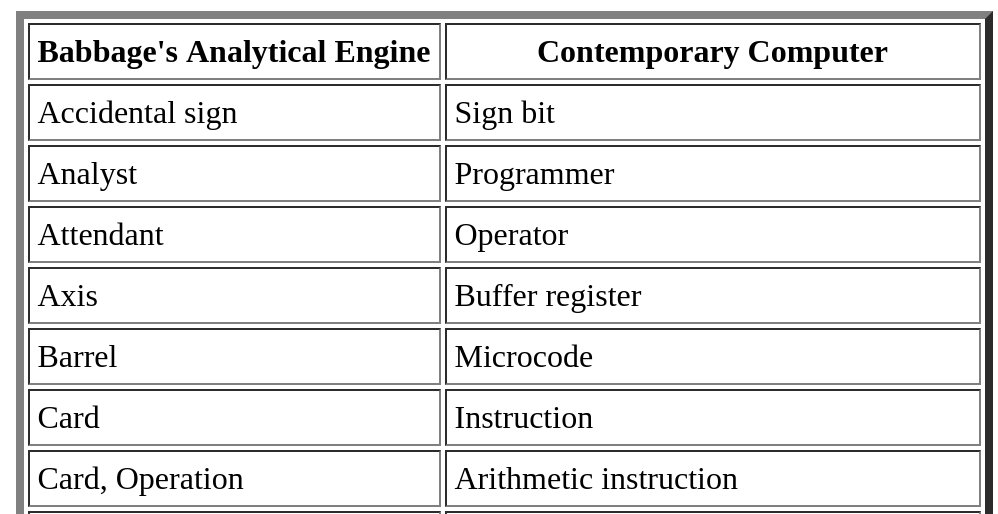
Translate between Charles Babbage’s computing jargon and modern terminology
via Boing Boing by Cory Doctorow
If you’re intending to build an analytical engine with a six-sided prism to run Charles Babbage’s weird cardboard vaporware program, you will need some help with Babbage’s notes, as old Charles was inventing a whole technical vocab from scratch. Continue reading
The 2017 OECD report The Pursuit of Gender Equality: An Uphill Battle explores how gender inequalities persist in social and economic life around the world.
Young women in OECD countries have more years of schooling than young men, on average, but women are less still likely to engage in paid work. Gaps widen with age, as motherhood typically has negative effects on women's pay and career advancement.
Women are also less likely to be entrepreneurs, and are under-represented in private and public leadership.
In the face of these challenges, this report assesses whether (and how) countries are closing gender gaps in education, employment, entrepreneurship, and public life. The report presents a range of statistics on gender gaps, reviews public policies targeting gender inequality, and offers key policy recommendations.
an article by Rita Griffiths (University of Bath, UK) published in Journal of Social Policy Volume 46 Issue 3 (July 2017)
Abstract
Two-parent families with dependent children are known to be at lower risk of poverty and significantly less reliant on state financial help than lone-parent households. It might therefore be expected that the factors influencing partnership transitions among low-income women would represent a key area of policy interest.
However, driven by concerns about weak work incentives, policy focus and research has to date concentrated on understanding lone parents’ labour supply and encouraging the transition from benefits into employment. Surprisingly little is therefore known about demographic decision making among women reliant on UK means-tested welfare.
As part of a wider qualitative study exploring family formation, partnership dissolution and repartnering decisions among low-income mothers, this paper examines whether and to what extent entitlement to welfare benefits or tax credits influenced the decision to live with or apart from a partner or child's father.
The research found that the aspects of welfare that remove or reduce a mother's access to an independent income and require one partner in a couple to be financially dependent on the other had been strongly influential in partnering decisions and living arrangements.
When Kevin Braddock hit rock-bottom, he had every intention of killing himself. He recounts what happened next – and reveals why so few men ask for help
‘We fall apart alone, but we heal together’: Kevin Braddock. Photograph: Phil Fisk for the Observer
It was a Monday when Robin Williams killed himself three years ago – Monday 11 August 2014. His death was shocking even if in hindsight it shouldn’t have been a surprise that the world’s funniest man might also be the most sorrowful, too – a person despairing to the point of ending it all.
It’s a date I remember well, because I’d spent the previous day trying to do the same thing. I was in the psychiatric ward of the Berlin hospital which I’d been manhandled into by friends the day before, and I was waiting to see the doctor who’d asked me to promise that I wouldn’t kill myself.
I think that gives you enough to know what’s coming so continue reading
It’s been years since the major pharma companies agreed to participate in the Registry of All Trials, meaning that they’d end the practice of only reporting on trials whose outcomes they were pleased with, leaving about half of all trials unreported-on.
Today [which was 27 July 2017], Ben Goldacre (who is the Registry’s most prominent advocate) and colleagues released a paper in the British Medical Journal reporting on their audit of pharmaceutical companies' record on keeping that promise.
Jens Riehemann and Regina Jucks (University of Münster, Germany) published in International Journal of Higher Education Volume 6 Number 3 (2017)
Abstract
The digital age has changed how we communicate, inform ourselves, and even how we teach and learn. This study systematically analyses and compares the perspectives of university academics (N = 75) and university students (N = 206) from the field of teacher education on digitized teaching and learning.
In a between-subjects design, participants of both groups were asked for their perspectives on dealing with digital media (i.e., general assessment of digital media, use of different media types and the role of digital media in university courses).
Furthermore, they were asked for their own and their anticipated perspectives of each other, in particular, their assumed advantages of using digital media in university teaching.
In sum, the findings indicate that it might be fruitful for university academics and students to exchange their views on the use of digital media for teaching and learning in higher education.
My career in information management started back in 1987 working on the Training Access Points project. Nearly thirty years later I am still concerned to ensure that end users, and their mediators, have access to appropriate, relevant information in a form that they can understand, at a time and in a place that is right for them. The Internet seems to be for everyone and everywhere but the digital divide gets bigger. By pointing advisers in the direction of resources I hope to increase what can be done to help clients/customers.
I ran my own company for 16 years but am now a semi-retired freelancer.