an article by Natalie Moffat and Lucy Pickering (University of Glasgow, UK) [ublished in The Sociological Review Volume 67 Issue 4 (July 2019)
Abstract
This article examines the double burden of ‘menstrual etiquette’ and the implications for women’s inclusion in public spaces in Scotland today.
Beginning from Laws’ work on ‘menstrual etiquette’, we explore how menstrual etiquette is characterised primarily by the burden of rendering menstruation invisible, both discursively and practically. However, women not only work to ensure that others remain unaware that they are menstruating; they depend on technologies, such as menstrual product dispensers and bins, to facilitate this process of rendering menstruation invisible.
When these technologies are absent or poorly maintained, women experience a double burden: not only must they maintain the social invisibility of menstruation but do so without social or infrastructural support or drawing attention to this absence (for fear of breaching the discursive silence demanded of menstrual etiquette).
We locate poor maintenance of facilities within the very same ‘civilising process’ that has pushed women’s bodily management to the furthest reaches of the private sphere. Socially invisible, these infrastructural supports are granted low status and poorly maintained. The pressure to maintain conceptual silence around menstruation limits women’s capacity to contest this neglect and, in turn, perpetuates their exclusion from public space.
This article, then, exposes the nature and the compounding temporal and affective burden of menstrual etiquette and advocates for breaking discursive silences to facilitate much needed social change.
Showing posts with label menstruation. Show all posts
Showing posts with label menstruation. Show all posts
Monday, 22 July 2019


Sunday, 18 March 2018
Bipolar Disorder & Premenstrual Dysphoric Disorder Often Get Confused, But Here’s The Important Way They’re Different
a post by JR Thorpe for Bustle [via World of Psychology’s Around the Net blog]
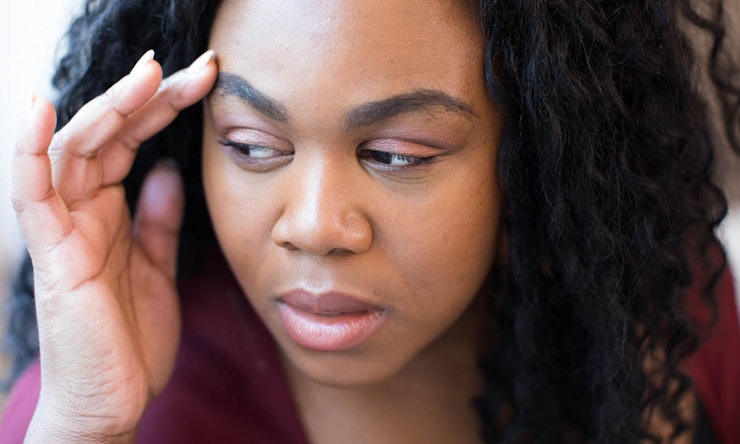
You’re not alone if you’ve never heard of premenstrual dysphoric disorder; it’s one of the lesser-known conditions surrounding menstruation, and was only recently given its own entry in the Diagnostic & Statistical Manual, which defines how psychiatrists understand and treat mental disorders. But the condition is often misdiagnosed as bipolar disorder, if it’s ever diagnosed at all, leading to confusion on how to treat it – the two disorders are very different, though both affect mood, and it’s important to know the difference between them.
According to scientists at the period-tracking app Clue, premenstrual dysphoric disorder “differs from other psychiatric conditions, such as generalized anxiety disorder, in that symptoms are linked directly to the fluctuations of reproductive hormones, and a diagnosis usually requires that people experience these symptoms predominantly during the late luteal phase”. This means that PMDD, as it’s called, is occasionally described as a “severe” form of PMS, but that’s not exactly accurate.
According to Dr. Marsha Tanenberg-Karant, a psychiatrist in New York, there are distinct differences if you know what to look for. “PMDD”, she tells Bustle, “can be thought of as a mood disorder that develops within the week before the onset of monthly menses and disappears within the week following menses. These are sharp time boundaries. The symptoms have to cause clinically significant distress or interfere with your usual activities”. One of the main differences, she says, is the timing. PMDD mood fluctuations and depressive symptoms are “by definition not present outside this time frame during the menstrual cycle, while bipolar affective disorder types I and II are not time-limited the way PMDD is time-limited. Periods of depression and/or what is known as hypomania are not restricted to the weeks surrounding menses”.
Continue reading
You’re not alone if you’ve never heard of premenstrual dysphoric disorder; it’s one of the lesser-known conditions surrounding menstruation, and was only recently given its own entry in the Diagnostic & Statistical Manual, which defines how psychiatrists understand and treat mental disorders. But the condition is often misdiagnosed as bipolar disorder, if it’s ever diagnosed at all, leading to confusion on how to treat it – the two disorders are very different, though both affect mood, and it’s important to know the difference between them.
According to scientists at the period-tracking app Clue, premenstrual dysphoric disorder “differs from other psychiatric conditions, such as generalized anxiety disorder, in that symptoms are linked directly to the fluctuations of reproductive hormones, and a diagnosis usually requires that people experience these symptoms predominantly during the late luteal phase”. This means that PMDD, as it’s called, is occasionally described as a “severe” form of PMS, but that’s not exactly accurate.
According to Dr. Marsha Tanenberg-Karant, a psychiatrist in New York, there are distinct differences if you know what to look for. “PMDD”, she tells Bustle, “can be thought of as a mood disorder that develops within the week before the onset of monthly menses and disappears within the week following menses. These are sharp time boundaries. The symptoms have to cause clinically significant distress or interfere with your usual activities”. One of the main differences, she says, is the timing. PMDD mood fluctuations and depressive symptoms are “by definition not present outside this time frame during the menstrual cycle, while bipolar affective disorder types I and II are not time-limited the way PMDD is time-limited. Periods of depression and/or what is known as hypomania are not restricted to the weeks surrounding menses”.
Continue reading
Subscribe to:
Posts (Atom)

