Showing posts with label Russia. Show all posts

Saturday, 5 October 2019

Turkey and Russia: A paradox of family resemblance

an article by Igor Torbakov first published in Osteuropa [via Eurozine]


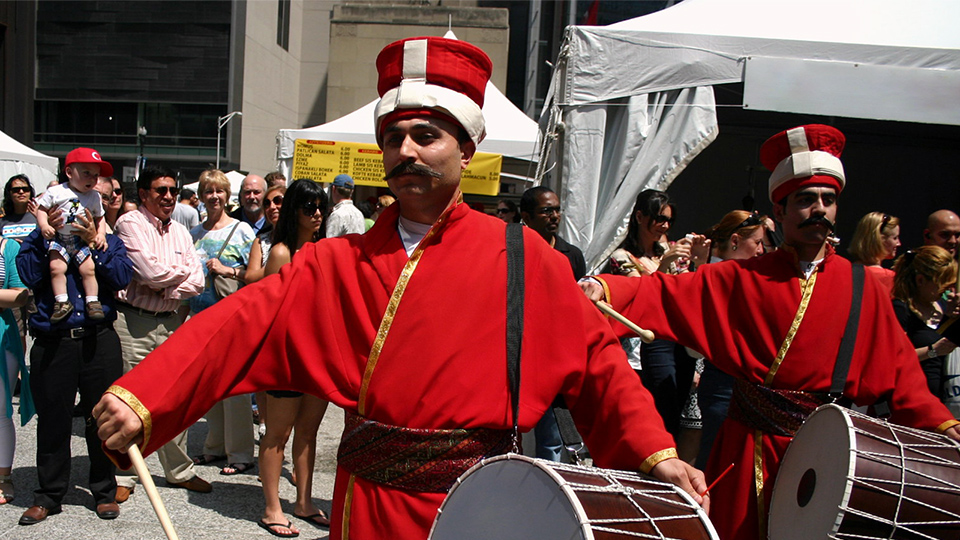
Ottoman Army Marching Band (Mehter)
Photo by Turkspot from Flickr

Both Russia and Turkey are ethnically diverse former empires that underwent similar processes of modernization and had similar relationships with the West. Today, they have revived a civilizational paradigm with a strong authoritarian and anti-western character. Precisely this resemblance is resurrecting rivalry for power and influence in the region.

Continue reading

I learnt a lot about current Eurasian political relationships from this article.


I also learnt about an earlier time from a novel by Ann Bridge. “The Dark Moment details the leap by which Turkey progressed from a feudal-style government to become a modern republic in which women enjoyed equality of rights and equality of opportunity. 

More information about 
“The Dark Moment here


Wednesday, 13 March 2019

Russia in the Great War: Mobilisation, grain, and revolution

a column by Andrei Markevich for VOX: CEPR’s Policy Portal

Prior to World War I, many authorities believed that countries with substantial agrarian sectors and grain exports, including the Russian Empire, could overcome war hardships more easily than those countries that imported grain.

This column asks why the experts got it wrong in the case of Russia, and concludes that the economics and politics of the Russian grain and labour markets provide the answer. It was impossible simultaneously to mobilise 15 million males into the Russian army, procure the grain to feed them as soldiers, and avoid revolution.

Continue reading


Tuesday, 24 April 2012

Social Inequality and Access to Higher Education in Russia

an article by David L. Konstantinovskiy (Russian Academy of Sciences, Moscow) published in European Journal of Education Volume 47 Issue 1 (March 2012)

Abstract

This article analyses research on social inequality and access to higher education in Russia.

It argues that the myth about equality of life chances, as with certain other myths, was an important part of the Soviet ideology. However, children from privileged groups traditionally received the education and professional training which were most advantageous for their subsequent lives and careers.

Recent research indicates that conditions in post-Soviet Russia are not eliminating social differentiation. This is clearly seen in access to higher education. It is shown that the inequality is noticeable in secondary education and is aggravated during the transition to higher education and vocational training (universities, colleges, vocational schools).

In order to explain the genesis of such inequality, the article considers research focusing on the situation at secondary school. The dynamics must be analysed over a long period, since the problems that post-Soviet youth face today have roots in the Soviet past. Hence, the article considers the results of studies conducted between the 1960s and today.


Monday, 27 February 2012

Can Russia be modernized? Problems, causes, opportunities

via Eurozine articles by Vladislav Inozemtsev

Plans to modernise Russia’s economy are resisted by bureaucracies benefiting from the country’s role as natural resource appendage of the developed world. That dependency on energy exports hinders political and economic progress is certain is certain. But is high-tech the solution?
Read in full (HTML)