provides links to information management, information sources and other "useful stuff" with a strong bias towards the management of information in a careers guidance context.
As of 17 July 2017 I include mental health information and comment.
I tweet as @careersinfo and am on LinkedIn and Facebook as Hazel Edmunds
a post by John Amodeo for the World of Psychology blog
Infidelity, deception, broken promises. Being human means having to face the pain of betrayal at some point during our lives. As I explore in my book Love and Betrayal, the important question is how do we deal with it?
How can we face this most difficult aspect of the human condition without succumbing to cynicism or despair?
Whether a betrayal happened recently or years ago, we need to find our way toward healing.
Here are some tips for moving forward in our lives after a life-changing betrayal.
a post by Robin Varghese for 3 Quarks Daily: Nick Martin in The New Republic:
Ian Gavan/Getty Images
This is a time to sustain. To find ease where we can in a world rapidly placing us into chaos. “We do not tend to see maintenance and care as productive in the same way,” Odell wrote. But we should.
This piece, the one you’re reading right now, took roughly an hour longer for me to write than it normally would have because I am currently sitting in my New York apartment thinking about a million different things: Are all my grandparents properly secluded? Is my extended family taking this seriously enough? Should I rent a car and drive home and get away from the city before it all really goes to hell? Are rental car companies going to be price gouging? When will the money from my cancelled vacation return to my account? Did I order enough cat food? Do I have enough food? What will things look like two weeks from now? A year from now?
That is normal, now. That is the experience I am sharing with my friends and cousins and family and neighbours. While I’m still reading emails and scanning my drafts for revisions, my mind is miles away with the people that matter most to me. For those with the privilege and ability to conduct their work from home, the coming weeks should be a time to focus on ourselves, our communities, and our loved ones. It should be a time to do nothing and produce little without the accompanying feeling of guilt or panic caused by a ping from a higher-up that you should be doing more as the rest of your world slowly cranks to a halt.
an article by Jan Kleinnijenhuis, Tilo Hartmann, Martin Tanis and Anita M. J. van Hoof (Vrije Universiteit Amsterdam, The Netherlands) published in Communication Research Volume 47 Issue 2 (March 2020)
Abstract The hostile media effect (HME) entails that partisanship incites hostile perceptions of media content. However, other research underscores that partisans selectively turn to like-minded media, resulting in a friendly media phenomenon (FMP).
The present study suggests that the HME and FMP co-exist, and, furthermore, jointly affect people’s voting behaviour. More specifically, based on a media content analysis and a long-term panel survey surrounding the 2014 election for the European Parliament in the Netherlands, we find that people selectively turn to like-minded friendly media (FMP), but perceive coverage about the EU (European Union) in these media as relatively unsupportive of their own position (HME).
In this context, the FMP and HME appear to jointly influence voting behaviour. People cast votes in line with the objectively partisan-friendly media tone of their self-selected media. However, to a certain extent they do so, because they seem motivated to counteract the seemingly unfair or insufficient coverage about the EU.
a report by Jorge Cabrita, Julie Vanderleyden, Isabella Biletta and Barbara Gerstenberger published by Eurofound: European Foundation for the Improvement of Living and Working
Conditions
Key findings
Men are more likely to work in more demanding physical environments and have relatively worse working time quality than women, but more likely to enjoy better pay. Men report higher levels of quantitative demands (for instance, working to tight deadlines), while women are much more likely to report being exposed to emotional demands (such as handling angry clients, patients or pupils).
In terms of social environment, men tend to receive less support from colleagues and managers, while women are much more likely to be exposed to adverse social behaviours, such as threats, verbal abuse or harassment.
Access to training is more limited among less-skilled occupations; within these occupations, women have even less access to it.
Variable forms of pay, such as shares in the company or payments based on company performance, are becoming more common. These pay components are increasing more rapidly among men than women and the gender gap is therefore widening. This is a trend that requires further investigation.
Mixed occupations – those with the most balanced shares of men and women – not only differ from the male-dominated and the female-dominated occupations but also show better job quality in most, if not all, dimensions. Such occupations also display the smallest differences between men and women.
Abstract
Gender inequality at work persists across Europe, despite the long standing attention paid and efforts made to tackle it. This Eurofound report presents a closer look at women’s and men’s working conditions, using data from Eurofound’s European Working Conditions Survey (EWCS) and complementing previous Eurofound research on, among other things, working time patterns, work-life balance and workers’ health.
Beyond the general differences in the labour market, it highlights many important gaps in men’s and women’s working conditions and job quality which require specific attention.
According to the EWCS data, the reduction of gender gaps in those areas showing improvement over the last 5 to 10 years remains limited. European and national strategies aimed at achieving job quality for all, that seek to mainstream gender equality, could help address persistent inequalities between men and women.
an article by Jenny Preece (The University of Sheffield, UK) published in Urban Studies Volume 57 Issue 4 (March 2020)
Abstract
This article draws on repeated, biographical interviews with 18 households to explore how people construct a sense of belonging in two post-industrial neighbourhoods in the ‘ordinary’ urban areas of Grimsby and Sheffield, UK.
It argues that experiences of low-paid, precarious work undermine the historic role that employment has played in identity construction for many individuals, and that places perform a crucial function in anchoring people’s lives and identities.
Three active processes in the generation of belonging are elaborated.
Through identification, dis-identification and the micro-differentiation of space, people constructed places in order to belong with others ‘like them’. Residents also internalised the symbolic logics of places through their daily movement, territorialising space as they learned how to be in particular environments. Finally, places were temporally situated within relational biographies and experienced in relation to past and imagined futures. Places fulfilled an important psycho-social function, anchoring people’s identities and generating a sense that they belonged.
an article by Henry Overman (LSE and CEP, London, UK) published in CentrePiece Volume 25 Issue 1 (Spring 2020) Paper No: CEPCP570
Abstract
As has been much discussed since the election, economic performance varies widely among the towns, cities and regions of the UK. Henry Overman argues that policies to address these spatial disparities should be judged on whether they improve individual opportunities, not whether they narrow the gaps between different parts of the country.
Hellenistic Elite Found Buried on a Bronze Bed with Gold in Her Mouth
via Ancient Origins by Alicia McDermott The Hellenistic tomb of a woman found in the Kozani region of Greece. Source: Kozani Ephorate of Antiquities
Ancient tombs are fascinating finds, especially when they’re intact. They can provide us with clues on how a person died, social status, burial styles, and funerary rites. The last of these is perhaps the most exciting because it can provide a wealth of knowledge about how our ancestors viewed life and death and what may lay beyond. Let’s see what an intact tomb of a woman who died in the Hellenistic period may say about rituals surrounding death in her time. Continue reading
==============================
When This German Artist Tried to Use His Work to Warn About Hitler, the World Ignored Him. It's Time to Listen
via Arts and Letters Daily: Mary M. Lane in Time Magazine
German-born painter George Grosz working on a satirical painting that depicts Adolf Hitler resting with skeletons at his feet, in studio at home
Time Life Pictures/Getty Images
When Adolf Hitler took charge of Germany 85 years ago this summer [2019], he did not, contrary to popular belief, “seize power”. Rather, Germans elected him their Führer, or leader, in a referendum on Aug. 19, 1934 and subsequently chose to subscribe to the cultural narrative that he created: that Germany had become too open, too tolerant of cultural diversity in the early 20th century. This openness, Hitler argued, had caused their recent national identity crisis.
Hitler knew that to conquer the wounded hearts of a broken citizenry, he must first conquer culture itself. Dozens of artists faced his persecution when he pushed “Degenerate Art” out of museums and into a derisive exhibition in 1937, but very few tried to warn against it through their work. Continue reading
==============================
Watch how this adorable hummingbird makes friends with a human
via Boing Boing by Carla Sinclair Continue reading
==============================
Ancient Mesopotamia and the Rise of Civilisation
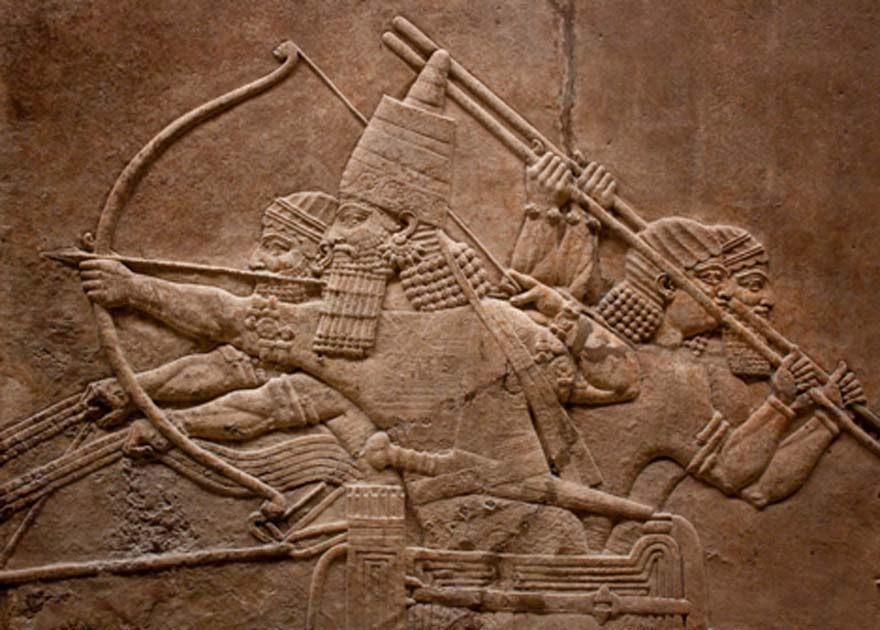
via Ancient Origins by Sarah P Young Mesopotamian relief of Assyrian warriors. Credit: kmiragaya / Adobe Stock
In ancient times, Mesopotamia, meaning ‘land between two rivers’, was a vast region that lay between the Tigris and Euphrates river systems, and it is where civilization emerged over 7,000 years ago. The first inhabitants, the Sumerians, established an advanced system writing, spectacular arts and architecture, astronomy and mathematics. The Akkadians would follow the Sumerians, borrowing from their culture, producing a new language of their own, and creating the world’s first empire.
Mesopotamia corresponds to what is now Iraq, Kuwait, Eastern Syria, Southeast Turkey, and parts of the Turkish-Syrian and Iran-Iraq borders. The region encompassed some of what is known by historians as the ‘ fertile crescent ’. The conditions in the fertile crescent, which also includes the Levantine coast, the Iranian-Iraqi modern border, and significant ancient sites such as Göbekli Tepe and Jericho, made it ideal for agriculture. All eight of the ‘founder’ crops of Neolithic agriculture (the wild forms of emmer wheat, barley, flax, einkorn, pea, lentil, chickpea, and bitter vetch) were found in abundance along with easily domesticated animals (pigs, sheep, cattle, and goats) with horses nearby. Continue reading
==============================
The Best of Early Wyndham
via Interesting Literature
In this week’s Dispatches from The Secret Library, Dr Oliver Tearle enjoys some vintage science fiction courtesy of The Best of John Wyndham, 1932-1949
I’ve blogged before about my discovery of John Wyndham’s science fiction in a local charity shop, which had a number of old paperbacks for 99p each. That initial book haul yielded, among others, The Seeds of Time, one of a number of short-story collections published by the master of what Brian Aldiss called (perhaps a tad unfairly, if not reductively) the ‘cosy catastrophe’. But John Wyndham had served a long apprenticeship by the time he became a household name in the 1950s thanks to The Seeds of Time, The Midwich Cuckoos, The Chrysalids, The Kraken Wakes, and, first and chief of all, The Day of the Triffids. The Best of John Wyndham, 1932-1949 showcases the best of John Wyndham’s early stories. Continue reading
==============================
The skull of Sultan Mkwawa
via The National Archives Blog by Dr Juliette Desplat
Signed on 28 June 1919, the Treaty of Versailles ended the war between Germany and the Allied Powers.
Between the War Guilt Clause and the Financial Clauses, Article 246 stated: ‘Within six months from the coming into force of the present Treaty […], Germany will hand over to His Britannic Majesty’s Government the skull of Sultan Mkwawa which was removed from the Protectorate of British East Africa and taken to Germany.’ (FO 93/36/76) Continue readingand discover a rather macabre story.
==============================
Spooky Factions At A Distance
via 3 Quarks Daily by Ashutosh Jogalekar
For me, a highlight of an otherwise ill-spent youth was reading mathematician John Casti’s fantastic book “Paradigms Lost“. The book came out in the late 1980s and was gifted to my father who was a professor of economics by an adoring student. Its sheer range and humor had me gripped from the first page. Its format is very unique – Casti presents six “big questions” of science in the form of a courtroom trial, advocating arguments for the prosecution and the defence. He then steps in as jury to come down on one side or another. The big questions Casti examines are multidisciplinary and range from the origin of life to the nature/nurture controversy to extraterrestrial intelligence to, finally, the meaning of reality as seen through the lens of the foundations of quantum theory. Surprisingly, Casti himself comes down on the side of the so-called many worlds interpretation (MWI) of quantum theory, and ever since I read “Paradigms Lost” I have been fascinated by this analysis. Continue reading
==============================
Beekeeper uses bears to taste test his honey
via Boing Boing by Seamus Bellamy
Trabzon is a northeastern province of Turkey. You'll find a lot of light industry there: small farmers, plantations growing tea and craftsman. It also happens to be home to some of the most sought-after honey in the world.
Ibrahim Sedef, is a beekeeper who, along with his bees, works in the region, producing Anzer honey. It's aromatic stuff and is wildly believed to have curative powers—your healthcare mileage may vary. People love Sedef's honey. Unfortunately, so do a bunch of local bears.
Sedef tried a number of solutions to keep the animals away from his beehives: he locked the hives up for the night. He secured his home against the animals breaking in. He even left out sweet fruit and baked goods for the bears to draw them away from his products. No dice. Over three years, he lost over $10,000 in profits. At this point, a lot of folks may have turned to having the animals killed, in order to protect their profits. Not Sedef: he enlisted the furry brutes to do a bit of taste testing for him, instead.
==============================
A Short Analysis of the Shakespeare Song ‘When Daisies Pied’
via Interesting Literature
‘When Daisies Pied and Violets Blue’ is a song from Shakespeare’s play Love’s Labour’s Lost. Although it’s easy, because this is a song, to dismiss its meaning as frivolous or the words as ‘nonsense’, it’s worth stopping to analyse the lyrics of the song and their place in the play as a whole. Here’s the text of ‘When Daisies Pied and Violets Blue’ followed by a few words of comment and analysis. Continue reading
==============================
When Children Came out to Play: Ancient Toys and Games
via Ancient Origins by Ashley Cowie Children Playing by David Klöcker Ehrenstrahl (1651) Skokloster Castle ( Public Domain )
The main halls and secured vaults of museums around the world are loaded with vast arrays of grotesque antique weapons, golden lined velvet robes, ceremonial swords and crowns, jewel encrusted scepters and other adult treasures and artifacts. Toys, play paraphernalia and games from the most remote past are generally assigned a shelf or a dusty cabinet but kites, balls, yo-yos and stick dolls wrapped in cloth have been discovered across the face of the planet, proving that children’s imaginations have always mimicked real life. Continue reading
My career in information management started back in 1987 working on the Training Access Points project. Nearly thirty years later I am still concerned to ensure that end users, and their mediators, have access to appropriate, relevant information in a form that they can understand, at a time and in a place that is right for them. The Internet seems to be for everyone and everywhere but the digital divide gets bigger. By pointing advisers in the direction of resources I hope to increase what can be done to help clients/customers.
I ran my own company for 16 years but am now a semi-retired freelancer.